Author: Volunteer

Customize Your First Aid Kit

Share

First Aid Kits for home, car, survival kitYou have three first-aid kits, don’t you? One in the house, one in the car, and one in your emergency backpack?

You can buy a reasonable pre-built kit for around $20. But, as always with pre-built collections,

Are your first-aid kits well-stocked?

  • First, your kits should have high-quality items. I’ve read so many reviews that mention scissors that won’t cut or tweezers that don’t tweeze!
  • Second, contents should match your own level of medical knowledge. For example, some pre-made kits contain actual surgical equipment – probably useless and even dangerous for the untrained.
  • Third, your kit should have room for any specialty items that fit your family members, your climate and potential natural emergencies. For example, you may need to add sunscreen, water purification tablets or insect repellent, given where you live.

Extras that may make the difference.

Spend some time reading the list of items contained in several of the ready-made kits, and you may get some good ideas for extras. Here are a few to consider.

Liquid bandage

As the name suggests, this liquid can be applied to small cuts or wounds. It quickly dries, holding the cut together or covering the wound with a tough “skin” that protects the wound from dirt, is flexible and waterproof, and antiseptic to boot. (Won’t stick if applied to wet or bloody skin.) This pack has four bottles.

New-Skin Liquid Bandage, First Aid Liquid Antiseptic, 1-Ounce Bottles (Pack of 4)

Tampons and pads

If you have a cut that needs more than a band aid, a pad gives you something solid to apply pressure against. As for tampons, obviously they could be used to plug a puncture – and the string can serve as the wick for a long-lasting emergency light if you have oil as a fuel. Head to your local drugstore to pick up the sizes and style you want. If they aren’t packaged individually, you can always put a few into a plastic bag and then into your kit.  Be sure to use the unscented versions. 

Hand sanitizer wipes

We’ve all used “wipes” after eating messy food – and discovered that some are a lot better than others, and smell better, too! Still, in an emergency, probably any reasonable sanitizing wipe would be better than nothing. Individually packed wipes can be tucked right into your first aid kit. A small plastic bottle of hand sanitizer could work, too. I’ve used Purell and liked it.

Individually wrapped: PURELL Sanitizing Hand Wipes Individually Wrapped 100-ct. Box
Small, 2 oz. bottles: Purell Instant Hand Sanitizer, 2 Ounce (Pack of 12)

Ace bandage or “self-stick” bandage

In rough terrain, an ace bandage can keep your turned ankle functioning. A standard ace bandage needs safety pins or special clips to keep it secured; the “self-stick” version looks the same but sticks to itself just like cling wrap.

Standard bandage with clips: ACE Elastic Bandage with Hook Closure, 3 Inches (Pack of 2)
Self-stick version: ACE Self-Adhering Elastic Bandage, 2 Inches (Pack of 3)

Adhesive Tape

Taping gauze over a wound takes precision. If you mess up, drop a piece, etc., you can go through the provided supply very quickly. My recommendation – add another generous roll of 1 in. tape to your kit so you won’t run out.
Durapore Medical Tape, Silk Tape – 1 in. x 10 yards – Each Roll


Virginia
Your Emergency Plan Guide team

P.S. While you’re thinking about First Aid kits, you may want to review this Advisory about the dangers of out-of-date medicines.



Recognition and Positive Reinforcement for Your CERT Group

Share

Yay for us!

Our public relations coup.

Over the past two weeks, our neighborhood Emergency Response Team has been recognized three times for – well, for being active and being prepared!

CERT group article

Front Page Article!

First, the local police department attended our homeowners’ association meeting and presented us with the “First Annual Community Preparedness Award!” Picture of 30+ team members in their vests appeared on the PD’s Facebook page.

Then, a week later, the local newspaper came out with a front page photo and article, “They’re Ready to Respond.” The sidebar included a comprehensive list of “how to prepare.”

The same photo and slightly different article appeared in the regional issue of the paper four days later.

So, in our local community, we are now famous. And besides the positive public relations, we’ve helped spread the message about preparedness. Feels good, and our group is energized!

After all, everybody wants to be appreciated.

Of course, we don’t always have the chance to get our local press out for photos. Still, there are a lot of easy and inexpensive ways to keep up morale. Here are some we’ve used in the past and will be using again. Can you add a few of these to your own list?

Some ideas for ongoing recognition

  1. Include thanks at every meeting. I have a line on my written meeting agenda to fill in with the name of at least one person who helped behind the scenes to put that meeting together: refreshments, name tags, audio-visual, whatever.
  2. Feature a member in a newsletter article or in a meeting invitation. A Smartphone makes it so easy to get a picture of one of your members. Then, add a short paragraph whenever you’re publishing something. Just call it, “Get to know your Emergency Response Team neighbor” and add a few details. People love seeing their picture!
  3. Give all members official nametags. Invest a few dollars in clip-on badges so regular group members will have that bit of added “status.” (Visitors get plain stick-on paper name tags.)
  4. Hand-written thank-you cards. Taking the time to thank someone in “the old-fashioned way” still really works. You can write a note for a specific action that a member took, or offer thanks for steadfast support of the group.
  5. Ask for opinions and help. People like to be valued! It may seem easier just to do it yourself, particularly if you are extremely busy, but involving a sub-group or team may actually take some of the burden off you – and give your team members a dose of personal satisfaction.
  6. Present a small gift to one of your members who has shown particular initiative. The gift should reflect your emergency mission – something like a whistle, or a small flashlight, or even a package of “emergency rations” might be appropriate.
  7. Create a “traveling award” to be presented to the sub-group that excels at a particular task. For example, it could be the Division that signs up the most new members, or that has the best participation in the monthly radio drill. The next month, the award is passed along to new recipients – or kept, if deserved!

Oh, and back to that newspaper article. The reporter knew nothing about emergency preparedness, but thanks to careful reporting and good writing, her article was really well received.

Have you considered pitching the story of your group to a local reporter? The result may surprise you!

Virginia Nicols
Your Emergency Plan Guide team

P.S. I’d like to double the list of “ways to recognize team members.” What can you add?


Terror at the Mall

Share

How safe is your local mall?

Mall security

Where are the exits?

Today’s news is filled with threats of terrorist attacks on local, American, British and Canadian malls. These threats follow on the heels of the release of HBO’s amazing documentary, “Terror at the Mall,” showing one such attack.

If you are involved in security and counter-terrorism, you need to have seen this chilling story. If you are simply a parent, or even a shopper, you may want to take time to see it, too.

Security camera footage

Footage for the film was taken from the over 100 security cameras that continued to run while noontime shoppers visited the upscale WestGate Mall in Nairobi, Kenya on September 21, 2013. Again and again, the footage shows innocent and unsuspecting families and store personnel suddenly confronted by militants armed with automatic weapons.

These men entered the mall like any other shopper, moving steadily through the corridors and into stores and shooting down anyone who moved.

Over the course of four hours, over 60 people were killed, women, children and police. The floors ran with blood.

You may well ask, “Four hours?”

It was a classic example of a “soft target” attack combined with poor response by police and military. While the terrorists continued to move throughout the mall,, police and military forces, who took over 45 minutes to arrive,  milled around outside. One of their leaders is seen shouting, “Give us time to get organized!”

The gunmen were purportedly from Al-Qaida-linked al-Shabaab in Somalia. They were quoted as wanting “revenge” for the death of some of their brethren. Ultimately, after 4 days, a potion of the mall and the terrorists were destroyed by fire, purportedly the result of the army’s artillery “remote assault.”

Mandatory training

Viewing this chilling film should be mandatory training for anyone involved in security and counter-terrorism activities. It also reinforces the lessons taught in the “Run-Hide-Fight” active shooter video that was created by the City of Houston, Texas and the Department of Homeland Security. This film was reviewed by us last year. It has now had over three million views on YouTube.

As a matter of policy, at The Emergency Plan Guide we normally avoid publishing anything that smacks of “alarmist” publicity. Unfortunately, given the open threat from al-Shabaab, recent events in Paris and Copenhagen and warnings coming today out of Homeland Security, we can probably expect soft target attacks in the not-too-distant future. And, if ISIS gets its way, even the possibility of large-scale events cannot be overlooked.

“If you see something, say something.”

The Department of Homeland Security began a new campaign at the Superbowl, promoting awareness. It applies here, too.

If you feel that your lifestyle is such that you have higher than normal exposure, you would do well to view the Houston film (it’s only about 10 minutes) and even the HBO Documentary (60 minutes). It’s important to see how many people were able to get away and how others successfully hid from the attackers.

Finally, it makes good sense to always be aware of exit routes for any public structure. And, if you see something, say something!

Joseph Krueger
Your Emergency Plan Guide team

P.S. The Documentary is available to subscribers online at HBO. There are also a number of interviews, clips and trailers available on YouTube, but some have been apparently been “hijacked” by groups trying to take advantage of the title of the documentary. Caution is advised.


Neighborhood CERT Supports Fire Department Training

Share

At Christmas, some of my neighbors bake cookies and deliver them to the local fire station. They are duly thanked. But last month, our fire department showed their appreciation in a whole different way.

They used our streets and houses for training!

Getting familiar with our community

Non-standard fire hydrant

Non-standard hydrant

First Responders always have to get used to our community. It has narrow streets and smaller-than-regulation fire hydrants, not to mention an impossible house numbering system.

So last month, when they had a recruit who needed training, they gave us a call.

Could our neighborhood CERT group host a training exercise?

Well, of course we could!

With only two days’ notice, we pulled together a team, sent out a flyer to everyone warning them to stay out of the way, and when the engines pulled in on a Friday morning, we were ready.

  • Our CERT member posted at the gate saw them enter and notified the entire team via hand-held radio.
  • Block by block, turn by turn, we tracked them and reported in.
  • When they arrived at the “subject house,” our team members set up a traffic management system, meant to keep residents’ cars – and residents on foot — from getting tangled up in the hoses.
Traffic hazard

Traffic hazard

Things went well! The recruit passed his test (locating the hydrant, attaching the hoses, pulling hoses around the corner and across the street, etc.). Our traffic management proceeded without incident, and radio communications worked perfectly. (One of our members acted as Net Control, accompanying the Incident Commander in a golf cart.)

At the end of an 90 minutes, the fire department had rolled everything up and were gone.

Then, later that same day, they called to ask if they could come back the following week and do it again!

Benefits of working together

Working with our local fire station crew this way has so many benefits.

First, they learn more about the neighborhood and will obviously be able to respond more quickly and confidently to the next emergency.

Second, they got to see our CERT team in action – and they voiced their admiration for the way we were organized and for the help we gave them.

Finally, we got to know those crew members personally, and they got to know us. Nothing can substitute for this personal connection.

Plans for future training exercises

Now that we have had this experience, we will be inviting other stations to take advantage of our “training facility” when they can.

It’s a way to position our CERT group positively in the eyes of the First Responder community, and it gives us a way to reinforce our preparedness message to our neighbors, too. Not to mention the all-important radio practice!

Have you ever hosted a training in YOUR community?  Who initiated contact? How did it go? Let us readers know!

Virginia
Your Emergency Plan Guide Team

Don’t miss any of our “adventures!”  Sign up below to get all our Advisories.


Hey CERT Trainers!

Share

A New Piece of Gear For Your Kit!

If you’re in charge of putting on neighborhood CERT meetings, you know what a challenge it is!

A good meeting pumps up the energy and attracts new members. A poor meeting – well, you can lose members overnight!

So searching for good meeting ideas goes on . . . and on.

Over the past 10 years, Joe and I have been either on the front lines or behind the scenes, planning meetings for our neighborhood group. That’s well over 100 meetings!

It recently occurred to me that buried in my computer is a treasure trove. I dug in, pulled together my notes, and wrote up some of the ideas for meetings that we’ve held successfully.

CERT Meeting Ideas, Emergency Plan Guide

From the trenches . . .!

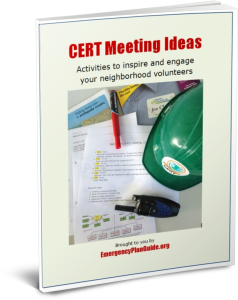
Our best ideas have now been assembled into a 55 page ebook called CERT Meeting Ideas.

The ideas seem to have worked. We’ve had as many as 60 volunteer members in our community, and our teams have responded to five major emergencies (mostly construction related). We have received awards from the Mayor and local First Responders for our efforts.

What makes a good meeting?

Now, Joe and I are not professionally trained CERT instructors. But we know from business experience that good meetings have to have some valuable content, a delivery method that’s effective for your group, and, of course, a setting that works for both.

That’s what we’ve tried to put into every meeting.

Content is easy.

When it comes to emergency planning, there’s plenty of content. You can just page through the training manual and come up with stuff to learn more about on every page.

But we have learned, also from our business experience, that people resist being “taught.”

What they seem to want is to “experience” an activity so that it reinforces appropriate behavior in response to an emergency!

So it’s the delivery method that’s the bigger challenge.

Over our years of providing training, we have tried all kinds of methods, with these topping the list.

  • We have had guest speakers, and guest speakers with power point slide shows.
  • Neighbors have volunteered to get up and “show and tell” about a particular piece of emergency equipment.
  • We’ve watched videos featuring official CERT groups, professional industry association members and product manufacturers.
  • Getting outside onto the street, practicing finding and reporting on “emergencies,” is a lot of fun for active volunteers.
  • Kicking back in a social setting is also essential.

Finally, the setting has to work.

Our group has met in a variety of meeting rooms, in a temporary construction trailer, outside in a parking lot or on the street, and in people’s living rooms and driveways.

So, if you, like us, are looking for more ideas . . .

Based on discussions with some CERT alumni, and comments from online Facebook and LinkedIn groups, it seems that other trainers are searching, too.

If you’re responsible for planning meetings, I think you’ll like the detail. I list everything you’ll need and some places to find those speakers and that equipment. I describe how some activities were particularly well-received, and how some took some easing into!

The book isn’t free – but at $10 it’s close to free, and we will use the money to continue with more of our volunteer efforts. Find out more here.

Thanks,

Virginia Nicols
Your Emergency Plan Guide Team


Whoops, sorry about that!

Share

Post instead of Page

In the world of the internet and WordPress, a post is a post and a page is a page. You just got a post from me when I meant to put up a page!

So now the secret is out!

I’m assembling a book of CERT Meeting Ideas for people who train neighborhood CERT groups.

Group leaders, particularly new ones, are always looking for good meeting ideas. After playing a leading role in our neighborhood group for over 5 years, I have planned and put on dozens of meetings! And since I’m me, I have kept notes on each one.

My upcoming book . . .

has about 30 meeting ideas, based on actual experience. There’s a page for each idea, with:

  • a title
  • objective
  • procedure
  • materials needed
  • comments

As soon as the book is finished, I’ll be coming out with a grand announcement. In the meanwhile, if you would like to get on the list to get that announcement, you can do so by clicking here:

I want Ideas for CERT meetings!

Thanks for your understanding regarding the post/page foul-up!

Virginia
Your Emergency Plan Guide Team


Portable Generator Safety Update!

Share

The recent blizzard in the Northeast may not have been as bad for New Yorkers as anticipated, but it was bad enough to cause power outages to thousands.

When we hear power outage, we naturally think “generator.”

Generator safety Emergency Plan GuideHere at Emergency Plan Guide, we have looked several times at the pros and cons of generators while we considered purchasing one for our own neighborhood. And we have told the story of what happened AFTER we purchased it, too!
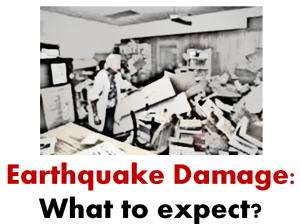

Today, as we head into National Severe Weather Preparedness Week (February 3 – 7), it seems a good time to add one more piece of information to the discussion.

Generators can be dangerous!

Here are three things to keep in mind as you consider the purchase of a new generator and/or get ready to turn yours on.

1. Location. The most important safety alert has to do with where you place your generator. You know that the off-the-shelf, standard generator kicks out significant quantities of carbon monoxide (resulting from the burning of fuel). Too much CO in the air can render you unconscious and kill you. In fact, According to the Centers for Disease Control (CDC), unintentional CO poisoning claims more than 400 lives a year, and about half of those are due to generators.

To protect yourself from the dangers of CO, run your generator outside and place it at least 20 ft. from the building, further if there are any doors, windows or vents. In particular, never run your generator in the garage, even if you keep the door open.

2. Connection. When the generator is running, it can power a number of appliances (as long as its fuel lasts). Use a heavy-duty outdoor electrical cord (10 gauge or better) with grounded plug (the three-prong one) to run from the generator outside to the appliances inside. Adding a heavy-duty power strip at the end in the house will make it easier to plug in the appliances.

Do the math!  Add up the wattage of the appliances you intend to plug in to make sure the generator can support that load.

3. Protection. NEVER NEVER NEVER plug the generator into a wall socket in the house! First, a generator cannot power your whole house so from a power standpoint, that’s useless. Second, and more important, the power from the generator flows through the house and into the power grid. Workers working on repairs to the grid could be electrocuted because of YOUR generator!

For more about generators,

check out these Emergency Plan Guide posts:

And if you are thinking “generator” you also need to be thinking “carbon monoxide alarm.”

Read our review questions before you purchase anything.

Carbon Monoxide Alarms and Detectors

You may not be anticipating any severe weather, but please forward this information to friends who are right in the path of these winter storms. Thanks.

Virginia
Your Emergency Plan Guide Team


Neighborhood CERT — Don’t Overlook This Resource

Share

A Fantastic Resource for your Neighborhood CERT Group

I try to keep feeding you with real-life stories about our neighborhood CERT group – what we do to attract volunteers, what works, what doesn’t. This is another chapter in the on-going saga.

And this one is a real success story.

Visit from the Fire Department

Last fall, at the first meeting after the summer break, our Homeowners Association invited the local fire station to send over some firefighters to talk about what to expect in the case of an earthquake. A big quake had hit Sonoma, in Northern California, just two months earlier, so everyone remembered the fires and the devastation, and was eager to talk about it anyway.

Earthquake Damage Slide Show

Slide Show

Since I was in charge of the agenda as President of the HOA (!), I took advantage of the situation.

First, I prepared a slide show for the fire department.

  • I used current news photos interspersed with a few other choice examples of failed foundations, street collapses and trashed home interiors.
  • I included special slides customized for our type of housing, our age group, etc.
  • I customized the slide show with THEIR logo and contact info.

The plan worked perfectly.

Result: Over 100 residents of our community showed up for the meeting.

While they came to see the firefighters, not to hear about emergency preparedness from our CERT group, they got our message!

Training session for the Fire Department

Then last week, the Captain of that local station called us, and asked if they could hold a training session for new recruits here in our community!

I’ll be writing more about how the training session went. The point of this Advisory — if you reach out to your local fire station, you are likely to get an enthusiastic response.

Make it easy for them

Response from your local fire department is likely to be even more enthusiastic if you –

  • Take the time to create an engaging and useful presentation for them – and give them the chance to edit and practice it. (As it turned out, the Captain we had been working with wasn’t able to make the meeting, so he passed the slide show on to a colleague and HE became our speaker. Smooth.)
  • Put them on the meeting agenda right up front, so they don’t have to wait through any business.
  • Provide a question and answer period. By and large, firefighters are eager to educate the public, and this is a great opportunity for them. Our crew brought handouts for everyone.

Naturally, planning with firefighter teams is tricky, because wherever they are, their radios are blipping and buzzing, and they could be called away at any moment.

And the main challenge, as always, is pulling together a large enough crowd to justify the crew taking time away from the station.

In our case, we have a community that is used to assembling for a monthly HOA meeting. You may need to combine forces with a local school or local church to find the right facility and attract enough people. But if you can, I think you’ll find both the crowd and the firefighters to be appreciative of your efforts.

And ultimately, lives may be saved. That’s really the point of it all!

Action Item: Set up a presentation from your local fire department for your group. Let us know how it goes!

Virginia Nicols
Your Emergency Plan Guide Team


Are you trying to build, or maintain, a local CERT group? Let me know in an email, and I’ll be sure you get all my tips for organizing.


Small Business No Brainer?

Share

“News Item–If you own or work for a small business the odds of it surviving a major earthquake or weather event are 50/50 at best.”

Ignoring Reality of Small Business Disaster

Ignoring reality?

Around our household we have an item that we brand as “the ecology.” It’s actually a “sanitized” word for the sometimes-yukky vegetable garbage destined for the compost pile.

In the world of business, similar sanitizing goes on around the mess that can occur after a major disaster.

The first sanitized term that comes to mind is “Business Continuity.” “Business Continuation” runs a close second. By and large, these expressions are unfamiliar to employees and may be only vaguely understood by owners. (“Something to do with insurance?”)

When a catastrophe can result from something as simple as a backhoe cutting communications lines, it makes no sense to ignore emergency preparedness!

“Sanitizing” the way we think or talk about survival is plain foolish.

A Major Flaw

Large corporations put a great deal of effort into plans to preserve data and – in theory – protect their employees and physical premises. Whether or not their cumbersome plans are even read by staff is questionable, and the subject of another article.

When it comes to small businesses, only about 35% have even a rudimentary plan for how to prepare for and recover from an emergency. (Employee surveys show that employees are aware of this lack.)

Even when a small business does have a Continuation or Continuity Plan, most totally overlook their major asset: their people.

The False Assumption

Business owners seem to be operating on the assumption that their employees and suppliers will continue to be available in an emergency.

“We’ll just pitch in, clean up and get back to business.”

The reality is that everyone impacted by a catastrophe will be preoccupied with their own priorities. The business will take second place and may not even come into focus for hours or days.

It’s no wonder that most small or local businesses simply never reopen their doors after an emergency, or shut them down permanently within a couple of years.

Plugging the Hole

While there is no silver bullet, there are ways to improve your chances of survival. One of the best ways is also often the least expensive. It’s called CERT.

Many cities in the U.S. have an emergency management department and many provide free Community Emergency Response Team (CERT) training, in conjunction with FEMA. If your city doesn’t offer the training, it is on line at the FEMA site. (https://www.fema.gov/community-emergency-response-teams/about-community-emergency-response-team)

An astute business owner or senior manager recognizes the conflict of priorities between work and family. Supporting CERT training for employees has benefits for all:

  • CERT training starts with security for the family. The sooner employees are confident that their families are O.K., the faster they can turn their attention back to work.
  • The same survival skills learned in CERT work for neighborhood groups and work teams.
  • A CERT-trained employee is likely to have honed communication and teamwork skills that benefit many areas of the business’s day-to-day operations.

Everybody Wins With CERT Training

Why are city and county governments so willing to put on this training for businesses and communities at little or no cost?

Simple. Trained citizens and prepared businesses have a 500% better chance of survival in a catastrophe.

That means less pressure on the First Responders and Disaster Recovery Operations in the aftermath. It means fewer deaths from “spontaneous” untrained volunteer efforts. And the big benefit is the continued tax revenues that support the community.

No matter how you look at it, Business Continuation Planning and CERT training for citizens and employees is a win-win situation. It should be a no brainer for any business owner.

Ready to start the conversation about emergency training in your own business?

We’ve put together a one-page pdf to get you started. It’s free.

Joe Krueger
Your Emergency Plan Guide Team


Three Days in Paris

Share

. . . Give Us Pause for Concern.

Last week the British Intelligence MI-5 issued its warning about the renewed threat of terrorist attacks on so-called “soft targets.”

Soft target for terrorist

Classic Soft Target

This proclamation, against the backdrop of the savage attack by two minimally-trained terrorists with automatic weapons on the French tabloid Charlie Hebdo, got my attention . . . especially since it warned of growing risks of attacks in the U.S.

But, real as the terrorist threat may be, it is only one of many threats against soft targets!

So what are soft targets and should we really be worried?

Soft targets are basically any person or location that isn’t protected by armed guards or official security. The school at Sandy Hook, the two off-duty British soldiers and the school in Pakistan are all soft targets. Your grocery store, gas station, your church and even your own home are all soft targets by definition.

And, yes, we should be concerned and vigilant.

San Francisco rampage

In the U.S., widespread availability of assault weapons means that mentally-ill people are all capable of becoming potential “terrorists.”

On July 1, 1993 in San Francisco, California, Gian Luigi Ferri, a 55-year old therapist, burst into a law office at 101 California Street and began shooting with two automatic weapons, killing eight people including a receptionist and a secretary, and wounding several others.

I knew “John” Ferri. I actually met him on three occasions. One of these was to sever him from a counseling assignment with a young relative of mine who “didn’t feel comfortable” with him. Neither did I after a fifteen minute conversation.

But neither did I suspect that years later he would become a mass murderer.

A more recent threat

That series of events, together with a number of workplace killings, made me particularly concerned for the safety of one of my daughters, a senior human relations executive who has been tasked with laying off several dozen employees since the 2008 financial meltdown. I worry about disgruntled employees “snapping” and returning to their workplace to “get even.”

For every real terrorist event, we can expect half a dozen of these “domestic violence” events. Does the fact that they are to be expected make me feel any better? Not really.

More precautions, increased vigilance

With terrorist incidents likely to increase in the future, there’s every reason to take all normal precautionary measures while increasing our vigilance. If you work or live in a high-risk target area, a healthy dose of paranoia might even be in order.

So, what’s the bottom line? The more progress we make in containing terrorism on the various battlefields of the Middle East, the more we can expect isolated, one-off incidents of attacks by one or two would-be terrorist actors. MI-5’s Director, Andrew Parker, pointed to what he called “the growing gap between the increasingly challenging threat and the decreasing availability of capabilities to address it.”

Of course we here in the U.S. are less likely than countries in Europe to be hit this way, but only because we are not as close or accessible to the thousands of militants coming and going between a battlefield and an adjacent country.

In response to this threat, here at Emergency Plan Guide we’ll be taking another look at physical security devices and related protection equipment. You may want to follow these periodic reviews to see if any resonate with you.

Joe Krueger
Your Emergency Plan Guide Team

Don’t miss our upcoming reviews of security equipment. Be sure to get on our Advisory mailing list.  Sign up below.

Safer at Home in an Emergency

Share

 [This article is aimed at people living in a neighborhood with a clubhouse or community center. If you’re building a CERT group in such an environment, you can use these questions for valuable training.]

“In an emergency, we come to the clubhouse, right?”

“No, No, No!”

Think about it. In a real emergency, why would you head for the office, or the clubhouse, or any central meeting place in your community?

Consider these emergency conditions in a clubhouse.

  1. Will the clubhouse be standing?

Unless your clubhouse is brand new, and built to modern safety standards, it is just as likely to collapse as any other building, and probably more likely to collapse than a smaller and more compact building.

  1. Will the clubhouse be open?

If an emergency hits in the middle of the night, every door in the clubhouse will be locked and management will be away. Are you going to break in?

  1. Will there be electricity or phone service?

Does your office or clubhouse have an emergency generator? Where is someone who knows how to turn it on? If no generator, then there will be no lights (after emergency lights have gone off). No automatic doors, no elevators, no air conditioning, no heat. No emergency communications. Not safe!

  1. Will there be food?

A few centers may have kitchen facilities and some food supplies. In an emergency, however, the kitchen cupboards and refrigerators may be locked. There may be no way to heat water or to cook. Perhaps most disturbing – who will decide who gets to be first in line?

  1. Will there be bathroom facilities?

If water pipes are broken, the image of a crowd of people lining up to use one or two toilets that don’t work is . . . well, repugnant. And what if people bring their pets with them?

  1. Where will you get your medications?
  2. Finally, who will take charge of the group?

And will volunteers be willing to stay at the center hour after hour to help out?

Your home is the best place to be.

Unless it’s been designated as an official “evacuation center,” your central community area is most likely worse for survival than your own home.

That’s why our neighborhood CERT group stresses shelter in place.

If you take a look at the same questions from above, and fill in “in your own home,” here are some of the answers you’ll get.

  1. Will the house be standing?

Your apartment, single-family residence or mobile home is as likely to withstand an emergency as any other structure, depending on its age, the kind of disaster (earthquake, tornado, flood, etc.). And since it is your home, you have the opportunity to make it as safe as possible by fastening furniture to the walls, putting locks on cupboards, storing food and water, assembling tools, etc.

  1. Will your home be open?

If an emergency hits in the middle of the night, you’ll be there. And even if you have to get home, you’ll have keys or know how to get safely inside.

  1. Will there be electricity? How about emergency communications?

You may or may not have a personal home generator. But you certainly should have emergency lighting in your home, probably in the form of multiple flashlights and LED lanterns. At home, you can add or subtract clothing, add or take away blankets in order to adjust to weather conditions. And you should have access to emergency radios and first aid materials.

  1. Will there be food?

If you’ve done any preparing, you’ll have water and food, including some food that doesn’t need any cooking. You’ll have your medications – and food and medications for your pets, as well.

  1. Will there be bathroom facilities?

If water pipes are broken, you won’t be able to use your own toilet. Again, if you’ve done some preparing, you may be able to flush using outside sources of water (e.g. swimming pool water). Or you can put plastic bags into the toilet, secure them when they’re full and then put them somewhere outside. Not pleasant – but workable.

Are you thinking there’s a better place than home to be in an emergency?

Are there other people more qualified to help you than you are to help yourself?

Think again!
Virginia and Joe
Your Emergency Plan Guide Team

P.S.  Who do you know who lives in a complex with a clubhouse or community center?  Forward this to them right now!  Thanks.

P.P.S.  If you’re working to build a neighborhood CERT group, drop us a line.  We have some experiences and some training materials that we’d be glad to share.

Planning for Emergencies – “Survey Says . . .”

Share

Two weeks ago I sent out a survey to my various Emergency Plan Guide subscribers.

Only two questions resulted in any real intelligence.

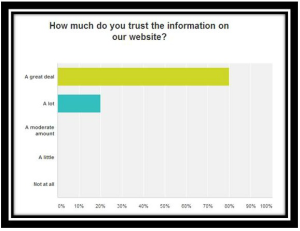
Emergency Plan Guide Surv eyThe first interesting question made me really pleased. The image shows the question and the result: 100% of the respondents trusted the information on the site “a great deal” or “a lot.”

The second interesting question was the very last one, where we asked people to let us know what they want more of in upcoming Advisories. Here the answers were totally diverse.

Some people wanted pure survival information.

Others were looking for ideas to help them organize CERT groups. (One CERT group was in a medical facility!)

So we fall back on our original assumptions regarding our audience, assumptions that have been upheld via comments we’ve received. And to continue with the questions . . .

Do you fit into one of these categories?

  1. Preppers – Make preparations to get through an emergency or a disaster (caused by weather, societal turmoil, etc.) by relying on their own stockpiled supplies and skills.
  2. Survivalists – Prepare to survive a long-term, total breakdown of society, probably as a result of anarchy. Survivalists endorse and practice traditional wilderness survival skills including use of weapons, traps, emergency shelter, etc.
  3. Homesteaders – Look to the land to be self-sufficient as a regular lifestyle. Homesteaders grow crops and preserve them; they may also craft their own materials and tools.
  4. Professional Emergency Responders and Planners – Formally trained to respond to and manage emergencies of different types and intensities. These include First Responders (firefighters, police, emergency personnel), leaders within city or government agencies, and staff of the Big Daddy of them all, the Federal Emergency Management Association (since 2003, part of Homeland Security).

Where do we fit?

Over the years Joe and I have absorbed good info from all these groups!  (Actually, our interest in preparedness started when we were children. My parents were pioneers in Alaska in the 30s and I inherited their attitudes along with their stories. And Joe survived on urban streets by himself as a child – yet another skill set.)

At Emergency Plan Guide, we have ended up finding a niche that doesn’t seem to get a lot of sustained attention.

We are Team Builders.

We tend to like – and want to trust — people. We enjoy being part of a bigger team. And nearly every news story we hear makes it clear that in the case of a widespread emergency, it’s the people physically closest to you who will make the difference to your survival!

Yes, your “immediate survival team” will be made up of your neighbors or your co-workers.

We can’t count on strangers to have any particular skills or understanding. But we can and should count on neighbors and co-workers to have (1) basic knowledge, (2) some practiced responses and (3) a readiness to pitch in.

So let me ask you for a bit more follow-up.  Can you reply to this Advisory and let us know which group from those described above fits you the best? Or do you fit into another category altogether?

We look forward to hearing from you!

Joe Krueger and Virginia Nicols
Your Emergency Plan Guide Team

If you get this in an email, you can contact us here to let us know more about who you are and what you want.


Survival Training for Ten Special Hazards

Share

Your family may be prepared for common emergencies. But have you taken the time to think about these ten special hazards?

Checklist of Special Hazards

Emergency Planning for Tsunami

Tsunami Siren – New Zealand

1. Emergency siren

We’re all used to the weather alert sound that’s tested monthly on the radio. But what if you suddenly heard a siren going off outside? Would you know immediately what it meant, and what to do? In our part of the world, sirens are associated with just one thing: a leak at the nearby nuclear power plant. In Oklahoma, a siren might announce imminent threat of a tornado. In Asia, sirens are used to warn of giant waves or tsunamis. What sirens operate where you live or where you’re planning to travel?

2. Railroad crash

When the track doesn’t run right next to your house, you may not realize how many trains are traveling through your community. Although train accidents are infrequent, every year we hear of derailments, explosions, fires, traffic disruption, and evacuations. Where could a train crash happen in your local neighborhood? What cargo might that train be carrying?

3. Fire at sea

I’ve personally been through two ferry fires, both in the Mediterranean. Any time you’re aboard a ship, or even a boat, there’s danger from fire. Do you think about this possibility BEFORE you board? Do you think about how to respon

4. Airport/aircraft emergency

As a civilian, you’re not likely to be called upon to respond to an emergency at an airport but do you live or work near an airport?  In the flight path?  What do you know about emergency preparedness at the facility and how you would be impacted if there were a mishap?

5. Unusually heavy rain

Here in Southern California, rain (finally) fell on areas that a year ago had been burned by wildfires. The result: uncontrolled run-off of water and, unfortunately, mudslides. Could you become a victim of such a disaster?  Do you know how to protect your property (as best you can) using sandbags and K-rails?

6. Disabled residents

We’ve said it over and over again: many evacuation or disaster response plans overlook people with disabilities. How have you prepared to assist disabled family members, neighbors or co-workers in the case of an emergency?

7. Dam break

A wall of water from a broken dam is a favorite movie image. Reality might look a little different. (It might not be a flood; it might mean seepage or discharge and contamination of the water supply.) Is there a dam or water supply anywhere near you? Or a storage area for industrial liquid waste? It may be well camouflaged! How would you find out?

8. Explosions or release of toxins from industrial plants

We’re pretty aware of the dangers associated with oil refineries and fertilizer plants. What other industrial activities are underway near your community?  Do you actually work where you have identified hazards associated with the job?  OSHA is the agency where you can seek information and assistance regarding industrial hazards.

9. Dangerous animals

As populations expand, communities come ever more in contact with animals that used to be wild but which now exist nearby. We’ve all seen videos of bears wandering between houses, of coyotes chasing pets and even children, and, of course, snakes that have grown to become life-threatening. Do you and your children know how to recognize a dangerous animal and what to do if you encounter one?

10. Active shooter

Do you know what gunfire sounds like? If you heard it, would you know what to do? What about your children? Your parents? Where might you encounter a shooter? Immediate action could save your life; confusion or a delayed reaction could put you in increased danger.

There is emergency preparedness training available for each of these special circumstances. We’ve discussed some of them here at Emergency Plan Guide and will likely talk about them again.

If you’d like more info on any item in particular, or have personal experience to share, please leave a comment.

Virginia Nicols
Your Emergency Plan Guide Team


Hand-Held Survival Tool

Share

We have spent a lot of time talking about the various emergency radio choices that are available — solar/crank-powered for receiving emergency communications, and hand-held walkie-talkies for keeping in touch. We even did a video about workplace communications — you’ll see the link below this post.

But when you’re caught on the road . . .

But, it’s clear that we need to address the reality that few people caught on the road or away from home will be carrying their solar/crank-powered emergency radio with them — and their walkie-talkies won’t do them much good, either, since those are limited in range.

If you stay in the car, you’ll probably be able to get emergency news and weather reports on your car radio. But if you have no radio,

Or if you have to start walking . . .

You need a reliable alternative.

Reliable emergency radioThe only one we have found that is consistently reliable, affordable and the right size is the Ambient Weather WR-090 Emergency Pocket AM/FM/WB Weather Alert Radio with Digital Tuner and Flashlight

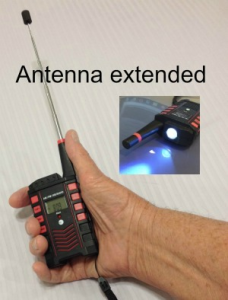
You can gauge the size of the radio by seeing it in the photo, in my hand.  In the photo, the antenna is fully extended; when you store it, of course, you’ll retract it into its 2-inch antenna stub  (shorter than my thumb).

When you select the weather band mode, there’s a red LED ALERT feature (right under the screen), and a clearly marked button on the side turns on a reasonable built-in flashlight.  (Photo insert)

This powerful gem is powered by three replaceable, AAA batteries. It only weighs 4 ounces (including the batteries) and

Easily fits into a pocket, purse or glove compartment of the car.

Most alkaline batteries have a shelf life of ten years. We recommend, however, that the batteries be changed at least once a year, depending on the frequency of usage and exposure of the unit to excessive heat, etc.

As with any battery-powered electronic device, you always want to have extra, fresh, replacement batteries on hand. We prefer the premium Duracell Quantum or Energizer equivalent high-density core. These premium batteries deliver full power longer than the standard models. When you’re dealing with emergency-related devices, you want the best quality, most dependable power available.

(Store extra batteries in your Commuter Kit. )

We personally have three of these units, one for each of our two cars and one for the kitchen drawer.  You’ll feel better if you have a couple of them handy, too. Here’s the direct link to the radio at Amazon, which is where we get ours.

Joe Krueger
Emergency Plan Guide


If you’re interested in radios, here are three more resources:


Emergency Preparedness for People with Disabilities or Special Health Needs

Share

Overlooked or Abandoned?

Every week I get one or another Google Alert about some group that is either not taking care of itself in an emergency or that has been overlooked by “the authorities.”

In our community CERT group, we do not have the where-with-all to take care of neighbors with disabilities. We don’t have specialized medical knowledge, or (expensive) specialized equipment or even the physical stamina to lift or move some of them. But . . .

We are aware of our neighbors and do our best to keep their needs in mind . . .

as we work on building our – and their — readiness to respond in the face of a disaster. As you build your own neighborhood group, here are

Some questions to ask:

Evacuation sign for disabled.

from Lee Wilson, founder at The Egress Group. More at http://accessibleexitsigns.com/

Shelter-in-Place.  When a heavy storm hits, the best course for most people is to shelter in place, assuming they have stored food, clothing, etc.  The questions to ask your disabled neighbors:

  1. Do you have food supplies that you are able to prepare for yourself (canned food, water) or do you depend on regular food deliveries from Meals on Wheels or other food service?
  2. Do you use any electric or electronic devices to treat a chronic condition, such as breathing treatments or sleeping machines? What plans do you have for back-up power? (Oxygen tanks, battery back-up)

Needed travel.  Do any of your neighbors need regular trips away from their home to get medical treatments like as kidney dialysis? In a severe weather situation, can your neighbor answer these questions:

  1. Do you know what to do if you are unable to reach your doctor for several days? (diet, hydration)
  2. Do you know where to go for treatment if your local clinic is closed? (addresses of alternate locations)
  3. Who would come to get you for dialysis if your regular caregiver isn’t available?
  4. What if the elevator isn’t working?

Evacuation.  In the case of an evacuation, many people who may not appear disabled may need assistance.  For example, people who are hard of hearing might not recognize the signal to evacuate. People with difficulty walking might not be able to negotiate stairs. People who can walk may not be able to handle door handles or locks. Questions to ask:

  1. Does our building/community have evacuation signage that incorporates signage for disabled people? (visual? touchable?)
  2. Is there a plan to find people ready and able to assist disabled people to evacuate?
  3. Is specialized evacuation equipment necessary, and available?

Practice and planning do make a difference.

The National Fire Protection Association’s 2007 Emergency Evacuation Planning Guide for People with Disabilities tells the following story.

During the 1993 bombing of the World Trade Center, a man with a mobility impairment was working on the 69th floor. With no plan or devices in place, it took over six hours to evacuate him. In the 2001 attack on the World Trade Center, the same man had prepared himself to leave the building using assistance from others and an evacuation chair he had acquired and had under his desk. It only took 1 hour and 30 minutes to get him out of the building this second time. 

Perhaps you can share this story with friends and with your CERT team to stimulate some creative thinking.


Virginia
Your Emergency Plan Guide Team

Forward this email to someone you know who could use the information.  One out of five Americans has some sort of disability.