Author: Volunteer

Tornado – An Ounce of Prevention

Share

An Ounce of Prevention Equals More Than a Pound of Cure.

Heartbreaking is a strong word but it isn’t adequate to describe the collective grief we all feel when viewing the devastation in the aftermath of the massive tornado that swept through the outskirts of Oklahoma City recently. Your heart goes out to the young mother who asks, “Why didn’t we have better protection for our schoolchildren?” Why indeed.
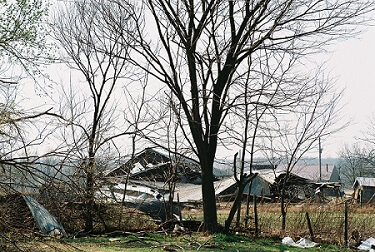
Home damaged by storm

Survivors?

Where were the voices of prevention before the storm? There’s a reason this area of the Midwest is called “Tornado Alley!”

Why indeed weren’t there underground or interior shelters in the schools and pre-schools? It’s a very interesting question and a curious commentary on the workings of the human mind.

Tornadoes versus earthquakes and floods.

I recall vividly a visit I made to some relatives living in Baxter Springs, Kansas, a few short weeks after a tornado tore through the area and took the lives of a few residents, including some of my remote American Indian relatives. My own experience of getting tossed out of my upper bunk bed in 1953 (or was it 1954?) by an earthquake in the Tehachapi Mountains in Southern California had burned into my brain the need to take precautions against the natural risks.

Yet my relatives’ attitude about the tornadoes could only be described as nonchalant. At the same time, I had to wonder about their reluctance to even visit California because of their fear of earthquakes!

These same people chose to live with the yearly risk of tornadoes . . . the natural disaster risk they’ve become accustomed to. Their fatalistic attitude (“. . . if it’s God’s will,” etc.) seemed to work for them with tornadoes, but not with earthquakes.

I guess it’s a lot like buying insurance.

Would we agree that “responsible people” purchase insurance against recognized risk? Many responsible people who live in flood prone areas do seem to take out flood insurance . . . but not all. And the fact that less than 20% of California residents have earthquake insurance – despite the near 100% probability of a major earthquake over 6.7 on the Richter scale in the next 20-30 years – seems a bit incongruent.

The good news, however, is that 40% say they have taken at least some actions to prepare themselves and, in the case of CERT organizations, have expanded their efforts to include their neighborhoods and businesses. Hopefully, we are having some impact on these wider preparations as well.


Joe Krueger

Your Emergency Plan Guide Team
 

Retrofit Your Home to Prevent Earthquake Damage

Share

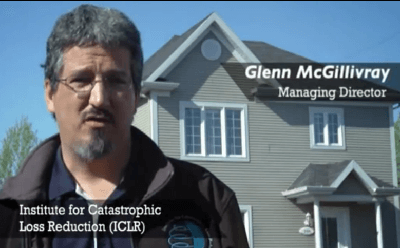
Are you a homeowner, property owner, remodeler or home builder, or home energy specialist? Take three and one-half minutes to watch this video showing retrofit steps for protecting a home against damage from earthquake and winter storms.

Remodel home for earthquake

Click image to see 3 minute video on home remodel

The video was posted on YouTube by the Canadian Institute for Catastrophic Loss Reduction (ICLR) in partnership with Desjardins Insurance.

Most of the steps are simple and would apply to ALL homes, no matter where they are located. As an owner, you could consider having these changes made to your home or rental properties.  As a member of the construction industry, you might want to recommend these changes to customers.

Some of the work you could do yourself, like installing a fire extinguisher. (The video recommends “at least one in every home.” We think you probably need more than one: in the kitchen, for sure, but in the garage, too, or in the laundry room area.)

You would need a licensed professional’s help for some of the other items, like installing a generator or snow melting system along the roof edge.

Even if you aren’t in an area prone to earthquakes, a number of the suggestions in the video will apply, enhancing your home’s security and safety as well as your ability to function in a number of emergency situations. In some cases, making these improvements might even give you a discount on home insurance costs.

If this video is of interest to you, you may also want to review these more detailed home improvement advisories. Whatever you can do to protect your home will help you sleep better at night. Plus, it may help with the resale value!

What other improvements do you think people should consider? Drop your suggestions into the comments box below!

Thanks.

Virginia Nicols
Emergency Plan Guide Team

Slick Road Driver Training

Share

Prevent a disaster!

Porsche with driver

Some serious driver training represented in this photo!

You may not know that I drive a 1985 Porsche 944. I’m the original owner; the car is a “daily driver” and and I’ve had such fun with it, on race tracks, autocross courses, and hill climbs. The first week I had it, though, I almost killed myself. Fortunately, I didn’t, and after 28 years of excitement I can truly say it has been repeated drivers’ training that has kept me safe.

This message is for “above average drivers like me.”

You may be like 80% of all drivers, who think they are “above average.” (There have been many studies, both in the U.S. and in Europe, that have resulted in similar findings. Check out Wikipedia: “Illusory Superiority.”) All that confidence disappears, however, when you find yourself hydroplaning in the rain, or sliding sideways downhill on an icy shoulder.

And what about your “above average” children? Are they truly prepared for emergency driving? Would you trust them to drive in severe weather conditions? Do they know what to do when they’re suddenly in a skid?

Of course, we avoid driving when conditions are dangerous.

Sure, that makes sense. But in a real emergency, you may be required to drive – and that’s when training will be invaluable.

But when it’s necessary . . . ?

Nearly every Drivers’ School has a special course as a refresher for teens or for experienced drivers who want to sharpen their driving skills. It may take you a while to find the right one in your local area. Start by going online to your favorite browser and typing in combinations of the following words, followed by the name of your city:

  • Bad weather or wet weather driving course
  • Hazardous weather driving training
  • Slick road survival
  • Skid school
  • Emergency driving course

First, you’ll just find advice.  But what you’re looking for is the opportunity to get actual experience – a class that gives you extended time behind the wheel on a skid pad or directly on wet pavement, ice or snow. Taking such a course is intense, exciting, and FUN! I’ve done ‘em all, with the exception of snow; most recently, I took a course right here in Southern California that featured emergency stops plus throwing the car into a 360 degree spin. I loved every minute!

Just like any other emergency preparedness skill, once you have practiced, you have a much better chance of reacting rightly instead of wrongly when necessary.

Consider giving an emergency driving skills course as a gift — to yourself and other family drivers. You’ll never regret it!


Making Progress with Emergency Preparedness

Share

A Frenzy of Recent Activity!

If you track the news like I do, you will have seen, over just the past couple of months, literally hundreds of cities announcing “Emergency Preparedness Training” meetings. Some of these meetings are sponsored by the local fire department. Some are held in conjunction with the local college. Some are aimed at children; a few have senior citizens as their target audience. Occasionally even an elected official takes the time to make an appearance.

All this activity seems to have been accelerated by our experiencing one disaster after another over the past few years. Lately, they seem to be happening even more frequently: storms, hurricanes, flooding, explosions, bombings . . . the list goes on.

Will these meetings make any difference?

From the standpoint of community preparedness, I welcome all this attention.

From the standpoint of being a trained Community Emergency Response Team member, I realize that a bunch of one-time meetings are just a start. Just a start! It takes weeks and months for people to change their level of general awareness. It takes them weeks and months and sometimes years to get around to taking even the most elementary precautions or preparations.

Which brings me to the point of this article . . .

Our ten-year track record!

CERT Volunteers

Ready and willing to help

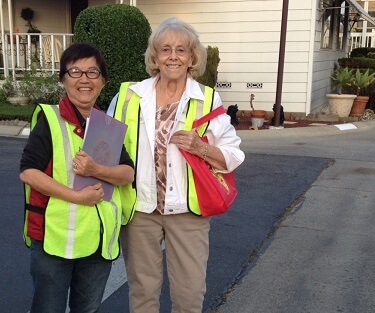
Here in our local community, our CERT team has been actively building a plan, recruiting, training, assembling supplies, working with the local authorities – for nearly 10 years now.

Last week was no exception to our regular efforts. We held one of our annual training exercises. It involved Block Captains “discovering” emergencies located around the neighborhood, then taking the appropriate action and recording what they did.

Afterwards, we all got together with cookies and discussed what people had done, and what they might have done better.

While the “emergencies” were ones we might reasonably expect – a train wreck on the tracks next to one row of homes, an earthquake, a live shooter event, a wild fire requiring evacuation – the responses were also what one might reasonably expect.

The important thing – no one really had to think about what to do! After years of talking and writing articles and inviting neighbors in for coffee and a slide show…after a hundred meetings with as few as three people to more like 60 people in the group, it’s all paying off.

Now that’s progress!


“Down Payment on Disaster”

Share

Pile of cashWe have written page after page of recommendations and suggestions about how to prepare for a disaster. Some of our tips include simple changes in behavior – like keeping a flashlight and shoes next to the bed, or making sure you have extra canned food stored in the back of the cupboard.

Other recommendations involve taking on what I would call home improvement or repair: attaching bookcases to the wall, strapping the water heater, or reinforcing the chimney.

Lately, we’ve spent a lot of time discussing how to assemble various emergency supplies, including water (number one), food (number two) and emergency communications (or is this number two for you?). You can be assured we’ll continue with this theme!

In any case, many of these recommendations involve spending money. Yes, making a deliberate investment in something you really don’t want to have to use!

How can you justify spending money on emergency preparedness?

I’m sure you can come up with several reasons, of course, but the main one is:

You don’t want your family to ask, “Why didn’t you do something to protect us?”

There’s another reason, though, that you may not have considered. And here it is, as a rule of thumb:

Every dollar spent on preparedness saves $4 in recovery costs, according to a widely cited report by the National Institute of Building Sciences’ Multihazard Mitigation Council.

Think “recovery” when you build.

  • If you are building a home near the beach, for example, elevate it above the flood line! If you already live in a low-lying area, keep materials like sandbags, plywood, plastic sheeting and lumber handy for emergencies.
  • If you live in a hurricane-prone region, invest $3,000 in an underground shelter. (You may even be able to have part of the cost borne by the government.) Make sure your home has an extra strength frame and roof.
  • Here in earthquake country, we recommend earthquake bracing for mobile homes, bolting sill plates to the foundation, and anchoring light worktables to the floor and heavy computer equipment to the table.

Everyone has to make decisions about what to spend on preparedness for natural disasters. A $4 savings for a $1 investment is a pretty good return. But if that seems too much for you, consider what a life is worth!


Beside My Bed

Share

Here in earthquake country the chances of “the Big One” hitting are greater every day. My particular concern is that it will happen at night, making things far more scary and dangerous. One thing I’ve done to set my mind at ease is to create a little emergency stash right next to the bed.

Bedside emergency stash

What’s missing?

My bedside chest has the space on top for a lamp, a couple of books, and an alarm clock. (These days, that’s my phone.) It also has a water bottle and my glasses. And whatever else gets piled there temporarily. Sound familiar?

In a real temblor, that table is likely to tip over and crash. The lamp will break, my glasses could break, and the phone will slip down and likely be lost, at least for a while, in whatever pile of stuff it lands in.

And all this will be in the pitch black!

As a simple precaution I have taken the time to pack, inside that same chest, just a few important items to carry me through the first minutes after the earthquake.

Here’s what I have so far:

* A pair of heavy shoes, and inside the shoes

* Socks

* Flashlight

* An extra pair of glasses in a hard case

At least I won’t be trapped, barefoot and blind, in the immediate aftermath!

I expect you could put together the same simple package beside your bed, too. I’m sure you’ll feel better once it’s done.

P.S. As I took this picture, I realized that I‘ve forgotten one simple thing in my bedside stash.  Gloves!  I’m putting them in right now!


“What do kids know?!”

Share

We often get discouraged trying to get people to take preparedness seriously. “It’ll never happen to me,” they say with a smirk. “Too much trouble; I don’t have time!” say others, shaking their heads. “Don’t know how to start,” they complain.

I was glad to hear of some young people who DO have the time and energy to Get Prepared! Here are five youth programs going on right around us!  Do you know about them?

FEMA for Kids

In Middlesex county, New Jersey, FEMA is implementing FEMA for Kids. While it’s designed to come into a community after a disaster, it is directed to children, using them as conduits to their parents with tips and advice on disaster preparedness for the future.

BSA Merit Badge

BSA Merit Badge in Emergency Preparedness

Boy Scouts of America

The merit badge in Disaster Preparedness (required for Eagle Scout) helps a Scout learn what is “helpful and needed before, during and after an emergency.” Over 50,000 scouts earn this badge every year. Official materials say that Scouts are “are often called upon to help because they know first aid and they know about the discipline and planning needed to react to an emergency situation.”

Girl Scouts of the USA

In 2009, then Department of Homeland Security Secretary Janet Napolitano and Girls Scouts of the USA unveiled a Girl Scout preparedness patch, aimed at advancing community preparedness nationwide. Napolitano is a former Girl Scout who says she knows what it means to “Be Prepared!”

Camp Fire USA

Prepare Today – Lead Tomorrow is a teen program developed by Camp Fire USA. Its goals are to engage teens in intensive community preparedness learning experiences, and create opportunities for them to participate in community preparedness efforts.

FEMA Corps

In 2012, the White House announced FEMA Corps, part of the AmeriCorps program. Some 1,600 people ages 18-24 will join teams to learn skills and get community experience in the field of emergency management.

We all know what an impact kids can have on families and communities. It is thanks in large part to kids that parents stop smoking, start using seat belts, recycle … the list goes on. Find out what your kids are learning at school or elsewhere about Emergency Preparedness. Enjoy their enthusiasm as you conduct your own preparedness efforts. Figure out ways to include the local Boy Scout or Girls Scout troop as a resource in your CERT expo, you neighborhood block party, or your family garage sale.

They will probably be able to teach you something valuable!


Apartment Survival

Share

Home ownership, the standard

Most descriptions of preparing for disaster seem to focus on a single family home and how its residents should prepare. These descriptions include making changes to the building itself, like installing braces or safety glass or reinforcing the chimney or roof. Some families go so far as to fortify their homes or to build totally separate disaster shelters.

Naturally, the family stores large quantities of water and food and perhaps invests in emergency equipment like solar panels or generators. The family also is reminded to include emergency preparations for pets.

Highrise apartment buildingBut what about renters?

But if you are one of the 35% of all households that live in rented homes and particularly in apartments, options may be different – and limited. You probably have far less square footage to start with. You are not likely to have outside area where emergency items could be securely stored or easily accessed. And you certainly would not be allowed to make any structural changes to make the building any sturdier or safer.

What can apartment dwellers do differently?

1. Be efficient!

Your requirements are every bit as important as those of a family living in a single family home, but you will definitely have to be cleverer in order to store even the basics. The smart apartment dweller will become an expert in high-nutritional-value, low-bulk food and in multi-purpose tools and equipment. Instead of investing in a generator, the apartment dweller may need to invest in storage containers that can be hidden under the bed, stacked 8 feet high in a closet, or converted to use as an end-table.

2. Be creative!

Whereas someone with plenty of space outside can store emergency water in a 55 gallon barrel, you may have to make do with a variety of individual bottles, supplemented with a supply of expandable bottles, to be filled at the last minute. Given your limited ability to store water, you may be putting your filtration equipment to use immediately as you are forced to supplement your original water supply.

3. Make friends!

In an apartment setting, neighbors can make all the difference. A group of people can cooperate in assembling and storing food, tools, and other essentials. (For example, two families could share one stove.) One neighbor may have handyman skills and tools; another might have medical training; a third might be a competent cook. Sharing the burdens and responsibilities may serve the entire community better than each person trying to fend for him or herself.

For a whole lot of ideas about organizing your neighbors, check out Emergency Preparedness for Apartment Communities. It discusses getting your own preparedness act together and then helping neighbors get prepared, too.

Are you in a flood zone?

Share

Like maps?

If you are a map fan, check out FEMA’s Map Service Center to see whether you’re in a flood zone. The map is designed for ordinary citizens, but also for real estate and insurance specialists, who can create printouts coordinated with the Digital Flood Insurance Rate Map.

Starting in May, 2013, the map service is being expanded and upgraded. But in the meanwhile, you can do what I did to check out your own home and community. It’s easy!

Check FEMA’s map service.

Here’s the link. www.msc.fema.gov.

Do a “Product Search” by filling in your address. A second screen will come up identifying your general area (county). Click on “View” and be patient as the data loads. Ultimately, you’ll be rewarded with a very small map of your area!

FEMA map shows flood zones

Red arrows point to flood zone markings

You can adjust the scale at the top of the screen. (I changed the 4% to 15 % and that gave me a much better size map, and I could read most of the street names.) You can also click on the “pan” button on the left (looks like a little hand) and move the map around. (Again, be patient since it’s a lot of data and the map re-adjusts slowly.)

Once you’ve found the right area and the right level of detail, search for overlays. In our example, the gray dotted area (left arrow in the illustration) indicates a 500-year-flood zone, and the bright blue color (right arrow in the illustration) indicates a 100-year-flood zone, which means there’s a 1 percent chance of a 1-foot or higher flood in that area in any given year.

How would you be affected?

In the illustration, our home is not in the flood zone. But the blue area happens to be a key highway/railroad overpass/underpass. This interchange is about one mile from our neighborhood, so a flood there would definitely impact our emergency response, particularly if an evacuation were called for.

Check out this resource for your neighborhood, and also for your business or place of work. It’s interesting and good information to have.

Virginia
Your Emergency Plan Guide Team

We’ve added more information about flood insurance. Check it out here.


Business Owner – Do you employ drivers?

Share

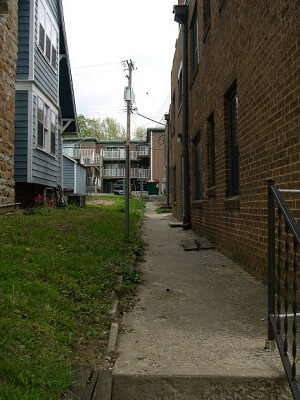
Alley

Where will your driver be when the disaster hits?

Delivering services to homebound seniors

At a meeting last week at the local American Red Cross, we were discussing a new program aimed at preparing the senior community for disaster.

Most of the people in the room represented companies that deliver services to homebound seniors. There were folks from Meals-on-Wheels, SeniorServ, and a whole group of home health care providers.

Home health care staff members drive from home to home to assist their elderly clients. In the case of an earthquake disaster, these drivers will likely be on the road in their car or in the home of a client when the earthquake hits. The drivers will NOT be at their own home, and they will NOT be at their employer’s office.

Homes with few if any resources

These senior clients are people who, by definition, are not self-sufficient. They may be disabled or frail. This means that the driver, caught in the home with the client, will be faced with taking care of the client as well as him or herself.

If the driver is on the road when the earthquake hits, what is her responsibility? To continue on to the client’s home when possible? Return to the office? Or head for home to join the family?

Responsibility of the employer

This situation raises several issues for the employer that need to be addressed through training or investment in appropriate emergency supplies and equipment. Based on the group at the American Red Cross meeting, there was no one correct answer. But everyone agreed that these questions DID deserve consideration, and a positive answer.

1. Do your drivers all have an emergency supplies kit in their vehicle?

2. Does the kit contain enough to share with a client?

3. Are your drivers clear about their responsibility to their clients in the case of an emergency?

4. Do you know how you will communicate with your drivers in an emergency?

5. Do you have a plan for communicating with your clients’ families in an emergency?

Are you an employer with drivers?

What emergency preparations have you made to cover your staff and your customers?  What liability do you feel you carry as the employer?  Please share!


Nine Hazard Signs — A Quiz

Share

What does that sign mean?

Think you’re pretty aware?  I’ll bet you’ve seen many, many danger signs, whether in “real life,” on the pages of a magazine or on a movie or computer screen.

But do you REALLY know what the signs are warning about?

Use the quiz below to refresh your memory. Share the quiz with your family at dinner, with your colleagues at work. Use it to start a discussion of what dangers might be present in your local neighborhood or in your region – dangers you really don’t think about.

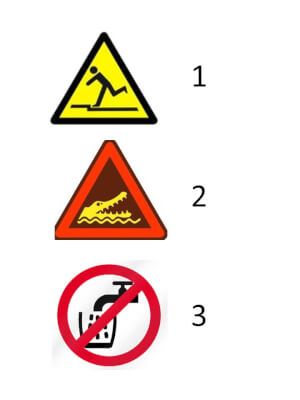
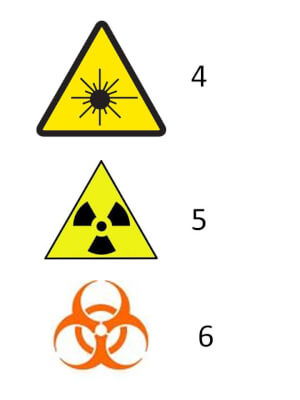
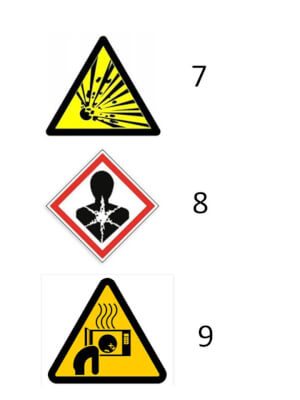
Match the description to the sign!

We’re starting with the easiest ones first!  (Answers are below the images.)

Danger Signs

Danger Signs

Danger Signs


And the answers:

  1. Trip Hazard
  2. Alligators in the neighborhood!
  3. Don’t drink the water

OK, now it’s on to the REAL signs . . .

  1. Laser Beam
  2. Radiation or electromagnetic waves
  3. Biohazard, contaminated or infectious materials
  4. Blasting – watch for more signage or a guard
  5. Health hazard
  6. Do not microwave your head (Thanks to Dan Wolfe!)

Of course, the image at the very top of this Advisory indicates POISON.

What other signs do you see regularly that warn of danger in your environment?

Action item:  Test your family and neighbors using this article!  It will be a great conversation starter!

Virginia
Your Emergency Plan Guide Team

P.S. Later we’ll take a look at the container placards you see on trucks. You know, the diamond shaped ones!


Severe Weather Alerts

Share

Without being paranoid about it, you need to be aware when danger is heading your way. Some things, of course, can’t be anticipated. But tornados, storms, floods, ice – these you can be ready for! Here’s how to find out what’s coming:

Local weather channel on T.V.

Watching the local weather news is the easy option, of course. But most of us don’t have the “luxury” of having a T.V. available whenever we want.

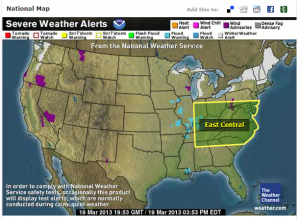
weather map

Regional weather map on Weather.com

Severe Weather Alerts on your tablet or computer

Head to www.weather.com , find your regional map and read about what’s coming. You can bookmark this page so you can find it readily. Typing in your zip code will give you even more local detail.

iAlert

This is a message service managed by your local law enforcement or emergency management service that alerts you by text message, automated phone call or email whenever there is an emergency.  (weather related, traffic emergency or crime related) You can find out if your city has the service and sign up for alerts here: http://ialert.com

Mobile Phone Hurricane App

The American Red Cross offers an app that will help you monitor conditions in your own area or where family members live, find help, and let others know you’re safe with one click of a button. It can warn you with a siren sound, and even turns your phone into a flashlight with strobe if you’re trapped. From your mobile phone, call “**REDCROSS” (**73327677) and you’ll be sent a link for downloading to your phone.

Other severe weather apps

A few minutes online and you will discover many other apps. Some of them might be sponsored by an organization right in your town, like the local news channel. Others may be offered by insurance companies or other organizations.

As you surf, you’ll see that some apps work only on specific phones. Some are free, others may cost a couple of dollars.

Action Item: If you carry a smart phone, invest a few minutes in checking out “severe weather apps” either online or right on your phone through the iTunes Store. Try a couple of the apps that make sense for your locality and your circumstances. (Get your kids to help if you haven’t downloaded an app yet.)

This is one emergency preparation action that is easy and fun!


Protecting Yourself in an Emergency

Share

Home security

Guidebook to home defense

We’ve said this before and no doubt we’ll repeat it more than once in the future. But the recent school shooting in Newtown has given new life to the continuing controversy about firearms – especially assault weapons and high-capacity magazines, etc. – for self-protection. If you’ve watched any of the “Doomsday Preppers” TV shows on the NatGeo Channel, you may have been shocked by the extent that some people go to for their imagined need for survival in a major catastrophe. Their arsenals look more like preparation for war.

Here are three things to think about if you are truly worried about having to protect yourself and your property in the event of a major disaster event. The first two are, in our opinion, negative approaches to life.  The third is in keeping with our philosophy of taking positive action.

Assault weapons are a terrible choice.

First, as any combat veteran will tell you, few people have the natural ability to calmly shoot people with a handgun, much less a rapid-firing assault weapon. Such weapons require training and discipline if you ONLY plan to hit a specific target while the adrenalin is flowing fast and heavy. The chances of hitting innocent people or things around and beyond the target are usually very high. There’s a reason mass murders use these weapons . . . they kill and destroy indiscriminately.

Shotguns aren’t a whole lot better.

Second, the best firearm in a self-defense circumstance is usually a shotgun. It has a limited range but a “spread” in the shot pattern that makes it more likely to hit the intended target on the first shot. You don’t have to be a marksman or highly-trained soldier to be effective with it. The bottom line, however, is if you find yourself having to use it, it’s still likely to take someone’s life. And, regardless of the situation, even if there is no legal consequence, that’s something you will have to live with.

Trusted Friends — Absolutely Your Best Protection.

Third, and most important of all in our opinion, your best protection in an emergency will be good neighbors – people you know and can trust immediately, instead of mistrust. We have seen over and over again the natural tendency of people to help one another following a catastrophic event. And, the more your neighbors are trained and prepared to survive themselves, the better equipped they will be to help you and vice versa. Unlike the first two means of self-protection, you can count on having enough friends if you have allowed for them.  And unlike the first two means of self-protection, this is one that saves lives instead of taking them.

Programs like the Community Emergency Response Team (CERT) training are excellent examples of the best way to prepare yourself and to work along the side your neighbors as an effective team. CERT neighborhoods will not only have a better chance of surviving, but will emerge as a true community with pride in having known what to do in advance . . . and possibly having saved lives and property because of their training.


Testing Your Emergency Equipment

Share

Practice ahead of time!

Virginia asked me to write this Advisory. It was prompted because of a blog post she read recently. Seems someone was trapped on his way home during Superstorm Sandy. By phone his wife reported the power was out and temperatures were dropping rapidly. He was proud and relieved to remind his wife that they had a back-up generator. The problem? His wife didn’t know how to turn it on!

Figure it out ahead of time.

Uhhh – confused?

This led us to take a look around our place at some of the emergency equipment we have to see what we really haven’t tested. Here’s my report.

Generator – Yes, we have a generator, a compact one, highly rated. It is still in the box and Virginia has never really seen it! (Two months ago our CERT organization set out to test its large new generator, and the starter did not function. So back it went to the store where we had bought it.)

Camp stove – Virginia and I have camped for years, both in tents (a LONG time ago) and in our RV, so we are familiar with propane stoves. The glitch – where are the gas canisters? And is there any trick to attaching them? If there is, we could waste a valuable resource trying to figure it out.

Water barrel – Last year we purchased a 55 gallon water barrel. (We wrote about our water barrel earlier.) It came with a pump to be inserted when the water is needed. OK, we haven’t needed the water yet. So, where is the pump, and how difficult is it to attach to the barrel? We haven’t tested it yet.

Solar panel back-ups for computers and phones – This one we’re good with. But if you have purchased panels yourself, be sure you have the right connectors that go between the panels and your device. Surely you have noticed that every mobile phone has a different plug on the end. Test NOW to be sure you have what it takes to take advantage of your solar back-ups.

Emergency radios – When we wrote the review of the best emergency radios, we tested all of our radios, so we know how to crank them, where the batteries go (if there are batteries), what connectors they require, etc. I recommend that you use your emergency radio daily. (It gets music or news, not just emergency alerts!) That way you’ll know it it’s ready to go.

How to Send a Text –– You may need grandchildren to help you out, here. But learn!

Turn on the Power — Again, something as simple as knowing where the fuse box is, and how to reset the switches, could make a difference. Everyone in your family needs to know this.

I think this list could go on. But the message is, “Test and practice.” Our plan is to set up a schedule to test one thing every week. You could set up the same action item — and include your children in the exercise. You won’t all be home when the emergency hits!

The more trained family members, the safer you’ll all be.


Joe Krueger
Emergency Response Team


Neighborhood CERT – How to Recruit

Share

It ain’t easy!

Our local CERT group is having another recruiting drive. It’s an ongoing effort, of course, since people come and go in the neighborhood.

This month we are having a real “recruiting meeting.” Here are some ideas that seem to work to get people there and give them a valuable experience.

Timing – Plan around a disaster.

Frankly, a newsworthy disaster can improve attendance at your meeting. Here in California we say, “Just give me a 3.7 earthquake and we’ll find some more CERT members.”

Even when you have to plan in advance, you will be able to find some recent disasters to feature as part of your recruiting material. (The United States Geological Survey maintains http://earthquake.usgs.gov/earthquakes/map/. As I write this, it lists 198 earthquakes as having happened over the past seven days!)

Invite an “expert” speaker.

Yes, having trained and knowledgeable neighbors is appealing. But sometimes a recognized “expert” can be a better draw. We have had good success inviting the local Police Chief, Fire Chief, and particularly people who have actually participated in disaster recovery (in New Orleans, Fukushima, Christchurch) to be the featured speaker for the evening.

Give attendees materials to interact with: maps, photos, radios.

Maps, photos, radios — all good recruiting tools.

Give attendees something to do.

Emergency response is all about – response! It’s about being ready to take action, and not hesitating. We find that our meetings are more interesting and more successful if we have an activity that all people in the room can take part in, whether or not they are familiar with CERT. For example:

  • Survey the crowd for their ideas of the threats the neighborhood is facing. Record those threats on an easel in the front of the room.
  • Pass out maps of the neighborhood (or use an overhead projection). Have people identify where they live and work in relation to high-threat areas like a chemical plant, a railroad track, flood zone, or a high-pressure gas line.
  • Have extra emergency radios available for people to hold and try out. Your team members can share with visitors. Go through a drill to replace the batteries, change channels, etc. It will result in pandemonium if not well managed, but people always enjoy it!
  • Provide people with resources to take home: a sticker with emergency numbers, an abbreviated emergency supplies list, notice of an upcoming training.
  • A raffle is fun if you can organize it.
  • And, of course, refreshments are always appreciated. Set them up on a side table and give people a chance to mingle.

Invite people at least twice.

People need to be exposed to your marketing message more than once. (You’ve heard the classic “seven times before people buy” story.) We find that an invitation flyer (sent via email or actually printed and delivered to the doorstep) followed by a shorter reminder just the day before works pretty well. Best is if a neighbor actually says, “Let’s go together. I’ll pick you up.”

What’s the Call to Action?

At the end of the meeting, attendees need to be directed to “take the next step.” There is no fixed rule about what that next step should be; that will depend on your individual group. But a call to action is essential. Without it, you have just wasted your recruiting opportunity!

Joe and I have developed, and continue to develop, tools to make all these recruiting tasks easier and more efficient.  Best way to get them is to subscribe to our Advisories.

Virginia Nicols

Emergency Plan Guide