Author: Volunteer

Video Conferencing Best Practices


Share
At-home video conferencing
“Gallery view” lets you see when people arrive — or leave.

“Stay connected” is the advice we hear these days. And it’s not just friendly advice. It’s a requirement for businesses that plan to stay in business!

Of course text messages and email generally work as well as they ever did. But because of the pandemic, business communications are turning to web and video conferencing – a market expected to grow by well over 100% in just this one year!

Whether you’re using video conferencing for daily business meetings or as a marketing tool to reach out to clients and prospects, get the results you expect by choosing the right platform for the job and following best practice guidelines. And stay tuned, because what’s considered “best” keeps evolving!

Use the right video conferencing platform for the job.

As you have surely discovered, well over two dozen popular video conferencing services are competing for place. That list includes Zoom, BlueJeans Meetings, GoToMeeting, Microsoft Teams, Cisco WebEx, Skype, Google Hangouts – and the list goes on. One of my consultant friends reports that over the course of the workday he may find himself using several of them!

When you are joining . . .

as a meeting participant, all that’s required is that you click on the invitation link. You can join online via the platform’s website or you can download an app onto your cellphone or mobile device and join there. (Phone apps may be faster, but they only function on iOS or Android.) Either way, the platform that the host selected will automatically open.

If you’re the host of the meeting . . .

however, how do you know which platform to choose? Features you’ll want to consider as you plan your meetings:

  • Customer support. Particularly if you are a relative beginner, look for companies that offer strong training videos and 24/7 help desk. (You aren’t likely to get all the support you’d like on a free service.)
  • Budget. Several of the leading services offer a level of free service, with monthly plans that add more dollars for more features. You may want to start at that entry level and move up as you discover exactly what you need.
  • Size and length of meeting. Every platform has limits to the number of people allowed to attend the meeting and how long the meeting can run. (It’s a question of bandwidth. Too many connections can overload the capacity of the system.)
  • Number of meetings. Again, different levels have different limits, both on how many “hosts” from your company can be registered to use the platform and how many “participants” can fit into any given meeting. (I was at a meeting a week ago where attendance reached the maximum and the guest speaker, who was running late, couldn’t get in!  Not good!)
  • Ability to record. Not everyone can make every meeting, so it’s convenient for people to have access sometime later. (Recent statistics show that nearly 30% of people who sign up for webinar presentations miss the original schedule but show up later for a repeat!) Having a recording also allows people to go back and check the details of what was presented or what everyone said.
  • How much collaboration or interactivity. If you know you want to stream presentations on demand, share screens, share documents, interact with participants via surveys or monitored Q&A chat, etc., look specifically for “web conferencing” capabilities. Some apps don’t offer full interactivity. And while many of the popular platforms offer these services, it’s generally not part of the free level.

As you consider these features you may come up with more you want or need. But this list will get you started!

Be sure your meeting is secure.

Everyone needs to consider security when going online. Earlier this year some online meetings were “bombed.” Pranksters and/or more determined bad actors assaulted meetings with racist images, pornography, interruptions, loud music, etc.  Online teaching sessions (with young children) were particularly targeted.

“Bombing” has been declared a cybercrime, so incidents seem to have died down. At the same time, better security practices have arisen. Your company may already have instituted upgraded security practices. Here are standard recommendations you and your company should be familiar with:

  • At home, use a VPN for your online meetings. By default, your data will be encrypted. Keep all your home devices updated and running anti-virus and malware protection. In particular, change default passwords for your router and any home IoT devices. (Surely you have heard the stories of hackers taking over home security cameras – and business security cameras, too! Readily accomplished when people use the same password for multiple accounts or devices, or never update passwords!)
  • If you are hosting the meeting, use strong meeting platform passwords at every step and change them frequently. Never share a host pin or meeting passwords publicly.
  • Only invite people you want to attend, and restrict meetings to people who signed up in advance or who are otherwise authenticated.
  • Require participants to sign in for meetings and choose “Announce When User Enters” for all meetings. When everyone has arrived, “lock” the room.
  • Enable “Mute participants on arrival” if available to prevent interruptions. You may also want to disable the chat feature.
  • If you run meetings back to back, use a “Waiting room” feature which keeps a new meeting attendee from accidentally barging in on a meeting still in progress.

A new caution: Be sure to block your webcam (unplug a separate camera, or put a piece of tape over the built in camera) when you are not on a video call! Hackers may be watching everything you do and seeing everything in your work space!

Communicate effectively!

We’ve all attended or seen video conferencing episodes interrupted by charming children or pets. We can overlook these . . . but participants will not welcome a meeting that is disturbed by echoes, static, loud noises, telephones ringing, faces in shadow, etc. Set up your meeting for the best possible experience!

  • Manage the audio, above all else. The audio from most laptops is simply not good enough, and it gets worse the farther you are from the device. If possible, use a noise-reducing headset and microphone. (Hint from pro user: “Consider an over-the-ear headset with microphone boom — the type used by gamers are just as good and cost less than high-priced office versions!” See a sample here.) A separate microphone is also key if you expect to do any typing during the session; the integrated mic on a laptop will make the sound VERY loud for others in the meeting!
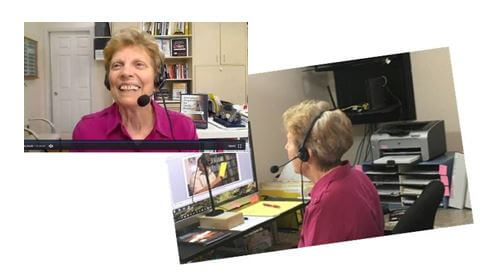
    I have a stand-alone camera, too, because I use a desktop set up with separate screen. Here you can see me with headphones and microphone, and my Logitech webcam.)
  • Light (at least YOUR face!) from the front. No windows behind you! If you can’t sit facing a window, set up soft lighting from a lamp. The light from a laptop screen usually shines upward – and it’s usually blue. Not attractive.
  • Position yourself directly in front of the screen. We’ve all seen interviews on TV where the speaker is looking down (through glasses?) at the computer screen — and we are looking up his nose.  Best way to get the effect you are looking for is to place your laptop at eye level on top of a box or even a stack of sturdy books.
  • Look professional. Even though you are at home, make the effort to dress professionally, comb your hair, and apply make-up as appropriate. Avoid clothing with stripes or patterns or large white spaces –they don’t translate well onto video! Professional also means making sure what’s behind you is simple and uncluttered – and no visible white board with confidential info on it! (Some platforms have “virtual backgrounds” that block everything behind you. Be sure to pick a virtual image that suits your audience!)
  • If you are the host, TEST and PRACTICE with a friend before your meeting to be sure your equipment is set up properly. Most programs have an audio and video test meeting you can play with. Test with mobile devices, too.
  • Schedule your family to avoid interruptions. Turn off your phone, silence alarms, send dogs and children out for a walk.
  • Manage your meeting with an agenda and a clock. Be sure to welcome everyone and go over any instructions about how to use the platform. Check that everyone knows how to “raise their hand” to ask questions or make comments. (Introverts can get lost if they don’t use these tools!) Have all your props or tools at hand so you don’t have to get up to get them.
  • Have a glass of water handy – but not too near your keyboard! — in case your throat gets dry!

You may never have imagined being “on camera,” with everyone’s eyes on you. It may be intimidating — at first! But get used to it, because there’s no doubt that video meetings are here to stay.

As with any new skill, the more you practice, the more confident you’ll be. You can start practicing today using a free trial from one of the video conferencing companies mentioned above.

Virginia
Your Emergency Plan Guide team

P.S. If you are working from home, guidelines for effective presentations may be just that — guidelines. But best practices for security really shouldn’t be considered optional. Share this info with co-workers. Be sure your online communications aren’t inadvertently exposing the company to a cyber threat.
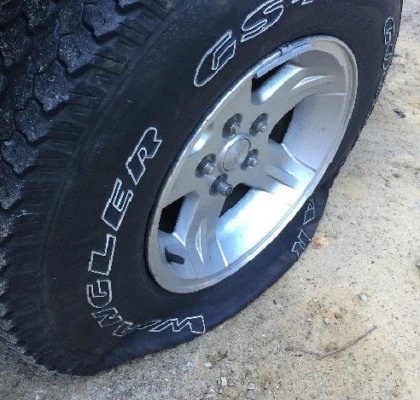
Underinflated tires – another COVID concern

Share
Underinflated tire showing flex

Story from my neighbor, earlier this week . . .

“I was on my way home, zipping along on the freeway when all of a sudden BOOM, the rear end of the car shot up like it had gone over something BIG, then came down with a tremendous thump! Scared me to death!”

When she got home, we saw what had happened. The tread on the right rear tire had exploded, separating from the tire, wrapping itself around the bumper, flapping and destroying the back fender before the car could be brought to a stop!

What does this story have to do with the coronavirus? Well, read on!

During COVID, drivers are facing an elevated level of danger!

What?!

It only took an hour or so before both the friend and I had done some research about this accident, and what we found became the basis for this Advisory. And what we found is really worth a warning or two.

One result of the COVID shut-down – you may have let your car just sit for days or even weeks.

When was the last time you drove your car? If it’s been a while, you may discover an unpleasant surprise the next time you go to look for it. For instance,

  • The car may be gone. In some urban areas, COVID means people aren’t going to work, so their cars are parkeded without being moved for days and weeks. Perfect targets for thieves. (In LA, car thefts doubled during the month of June!) And even if your car was just taken for a joy ride, the Insurance Information Institute reports that the average car theft costs $8,407. So, check on your car and move it to where you can see it!
  • The battery may be dead. Which of your friends has jumper cables and is willing to come by to rescue you? (And will your newly chosen parking place still be available when you finally get there?)
  • You may have new occupants – wild animals!  A car is a nice quiet, closed space, offering safety and comfort for rats, mice and/or squirrels. Not only can they build a nest under the hood or even inside, but they really like those tasty rubber wiring harnesses or hoses. (On this same topic, just yesterday I saw a “Ring video” of a bear going along, trying the handles of parked cars, finding a pick-up that was open, and crawling in! The owner of the pickup checked the footage in the morning when he looked out the window and saw the door still open!)

Now, raise your hand if you’ve ever experienced any of the above!  If you’re lucky enough to be sitting there motionless, keep reading. You may have a chance to participate at the end of the next section of the Advisory!

We go back to my neighbor. She’s a reminder to us all to

Pay particular attention to tires – and in this case, underinflated tires in the heat.

Blowouts and tread separations like our neighbor experienced are more common in hot weather, anyway. But cars that have been parked for a while . . .? Here’s what to watch out for.

Are your tires underinflated?

If you look down at the tire of your parked car, you’ll see that the bottom of the tire bulges out just a bit, or “flexes,” where the weight is on it. (The picture above shows an exaggerated “flex” because this tire is definitely underinflated!) As the tire turns, the flex point changes. On an underinflated tire, the “flex” area will be greater and as the tire turns, it will generate more friction and thus more heat.

This is why every tire has a recommended inflation level. It is measured in pounds per square inch (psi). You’ll see the recommended psi on the side of the tire itself — probably something like 32 – 36 psi..

When you’re driving, the faster you drive the hotter the tire will get. Add more weight, and you’ll add heat, too. When the weather itself is hot, every 10 degrees of temperature can raise the temperature of the tires another degree or so.

When tires are underinflated, they will get even hotter because reduced pressure results in more flexing.

How hot do tires get? Drive on the highway for a half-hour, and tire temperatures will increase 50 degrees. If it’s 95 degrees out, as it was the day of my neighbor’s accident, the roadway itself was probably close to 150 degrees. (We have actually measured 149 degrees right here in front of the house using a thermal imaging camera.)

Add it all up and her tires may easily have reached as high as 200 degrees! And if her tires were underinflated . . .?!

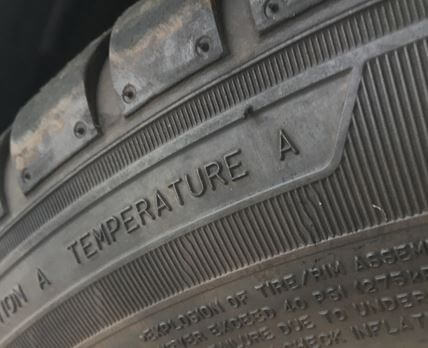
Check for the “heat” rating of your tires.

Tires are rated A, B and C, with A being best, for their ability to “run cool.” I ran out to check my own tires and here’s a picture of the tire and rating.

Tire showing heat rating

The point of it all? You can’t impact the weather, or the temperature of the road.

But you can easily keep your tires inflated per the tire recommendation.

This means you need to check them regularly, when the tires are cool, using a good quality tire gauge. We have several gauges in the car all the time – at least one of the inexpensive “pencil” type gauges, and also an easier to read circular gauge like this one, from Amazon:

Tire Pressure Gauge – (0-60 PSI) Heavy Duty, Certified ANSI Accurate with Large 2 Inch Easy to Read Glow Dial, Low – High Air Pressure Gauge. Tire Gauge for Car and Trucks Tires by Vondior

Check the overall condition of your tires, too.

Just sitting, tires lose a pound or two of pressure in a month. So when you check the tire pressure, particularly if you notice a loss in tire pressure, look for damage. The best way to really inspect your tires is when they are clean. (Getting off the dust and dirt and oil build-up will help your tire shed heat, too.)

Here’s what to look for:

  • Is tread wear even? If your tires have worn tread on the outside but thicker tread on the inside you need to find out about an alignment!
  • Do you see any bulges?
  • What about cracks along the tread or sidewall? Don’t forget the inside of the tire, too.
  • What’s the condition of the valve stem and valve cap?
Protect your tires from drying out and cracking.

You can also apply a protectant, typically wax-based, that will help keep tires clean longer, give them a nice shine, and protect them from drying out.

There are dozens of car products aimed at cleaning, restoring, lubricating, and rehydrating your tires. Read all the product info carefully to be sure you are getting protection and not just shine.

Apply on very clean tires. Don’t over apply! Follow directions on how to apply and how to let it dry and/or buff. Be sure to keep excess off the paint and brakes. If you’re using a spray, be aware that the spray may stain the concrete floor around the wheel. We have resorted to parking on an old towel!

Car tire products are fun and not too expensive.

You can get a couple or maybe even three to try for less than $20.  Here are two we have used over the years. (Car buff friends always have their favorites, so ask around!) Click and you’ll go to Amazon, where we are Associates and may get a commission if you buy.

A GEL product from ArmorAll

Armor All Car Tire and Wheel Shine Gel, Cleaner for Cars, Truck and Motorcycle, 18 Fl Oz, 9938

And a FOAM product (”Just spray and walk away!”) from Meguiars

Meguiar’s G2819 Hot Shine Reflect Foam, 19 oz.

Taking care of your car is always worth it. But today, with people driving less and at the same time faster and/or more erratically (!), it’s a good idea to head out today to check the condition of your tires.

I hope you’ll find them in good shape!

Virginia
Your Emergency Plan Guide team

P.S. If you are taking another look at your car in terms of general preparedness, don’t overlook our earlier Advisory about emergency car supplies “to get you home.” Here’s the link.

P.P.S. This has been a fun Advisory for me to write! Reminded me of trying all sorts of car care products on my own “daily driver” that I cherished for 33 years.

Well-maintained car and tires

Steps we are taking to avoid getting infected by COVID-19

Share

What are you doing TODAY to help prevent getting infected by COVID-19? Check out these two things that we are doing. Maybe you can find them useful, too.

(I apologize to new readers for jumping right into action here, but there doesn’t seem to be time for a gentle introduction! I’ll be working on more “conversational” blogs in the coming days!)

Masks reduce the chance of getting infected and of infecting others.

We live in a retirement community – which puts all our neighbors, by definition, at a higher risk of carrying and getting seriously ill from the coronavirus. The good news is we have developed a Neighborhood Emergency Response Group that stays in touch (with regular walkie-talkie drills! and now, with zoom calls or telephone conference calls) and tends to be proactive instead of reactive.

Our neighborhood group is sewing and delivering masks.

For instance, this morning I picked up two sets of hand-made masks from one of my group members. The masks were stitched, disinfected and packed carefully in clean plastic baggies. With ever more urgent information coming out about wearing masks all the time in public – and maybe even in the house if you have someone who is ill – this is the second wave of protection that we’ll be offering to all our neighbors. (We have already been practicing distancing and sheltering-in-place for weeks.)

So the question – where are you getting masks for yourself and your family? To avoid depleting the commercial supply for health care workers, you can make them yourself. Here is an article with links to several different models and patterns, plus a video showing a simple mask made with just a handkerchief and rubber hair bands, no sewing at all!  However you make or buy masks, it’s clear that the more layers of cloth, and the closer the fit (without gaps), the more effective the mask.

(If I were going to buy the hair bands as shown in the video, I’d look for some like these shown below. Click the link and you can see what prices are for these and similar bands at Amazon. Full disclosure — we are Associates at Amazon and can get a small commission if you buy through this link. It doesn’t affect your price, of course.)

Improve your lungs even before you get infected by COVID-19.

True story. Last November friends of EmergencyPlanGuide were alerted to my partner Joe’s life-threatening anaphylactic response to the contrast dye associated with a CT scan. This had nothing to do with COVID-19, of course. And I am happy to report that he is not only back to normal but even BETTER than he was before this all happened!

During the episode, though, doctors were concerned that his lungs had been damaged. And they kept testing and testing. One of the tests is what I want to mention today. It seems as though there could be a use for it as more and more people are threatened with respiratory distress associated with being infected or even having survived COVID-19.

Joe was using only half his lung function.

After those days in the ICU, Joe couldn’t exercise. He was lying down much of the time. He was breathing very shallowly.

To get Joe to exercise his lungs, doctors told him to use what’s called an incentive spirometer. Put simply, you breathe in through the spirometer tube and it measures how well your lungs are working. Because it measures, you get a baseline and as you practice, you can see your lung capacity improve.  The spirometer allows you to keep your lungs active even without exercise.

Here’s a video that shows how the spirometer works. 

And here’s a link to Amazon, where you can purchase a spirometer.

Now I’m not a doctor and I’m not giving you medical advice. We are using each of these two items and I don’t think either one has a downside. So I pass them along for you to consider as you do your best to be proactive in this difficult situation.

And tomorrow, I’ll come back with more info about who I am and how Joe is better than before it all happened . . .!

Virginia
Your Emergency Plan Guide team

National Household Survey — How do you measure up?

Share
FEMA logo

Every year FEMA comes out with its National Household Survey on Preparedness. The 2020 survey – with estimated results — just appeared. (It seems odd to me that 2020 results would be released with 3 months still to go in the year, but . . .?)

While the survey results do show progress, they are not exactly ideal: only 51% of the US population considers itself prepared, up just 2 points since 2019. (You could say that this household survey confirms, again, why Joe and I continue our work at Emergency Plan Guide!!)

Let’s see how well you are doing.

Just for fun, here are a couple of little quizzes to see how you measure up! Of course, since you are reading this Advisory I’ll bet that your answers will put you into the very top tier of “preppers.”

If you are working with a group, please consider turning this Advisory into a newsletter article or an email exercise, and then compare your group results with what the 5,000 FEMA interviewees said!

Comparing national Basic Preparedness Actions.

FEMA defines six basic preparedness actions, and in 2020 about 68% of the people interviewed took at least 3 of them.

So here are the six basic actions. Which ones did YOU take in 2019?

ActionYes, I didNo, I did not
Attend a local meeting or training  
Talk with others on getting prepared  
Make an emergency plan  
Seek information on preparedness  
Participate in an emergency drill  
Gather supplies to last 3 or more days  

And here’s what the survey says about your neighbors!

ActionNational percentage who did
Attend a local meeting or training29%
Talk with others on getting prepared48%
Make an emergency plan48%
Seek information on preparedness65%
Participate in an emergency drill56%
Gather supplies to last 3 or more days81%

Comparing national household financial preparedness.

How well are people prepared for a financial emergency? The coronavirus pandemic has certainly shed some light on our savings habits . . ! But even in 2019, when we’d never heard the word “Novel,” the National Household Survey found that while 68% of adults have set aside some money for an emergency, only about half of them had more than $700. That number didn’t change in the 2020 survey.

Note: When I wrote the mini book on Emergency Cash it included a fictional story about the costs associated with a 200 mile, one-way evacuation from a hurricane-threatened coast to a relative’s house inland. Costs in the story quickly added up to close to $600, just to get there!

Clearly, emergencies take extra cash. How much do you have set aside? _____ Or, given today’s income challenges, how much is your goal for emergency savings? ______

What influences preparedness?

The study gathers information on four things that influence people’s decision to begin preparing. One of the four stands out as having the greatest influence. The other 3 seem to have a similar degree of influence.

Here are the four influencers. Which one do you think has twice the influence of the others?

  1. Awareness of information – That is, I have read, seen or heard information in the past six months about how to get better prepared for a disaster.
  2. Experience with disasters – I have personal or familial experience with the impact of a disaster.
  3. Preparedness efficacy – I believe that preparing can help AND I am confident in my ability to prepare.
  4. Risk perception – I recognize that at least one disaster type could impact where I live.

To answer the previous question, Item #4 has a 98% correlation with influencing people to start preparing. The other three only have a 47% correlation.

Measuring preparedness behavior change.

As we look at this last excerpt from the National Household Preparedness study, it offers some perspective for preparedness leaders.

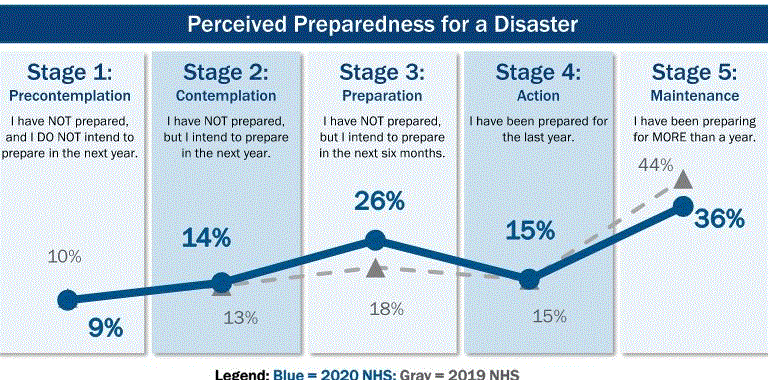
FEMA uses a Stages of Change Model to measure attitude and behavior regarding preparedness. This chart measures changes between 2013 (grey line) to estimated 2020 (blue line). You can see how slow progress has been over these seven years! The only good news from 2020 is that more people “intend to prepare in the next six months.” (Stage 3)

National Household Survey on Preparedness for a Disaster (FEMA )

What recommendations come out of this study for local groups and their leaders?

As I read these statistics, and fit them in with my own experience, I find at least 3 things that stand out to guide all our efforts.

  1. We need to make neighbors understand what threats we face in our individual communities. And not just a name of a threat, like “hurricane” or “earthquake,” but details about alerts and warnings of danger, what damage could be caused, what to expect from authorities, and exactly how to best prepare for that threat. (This includes dispelling out-of-date recommendations like parking under an overpass during a tornado, or standing in a doorway during an earthquake!)
  2. We need to emphasize that preparing for this threat is doable and will make a difference in how we get through or even how we survive. Simple step-by-step instructions will give people confidence they can do this. When you focus on the role of everyday household items for preparedness, like a flashlight or extra phone-charger, you are showing that preparing doesn’t need to be expensive.
  3. Sponsoring local neighborhood meetings is the best way to share information about threats and preparing! (Haven’t we been saying and doing this all along?!)

When FEMA started their surveys way back in 2007, they studied a few factors that were not mentioned in the 2020 survey. I pulled out some info from earlier studies and am including it below. It certainly fits with my own experiences.

  1. Information needs to be customized to the community – considering language, experiences with disasters, experience with law enforcement, etc.
  2. Social networks within the community have a powerful influence on preparedness behavior. In particular, volunteering in preparedness/safety/disaster-related organizations spreads and strengthens knowledge and commitment.

Next steps for our groups.

Here in our neighborhood we are not yet back to regular, face-to-face meetings, so our ability to share detailed information is limited. Yes, we do publish various email announcements. And other groups are arranging for conference calls and zoom meetings to keep their members motivated.

However you manage your meetings, I hope you’ll consider what FEMA has discovered via its National Household Survey and use that information to encourage your attendees to learn more and do more. As I’ve sure you’ve found, once people start taking preparedness actions, it’s much easier for them to keep taking more. We can all strive to beat that 51% preparedness level in our neighborhoods!

Good luck with your own meetings, whether it’s just your family or includes neighbors or other social groups.

Virginia
Your Emergency Plan Guide team

P.S. Looking for inspiration? Our book of Emergency Preparedness Meeting Ideas has plenty of meeting suggestions that can be readily converted from face-to-face to online format.

P.P.S. If you’d like to see the full FEMA National Household Survey report, you can get summary results here. On that same page you’ll find links to 2 videos that present the entire study.


Store Water for Emergencies — Revived

Share
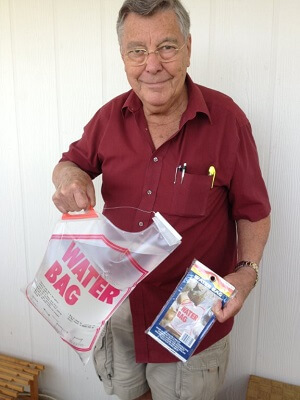
collapsible water bag
2 gallons, carryable, collapsible

You have surely read many articles about why and how to store water for emergencies. The picture above came from one of our own earlier Advisories! But with hurricane season starting, an a tornado having just hit last week, it’s time once again to address this most important preparedness topic.

If some of this looks familiar, please jump to the bottom half of the Advisory where we address Buckets, bladders and bags! All new!

Why is storing water so difficult? Consider these possibilities:

  • Your household changes. What you needed to survive for 10 days a couple of months ago won’t be enough with the new baby plus your mother now living with you.
  • You move to a new home in a new location with a totally different climate. You used to be near the Washington coast. Now you’re in the middle of Oklahoma.
  • Another hurricane is threatening off the coast. Its storm surge will overrun your municipal water system — again.
  • Carcinogens and toxic contaminants have been discovered in the drinking water in your state.

The point? You can’t just check the box one time and be done with it! Having enough water in the right place at the right time is an ongoing challenge.

So, time for another look at how best to store water for emergencies.

Plastic bottles of water? Handy but . . . maybe not!!

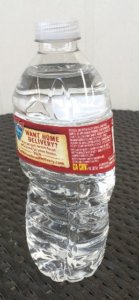
Here’s another photo from my own camera. The bottle is from a case of water that has been sitting in our HOA office for about a year.

Deformed plastic bottle of water
Would you want to drink this?

Plastic bottles are NOT a good idea for long-term, emergency storage. (Not to mention the issue of plastic waste . . .) Plastic doesn’t stand up to weight or to heat. And that heat issue makes them particularly impractical for storage in the car.

On the other hand, high-quality BPA free plastic containers DO work for longer-term storage.

The following examples of storage containers come from Amazon. As an Amazon Associate I earn a commission if you make a purchase through these links.

WaterBricks –In the past we’ve talked about WaterBricks – relatively expensive but of excellent quality and extraordinarily useful for apartments and condos where storage space is limited. They stack and fasten together for stability. The full-sized brick holds 3.5 gallons; the half-size holds 1.6 gallons. You can also get a spigot for a brick, so you could set it up on a counter for real dispensing convenience.  (I’d get more than one spigot.)

WaterBrick Blue Water Storage Container (6 pack) 3.5 Gallon

Last time I checked at Amazon, the WaterBricks were on back order. I soon discovered Saratoga Farms, another stackable container set, slightly different but just as useful. It’s “blocks” hold 5 gallons each.

Saratoga Farms 5-Gallon Stackable Water Containers (100 Total Gallons), 20 Pack, Blue, BPA Free, High Density Polyetholene (HDPE) with Built in Handle

Plastic containers for ice. Don’t forget to fill smaller-sized clean plastic containers with water and use them to keep your freezer tightly packed. (Be sure to leave plenty of space for the water to expand. And avoid containers marked “3” (for polyvinyl chloride, or PVC), “6” (for polystyrene, or PS), and “7” (for polycarbonate). Frozen plastic “cubes” will help save energy by maintaining the cold in the freezer, and if the power goes out they’ll give frozen foods a bit of a longer life. Finally, you can use the melted ice as a source of emergency water – for hygiene if not for drinking.  (Once-frozen water sometimes doesn’t taste so good.)

[16 Pack] Food Storage Containers with Lids, Plastic Food Containers with Lids, Airtight Storage Container Sets for Healthy Diet, Vegetables, Snack & Fruit (Small&Large Size), BPA Free & Leakproof

It’s probably best to recycle the water in your WaterBricks and your food storage containers every 6 months or so.

Aluminum cans – Good for 50 years!

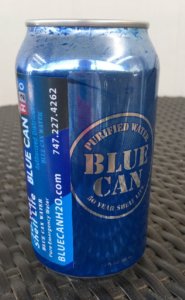
Last year Joe and I participated in an Emergency Preparedness Forum north of Los Angeles and there we were introduced to canned water. Here’s a picture of one of our cans. You can buy cases of the stuff, easy to store. And here’s the most exciting thing – the water has a 50-year shelf life! 

Aluminum Can of Water
Canned water?

As you can image, these aluminum cans are relatively expensive. You can get them at Amazon – and they will be delivered. Here’s the link:

Blue Can Premium Emergency Drinking Water – 24 Pack

If you live in or near California, you may be able to get discounted prices on cases of Blue Can Water from my friend Patty Kirby. She introduced me to canned water, and she works with HOAs, businesses and other groups. (Obviously, an order big enough to fill a pallet (100 cases) would get the best possible shipping price.) Contact Patty directly: patty@BlueCanH2O.com

Water Barrels – Good for at least a year and probably twice that long!

Quite a few years ago we got a great deal on blue barrels for our volunteers. These days prices are considerably higher, but the need to store water for emergencies is still there, and maybe even greater. In fact, you may need more water than you did before!

Augason Farms Water Storage Barrel 55-Gallon Drum

Some thoughts to remember when it comes to water barrels:

  • When it’s full, the barrel weighs about 480 pounds. So – how are you going to get the full barrel to where you can use it? Not easily! That’s why you need a pump to get out a gallon or two at a time.
  • Be sure your barrel is of food-grade plastic. Give it a good clean by adding a couple of gallons of water, a cup of fresh chlorine bleach , and rolling it around until every surface has been exposed. Drain and rinse.
  • Find a good place to set the barrel because that’s where it’s going to remain once it’s filled. Keep it out of direct sunlight. Don’t place it directly on a concrete floor – put some boards down as a platform. And you may consider how to camouflage it. No use broadcasting that you have a lot of water available.
  • Once your barrel is clean, fill it with tap water as is. (Make sure the hose isn’t dirty!) But you may wish to add another layer of protection by treating the water you are storing with bleach or water purifier. The water storage recipe: add 6 teaspoons of fresh, regular unscented bleach to your 55 gal. barrel of water.

NEW: Buckets, bladders and bags to fill at the last possible minute.

Recently one of my LinkedIn groups was filled with water storage ideas. Here are several more containers for you to consider, based on recommendations from that group. Consider how HEAVY the various containers will be once they are filled with water! 1 gallon (in its container) weighs about 8 1/2 pounds.

(So the 2-gallon bag Joe is holding in the picture above weighs about 17 pounds.)

We own a couple of these, and have them tucked into our survival kits. Probably not too durable, but they have held up for us. Certainly convenient!

Stansport 2-Gallon Water Storage Bag
If your container doesn't have a spigot, consider how you are going to get the water out. This one has a spigot.

WaterStorageCube BPA-Free Collapsible Water Container 5.3 Gallon with Spigot, Camping Water Storage Carrier Jug for Outdoors Hiking Hurricane Emergency, Foldable Portable FDA Water Canteen (1-Pack)
Rigid container, bigger yet. Gets excellent reviews.

Reliance Products Aqua-Tainer 7 Gallon Rigid Water Container
This is a one-gallon collapsible container, which makes it easy to store until you want to fill it.

4-Pack Bundle | Reusable Transport and Storage Water Container Solution | 1-Gallon | Collapsible | Non-Toxic BPA-Free | Space Saver Solution | Proven no leaks
Comes in a variety of colors, and has a lid.

Freegrace Premium Collapsible Bucket Compact Portable Folding Water Container - Lightweight & Durable - Includes Handy Tool Mesh Pocket (Green(Upgraded), 23L (Lid))
Efficient. BIG when filled! (Bad illustration. Click below to get the full "picture.")

AQUATANK2 Water Storage Bladder (60 Gallon)
Another poor image for a dramatic piece of equipment. Power outage threatened? Lay the liner in any standard bathtub, attach the fill sock to the faucet, and fill the bladder to capacity, which takes approximately 20 minutes. A siphon pump is included to easily dispense the water into jugs or pitchers, making it easy to use your water every day.

WaterBOB Bathtub Emergency Water Storage Container, Drinking Water Storage, Hurricane Survival, BPA-Free (100 Gallon) (1)

I encourage you to get some containers like those above. Knowing that you have what you need when the emergency threatens will give you greater peace of mind. And you’ll have some credibility when you remind neighbors that they should be ready or already storing water, too!

Let us know if YOU have a favorite water storage container.

Virginia
Your Emergency Plan Guide Team

Walkie-talkies for emergencies and much, much more!

Share
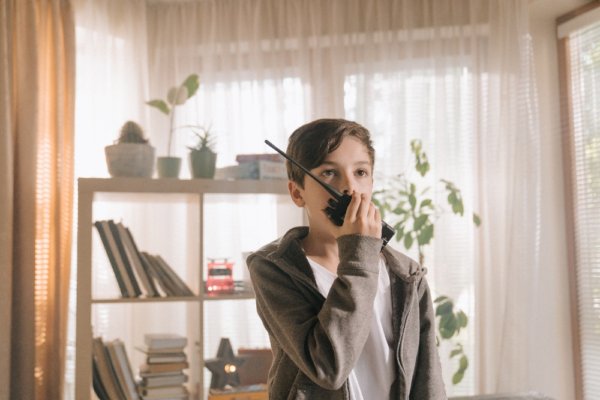
Boy with walkie-talkie
Walkie-talkies not just for emergencies

It’s one thing to make your lists and carefully assemble all your emergency supplies and equipment. I assume your stash includes walkie-talkies, or hand-held battery-operated radios.

But if you really build preparedness into your lifestyle, you’ll find yourself using walkie-talkies for emergencies but also for every day tasks!

We use walkie-talkies for emergencies but also for so much more!

If you haven’t considered getting radios for your own stash of emergency supplies, consider the following list of how you might use them if you had them.

Manage traffic using walkie-talkies.

Just yesterday Joe and I were asked to help direct traffic at a drive-thru food distribution taking place right down the street. (It was a last-minute call.) We grabbed our fluorescent-striped vests (always important for both visibility and authority), a couple of walkie-talkies each, and jumped into action. I stood at the distribution point, Joe positioned himself at the assembly point around the corner, and we made sure cars approached slowly, on the correct side of the street, etc.! Safe and easy because we could keep in constant touch!

Pickup at airport.

We always carry walkie-talkies when we’re picking up somebody at the airport. Joe drops me off and continues around the loop. (No parking and waiting allowed.) I run in, find our guest, keep Joe apprised of the timing, tell him exactly where we’re coming out – and he swoops right up in front of us! There’s no dialing, no answering of phones, etc. Joe just listens to my commentary so the pick-up is smooth and easy.

Convention contact.

In the days before COVID, we regularly attended industry conventions. Since the purpose is to network, that means you can easily get separated – one person stays to talk with a vendor, while the other cruises on down the aisle. Pretty soon you have lost each other in the crowd. But, with a handy walkie-talkie, you can let the other guy know right where you are. Again, no need to dial, no crossing your fingers hoping there’s reception within the conference hall. Works perfectly.

County fair.

This same concept works for any kind of fair, outing at a theme park, etc., but with an improvement: You can let the whole family know, all at once, that you’ve decided to take a rest by the Snow-Cone stand.  

Parking assistance.

Last week I watched as a neighbor tried to back his new camper into a parking space. (There was no option for a drive thru!) He was having a tough time. His wife was trying to help, but he couldn’t keep her in view because of the sharp angle. (And her hand signals weren’t too clear, either.) Joe and I have used walkie-talkies for years to safely back RVs (and RVs towing cars!) into campgrounds, storage areas, etc. It’s a lot easier to tell the driver when the hitch is just 6 inches from crunching into the corner of the rig than to try to SIGNAL it!

Tracking racers.

Our CERT group often participates when the city sponsors a long-distance race. People with walkie-talkies are positioned along the course and report as the runners come by, if there’s an emergency, etc. All the course monitors can hear as the race progresses and be ready as contestants approach. We’ve used walkie-talkies to track cars passing checkpoints in a hill climb, too.

Sporting events.

When you are in line at the stadium concession stand for hotdogs and beer, and your youngster needs to head to the bathroom, send him along with a walkie-talkie and instructions to check in at the top of the stairs, at the door to the restroom, etc. He’ll be fine – and you won’t have to worry.

Explore safely.

Part of the joy of camping is heading off into the trees just to see what there is to see! As a parent you want your kids to have that experience. But as a parent you naturally worry that they could get lost, injured, etc. Send your kids off with walkie-talkies so they can keep in touch with each other AND with you. Then let them all know when it’s time for lunch. One call is all it takes to reach the whole pack.

Car convoy.

If you’re traveling with a couple of cars it’s good to be able to agree to a stop, warn about something ahead on the road, report that you’ve lost sight of the other car, etc. Walkie-talkies are instantly available for messages like that! Now safe driving habits include not having to REACH for a phone and not having to use more than ONE FINGER to activate the phone. That’s why walkie-talkies are usually not included in legislation defining “distracted driving.” (At least, that’s what I’ve been able to discover. Check with your own state.) It’s best, of course, for the radio operator not to be the driver.

Construction and plumbing.

We occasionally find ourselves trying to figure out where there’s a break or an obstruction or a leak in a pipe. Picture Joe outside at the sewer cleanout, me inside at the sink.  “OK, turn on the water!” “OK, now turn it off.” No yelling. Easy and efficient. Or picture me on the roof, cleaning off dead branches. “Can you hand me up the leaf blower?” Again, no yelling!

I think you get the message! Walkie-talkies rock!

Of course, our walkie-talkies are our main resource for emergency communications. We fully anticipate that a wildfire could cause a complete communications shut-down. So we’ll be holding our monthly neighborhood group radio drill this very evening.

But having and using the walkie-talkies on a regular basis makes them even more valuable. If you haven’t yet considered adding them to your own supplies, now may be the time. Perfectly good ones are available for around $30 a pair.

Our walkie talkie reviews page goes over 6 things to watch for, and has links to examples of different styles and their costs. Our favorite for regular usage is the first in the list.

We think everyone can take advantage of walkie-talkies for daily living!

Virginia
Your Emergency Plan Guide team

P.S. Let us know how YOU use walkie-talkies — for everyday and also for emergency communications. Really, these are some of the most valuable and useful tools available! (They make great gifts, too.)


Heading back to work

Share
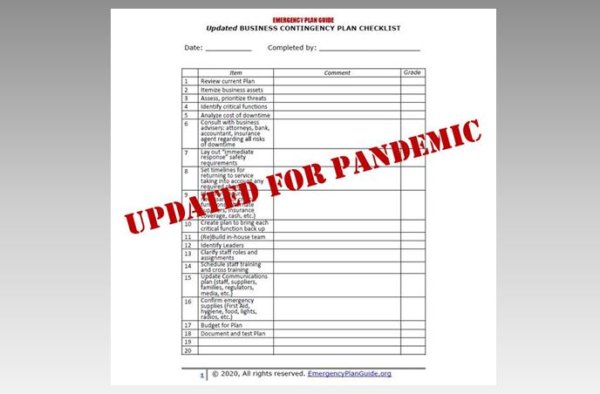
checklist updated for pandemic
Our checklist has been updated. Have you updated your plan?

If you are like most business owners and employees in America, your company is somewhere on the line between “still shut” to “fully operational.” Many of your employees heading back to work, even if they are healthy, may be struggling with finances, transportation, and home schooling. These are unsettling times, in large part because the pandemic was so totally unexpected.

“Who would ever have guessed we’d have a pandemic?!”

If you watch the news, you’ve probably heard that statement a few times. But what I have heard hanging around online with emergency managers goes a little differently.

“Every good business continuity plan does have “pandemic” on its list of threats!”

Of course, just being on the “list of threats” doesn’t mean it gets included in the plan with full details. Still, having planned for a half-dozen or so of the most LIKELY threats puts your business on much stronger footing when ANY disaster hits.

So while we’re all dealing with heading back to work, it makes sense to once again revisit . . .

The role of emergency preparedness in the workplace.

Here at Emergency Plan Guide we address preparedness for small business in about 25% of our Advisories. We included a book on emergency preparedness for small business in our Neighborhood Disaster Survival series.

We think that business has the potentially most important role of all in improving community-wide resilience! You can click here to read more about why we think that.

Right now, however, businesses need to get their people back to work.

Part of heading back to work includes updating the business continuity plan.

We revisited our own Business Continuity Plan Checklist to help you with that update.

How to use the Business Continuity Plan checklist.

The full checklist is simple. It consists of just 20 steps. The first one is to go through the list and give each step in your current plan a “grade” as to how completely that step has been done. (We include a few hints in a couple of pages of accompanying notes.)

I’d print out several copies and share with selected leaders or senior managers. Have each person grade the company plan separately. Then get together and compare notes. This may be an eye-opening experience!

The checklist is a tool, not a plan.

It can serve two purposes. First, it can help you identify weaknesses in your existing continuity plan. Second, if you don’t have a plan yet, it may give you a push to get started.

You can download the full Checklist here and have it ready to go on Monday.

Virginia
Your Emergency Plan Guide team

P.S.  Our country has been severely shaken by an emergency most people hadn’t planned for. If ever there were a time to take another look at the value of your business continuity plan, this should be it. Of course, planning doesn’t keep bad things from happening. But planning can help get you through unexpected events. This is an important time.


Dust Mask for Your Survival Kit

Share
dust mask for survival kit
Useful for emergencies?

Update as of 9-2020. Because of COVID-19, supplies of commercial masks may be limited. Take steps NOW to get the masks you need.

Do I need a dust mask for my survival kit?

As the pandemic continues, and fires explode in California, we are taking yet another look at the role masks play in protecting our health.

This week, a question first asked over a year ago was raised again.

What’s the best dust mask to protect me from smoke from a wildfire?

In my neighboring county here in southern California the overall Air Quality Index today registers more than 5 times the “safe” levels as set by the EPA!

Air quality considers gases and particles. Particles are the first thing a dust mask attempts to stop. Masks are labeled according to how much particle protection they offer. For example, a mask will get a measurement like “90” or “95” or even “100.”  This tells you the percentage of particles this mask can block from entering your lungs.

Particles are also measured by size. Some masks protect against particles down to 10 microns in size. Others protect against particles down to 2.5 microns. The smaller, the better.

Let’s look more closely at some of the options from the standpoint of preparedness.

1-Option One – standard disposable paper or cloth dust mask

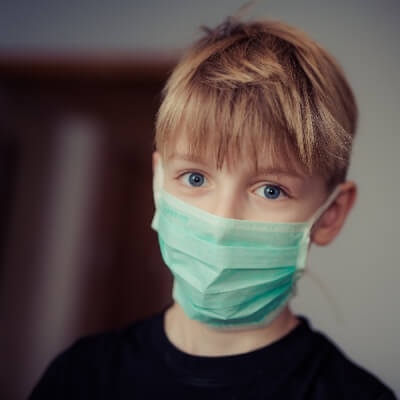
(FYI, the child in the image at the top of this Advisory is wearing a standard surgical style disposable paper mask.)

As we wrote just a couple of weeks ago, your Go-Bag should include a supply of surgical style paper masks as protection against the spread of COVID-19 in a evacuation or shelter situation. Thin paper masks are meant to stop YOU from transmitting virus via droplets from your breath.

They can also protect you from breathing in larger particle pollutants that may be in smoke.

These masks typically have thin elastic straps that go around the ears or around the head. You can see that the one in the image has only one strap. This means it probably won’t fit too well — particularly if you have a beard or mustache.

These masks are for one-time use only.

Inexpensive cloth masks – or just a bandana — can be washed and reused but tend to get wet around the mouth. These masks may give you the impression of providing security. They may stop you from passing on the virus. But they can really only prevent some of the very largest smoke particles from getting into your lungs.

2-Option Two – “respirator” built for better protection

It appears that the best all-purpose masks are those labeled N95. They filter out 95% of pollutants that aren’t oil-based. (Some masks are labeled N99 or even N100 and are more effective.) These are the masks that health care workers, first responders and volunteers working in the burn areas of California wear – or should be wearing.

Like the Option One masks discussed above, these masks are also disposable. But they fit better (two straps, nose piece) and are more comfortable and thus can be worn longer before being replaced. One additional comfort feature is an exhalation valve. The valve makes it easier to wear the mask in hot or humid conditions.

Here’s an example from Amazon (where we are Associates) of an N95 mask with exhalation valve. This model comes 10 to a box.

3M 8511 Respirator, N95, Cool Flow Valve (10-Pack)

Caution: While a mask with an exhalation valve may make it easier for you to work in smoky conditions,, it does not protect you from harmful gases. Moreover, the CDC warns that because an exhalation valve makes it easier to breathe out, the mask will not keep you from transmitting a virus to others.

Masks can also be combined with additional layers or filters to keep out specific pollutants. The more layers, the more effective (as long as the fit is good). The mask below, for example,  is designed with extra layers of activated charcoal. (Note adjustable ear straps.) My research does suggest that while these masks with filters can protect against particles as small as 2.5 microns, they are NOT rated by the National Institute of Occupational Safety and Health (NIOSH), the one that gives us the “N95” rating.

Mouth Mask,Aniwon 3 Pack Anti Dust Pollution Mask with 6 Pcs Activated Carbon Filter Insert Fashion Cotton Face Mask PM2.5 Dust Mask for Men Women

3-Option Three – masks for specialty use

If you find yourself in a specialty situation — for example, where you are engaged in grinding or welding, or working in heavy pollution caused by a fire – you need a reusable respirator. Typically, it will have one or dual cartridge holders permanently affixed to a half-face or full-face mask. You add filters or cartridges to the holders to match the job you’re performing. If you’re looking for the highest level of protection, go for P100. It filters out 100 percent of both oil-based and non-oil-based particles.

3M Rugged Comfort Half Facepiece Reusable Respirator 6502/49489, Medium

You can probably find specialty, reusable masks like the one above starting as low as $25. (Prices quickly go up to well over $100). Be sure you’re getting the filters and/or cartridges you need. In particular, be sure the mask fits WELL. Any air leakage defeats the purpose entirely. Straps that are too tight will keep you from wearing the mask when you need to.

If you prefer a half-face mask, you may want to add goggles or some sort of eye protection.

For everyday survival kits, a full face respirator is probably more than you need. But if you know you are heading into a dangerous air situation, and can grab some extras from your stash of supplies, having a reusable mask with the appropriate cartridges would certainly be useful.

Some final thoughts about a dust mask for your survival kit.

Putting on a mask seems simple, but wearing one for hours can be difficult for some people. The masks become hot and scratchy, and if they get wet they may become soggy and block air altogether. People with facial hair and small children can’t get the fit that’s necessary for the best protection.

But in an emergency, it makes no sense to be without sensible simple protection.

I recommend you buy a box of surgical masks and another of N95 masks and put some in each survival kit you own — family members, the car, and the office. Practice putting on one of the masks to check its fit.

Now, take that mask off and tuck it back in the bag with the others and know protection is there when you need it.

Virginia
Your Emergency Plan Guide team

Have you had experience with face masks? Tell us your story!

Emergency Preparedness for Meeting Planners

Share
Emergency preparedness for meeting planners
This your meeting? Are you ready — for food poisoning, an accident, fire?

It’s a rare business that doesn’t host a meeting once in a while. While businesses are shut down as a result of the pandemic, this list may not apply! But as soon as you get back to face-to-face meetings, it will. So hang on to it!

Your meeting might be for marketing or educational purposes, or maybe to celebrate a holiday or having reached a company milestone.

Whatever the purpose, if you are the meeting planner, you have a long to-do list to be sure everything goes as planned. Even the simplest meeting needs decisions made about date and time, venue, food, invitations, theme and decorations, sign-in procedures, advertising and publicity, entertainment, audio-visual, vendors, etc.  

Our question for today:

Does your meeting to-do list include planning for emergencies?

If you’ve been reading here for a while, you know that we are constantly on the lookout for good emergency preparedness resources. And we look not just for ideas for family planning, but also for small business and, in particular, for neighborhood teams.

This Advisory will be useful for all three groups. But it is particularly vital for businesses, because . . .

If something goes badly wrong at your business meeting, and you could have prepared for it, you will be blamed. And you may be sued.

Please note: we are not attorneys, and this Advisory is not meant to give legal advice. Please consult with qualified professionals for detailed recommendations for your business and your meeting.

As you get ready to meet with those professionals, being ready with questions will save time and money. Here are some questions to start with.

1 – Is there a law that we must have a disaster preparedness plan for every meeting?

At Emergency Plan Guide we have never found a legal requirement on emergency preparedness for meeting planners. This doesn’t mean that there isn’t one!  Your professional advisers may have found it. Ask.

But at the same time we have read enough horror stories to know that people sue no matter what

They may claim that you should have let them know in advance that it was a dangerous neighborhood, that the venue was open to access from outside, that there was no internet security, that a storm was threatened, that medical aid was not immediately available, etc., etc. They will claim you were negligent.

2 – How do we protect ourselves if there is no clear-cut law?

Recent well-known lawsuits seem to have revolved around the legal concept of “Duty of Care.” The Legal Dictionary at Law.com defines Duty of Care this way: “a requirement that a person act toward others and the public with the watchfulness, attention, caution and prudence that a reasonable person in the circumstances would use. “

There’s a second legal term we also see connected with this same topic: “Standard of Care.” It is closely tied to “Duty of Care.” 

Basically, this is the “standard” that a reasonable person with the same qualifications would follow in a similar circumstance. As you might imagine, a professional would have a higher standard than a non-professional.

Here’s the challenge. Law.com adds:  “The problem is that the “standard” is often a subjective issue upon which reasonable people can differ.”

Not too helpful! 

Still, we already know that it just makes sense to prepare for emergencies to the best level you can.

3 – So what does a reasonable person do when planning a meeting?

These are my recommendations. They are similar to preparing for emergencies in your own home or business.

I see these as basic steps:

  • Evaluate your OWN level of preparedness. Who from your company will be there, what skills do they have, how ready will they be to respond to an emergency? What gaps do you find?
  • Identify risks for this particular event: geographic location and specific room or building, threats from weather and/or people (attendees or outsiders), security issues, availability of emergency medical personnel, cyber-security policies, firearms policies, alcohol policies, etc.
  • For each risk, confer with your business partners and then decide on who will respond and how. Make it clear who is responsible for what. Will any of the partners need to budget for additional personnel or equipment? List whom to call and all names and numbers. Decide who will interact with the news media or other officials, etc.
  • Confirm appropriate insurance coverages, yours and your meeting business partners.  
  • Write down and update your plan. Document your planning meetings. Share your decisions as appropriate in your marketing materials, since attendees deserve to know you have considered their safety in your planning. Document how everything went at the meeting.

This written document shows that you were attentive, prudent and thorough. This can be your very best protection against claims of negligence.

More resources on emergency preparedness for meeting planners

A while ago I attended a 2-hour training session sponsored by Meetings Today. The title was: Risk Management – Best Practices for Meetings and Events. The presenter, Brenda Rivers, also put out a 30-minute podcast on the Duty of Care. You may be able to find the podcast here: https://www.meetingstoday.com/magazines/article-details/articleid/32549/title/duty-of-care-keeping-safe

Meetings Today has also published a comprehensive template for meeting planners. If you have any responsibility for planning meetings, you may wish to download it for future reference. Here’s the link: https://www.meetingstoday.com/newsevents/industrynews/industrynewsdetails/articleid/31923/title/emergency-response-plan-template-for-planners

If you consider yourself to be a professional meeting planner, or just an enthusiastic meeting planner, please find out more about this topic!

Best of luck,

Virginia
Your Emergency Plan Guide team

P.S. Joe and I consider ourselves “enthusiastic meeting planners.”  Together, we have been responsible for literally hundreds of meetings for professional associations, Rotary International, neighborhood outreach for energy efficiency, and, of course, our local emergency response group. You can find one of our neighborhood group meeting planning Advisories here, recently updated.

And if you’re serious about putting on a successful meeting, check out this book from Alex Genadinik. There are a number of books available about planning events, of course, including those on starting a business as an event planner. I recommend this one because of Genadinik’s marketing emphasis.

Evacuation Realities This Week

Share
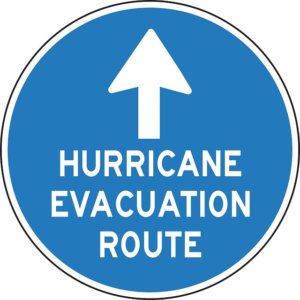
Sigh showing evacuation route ahead of hurricane

If you’re reading this, you’re probably not considering evacuation. You are probably not one of the hundreds of thousands of people who, right now, are displaced, wondering when they can head back home, trying to figure out if home still exists!

It’s been an astonishing couple of weeks. Evacuation orders impacted tens of thousands in the Bay Area of California and over 1.5 million people in Louisiana and Texas!

The current evacuation situation is calming, but . . .

As of today (September 1, 2020), all hurricane evacuation orders have apparently been lifted. A few new orders are still coming out in California for specific wildfire hot spots.

For many, the nightmare of cleaning up has already begun – in the worst cases, with no safe water and no electricity. (Read on for some more details.)

When will it be your turn to evacuate?

My “job” here at Emergency Plan Guide is to help make people aware of potential disasters. Maybe you’ve never had to evacuate before. But that good fortune may be running out. Not because you “deserve” to have anything bad happen, but because the number and the intensity of disasters is increasing. Take a look.

Bigger and fiercer wildfires still threaten the West.

For example, in California, where wildfires are of course expected this time of year, we have never seen so many at one time!!  Two weeks ago there were 560 wildfires burning simultaneously! The fires grew so quickly and so big that they outgrew their original names and came to simply be called “complex” fires! 

We watched real-time maps that showed the creeping growth of the CZU Lightning Complex, in the Santa Cruz Mountains, the LNU Lightning Complex, in the North Bay near San Francisco, and the SCU Lightning Complex in the South and East Bay.

And did you notice the word “Lightning” in each of these names? The record-breaking heat I wrote about last week was accompanied by thousands of lightning strikes. These strikes sparked the smaller fires that joined to make up the complex fires.

Even today, while temperatures are somewhat cooler, more thunderstorms and lightning strikes are expected over the next few days. (And they don’t bring any rain with themselves.)

I have lived in CA for most of my adult life – and Lightning Complex fires are new to me! The way experts are talking, it looks as though this is just the beginning . . .

The peak for hurricane season has yet to arrive.

Thousands of miles away, along the Gulf Coast, it was a one-two punch as Louisiana’s first Category 4 storm made landfall. Tropical storm Marco was right behind. This year’s hurricane season had been forecast to be “extremely active.” and the forecast is proving accurate. This is the first hurricane season on record in which 9 tropical storms formed before August and 13 formed before September. And the historical peak of the season doesn’t come for another couple of weeks!

As I’m writing this, the National Hurricane Center warns that 3 more storms are forming in the Atlantic.

If an evacuation were called right now, would you be ready?

This year we added another book to our Q&A Mini-Series. It carries the title “Evacuate!”  (With exclamation mark.) The intro to this mini-book asks four simple questions that I think are worth reviewing right now.

  1. Are you confident you would HEAR the call to evacuate?
  2. Do you think you would BELIEVE whoever made the call?
  3. Are you sure you would UNDERSTAND what you are being asked to do?
  4. Are you PREPARED for what you would need to have and do?

Now like the other booklets in the Mini-series, this book goes on to discuss about a dozen preparedness issues associated with evacuations. Along the way, it helps you answer these four questions.

Do you need a quick review of your readiness to evacuate? Grab a copy of the booklet and take the time to read the questions, consider the answers and fill in the blanks about your own situation. Here’s the direct link to Amazon.

But wait, there’s more . . .

But because I wrote this before the continuing spread of COVID-19, here are some more evacuation issues that have come up. You’ll want to build them into your own evacuation planning.

COVID-19 has made recent evacuations more difficult and longer-lasting.

In California, the high heat, hundreds of fires and the number of fire fighters incapacitated because of COVID-19 (including the thousands of inmates that usually support fire-fighting efforts) means that resources have been stretched much thinner than usual. Even though National Guard troops have been activated, and crews, aircraft and bulldozers have been arriving from other states, the big complex fires are still less than 50% contained. Evacuees are facing more days of waiting to try to get back home.

Social distancing and quarantine requirements for ill patients have further complicated matters.

Sign for Evacuation Assembly Point marked FULL

In Louisiana, one emergency planner trying to move people out of the way said that 2/3 of their bus capacity was lost because buses could be only filled up part way. It was the same story with community shelters. People were sent to hotels to maintain distancing.

In Texas, the Circuit of the Americas race track was being used as an intake center where evacuees could get a voucher for a local Austin hotel. But thousands showed up, where only hundreds were expected. Available hotel rooms were full by Wednesday, the day before the storm hit. In some cases, even where rooms were available, they couldn’t be used because staff had been furloughed or was sick because of the pandemic.

And more people could not afford to evacuate at all because they’ve been unemployed for weeks. They had to depend on public shelters or simply ride it out.

Recovery is now underway – but it’s going to be tough.

For hundreds of thousands of people, even if they can get back home to begin clearing debris and/or rebuilding, they’ll have to work and live without electrical power or water.

These difficult conditions add to the disaster. In Louisiana, half the 16 casualties of Hurricane Laura have come from carbon monoxide poisoning as people used generators to offset loss of utility electricity.

Mayor Nic Hunter of Lake Charles, Louisiana posted on Facebook: “There is barely a trickle of water coming out of most faucets in the homes of Lake Charles.” No estimated time of restoration for utilities was mentioned. “Make sure you understand the above reality and are prepared to live in it for many days, possibly weeks,” Hunter wrote.

Is it time to double down on your own preparations?

A doubling up of disaster – COVID-19 plus storm, or earthquake, or heat wave – will stretch everyone’s capacity. Now would be a good time to review your own preparations with regards to your emergency supplies (both home and Go-Bags) and your readiness to evacuate.

Virginia
Your Emergency Plan Guide team

P.S. Really, our Mini-Series booklets were designed just for this review purpose. Check them out.


Staying Active Despite COVID-19

Share
“Where is everybody?”

With COVID-19, we are stuck at home. We can’t hold our monthly neighborhood group meetings . . . so how to keep our group together? Here’s some of what we’re doing to stay active . . .

Local Activities Keep Us Busy

  • Regular email messages about pertinent topics. Last week, for example, we sent out information about “Managing Extreme Heat.” (I turned that into an Advisory, as you may have noticed.) By the way, that warning was extended to a second week. We had to send a couple of follow up messages explaining how the state grid operator manages “rotating outages” (1 or 2 hrs only) and how they differ from individual utility-managed Public Safety Power Shut-offs, which could last for days. Outages are rare – this is the first time we’ve had any in 19 years. We haven’t experienced any PSPSs so far this year, but they will be coming!
  • Remote training via webinar. Last month was the first time I’ve been the featured speaker for a newly-forming group in the Bay Area of California. That wide-spread group is actively recruiting even during the pandemic! Topic for the training: “Building a Neighborhood Group.” I stressed knowing the audience/target rather than following a strict top-down procedure.
  • Conference calls with neighbors. I’ve mentioned our volunteer team members who are sewing colorful, multi-layered masks. They’ve distributed 842 as of last week! (Some masks go to neighbors while others have been distributed to various non-profit groups that serve our community.) The reason we use a conference call instead of webinar is that this is our Low Vision Support Group! No need for a digital screen if you can’t see it!  (Obviously, not all members sew. But all get involved in other aspects of the project.)

So these are the very local neighborhood happenings – and there will be more info to come because we have a couple more projects in the works.

Publishing Activities Spread Valuable Info

More exciting, perhaps, is the fact that Joe and I added a 12th book to our Emergency Preparedness Q&A Mini-Series just yesterday! The title: Crisis First Aid.

This is a topic that generates a lot of emotion! Every time we bring it up at local meetings we get questions like these:

  • Oh, dear! How would I know what to do?
  • Who should I try to help first?
  • What if I try to help someone who is injured and I screw up?

Of course, Joe and I are not medical experts. And this 60-page booklet doesn’t make us one or make you one, either. But as we researched the writing we realized that we all have important experience to share in an emergency . . . not the least of which is a determination to approach the emergency with a plan, a collection of good medical supplies, and a basic understanding of what common sense actions we can take.

If these are questions that you have heard, or have asked yourself, consider getting this booklet. Give it a read. You may be surprised at how well positioned you already are to be of real help in a disaster. (Plus, there are other resources mentioned that you can follow up with.)

Almost Ready — Training for Other Community Groups

I know many of you share a desire to get more people involved in being more prepared. And of course, like us, you find it a challenge to make that happen!

I write weekly Advisories as one way to spread what I hope is good information. Joe and I reach out to our neighbors and plan regular meetings and training as a second level of sharing. Our books reach an even wider audience – but we still know that . . .

People don’t want to just READ about something, they want to EXPERIENCE A CHANGE!

While the Mini-Books were written to help people make that change one step at a time, the books also lend themselves to group training session.

Coming Soon — Preparedness as a Group Course

So our next goal is to turn the Mini-Series into an actual course that could become an activity for any kind of group: a neighborhood group, a youth group, a church group. The leader of the course will be one of the group members.

We’ll be calling on our years of formal educational training (I still have my Lifetime High School Teaching Certificate!) plus the many, many meetings and programs we’ve led for business clients and colleagues. We are developing simple tools to help course participants realize:

  • WHY getting more prepared makes sense
  • HOW to get past procrastination (with the help of your friends!)
  • WHAT a change the course will make in your daily life – including new trust and confidence.

We have just a couple more booklets to write to finish the collection, and then we’ll be pulling together the course. Maybe you’ll even want to be a course leader???

We’ll be letting you know as the program develops. If you have suggestions for groups, ideas you would have liked to have experienced in your own training, tips for engaging adults – don’t hesitate to drop us a note. If you’re reading this, you’re out there doing much of what we are doing, I am sure!

Prices On Books Going Up

As I may have mentioned some weeks ago, we set the introductory price low to encourage people to get started sooner. Since then Amazon has repeatedly urged us to raise the price and we’ve agreed to do so on the 1st of September.

So while the mini-series booklets are still very inexpensive – only $2.99 for an ebook and $4.99 for the paperback version – if you have thought about getting any of our books you can save some money if you do it now.

Crisis First Aid is the latest in the Mini-Series

As I said, the latest mini-series topic is “Crisis First Aid.” Click here to see the whole collection. And if you have any questions, don’t hesitate to contact us. We’re proud of these books and think they fit a real niche by being so affordable and easy to get through.

Virginia
Your Emergency Plan Guide Team


Heat Danger Threatening Us Here Over the Weekend

Share
Young man standing in water fountain to avoid danger
Is this an option for you?

Yesterday morning our neighborhood emergency response team was asked to set up cones and direct traffic for a drive-through food-distribution program scheduled for next Monday. It’s an important event in our community.

Of course, our team members are all senior citizens, so the first thing I did was to check the weather forecast. (The last time we were asked to help it was pouring rain!)

And here’s the danger that popped out at me immediately, from The Weather Service:

EXCESSIVE HEAT WARNING for Southwestern California Friday 11 a.m. through Monday 9 p.m.

That means a heat wave will be starting at just about the time this Advisory arrives in your email box on Friday! And it will continue right through the mid-day Monday hours that the food distribution program was scheduled for!

What’s the news about heat-related deaths?

Now, earlier this week I read an interesting article that suggested that heat-related deaths in the U.S. are down because of the Coronavirus!  Why?  People are staying inside more! Today, however, coronavirus just wasn’t on my mind. I was worried about the danger of extremely high temperatures.

You may recall that I wrote about summer heat just a couple of weeks ago. This week, I was obliged to dig a bit deeper. Here are the highlights of what I found – and what I will be sharing later today with my neighbors!

Heat danger is clear for senior citizens.

  • Heat deaths in the U.S. are generally trending down, because more people are getting air conditioning.
  • On average, though, heat is the leading cause of death from natural weather or environmental events — between 700 and 1,000 deaths a year. (“On average” doesn’t mean “everywhere.”)
  • The people most at risk? You might have guessed this: crop workers in California, Arizona and Texas, athletes (and fans) who insist on performing even in the heat, and people over 65.

Well, that last one was what I was looking for.

If you are over 65, or if you know someone over 65, here are steps to take to protect yourself from the danger of extreme heat.

I hope this is all review for you! But it may not be for some of your older friends or family members, so please read it with them in mind.

Level 1. (You should already know these.)
  • Wear light clothing.
  • Stay out of the sun. If you must go out, wear sunscreen, a hat, and dark glasses.
  • Pace yourself; avoid strenuous activity altogether.
  • Drink plenty of water.
  • Keep the house dark; close curtains, reflect sunlight.
  • Eat light meals. (Save on electricity, too, by not cooking.)
Level 2. (These should sound at least familiar if you read that earlier Advisory.)
  • If you don’t have air conditioning in your home, do some research now to find a heat-relief center. If necessary, head for the library or even a mall for a few hours.
  • Know the symptoms of heat exhaustion: heavy sweating, headache, dizziness, nausea, rapid heartbeat, skin that feels cool and moist, and muscle cramps. If you experience them, take action immediately to cool off: get into the shade, apply cool wet clothes, drink cool water.
  • Heat exhaustion can lead to heat stroke, which can be deadly. If the victim vomits or can’t drink, call 911. Other symptoms of heat stroke: the skin is dry and hot (no sweat); victim is confused, may see double. Have the person lie down; try to cool them down.
 Level 3. For people with medical conditions.
  • If you are on water pills, find out from your doctor how much water you can drink when it’s hot.
  • Avoid alcoholic drinks and very cold drinks. Alcohol is dehydrating; cold can cause stomach cramps.
  • If you are on a low salt diet, have diabetes, high blood pressure or kidney disease, check with your doctor before drinking sports drinks. (They replace important lost electrolytes, but they are high in sugar and salt.)
  • Some common medicines can INCREASE the risk of heat-related death because they interfere with sweating! They include antipsychotics, major tranquilizers, antidepressants, antihistamines, drugs used to treat Parkinson’s disease and some over-the-counter sleep medications.  Check with your doctor!
One last bit of information concerns the use of fans.

As you know, fans are cheaper to run than air conditioners, and they can make a significant difference in your comfort as long as the air temperature is still reasonable.

(Here’s a random but current illustration of a situation where fans won’t make much of a difference.  Two weeks ago (July 28), temperatures in Baghdad (Iraq) hit 125.2. It was the 4th day in a row they had topped 120 degrees!)

So, to sum up, before you experience extraordinary hot weather . . .

Check your home to close off leaks and figure out how to keep the sun out. Stock up on water. Postpone errands. Find out where a cooling shelter is located if you need it.

Consider getting a fan. A fan can make the air feel 4 degrees cooler just by evaporating your sweat!

The tiny 3 inch “personal” fans, while convenient, really don’t have much cooling power. But you can move a simple 8 in. table fan like the one pictured below with you from room to room. (It has to be blowing ON you, of course!) If you have air conditioning, you may want to get an 18-20 inch floor fan, often labeled “industrial.” Run in conjunction with the air conditioning, it can have a major cooling effect. (We have an old fan, very powerful. When the A/C goes on, we use that fan to spread cool air from the floor vents. Really works . . . but it is super noisy.)

Honeywell HT-900 TurboForce Air Circulator Fan Black

If you have friends over 65, plan to check on them every day during a heat wave, and not just once. Older people’s bodies don’t respond to extremes. As mentioned above, they may take medicines that interact negatively with heat. And if they live alone, they may simply not notice changes that are taking place until it’s too late. Check on them!

Oh, to go back to the very first part of the story? We postponed the drive-thru food pick-up to avoid the possible danger for our volunteers — and to protect our senior neighbors from coming out, too. And our team members will be checking on them.

Virginia
Your Emergency Plan Guide team

P.S. What with all the changes going on with policing, the deliberate delays in postal service, and, of course, the pandemic, some of our neighbors are feeling less secure. Our next Advisory will be addressing the topic of home security. (Be sure to sign up so you don’t miss it.)

Building a Neighborhood Preparedness Group via Zoom

Share

A week ago I was invited to share some Emergency Plan Guide stories about building a neighborhood preparedness group. But it wasn’t via this website, and it certainly wasn’t in person. It was as the presenter in a Zoom webinar! Here you see me from both sides of the camera!

Virginia on zoom call on topic of building a neighborhood preparedness group

Of course, I’ve told many stories about group building over the years. Many have found their way into Advisories. I’ve even collected some of my favorite outreach stories and turned them into a book: Emergency Preparedness Meeting Ideas.

But this Zoom webinar was a new experience!

A LinkedIn connection passed my name along to a neighborhood preparedness group just getting organized in Northern California. Since all their new members and potential members are stuck at home because of the pandemic, they are doing outreach and training via Zoom – and they invited me to be the featured speaker at last Saturday’s meeting.

Like you, I’ve gotten used to attending online webinars. (I make it a practice to add a few questions and comments in the chat box to make sure the presenter realizes the audience is engaged and interested!) But this was my first participation as presenter. I had to manage lighting, and audio, and video. (What were audience members seeing in my office, behind me?) I had to switch screens to my PowerPoint presentation. All new skills!

The presentation went better than I had hoped.

I used mostly photos to share our experiences with team building here at Emergency Plan Guide. Some photos were from our own group, others from activities our readers have sent in, and a few were screen shots from online resources. Only six slides had any text.

The presentation went well, finished on time, and it was fun! (We encountered only one technical glitch, from which I was smoothly rescued by the host.)

A number of people expressed generous appreciation – this one was particularly kind: “. . . love that you are sharing your pragmatic recommendations and lessons learned so we don’t have to reinvent the wheel!”

Yes, sharing was the name of the game that Saturday morning. And I would like to extend that interest in sharing via . . .

An invitation to you!

People across the country are working hard to help neighborhoods get better prepared. And it’s not an easy job. The annual FEMA National Household Preparedness Survey shows that while a few more people collect a few more supplies every year, the number of people that participate in neighborhood group activities stays stubbornly around 51%.

I believe that until neighbors can work together to prevent or respond to a disaster, we are spinning our wheels!

Our emphasis at Emergency Plan Guide always comes back to neighborhood team building. Can you help?

What’s the best meeting you ever put on in your neighborhood?

Here’s a chance for you to try something new yourself during this pandemic. Send me a story of your “best meeting” for building your neighborhood group’s skills and connections. In turn, I’ll share it here at Emergency Plan Guide and on LinkedIn, too, where hundreds or even thousands of people will see it!

If you think this may be the perfect time to become “a published author” (!), let me know. I’ll send you some simple copywriting suggestions to help turn your story into a useful and shareable resource.

I know you can do this, because I’ve received great emails in the past that were perfect as “best meeting ever” Advisories. (Often, I have referred to them here!)

We need to be creative during these enforced stay-at-home times. I did my first webinar. Maybe you can do your first neighborhood meeting story!

I look forward to hearing from you. Together we can strengthen the entire community!

Virginia
Your Emergency Plan Guide team


Rethink Your Go-Bag for Summer – and COVID-19

Share
Watermelon for summer refreshment - but won't fit in your Go-
Bag
A valuable hydration option .

The need for being prepared doesn’t go down because we’re stuck at home because of the COVID-19 pandemic. In fact, your summer preparedness plans may need to change right now and that includes the contents of your Go-Bag.

Consider some of what’s happening right now. . .

Hurricanes are hitting! When will the next hurricane hit your neighborhood?

When Hurricane Hanna made landfall last week in Texas, city leaders reported having to borrow to stock up on personal protective equipment for personnel and for residents. Tropical Storm Isaias is on its way to South Florida. If a hurricane forces you out of your home or causes you to interact with First Responders, you’ll want to have more than just a couple of masks on hand.

Wildfire season is well underway. Will you have to evacuate?

The National Interagency Fire Center reports as of today: “More than 8,100 wildland firefighter and support personnel continue to work on 43 large fires . . . in 11 states!”  If a fire threatens you, how will your evacuation plans need to change because of the virus? You can’t expect to crowd unprotected into a high school gym somewhere and stay safe from the virus! What do you have in your go-bag now to protect yourself from others in that shelter?

Day after day of over-90-degree heat has overwhelmed East Coast cities and is forecast for the Southwest this coming week.

People without air conditioning risk illness and even death. How will you manage in a heat wave if the power goes out? Municipal “Cooling stations” may be a life-saver – but they will not welcome people without masks!

Something new to add to every Go-Bag in the Time of COVID – Face Masks

Every one of these scenarios makes it clear that your personal Go-Bag needs to include something it may not have included in years past – a supply of masks and nitrile gloves.

Different types of mask offer different levels of protection. You don’t need N95 respirators. Yes, they offer the most protection for you and for others, but their supply is limited. Let health workers have them. The best masks for home use are  reusable, multi-layer, and well- fitting. I’m sure you have a supply already.

But you won’t be able to wash and reuse masks if you have to evacuate!

So for your Go-Bag, consider disposable masks.

You can buy them in packs of 50 at reasonable prices and tuck a dozen or more into each family member’s kit. Of course, they need to fit well.

These masks from Amazon, where I’m an Associate, are similar to others with one important feature: adjustable ear elastic.

50pcs Disposable Face Mask, Facial Masks, Mouth Masks 3-Ply with Elastic Earloops, Breathable Non-woven Mouth Filter Covers for Home, Office, Outdoor – Blue

Today, just as I was working on this Advisory, Dr. Birx recommended that people consider clear face shields in addition to masksWe recommended shields several months ago, and bought a couple for ourselves. Here’s what I have discovered – when you get the shield, be sure to peel off the very thin plastic covering so you can actually see clearly through it! (You may not even realize that protective covering is there.)  Also, the elastic head band can feel tight. That’s why I’d suggest you consider the shield model below, which attaches to glasses. Shields would not lend themselves to being packed into a Go-Bag, but for daily use they are something to consider.

Safety Face Shield, 2 Pack Reusable Goggle Shield Face Visor Transparent Anti-Fog Layer Protect Eyes from Splash

You’ll want nitrile gloves, too.

The news about surfaces remaining contaminated has died down considerably. Joe and I certainly don’t use gloves at home. But in an emergency . . .

If the family needs to move to another location, you will be touching all kinds of things that may be dangerous: door knobs and push bars,  gas pump nozzles, ATM keyboards, toilet flush handles, water faucets, TV remotes, etc., etc.!

Nitrile gloves are cheap, easy to pack, remind you not to touch your face – and can be easily discarded.  Get a package or two (different sizes?) and pack a baggie full of the right size for each family member’s Go-Bag.

Wostar Nitrile Disposable Gloves 2.5 Mil Pack of 100, Latex Free Safety Working Gloves for Food Handle or Industrial Use

You’ll want to be sure to have your favorite hand-sanitizer packets in each Go-Bag, too.

It’s summer – so protect against dehydration.

With temperatures so high, we all need to watch out for the dangers of dehydration, overheating and even heat stroke.

I personally experienced heat exhaustion one summer a few years ago. I was helping staff a service club “Summer Festival” fund raiser. You know the kind of event: food booths, baseball dunk tank, fire engine for kids to climb on, BBQ contest. I was chasing the baseballs for the dunk tank when I started to feel “disconnected,” clammy and faint. I thought I might throw up.

Fortunately, I had my walkie-talkie and called Joe. He found me a bench in the shade and I lay down with a bottle of water. Within about a half-hour I was feeling well enough to go home – but not to go back to chasing balls!

So that was heat exhaustion. Heat stroke is a lot worse, and a lot more serious, with seizures and even unconsciousness. But both of these can very likely be avoided as long as you don’t get dehydrated!

Hydrating drinks

In hot weather make sure to have “hydration” drinks available: water, fruit-infused water, coconut water. More important, have an added source of electrolytes like you find in sports drinks (Gatorade).

You could even offer watermelon, like in the image above! It’s about 92% water and it’s easy to keep down.

Hydration powder

Of course, packing extra hydration drinks (not to mention watermelon!) into a Go-Bag is challenging, so you might consider packets of “hydration powder” that can be added to a glass of regular water for extra hydration efficacy.

Emergen-C has packets of different flavored powder, easy to pack and have at the ready. (Be sure to keep them dry.)

Emergen-C Hydration+ Sports Drink Mix with Vitamin C (18 Count, Orange Spritz Flavor with Glucosamine), Electrolyte Replenishment, 0.34 Ounce Powder Packets

Don’t overlook these hot weather items for your Go-Bag.

Depending on where you live and your own preferences, don’t forget to check for these important additions to your summer go-bag:

  • Sunglasses (wrap-around)
  • Sunscreen (for lips, too)
  • A sun hat (wide brim or added neck flap) that fits! The hat below adjusts to your head size.
EINSKEY Men’s Waterproof Sun Hat, Outdoor Sun Protection Bucket Safari Cap For Safari Fishing Hunting Dark Gray One Size

I am sure you unpack and repack your Go-Bag from time to time.

This may be one of those times. After all, if you are stuck at home . . .

Just be sure you add extra protection against infection from the Coronavirus.

Virginia
Your Emergency Plan Guide team

P.S. This Advisory assumes you have a Go-Bag for every member of your household. If you don’t, may I suggest you consider getting your hands on our Mini-Guide: Custom Go-Bags. We’ve updated and improved this booklet, which was one of our very first! Here’s the link to the ebook at Amazon.


Better Home Security

Share
Report: Strengthen Your Home Against Intruders
Download the Short Report as a PDF

Preparedness is usually more of an attitude than an activity. But today we’re taking a look at actions to take for better home security. Most will require money. Some will require construction skills. We believe all are worth your consideration.

Strengthen Your Home Against Intruders

A Short Report from
Emergency Plan Guide

This Report introduces more ideas for avoiding trouble – what we refer to in the mini-book as the “outer ring” of protection for ourselves and our families.

Every one of actions listed here has to be dealt with before anything happens! in order for them to be effective.

The actions focus on your home. In a major disaster, we hope you can get home safely to shelter in place. But if the disaster lasts a while – like several days or weeks – your safety at home may be tested, as well.

You may be approached by family members, neighbors or strangers looking for assistance. Some of these people will be willing to share, while others will be intent on taking everything you have. You want more ability to handle these interactions.

We’re sure you have already thought about this topic, and we hope this short report gives you the chance to check off each suggestion as “already done.” If not, we’ve included a Personal Action Item List for your use.


Q&A Mini Series Personal Safety

(Editor’s note to this Advisory: Our mini-book on Personal Safety was first published the week of July 12, 2020. It may leave you with wanting more practical suggestions for better home security. You can get a head start on the book with this Advisory – so keep reading. Then come back here to get the details on the book!)


Six Steps to Better Home Security

Build an invisible supply of emergency food, tools, etc.

Nearly every one of our books emphasizes the importance of assembling emergency supplies. (Shelter in Place offers a plan for deciding what and how much.) But don’t store all your supplies in one place where someone desperate or determined could take them all!

Spread things around the house and garage, or in your apartment’s storage area. Camouflage by using mis-labeled cardboard boxes, hidden spaces beneath the stairs, or paint pails under a work bench covered with a dirty tarp. A repairman or visitor should not even notice them.

Above all, don’t brag to neighbors about all the effort you’ve put in.

Secure the perimeter to discourage casual trespassers.

We all know that people tend to take the easy way out. This applies to thieves or robbers, too. Don’t let your home be the “easy” target.

Put up a fence to keep people off your property. Install perimeter lighting that will automatically go on if someone trespasses. If you can, invest in a video doorbell to take pictures of anyone on the porch. At the end of the day, bring attractive furniture or toys (particularly bicycles) inside. Get a dog or a recording of a dog barking that you can play before opening the door to a stranger.

You can shutter the house down if you leave, but don’t let it look empty. Keep a car in the driveway, discontinue deliveries, etc. Consider interior lights on a timer.

Strengthen the doors and windows to prevent break-ins.

Most break-ins take place when a burglar or other criminal kicks in your front door. Consider stainless steel reinforcements for frame and hinges. And improve the strength of the deadbolt or replace it altogether. If you rent, and can’t always make these changes, at least invest in a heavy-duty door stop.

Don’t count on the latch of your sliding patio door, either. Use a rod to block it closed. As for windows, you can reinforce the glass with shatter-proof film. And be sure your windows have strong locks that are engaged.

(It’s a good idea to keep shrubs trimmed so they don’t block windows. You don’t want someone to be able to hide there. And you want to be able to get out safely in a fire or other emergency!)

Control any weapons in the home.

If you feel the need to protect your home from violent intruders, pick the right weapons and take responsibility for them. When it comes to firearms, assault-style weapons are usually not the best for home defense. (They are meant for assaulting, remember. And the likelihood of stray bullets striking unintended victims – next door or even down the street — is high.) A shotgun is probably a better choice for more control; you don’t have to be a crack shot to be effective at short or medium range.

Store all weapons so that others in the home – particularly children — will be safe. It should go without saying – become skilled at using your weapons.

Train family members in protection.

If you anticipate a threat, gather your family into a “safe room,” preferably an interior room with few or no windows and access to a bathroom. (You could have some emergency supplies there, too.) Agree on a signal and practice getting everyone into the safe room the minute they hear that signal. (A separate signal might be used to get them OUT of the house.) Teach kids how to call 911. Teach grandma how to text for help. Make preparedness part of your everyday lifestyle.

Build a neighborhood team you can count on.

You will always have a better chance of making it through a dangerous situation with the help of competent neighbors and friends. They are right there. They can take action immediately. This is why we emphasize building a neighborhood group of people who . . .

  • You know and feel comfortable with
  • Agree with you on the importance of being prepared
  • Are willing to share skills, equipment and even their supplies

Building this group takes time and consistent effort. If you like the idea of “strength in numbers,” you’ll agree it’s worth that effort!

Which of the suggestions for better home security in this Report might fit your circumstances? If you want to get started on a checklist, you’ll find one in the PDF version of the Short Report. Download the PDF here.

Virginia
Your Emergency Plan Guide Team

Do you have more suggestions for better home security? This is, after all, a Short Report. Please add comments below!