Category: Family Survival

Power out! Now what?

Share

When the lights suddenly go out, or there’s a bang and your appliance stops working, there are a couple of things you should do, and one thing NOT to do!  Here’s a quick review.

That is, for MOST people this should be a review. Please pass this along to people who may not know this info!

1. Is the outage widespread?

Take a look outside, or call a neighbor to see if the power is out everywhere or just in your home. If it’s a widespread outage, locate your emergency lamp or flashlight and sit tight. You can call your utility to report the outage, but remember, if your phone requires electricity, it may not work!

2. Is it your home only?

Think. What were you doing immediately before the lights went out? Were you

  • Watching TV
  • Running the dryer
  • Making popcorn in the microwave?

Too many electrical devices can overload your home’s electrical circuit, particularly in an older home. As a safety measure, the circuit will be broken to prevent a fire. Your job is to reset the circuit. First, though, turn off something from the list of “on” appliances so you don’t simply overload the circuit again.

3. Find the electrical panel.

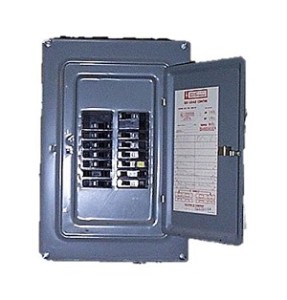
Where’s your electrical panel? It could be in a closet, on a wall (probably near the utilities hookup) or even outside on a post. It looks something like this – a metal case with a series of switches and some identifying labels on the door.

Electrical panel

4. Find the “thrown switch.”

The panel has a dozen or so switches. Most of them will be facing the same way. When a switch is “thrown” or “tripped,” it pops out of position, breaking the circuit. You can usually pick out the thrown switch just by looking carefully. Or lightly “wiggle” switches to see if any are loose.

5. Turn the switch back on to reset the circuit.

Simply make sure the switch is all the way off, then switch it back on. (It may be stiff, and require a firm push.) Nine times out of ten you will have restored your electricity, and you’ll feel like a hero!  (If this DOESN’T solve the problem, you need to contact an electrician.)

Oh, and the one thing NOT to do?

Don’t light a match or a candle! Until you know what’s really going on, an open flame could create even more of a hazard.

Make sure you have one or more working flashlights handy. In fact, you may want to permanently store one near the electrical panel so you’ll always be able to find it right away.

(At a meeting of our emergency response team last week, everyone was astonished to think that there would be a single homeowner who didn’t know how to reset an electrical switch. I think they were probably over-confident about the skills of their neighbors. If you have family members or neighbors who might need this information, please pass it along.  Can’t hurt, and could certainly be helpful!)

Virginia Nicols
Your Emergency Plan Guide Team

In charge of planning emergency response team meetings? Don’t miss a single one of these Advisories!  Most can be used as the basis for a meeting training session.

Power Outage – Where are your emergency lights?

Share

Have you been watching the news footage coming from Puerto Rico? Satellite images show how dark the island has become because of power outages. It’s a reminder to us all to revisit emergency lighting.

Always-ready ambient lighting . . .

If the power goes out in our community center, battery-powered emergency lighting goes on automatically. Why not have the same level of preparedness at home?

One model — wall mounted emergency lights.

I have written before about wall-mounted automatic emergency lights. They plug into a socket and normally do duty as night lights (good for kids, visitors and wakeful spouses). When there’s a power outage, they light up and can be pulled out and used as flashlights, too. Cost: $12-20 each.

In my estimation, Emergency Automatic Power Failure Lights are a basic piece of emergency equipment.

A new find — emergency light bulb.

And this week, I found another automatic light I want to make you aware of. I think it would be particularly appropriate for families with children or families with older people for whom not being able to see would be dangerous.

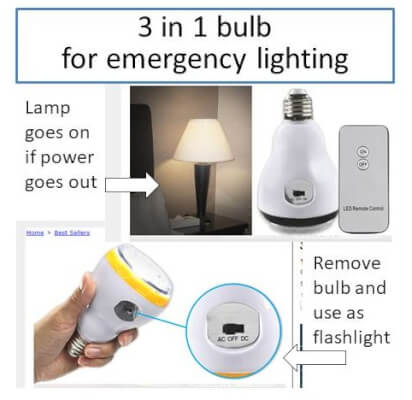
3 in 1 lamp

Why I like this 3-in-1 bulb.

I pulled these images to try to show how the bulb works. It’s designed to screw into a regular socket, so you can just put it into a table lamp, like in the picture, and use it like an ordinary bulb.  It’s a soft color, and because it’s LED technology, it doesn’t use much power and doesn’t get hot.

You leave it in all the time so it is always charged.

The cool this is that IF THE POWER GOES OUT, THE LAMP GOES ON!  Because it has a built in battery, it will burn for about 5 hours. (Ultimately its battery will run out, of course.)

Let’s say the power goes out. You can find your way directly to the lamp, and then you can REMOVE THE BULB and use it as a flashlight! What about having one of these bulbs with you when you travel?? Pop it into a hotel lamp, and if something happens during the night you’ll be able to see  (Just don’t forget it when you check out.)

This bulb costs less than $5 when you buy two. Check out full details and a video HERE before you buy.

But for powerful emergency lighting . . .

The lights described above don’t give off enough light to actually repair something or find and rescue somebody in trouble. For that, you need more power. After considerable research our CERT team invested in several very large spotlights. They have bright halogen bulbs – 18 million candle power!

These are too bulky to casually carry around. Rather, you’d turn one on and set it up to illuminate an entire scene.

One of the reasons we chose this model is because it can be plugged into a car battery to be recharged! (We’ll have plenty of cars available in our neighborhood.) The car battery (DC) adaptor comes with the lamp. Below is the link directly to Amazon. On the day I wrote this, prices varied from as low as $57 to as high as $97 for the same lamp! So shop carefully.
Cyclops C18MIL Thor X Colossus 18 Million Candle Power Rechargable Halogen Spotlight

Now you probably wouldn’t need something as big and powerful as the Cyclops to get you through a simple power outage. But if the outage continued for many hours – or for 14 days as happened to some people caught in Hurricane Sandy and now, in Puerto Rico – emergency lighting is going to play an important role.

Here’s a quick review of standard emergency lighting. Do you need to put some of these on your shopping list?

1. Ordinary battery-operated flashlight. Cheap ($3-$15), easy to operate. As long as the batteries work, you’ll have at least SOME light! I recommend getting at least 250 lumens. Of course, the beam is narrow, and you have to use one hand to hold the flashlight. Here’s a really good one: LED Tactical Flashlight,Wophain Super Bright 800 Lumens CREE XML T6 LED Outdoor Handheld Flashlight Adjustable Focus Zoom Flashlight With 5 light Modes, Ultra Bright, Zoomable,Water Resistant
2. Headlamp. Again, battery operated, but you’ll be SO much more efficient with two hands free! Tape one to your helmet, or wear one over a cap. Costs start as low as $7 and go up from there. Here’s a best-seller: LE LED Headlamp, 18 White LED and 2 Red LED, 4 Brightness Level Choice, LED Headlamps, 3 AAA Batteries Included
3. Battery-operated lantern. We’ve drafted an entire new Advisory about lanterns. Prices usually range from $10 – $30. Here’s one with an AM/FM radio built in: Northpoint 12-LED Lantern with 4-LED Flashlight and AM/FM Radio, Green (I have a lantern in nearly every room, particularly in the bathroom.)

One final note . . .

Having enough battery-operated lights, and a supply of extra batteries, will prevent you from reaching for candles until you are absolutely sure it’s safe.

Hope I’m not preaching to the choir on this topic, but it’s always worth a reminder!

Virginia Nicols
Your Emergency Plan Guide Team


Questions to Ask About Gas Line Safety

Share

An Ongoing Threat

Gas main shut-off

Where and how?

The March 26, 2015 massive explosion and fire in  New York’s  East Village caused the collapse of three buildings and fire damage to a fourth — a reminder that natural gas continues to be a threat, particularly where the gas lines are aging – as they all are!

At one of your Emergency Response Team meetings, I’m sure you’ve discussed the threat posed by natural gas. If you haven’t, or if it’s time for a review, here are some questions to start the conversation.

1. Where are gas lines located in our neighborhood and building?

Large-diameter transmission lines may run near or even through your neighborhood, with smaller-diameter distribution lines connecting to individual residences or buildings. You should be able to get from your gas company a map showing the transmission lines. Getting maps showing smaller distribution lines may be more difficult. (In our case, we were able to get original construction drawings from the city. They show the exact location and size of our gas distribution lines.)

2. Where are shut-off valves located?

The gas utility, gas system operator and/or property owner may not want to reveal exactly where shut-off valves are located, mostly because they don’t want to invite mischief or sabotage.

However, from a SAFETY standpoint it is imperative for First Responders to know how to shut the system down in an emergency. A strong neighborhood CERT group can get this information.

Shut-off valves may be located at the individual home, at the building, at the street, and in other places along the system.

We recently had a visit from the crew of our nearest fire station. It was a shock for us to learn that they did NOT know exactly where our gas main shut-offs are located!

3. How do our shut-off valves work?

As a neighborhood group, you may be limited to what you can really do in your community. However, to the extent that you do know where lines and valves are located, you should find out what it takes to shut the gas off.

Review the different types of shut-off valves in your vicinity.

  • Automatic? Some valves, like seismic gas shut-off valves, operate automatically. However, such valves are not required and you probably don’t have any on your system.
  • Appliance? Within the home, individual appliances may have their own shut-off valves.
  • Entire home? In an emergency, shutting off the gas to the home likely means shutting it off at the meter. To do this, you’ll need a wrench and an understanding of the ON vs. the OFF position of the valve. (See earlier post.) Your turn-off may look like the one in the picture, or it may resemble a regular garden hose faucet handle.
  • Gas main? When it comes to shutting off gas at a larger line, the shut-off may be a larger version of the wrench turn off, or it may operate with a large wheel and gear.

Are any of the valves locked?

Naturally, if a gas valve is locked, no one except the operator may be able to access it. In a widespread emergency (earthquake) this could be an added problem.

In the Northridge Quake of 1994, managers of an affected mobile home park saw that gas escaping through the streets was being ignited by cars of residents evacuating the park. Unfortunately, management was unable to break the lock to turn off the gas at the main so it continued to fuel these fires.

4. What procedures are in place for shutting off the gas?

In an emergency,

  • Who is authorized to shut off the gas?
  • Which valves are they authorized to shut off? Remember, the gas utility probably “owns” the system up to the meter; you, as property owner, own everything on the house side of the meter.
  • What training do these authorized people receive?
  • How likely is it that authorized and trained people will be on hand in an emergency, when immediate action may be required? In a widespread disaster, Fire fighters may not reach you immediately; representatives of the gas company may also be delayed, perhaps indefinitely.

In the deadly 2010 explosion and fire in San Bruno, California, it took the gas company over 60 minutes to get the gas shut off!

5. What exactly are the dangers associated with natural gas?

The gas distribution system has thousands of miles of pipeline that operate safely nearly all the time. However, when there is a failure, it can result in a dramatic explosion and fire. Failures result from the following:

  • Pressure. The first concern of the system operator is to maintain the appropriate pressure in the system based on the size of the pipes and the number of connections to it. (The more connections, the more pressure needed to deliver the gas.) As communities grow, and more connections are added to the system, the Maximum Allowable Operating Pressure (MAOP) may need to be adjusted.
  • Pipeline failure Leaks and breaks occur when old pipes fail due to corrosion, improper welds or joins, improperly installed equipment, too much pressure – or as the result of natural events such as an earthquake.
  • Leaks Just because your system is old doesn’t necessarily mean it is in danger of failing. And just because a gas leak is detected doesn’t mean you are in imminent danger. However, when a leak is identified, you need to act quickly and decisively. What you need to be concerned about is a build-up of gas around a leak or as the result of gas “migrating” to an area where it gets trapped, such as in a basement, under a house, etc.

CERT Action item #1: Learn the signs of a gas leak and know how to respond. Start by reviewing this Emergency Plan Guide Advisory, and then research and distribute gas line safety bulletins that you can get from your own local gas utility.

CERT Action item #2: Find out how often and what kind of system testing (pressure, cracks, etc.) takes place in your area.

One of our most effective guest speakers was a representative from the Fire Department who talked about the various gas lines in our neighborhood. (We have the usual mains and feeder lines PLUS a high-octane aviation fuel line running beside our community.) See if you can set up a speaker from your own fire department or local utility.

Your invitation will cause that Fire Official to update his or her knowledge about your neighborhood, as well as remind your neighbors to be more alert. Every bit of knowledge helps!

Virginia Nicols
Your Emergency Plan Guide team

Looking for more information on gas lines? Check out these Emergency Plan Guide Advisories:

Want to get a reminder once in a while to help you stay tuned in and up to speed on the latest preparedness issues? Sign up for our Advisories, below.  They are free.

Fire In Your Home!

Share

How safe are you? Take this quiz.

Cigarettes cause fatal firesPick the correct answer:

  1. According to FEMA, what is the leading cause of residential fires in the U.S.?
  • Kitchen fires
  • Smoking
  • Wild fires
  1. What is the leading cause of civilian deaths caused by fire?
  • Kitchen fires
  • Smoking
  • Wild fires

True or False:

  1. Cooking is and has long been the leading cause of home structure fires and home fire injuries.
  2. Most cooking fires and cooking deaths are a result of the heat source being too close to combustibles.
  3. Households that use electric ranges have a higher risk of fires than those using gas ranges.
  4. Fires caused by smoking material (burning tobacco) are on the increase.
  5. The risk of dying in a home structure fire caused by smoking materials rises with age.

The peak day of the year for home cooking fires is: ____________________

The Answers

Here are some statistics to ponder.

In 2012, 36.8% of home fires causing injury started from cooking. (Many more kitchen fires actually take place, but are put out by occupants and not reported.)

That same year, smoking caused 15% of the fires resulting in fatalities, followed closely by carelessness (13%) and then fires set on purpose (12%).

Cooking

Most kitchen fires happen when the cook leaves whatever is cooking unattended. And most of those involve frying on electric ranges

The right portable fire extinguisher can be effectively used to suppress small fires in their beginning stages. However, the extinguisher must be properly rated and needs to be positioned where you can get it quickly and safely.

If you blast a skillet full of flaming cooking grease with the wrong extinguisher, you’ll create a fireball, greatly increasing the size of the fire and threatening you with serious burn injuries.

The day with the most cooking fires? Thanksgiving Day!

Smoking

Three-quarters of deaths due to smoking-material fires involve fires starting in bedrooms (40%) or in living rooms, family rooms, and dens (35%). The item most frequently ignited is trash, but trash doesn’t kill – people die when upholstered furniture catches.

Nearly half (46%) fatal home smoking-material fire victims were age 65 or older.

One out of four fatal victims of smoking-material fires is not the smoker whose cigarette started the fire.

The Action

  • Stop smoking. If you smoke, do it outside. Carefully put out your butts.
  • Be ready in the kitchen.
    1. Clear space around the stove. No mitts, no clipboards, no recipe holders.
    2. Have a lid and/or cookie sheet READY to cover a grease fire. It has to fit SNUGLY on top of the pan, blocking all air.
    3. Have a large box of baking soda handy to dump on and smother a small fire.
    4. Buy a kitchen fire extinguisher and position it between the stove and the door. Be sure you know how to use it. Remember that a powerful fire extinguisher could SPLASH AND SPREAD THE FLAMES if directed too closely at a burning grease fire.
  • If a fire starts in a pan . . .
    1. Try to put it out immediately! It can grow too big to handle within 30 seconds.
    2. Do not move a flaming pan. You could spill flaming grease all across the floor or counter, instantly creating multiple fires!
    3. Cover the stationary pan with a lid, cookie sheet or wet towel. Make sure all air is blocked.
    4. Turn off the burner.
    5. Leave the pan until everything has cooled.
  • If you can’t control the fire at the pan . . .
    1. Be sure other occupants are evacuated.
    2. Use your fire extinguisher. Pull the pin, aim, squeeze and sweep. Start several steps away and approach the fire as you see the effect of the spray.
    3. If not successful, call 911 and leave the home.

Fire is the most common emergency your family is likely to face, so share this information with them! Be sure your children know how to put out a cooking fire, and train older children in the use of a fire extinguisher.

If family members haven’t been trained about how to respond to a fire in the kitchen, they are likely to do the wrong thing!

You can find dramatic videos on YouTube that show what happens when grease ignites, what happens when people try to move the pan, or when water is thrown on the fire. And you can find good training for how to use a fire extinguisher there, too.  Take advantage of this great resource.

Want more details?

Two websites with statistical info:

https://www.iafc.org/files/1FIREPREV/flss_ResidentialRangeTopSafetyReport.pdf
http://www.usfa.fema.gov/data/

And this Emergency Plan Guide Advisory gives tips on shopping for fire extinguishers:

Fire extinguisher, anyone? 

Hope you take this Advisory to heart. In this case, there’s no need to become a statistic when you know what to do.

Virginia
Your Emergency Plan Guide Team

Share this quiz and its answers with your neighborhood emergency response group, too. Remember, the more prepared your neighbors are, the safer YOU will be!

My New First Aid Kit

Share

Last week’s article about “extra” items for a first aid kit inspired me to use the topic for our monthly neighborhood emergency planning group meeting.

The meeting turned out to be . . .

Another good meeting idea!

First Aid Kit with missing items

Here’s how it went.

Procedure

  1. First, I invited our neighbor Theresa, who is a Registered Nurse, as our featured guest. She brought along her own first aid bag as a “show and tell.”
  2. Second, so we’d have something to compare it to, I bought a brand new first aid kit (cost around $10) at the hardware store down the street (photo).
  3. Third, as a reference, I printed out the Red Cross’s list of “20 basic first aid items.” Everybody got a copy.

As Theresa pulled out an item from her bag, we checked it off the Red Cross list and then looked in the kit I’d bought to see if it was included.

Results of the Comparison

Number of items

The new kit had about 60% of the items suggested on the Red Cross list.

First Aid Kit items, Red Cross list

Quality

The bigger problem: nearly everything in the kit was in miniature! Packets were tiny (one squeeze, and the ointment would all be gone), gauze squares were tiny, gloves were tiny. We all laughed, in particular, at the roll of adhesive tape. Take a look at it in the photo, bottom right. Really, it’s about as big around as a quarter and weighs less!

Missing from both the list and the kit

Here are the items that Theresa had in her kit that were not in the kit AND were not on the Red Cross list:

  1. Antihistamine ointment
  2. Liquid skin
  3. Duct tape
  4. Flashlight
  5. Plastic bags
  6. Dust mask
  7. Eyewash
  8. Phone number of Poison Control center
  9. Whistle
  10. Sunscreen
  11. List of medicines currently being taken

And finally, one last item that our group felt needed to be in there:

12. Extra eyeglasses

Shocking finale

Attendees had been invited to bring their own kits to the meeting, too. One guy had his neatly packed into a fishing tackle box. One neighbor shared her pet first aid kit.

What shocked me, however, were the people who admitted they didn’t have a kit in their car. And there were a couple of people who said they didn’t even have a kit in the house!

The reason it’s shocking is because this is our neighborhood emergency group, supposedly tuned in to being prepared!

Lessons learned

Emergency preparedness starts and continues with the basics.

  • If you have a first aid kit, check on its contents and “top it off” with more supplies. Use the lists above for suggestions.
  • If you are missing a kit, build one from scratch or buy an inexpensive one, like I did, and add more supplies.
  • If extended family members don’t have kits, buy up a supply and hand them out for Father’s Day or Mother’s Day or Christmas! Or without any explanation other than, “You need to have this!”

I looked for a better kit. I found one at Amazon that looks pretty good as a starter. I like the way its clear pockets fold out to make things easy to find. It costs about twice as much as the one I bought at the hardware store ($19 instead of $9), but instead of “77 items” it advertises “121 items.” Again, you’ll want to add some extras, but this kit would be a good start, particularly for the car.

Here’s the direct link: AAA 121-Piece Road Trip First Aid Kit

Don’t let something as simple as not having a first aid kit turn an accident into a real emergency!

“Friendly but Forceful” Action item: Take care of your first aid kit/s right away!

Virginia Nicols
Your Emergency Plan Guide Team

P.S. What first aid items haven’t been mentioned in this article?  Please share your recommendations in the comments box so we can all benefit.


Customize Your First Aid Kit

Share

First Aid Kits for home, car, survival kitYou have three first-aid kits, don’t you? One in the house, one in the car, and one in your emergency backpack?

You can buy a reasonable pre-built kit for around $20. But, as always with pre-built collections,

Are your first-aid kits well-stocked?

  • First, your kits should have high-quality items. I’ve read so many reviews that mention scissors that won’t cut or tweezers that don’t tweeze!
  • Second, contents should match your own level of medical knowledge. For example, some pre-made kits contain actual surgical equipment – probably useless and even dangerous for the untrained.
  • Third, your kit should have room for any specialty items that fit your family members, your climate and potential natural emergencies. For example, you may need to add sunscreen, water purification tablets or insect repellent, given where you live.

Extras that may make the difference.

Spend some time reading the list of items contained in several of the ready-made kits, and you may get some good ideas for extras. Here are a few to consider.

Liquid bandage

As the name suggests, this liquid can be applied to small cuts or wounds. It quickly dries, holding the cut together or covering the wound with a tough “skin” that protects the wound from dirt, is flexible and waterproof, and antiseptic to boot. (Won’t stick if applied to wet or bloody skin.) This pack has four bottles.

New-Skin Liquid Bandage, First Aid Liquid Antiseptic, 1-Ounce Bottles (Pack of 4)

Tampons and pads

If you have a cut that needs more than a band aid, a pad gives you something solid to apply pressure against. As for tampons, obviously they could be used to plug a puncture – and the string can serve as the wick for a long-lasting emergency light if you have oil as a fuel. Head to your local drugstore to pick up the sizes and style you want. If they aren’t packaged individually, you can always put a few into a plastic bag and then into your kit.  Be sure to use the unscented versions. 

Hand sanitizer wipes

We’ve all used “wipes” after eating messy food – and discovered that some are a lot better than others, and smell better, too! Still, in an emergency, probably any reasonable sanitizing wipe would be better than nothing. Individually packed wipes can be tucked right into your first aid kit. A small plastic bottle of hand sanitizer could work, too. I’ve used Purell and liked it.

Individually wrapped: PURELL Sanitizing Hand Wipes Individually Wrapped 100-ct. Box
Small, 2 oz. bottles: Purell Instant Hand Sanitizer, 2 Ounce (Pack of 12)

Ace bandage or “self-stick” bandage

In rough terrain, an ace bandage can keep your turned ankle functioning. A standard ace bandage needs safety pins or special clips to keep it secured; the “self-stick” version looks the same but sticks to itself just like cling wrap.

Standard bandage with clips: ACE Elastic Bandage with Hook Closure, 3 Inches (Pack of 2)
Self-stick version: ACE Self-Adhering Elastic Bandage, 2 Inches (Pack of 3)

Adhesive Tape

Taping gauze over a wound takes precision. If you mess up, drop a piece, etc., you can go through the provided supply very quickly. My recommendation – add another generous roll of 1 in. tape to your kit so you won’t run out.
Durapore Medical Tape, Silk Tape – 1 in. x 10 yards – Each Roll


Virginia
Your Emergency Plan Guide team

P.S. While you’re thinking about First Aid kits, you may want to review this Advisory about the dangers of out-of-date medicines.


Terror at the Mall

Share

How safe is your local mall?

Mall security

Where are the exits?

Today’s news is filled with threats of terrorist attacks on local, American, British and Canadian malls. These threats follow on the heels of the release of HBO’s amazing documentary, “Terror at the Mall,” showing one such attack.

If you are involved in security and counter-terrorism, you need to have seen this chilling story. If you are simply a parent, or even a shopper, you may want to take time to see it, too.

Security camera footage

Footage for the film was taken from the over 100 security cameras that continued to run while noontime shoppers visited the upscale WestGate Mall in Nairobi, Kenya on September 21, 2013. Again and again, the footage shows innocent and unsuspecting families and store personnel suddenly confronted by militants armed with automatic weapons.

These men entered the mall like any other shopper, moving steadily through the corridors and into stores and shooting down anyone who moved.

Over the course of four hours, over 60 people were killed, women, children and police. The floors ran with blood.

You may well ask, “Four hours?”

It was a classic example of a “soft target” attack combined with poor response by police and military. While the terrorists continued to move throughout the mall,, police and military forces, who took over 45 minutes to arrive,  milled around outside. One of their leaders is seen shouting, “Give us time to get organized!”

The gunmen were purportedly from Al-Qaida-linked al-Shabaab in Somalia. They were quoted as wanting “revenge” for the death of some of their brethren. Ultimately, after 4 days, a potion of the mall and the terrorists were destroyed by fire, purportedly the result of the army’s artillery “remote assault.”

Mandatory training

Viewing this chilling film should be mandatory training for anyone involved in security and counter-terrorism activities. It also reinforces the lessons taught in the “Run-Hide-Fight” active shooter video that was created by the City of Houston, Texas and the Department of Homeland Security. This film was reviewed by us last year. It has now had over three million views on YouTube.

As a matter of policy, at The Emergency Plan Guide we normally avoid publishing anything that smacks of “alarmist” publicity. Unfortunately, given the open threat from al-Shabaab, recent events in Paris and Copenhagen and warnings coming today out of Homeland Security, we can probably expect soft target attacks in the not-too-distant future. And, if ISIS gets its way, even the possibility of large-scale events cannot be overlooked.

“If you see something, say something.”

The Department of Homeland Security began a new campaign at the Superbowl, promoting awareness. It applies here, too.

If you feel that your lifestyle is such that you have higher than normal exposure, you would do well to view the Houston film (it’s only about 10 minutes) and even the HBO Documentary (60 minutes). It’s important to see how many people were able to get away and how others successfully hid from the attackers.

Finally, it makes good sense to always be aware of exit routes for any public structure. And, if you see something, say something!

Joseph Krueger
Your Emergency Plan Guide team

P.S. The Documentary is available to subscribers online at HBO. There are also a number of interviews, clips and trailers available on YouTube, but some have been apparently been “hijacked” by groups trying to take advantage of the title of the documentary. Caution is advised.


Portable Generator Safety Update!

Share

The recent blizzard in the Northeast may not have been as bad for New Yorkers as anticipated, but it was bad enough to cause power outages to thousands.

When we hear power outage, we naturally think “generator.”

Generator safety Emergency Plan GuideHere at Emergency Plan Guide, we have looked several times at the pros and cons of generators while we considered purchasing one for our own neighborhood. And we have told the story of what happened AFTER we purchased it, too!

Today, as we head into National Severe Weather Preparedness Week (February 3 – 7), it seems a good time to add one more piece of information to the discussion.

Generators can be dangerous!

Here are three things to keep in mind as you consider the purchase of a new generator and/or get ready to turn yours on.

1. Location. The most important safety alert has to do with where you place your generator. You know that the off-the-shelf, standard generator kicks out significant quantities of carbon monoxide (resulting from the burning of fuel). Too much CO in the air can render you unconscious and kill you. In fact, According to the Centers for Disease Control (CDC), unintentional CO poisoning claims more than 400 lives a year, and about half of those are due to generators.

To protect yourself from the dangers of CO, run your generator outside and place it at least 20 ft. from the building, further if there are any doors, windows or vents. In particular, never run your generator in the garage, even if you keep the door open.

2. Connection. When the generator is running, it can power a number of appliances (as long as its fuel lasts). Use a heavy-duty outdoor electrical cord (10 gauge or better) with grounded plug (the three-prong one) to run from the generator outside to the appliances inside. Adding a heavy-duty power strip at the end in the house will make it easier to plug in the appliances.

Do the math!  Add up the wattage of the appliances you intend to plug in to make sure the generator can support that load.

3. Protection. NEVER NEVER NEVER plug the generator into a wall socket in the house! First, a generator cannot power your whole house so from a power standpoint, that’s useless. Second, and more important, the power from the generator flows through the house and into the power grid. Workers working on repairs to the grid could be electrocuted because of YOUR generator!

For more about generators,

check out these Emergency Plan Guide posts:

And if you are thinking “generator” you also need to be thinking “carbon monoxide alarm.”

Read our review questions before you purchase anything.

Carbon Monoxide Alarms and Detectors

You may not be anticipating any severe weather, but please forward this information to friends who are right in the path of these winter storms. Thanks.

Virginia
Your Emergency Plan Guide Team


Three Days in Paris

Share

. . . Give Us Pause for Concern.

Last week the British Intelligence MI-5 issued its warning about the renewed threat of terrorist attacks on so-called “soft targets.”

Soft target for terrorist

Classic Soft Target

This proclamation, against the backdrop of the savage attack by two minimally-trained terrorists with automatic weapons on the French tabloid Charlie Hebdo, got my attention . . . especially since it warned of growing risks of attacks in the U.S.

But, real as the terrorist threat may be, it is only one of many threats against soft targets!

So what are soft targets and should we really be worried?

Soft targets are basically any person or location that isn’t protected by armed guards or official security. The school at Sandy Hook, the two off-duty British soldiers and the school in Pakistan are all soft targets. Your grocery store, gas station, your church and even your own home are all soft targets by definition.

And, yes, we should be concerned and vigilant.

San Francisco rampage

In the U.S., widespread availability of assault weapons means that mentally-ill people are all capable of becoming potential “terrorists.”

On July 1, 1993 in San Francisco, California, Gian Luigi Ferri, a 55-year old therapist, burst into a law office at 101 California Street and began shooting with two automatic weapons, killing eight people including a receptionist and a secretary, and wounding several others.

I knew “John” Ferri. I actually met him on three occasions. One of these was to sever him from a counseling assignment with a young relative of mine who “didn’t feel comfortable” with him. Neither did I after a fifteen minute conversation.

But neither did I suspect that years later he would become a mass murderer.

A more recent threat

That series of events, together with a number of workplace killings, made me particularly concerned for the safety of one of my daughters, a senior human relations executive who has been tasked with laying off several dozen employees since the 2008 financial meltdown. I worry about disgruntled employees “snapping” and returning to their workplace to “get even.”

For every real terrorist event, we can expect half a dozen of these “domestic violence” events. Does the fact that they are to be expected make me feel any better? Not really.

More precautions, increased vigilance

With terrorist incidents likely to increase in the future, there’s every reason to take all normal precautionary measures while increasing our vigilance. If you work or live in a high-risk target area, a healthy dose of paranoia might even be in order.

So, what’s the bottom line? The more progress we make in containing terrorism on the various battlefields of the Middle East, the more we can expect isolated, one-off incidents of attacks by one or two would-be terrorist actors. MI-5’s Director, Andrew Parker, pointed to what he called “the growing gap between the increasingly challenging threat and the decreasing availability of capabilities to address it.”

Of course we here in the U.S. are less likely than countries in Europe to be hit this way, but only because we are not as close or accessible to the thousands of militants coming and going between a battlefield and an adjacent country.

In response to this threat, here at Emergency Plan Guide we’ll be taking another look at physical security devices and related protection equipment. You may want to follow these periodic reviews to see if any resonate with you.

Joe Krueger
Your Emergency Plan Guide Team

Don’t miss our upcoming reviews of security equipment. Be sure to get on our Advisory mailing list.  Sign up below.

Safer at Home in an Emergency

Share

 [This article is aimed at people living in a neighborhood with a clubhouse or community center. If you’re building a CERT group in such an environment, you can use these questions for valuable training.]

“In an emergency, we come to the clubhouse, right?”

“No, No, No!”

Think about it. In a real emergency, why would you head for the office, or the clubhouse, or any central meeting place in your community?

Consider these emergency conditions in a clubhouse.

  1. Will the clubhouse be standing?

Unless your clubhouse is brand new, and built to modern safety standards, it is just as likely to collapse as any other building, and probably more likely to collapse than a smaller and more compact building.

  1. Will the clubhouse be open?

If an emergency hits in the middle of the night, every door in the clubhouse will be locked and management will be away. Are you going to break in?

  1. Will there be electricity or phone service?

Does your office or clubhouse have an emergency generator? Where is someone who knows how to turn it on? If no generator, then there will be no lights (after emergency lights have gone off). No automatic doors, no elevators, no air conditioning, no heat. No emergency communications. Not safe!

  1. Will there be food?

A few centers may have kitchen facilities and some food supplies. In an emergency, however, the kitchen cupboards and refrigerators may be locked. There may be no way to heat water or to cook. Perhaps most disturbing – who will decide who gets to be first in line?

  1. Will there be bathroom facilities?

If water pipes are broken, the image of a crowd of people lining up to use one or two toilets that don’t work is . . . well, repugnant. And what if people bring their pets with them?

  1. Where will you get your medications?
  2. Finally, who will take charge of the group?

And will volunteers be willing to stay at the center hour after hour to help out?

Your home is the best place to be.

Unless it’s been designated as an official “evacuation center,” your central community area is most likely worse for survival than your own home.

That’s why our neighborhood CERT group stresses shelter in place.

If you take a look at the same questions from above, and fill in “in your own home,” here are some of the answers you’ll get.

  1. Will the house be standing?

Your apartment, single-family residence or mobile home is as likely to withstand an emergency as any other structure, depending on its age, the kind of disaster (earthquake, tornado, flood, etc.). And since it is your home, you have the opportunity to make it as safe as possible by fastening furniture to the walls, putting locks on cupboards, storing food and water, assembling tools, etc.

  1. Will your home be open?

If an emergency hits in the middle of the night, you’ll be there. And even if you have to get home, you’ll have keys or know how to get safely inside.

  1. Will there be electricity? How about emergency communications?

You may or may not have a personal home generator. But you certainly should have emergency lighting in your home, probably in the form of multiple flashlights and LED lanterns. At home, you can add or subtract clothing, add or take away blankets in order to adjust to weather conditions. And you should have access to emergency radios and first aid materials.

  1. Will there be food?

If you’ve done any preparing, you’ll have water and food, including some food that doesn’t need any cooking. You’ll have your medications – and food and medications for your pets, as well.

  1. Will there be bathroom facilities?

If water pipes are broken, you won’t be able to use your own toilet. Again, if you’ve done some preparing, you may be able to flush using outside sources of water (e.g. swimming pool water). Or you can put plastic bags into the toilet, secure them when they’re full and then put them somewhere outside. Not pleasant – but workable.

Are you thinking there’s a better place than home to be in an emergency?

Are there other people more qualified to help you than you are to help yourself?

Think again!
Virginia and Joe
Your Emergency Plan Guide Team

P.S.  Who do you know who lives in a complex with a clubhouse or community center?  Forward this to them right now!  Thanks.

P.P.S.  If you’re working to build a neighborhood CERT group, drop us a line.  We have some experiences and some training materials that we’d be glad to share.

Survival Training for Ten Special Hazards

Share

Your family may be prepared for common emergencies. But have you taken the time to think about these ten special hazards?

Checklist of Special Hazards

Emergency Planning for Tsunami

Tsunami Siren – New Zealand

1. Emergency siren

We’re all used to the weather alert sound that’s tested monthly on the radio. But what if you suddenly heard a siren going off outside? Would you know immediately what it meant, and what to do? In our part of the world, sirens are associated with just one thing: a leak at the nearby nuclear power plant. In Oklahoma, a siren might announce imminent threat of a tornado. In Asia, sirens are used to warn of giant waves or tsunamis. What sirens operate where you live or where you’re planning to travel?

2. Railroad crash

When the track doesn’t run right next to your house, you may not realize how many trains are traveling through your community. Although train accidents are infrequent, every year we hear of derailments, explosions, fires, traffic disruption, and evacuations. Where could a train crash happen in your local neighborhood? What cargo might that train be carrying?

3. Fire at sea

I’ve personally been through two ferry fires, both in the Mediterranean. Any time you’re aboard a ship, or even a boat, there’s danger from fire. Do you think about this possibility BEFORE you board? Do you think about how to respon

4. Airport/aircraft emergency

As a civilian, you’re not likely to be called upon to respond to an emergency at an airport but do you live or work near an airport?  In the flight path?  What do you know about emergency preparedness at the facility and how you would be impacted if there were a mishap?

5. Unusually heavy rain

Here in Southern California, rain (finally) fell on areas that a year ago had been burned by wildfires. The result: uncontrolled run-off of water and, unfortunately, mudslides. Could you become a victim of such a disaster?  Do you know how to protect your property (as best you can) using sandbags and K-rails?

6. Disabled residents

We’ve said it over and over again: many evacuation or disaster response plans overlook people with disabilities. How have you prepared to assist disabled family members, neighbors or co-workers in the case of an emergency?

7. Dam break

A wall of water from a broken dam is a favorite movie image. Reality might look a little different. (It might not be a flood; it might mean seepage or discharge and contamination of the water supply.) Is there a dam or water supply anywhere near you? Or a storage area for industrial liquid waste? It may be well camouflaged! How would you find out?

8. Explosions or release of toxins from industrial plants

We’re pretty aware of the dangers associated with oil refineries and fertilizer plants. What other industrial activities are underway near your community?  Do you actually work where you have identified hazards associated with the job?  OSHA is the agency where you can seek information and assistance regarding industrial hazards.

9. Dangerous animals

As populations expand, communities come ever more in contact with animals that used to be wild but which now exist nearby. We’ve all seen videos of bears wandering between houses, of coyotes chasing pets and even children, and, of course, snakes that have grown to become life-threatening. Do you and your children know how to recognize a dangerous animal and what to do if you encounter one?

10. Active shooter

Do you know what gunfire sounds like? If you heard it, would you know what to do? What about your children? Your parents? Where might you encounter a shooter? Immediate action could save your life; confusion or a delayed reaction could put you in increased danger.

There is emergency preparedness training available for each of these special circumstances. We’ve discussed some of them here at Emergency Plan Guide and will likely talk about them again.

If you’d like more info on any item in particular, or have personal experience to share, please leave a comment.

Virginia Nicols
Your Emergency Plan Guide Team


Hand-Held Survival Tool

Share

We have spent a lot of time talking about the various emergency radio choices that are available — solar/crank-powered for receiving emergency communications, and hand-held walkie-talkies for keeping in touch. We even did a video about workplace communications — you’ll see the link below this post.

But when you’re caught on the road . . .

But, it’s clear that we need to address the reality that few people caught on the road or away from home will be carrying their solar/crank-powered emergency radio with them — and their walkie-talkies won’t do them much good, either, since those are limited in range.

If you stay in the car, you’ll probably be able to get emergency news and weather reports on your car radio. But if you have no radio,

Or if you have to start walking . . .

You need a reliable alternative.

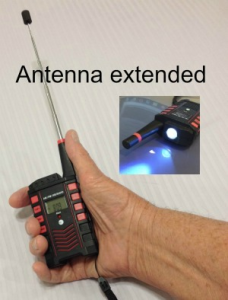
Reliable emergency radioThe only one we have found that is consistently reliable, affordable and the right size is the Ambient Weather WR-090 Emergency Pocket AM/FM/WB Weather Alert Radio with Digital Tuner and Flashlight

You can gauge the size of the radio by seeing it in the photo, in my hand.  In the photo, the antenna is fully extended; when you store it, of course, you’ll retract it into its 2-inch antenna stub  (shorter than my thumb).

When you select the weather band mode, there’s a red LED ALERT feature (right under the screen), and a clearly marked button on the side turns on a reasonable built-in flashlight.  (Photo insert)

This powerful gem is powered by three replaceable, AAA batteries. It only weighs 4 ounces (including the batteries) and

Easily fits into a pocket, purse or glove compartment of the car.

Most alkaline batteries have a shelf life of ten years. We recommend, however, that the batteries be changed at least once a year, depending on the frequency of usage and exposure of the unit to excessive heat, etc.

As with any battery-powered electronic device, you always want to have extra, fresh, replacement batteries on hand. We prefer the premium Duracell Quantum or Energizer equivalent high-density core. These premium batteries deliver full power longer than the standard models. When you’re dealing with emergency-related devices, you want the best quality, most dependable power available.

(Store extra batteries in your Commuter Kit. )

We personally have three of these units, one for each of our two cars and one for the kitchen drawer.  You’ll feel better if you have a couple of them handy, too. Here’s the direct link to the radio at Amazon, which is where we get ours.

Joe Krueger
Emergency Plan Guide


If you’re interested in radios, here are three more resources:


Emergency Preparedness for People with Disabilities or Special Health Needs

Share

Overlooked or Abandoned?

Every week I get one or another Google Alert about some group that is either not taking care of itself in an emergency or that has been overlooked by “the authorities.”

In our community CERT group, we do not have the where-with-all to take care of neighbors with disabilities. We don’t have specialized medical knowledge, or (expensive) specialized equipment or even the physical stamina to lift or move some of them. But . . .

We are aware of our neighbors and do our best to keep their needs in mind . . .

as we work on building our – and their — readiness to respond in the face of a disaster. As you build your own neighborhood group, here are

Some questions to ask:

Evacuation sign for disabled.

from Lee Wilson, founder at The Egress Group. More at http://accessibleexitsigns.com/

Shelter-in-Place.  When a heavy storm hits, the best course for most people is to shelter in place, assuming they have stored food, clothing, etc.  The questions to ask your disabled neighbors:

  1. Do you have food supplies that you are able to prepare for yourself (canned food, water) or do you depend on regular food deliveries from Meals on Wheels or other food service?
  2. Do you use any electric or electronic devices to treat a chronic condition, such as breathing treatments or sleeping machines? What plans do you have for back-up power? (Oxygen tanks, battery back-up)

Needed travel.  Do any of your neighbors need regular trips away from their home to get medical treatments like as kidney dialysis? In a severe weather situation, can your neighbor answer these questions:

  1. Do you know what to do if you are unable to reach your doctor for several days? (diet, hydration)
  2. Do you know where to go for treatment if your local clinic is closed? (addresses of alternate locations)
  3. Who would come to get you for dialysis if your regular caregiver isn’t available?
  4. What if the elevator isn’t working?

Evacuation.  In the case of an evacuation, many people who may not appear disabled may need assistance.  For example, people who are hard of hearing might not recognize the signal to evacuate. People with difficulty walking might not be able to negotiate stairs. People who can walk may not be able to handle door handles or locks. Questions to ask:

  1. Does our building/community have evacuation signage that incorporates signage for disabled people? (visual? touchable?)
  2. Is there a plan to find people ready and able to assist disabled people to evacuate?
  3. Is specialized evacuation equipment necessary, and available?

Practice and planning do make a difference.

The National Fire Protection Association’s 2007 Emergency Evacuation Planning Guide for People with Disabilities tells the following story.

During the 1993 bombing of the World Trade Center, a man with a mobility impairment was working on the 69th floor. With no plan or devices in place, it took over six hours to evacuate him. In the 2001 attack on the World Trade Center, the same man had prepared himself to leave the building using assistance from others and an evacuation chair he had acquired and had under his desk. It only took 1 hour and 30 minutes to get him out of the building this second time. 

Perhaps you can share this story with friends and with your CERT team to stimulate some creative thinking.


Virginia
Your Emergency Plan Guide Team

Forward this email to someone you know who could use the information.  One out of five Americans has some sort of disability.


Marketing Challenge for CERT

Share

Challenging the neighbors

A couple of weeks ago I reported that our local CERT group was

Run, Hide, Fight powerpoint presentation

PowerPoint presentation for group

scheduling a showing of “Run, Hide, Fight: Surviving an Active Shooter Event.”  Since it’s only 6 minutes long, we planned a brief half-hour meeting for intro, showing, and discussion.

(I embedded the downloaded video into a PowerPoint presentation – see photo — so I could create a complete talk, with intro and some follow-up questions.)

I announced the showing in our neighborhood newsletter (one small paragraph in a 20-page newsletter), on our neighborhood website, and also via email to my list of about 30 neighbors.

And I got a response I wasn’t expecting.

I’m sharing the story here because I’d like to hear YOUR comments.

As always, I try to create some curiosity with my headline to attract more readers. Here’s what I used this time:

“If it happens, you’ll have only seconds to react . . .”

Then I followed up with, “The chances of you finding yourself in the middle of an active shooter event are small, but that’s what the people in Ottawa probably thought, too.”  Details of the meeting followed.

Anyway, here’s a response that I received:

“Suspense, is that the answer to something so important to our lives?” 

 The writer went on for several long messages, criticizing me for not revealing immediately how to respond in an active shooter event.

 My reaction  . . .

  •  At first I was surprised at the vehemence of the writer.
  • Then I got defensive. (“I know from experience that simply reading a sentence or too won’t compare with making the effort to join a group to watch the video and discuss it.”)
  • Finally I figured this subject had simply triggered something for this particular individual.

The meeting came and went.

We had a modest attendance with a number of good comments and questions. This was a senior audience, so the discussion about “FIGHT” was different from what a younger crowd might have had. And it was also agreed that a new version of the video could profitably be made with the setting in a mall or retail establishment instead of in a workplace.

People were interested and participated, and several thanked us for “good information.”

With the meeting over, we went home. But I keep remembering that email exchange.

So now, it’s your turn to comment.

Have you shown the video to a group?  If so, what message did you use to attract attendance?  How did your promo work? How was the video received?

If you haven’t shown the video, please take the time to watch it now, and let me know how you would promote it to YOUR neighbors (work group, classroom)!

 You can go right to YouTube to watch it now: http://youtu.be/5VcSwejU2D0

A big part of our sharing these posts is to get MORE information to MORE people in such a way that they will INCORPORATE it into their daily lives.

It’s a big challenge . . . so I’d appreciate any suggestions or comments you have.

Thanks in advance!


Virginia Nicols
Your Emergency Plan Guide Team


Worried about power going out? Before you buy a generator . . .

Share

The terrible snow storms this week may have prompted you to consider buying a generator. Before you do, read this . . .

By way of background, Virginia and I have played a key role in building a Community Emergency Response Team (CERT) in our neighborhood. We even have a budget from our Homeowners Association. And a couple of years ago the group agreed to purchase a gas generator to support our emergency planning team.

We originally purchased two, each of which put out 6,000+ running Watts, with 8,000 Starting Watts. On sale, each cost about $800, and was compliant with California environmental laws.

Then reality set in.

First issue: “Pounds per Watt!”

Generator to power a whole house

Portable generator with wheels, handles

Our big generators were deceptive. Their wheels and handlebars make them look portable. After jockeying one of them around it became painfully clear that their weight – as well as their appetite for fuel – was greater than we had foreseen. Also, they have to be started and run for 15 – 20 minutes every month or two or they will require resurrectional service (cost around $100 . . . if WE take it in to the shop).

We returned the unopened generator, and went back to the drawing board.

What had seemed like a good idea at the time turned out poorly. We kept the one generator and plan to use it to power our Command Post in an emergency. There, we’ll need it for lighting and computers and other communications. We’re still debating about purchasing any additional generators.

Second issue: Realistic output. 

You probably know that a portable generators isn’t going to power your home around the clock during an extended power outage.
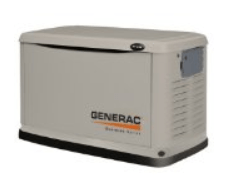
Generac Standby Generator

Standby, or permanently installed, generator

With careful management, however, an emergency generator can keep a minimum number of appliances operating in order to provide more comfort and convenience during an emergency. And with careful purchasing, you might be able to get what you need for less than $400.

For example, you can apply your power 3-4 times a day for 15-30 minutes to keep your refrigerator/freezer operating. (Exact times depend on the size of your appliance). Charging up electronic devices (laptops, tablets, cell phones, etc.) can be done at the same time since most generators have more than one plug-in socket. But plugging in an appliance that generates a lot of heat – such as a hair dryer or toaster or portable heater – may overload the generator.

Hence, managing run times and appliance combinations is required.

It’s up to you to do some homework by listing the power requirements of your various appliances, combining appliances for a reasonable total power requirement, then finding the smallest unit that will do the job.

Third issue:  What fuel to choose?

Most of the portable generators for sale at your local hardware store or online will be powered by gasoline. So, consider where and how you’ll store the gas you need. Gas is easy to get most of the time (though probably not during an emergency). But gas is messy, is highly flammable, and degrades after 12 months or so.

But what about diesel, you ask? Compared to gasoline, diesel is cheaper, lasts twice as long in storage, is more fuel efficient and less dangerous. But typically you’ll need to install a storage tank to hold it. So, while some generators are set up to burn diesel, they are mostly the larger, permanently installed models that are planned to run for longer periods at higher load.

Some portable generators burn liquid propane and some can burn either propane or gasoline.  Storing propane is easier than storing either gas or diesel; it can be stored in a tank or in cylinders. And propane is the cleanest burning fuel of them all. Naturally, a combo unit (running either gas or propane) is more expensive that a single-fuel generator.

You want to consider all three fuel options.

But, keep in mind that NOT ONE OF THESE MACHINES SHOULD BE RUN INSIDE!  They have specific directions for their use and warnings that should be respected by all users.

Some Guidelines to Help You Make Choices.

These examples come directly from Amazon, where you’ll find literally hundreds of different generators on sale.  We have picked these as having representative prices and positive customer reviews.  As you shop, compare:

  • delivery costs
  • warranties
  • environmental standards (for ex., CARB = OK to be sold in California)

Live in an apartment, condominium or modest home with access to an outside patio or small back yard, you’re looking at a small, portable unit that’s as quiet as you can find. (Propane generators are quieter than gasoline.) An example: the Champion Power Equipment 42436 1500-Watt Portable Generator, CARB Compliant costs $201.88 as of today. These items have to be shipped via ground so it may take longer than you’re used to for delivery.

Live in a Single Family Home, 3-5 Bedrooms, with outside access to patio or private yard? You can probably use a larger unit and won’t worry so much about noise or fuel storage.  For about $330, you can get something like the DuroStar DS4000S 4,000 Watt 7.0 HP OHV 4-Cycle Gas Powered Portable Generator.

Large Home or Small Business that still needs to continue running, even on a reduced basis, may require something like this model.  (It’s the one in the photo above, with wheels and handles that make it LOOK portable, but it weighs a good 200 pounds!Westinghouse WH7500E Portable Generator, 7500 Running Watts/9000 Starting Watts at $865, with free scheduled shipping.

Medium-Size Business that cannot afford to shut down for any sustained period, you’re looking at what’s called a “standby” generator. These are installed permanently and go on automatically even if you’re not there.  This example (shown in photo above.) runs on propane or can be connected to a natural gas supply (probably not the best idea if you live in earthquake country). Cost: $2,549 with extra $20 for shipping.Generac 6439 11,000 Watt Air-Cooled Steel Enclosure Liquid Propane/Natural Gas Powered Standby Generator (CARB Compliant) without Transfer Switch

This should be enough to get you started on some sensible shopping!

Joe Krueger
Your Emergency Plan Guide team


Looking for a bit more background? Here are a couple of Virginia’s recent posts: