Category: Family Survival

Severe Weather Alerts

Share

Without being paranoid about it, you need to be aware when danger is heading your way. Some things, of course, can’t be anticipated. But tornados, storms, floods, ice – these you can be ready for! Here’s how to find out what’s coming:

Local weather channel on T.V.

Watching the local weather news is the easy option, of course. But most of us don’t have the “luxury” of having a T.V. available whenever we want.
weather map

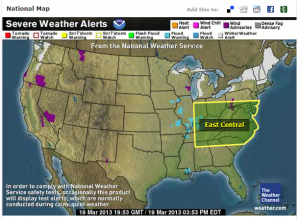
Regional weather map on Weather.com

Severe Weather Alerts on your tablet or computer

Head to www.weather.com , find your regional map and read about what’s coming. You can bookmark this page so you can find it readily. Typing in your zip code will give you even more local detail.

iAlert

This is a message service managed by your local law enforcement or emergency management service that alerts you by text message, automated phone call or email whenever there is an emergency.  (weather related, traffic emergency or crime related) You can find out if your city has the service and sign up for alerts here: http://ialert.com

Mobile Phone Hurricane App

The American Red Cross offers an app that will help you monitor conditions in your own area or where family members live, find help, and let others know you’re safe with one click of a button. It can warn you with a siren sound, and even turns your phone into a flashlight with strobe if you’re trapped. From your mobile phone, call “**REDCROSS” (**73327677) and you’ll be sent a link for downloading to your phone.

Other severe weather apps

A few minutes online and you will discover many other apps. Some of them might be sponsored by an organization right in your town, like the local news channel. Others may be offered by insurance companies or other organizations.

As you surf, you’ll see that some apps work only on specific phones. Some are free, others may cost a couple of dollars.

Action Item: If you carry a smart phone, invest a few minutes in checking out “severe weather apps” either online or right on your phone through the iTunes Store. Try a couple of the apps that make sense for your locality and your circumstances. (Get your kids to help if you haven’t downloaded an app yet.)

This is one emergency preparation action that is easy and fun!


Protecting Yourself in an Emergency

Share
Home security

Guidebook to home defense

We’ve said this before and no doubt we’ll repeat it more than once in the future. But the recent school shooting in Newtown has given new life to the continuing controversy about firearms – especially assault weapons and high-capacity magazines, etc. – for self-protection. If you’ve watched any of the “Doomsday Preppers” TV shows on the NatGeo Channel, you may have been shocked by the extent that some people go to for their imagined need for survival in a major catastrophe. Their arsenals look more like preparation for war.

Here are three things to think about if you are truly worried about having to protect yourself and your property in the event of a major disaster event. The first two are, in our opinion, negative approaches to life.  The third is in keeping with our philosophy of taking positive action.

Assault weapons are a terrible choice.

First, as any combat veteran will tell you, few people have the natural ability to calmly shoot people with a handgun, much less a rapid-firing assault weapon. Such weapons require training and discipline if you ONLY plan to hit a specific target while the adrenalin is flowing fast and heavy. The chances of hitting innocent people or things around and beyond the target are usually very high. There’s a reason mass murders use these weapons . . . they kill and destroy indiscriminately.

Shotguns aren’t a whole lot better.

Second, the best firearm in a self-defense circumstance is usually a shotgun. It has a limited range but a “spread” in the shot pattern that makes it more likely to hit the intended target on the first shot. You don’t have to be a marksman or highly-trained soldier to be effective with it. The bottom line, however, is if you find yourself having to use it, it’s still likely to take someone’s life. And, regardless of the situation, even if there is no legal consequence, that’s something you will have to live with.

Trusted Friends — Absolutely Your Best Protection.

Third, and most important of all in our opinion, your best protection in an emergency will be good neighbors – people you know and can trust immediately, instead of mistrust. We have seen over and over again the natural tendency of people to help one another following a catastrophic event. And, the more your neighbors are trained and prepared to survive themselves, the better equipped they will be to help you and vice versa. Unlike the first two means of self-protection, you can count on having enough friends if you have allowed for them.  And unlike the first two means of self-protection, this is one that saves lives instead of taking them.

Programs like the Community Emergency Response Team (CERT) training are excellent examples of the best way to prepare yourself and to work along the side your neighbors as an effective team. CERT neighborhoods will not only have a better chance of surviving, but will emerge as a true community with pride in having known what to do in advance . . . and possibly having saved lives and property because of their training.


Testing Your Emergency Equipment

Share

Practice ahead of time!

Virginia asked me to write this Advisory. It was prompted because of a blog post she read recently. Seems someone was trapped on his way home during Superstorm Sandy. By phone his wife reported the power was out and temperatures were dropping rapidly. He was proud and relieved to remind his wife that they had a back-up generator. The problem? His wife didn’t know how to turn it on!

Figure it out ahead of time.

Uhhh – confused?

This led us to take a look around our place at some of the emergency equipment we have to see what we really haven’t tested. Here’s my report.

Generator – Yes, we have a generator, a compact one, highly rated. It is still in the box and Virginia has never really seen it! (Two months ago our CERT organization set out to test its large new generator, and the starter did not function. So back it went to the store where we had bought it.)

Camp stove – Virginia and I have camped for years, both in tents (a LONG time ago) and in our RV, so we are familiar with propane stoves. The glitch – where are the gas canisters? And is there any trick to attaching them? If there is, we could waste a valuable resource trying to figure it out.

Water barrel – Last year we purchased a 55 gallon water barrel. (We wrote about our water barrel earlier.) It came with a pump to be inserted when the water is needed. OK, we haven’t needed the water yet. So, where is the pump, and how difficult is it to attach to the barrel? We haven’t tested it yet.

Solar panel back-ups for computers and phones – This one we’re good with. But if you have purchased panels yourself, be sure you have the right connectors that go between the panels and your device. Surely you have noticed that every mobile phone has a different plug on the end. Test NOW to be sure you have what it takes to take advantage of your solar back-ups.

Emergency radios – When we wrote the review of the best emergency radios, we tested all of our radios, so we know how to crank them, where the batteries go (if there are batteries), what connectors they require, etc. I recommend that you use your emergency radio daily. (It gets music or news, not just emergency alerts!) That way you’ll know it it’s ready to go.

How to Send a Text –– You may need grandchildren to help you out, here. But learn!

Turn on the Power — Again, something as simple as knowing where the fuse box is, and how to reset the switches, could make a difference. Everyone in your family needs to know this.

I think this list could go on. But the message is, “Test and practice.” Our plan is to set up a schedule to test one thing every week. You could set up the same action item — and include your children in the exercise. You won’t all be home when the emergency hits!

The more trained family members, the safer you’ll all be.


Joe Krueger
Emergency Response Team


Get an Emergency Kit!

Share

Tell the truth.  Do you agree that an Emergency Kit is a good idea?

Do you need one for the car/s as well as for the house?  Do you need one at work as well as at home?  Do you need to protect all the members of your houslehold in an emergency and not just a few?

All reasonable people must answer YES!

So putting together an emergency kit makes sense …

But it’s just not simple!

Emergency supplies

Kits packed and ready to go!

First, you have to pull together a list of what is needed. That list starts with basics: water and food. From there, it varies quite a bit depending on where you live, the make-up of your family, your commute patterns, etc.

Second, you have to shop for and/or assemble all the items on the list. This may take several days or even weeks, depending on how much stuff is required and how much money you will have to devote to this action. Many people build a plan and then lay out a purchase schedule to fit their budget.

Third, you need to get the right size container for each kit. The family kit is likely to be the largest; car kits, smaller. A child’s kit, smaller yet.  A workplace kit could be much larger, depending on how many people it is meant to serve. Of course, your kits need to be manageable; a backpack or rolling cart seems to be the favorite container.

Can you do all this? Of course! But will you?

If you haven’t done it up ‘til now, what would make a difference for you?

Consider this game-changer: Invest in a ready-made kit!

Then, improve it or personalize it as you go.

Yes, there’s an upfront cost, and it may be more than you would like. And yes, you could probably save money by assembling the kit on your own. But frankly, if you value your time at, say, $20/hr. you will save money by simply taking action now to buy a ready-made kit!

So consider getting a kit without further delay.

Five popular kits compared.

We have taken our time to look closely at five of the best-selling family kits on the market. We compare them as regards to contents, quality and price.

  • We start with the “basic” list of necessities, and note extras that some kits include.
  • Quality is sometimes not the best because these providers are competing on price. But some kits are better than others, and we’ll point that out.
  • Price ranges from $50 to $250 for a kit. Mostly the price depends on how many people the kit is meant for.

In our estimation, it doesn’t matter whether any given kit is perfect. What’s important is to have one for basic necessities, and then improve upon it when you can.

No more excuses.

If you haven’t put together your kit by now, you’re not going to…so be realistic! “I had it on my list of things to do…!” or “I was just trying to save money!” will be weak excuses when your family looks to you for help.

Check out our review of the Best Emergency Kits right now, pick the one that’s best for you, and get it. You will have taken a big step toward sensible preparedness.

Virginia
Your Emergency Plan Guide Team

When you buy your kit, let us and all our readers know what you got and how you found it, OK?? We appreciate your feedback!


Family Communications Plan — An Overview

Share

Timing is everything. Where will you be when the disaster hits?

You can almost assume that when an emergency hits, your family will not be together. Depending on the circumstances, you may not be able to get back together for some time. And whether you get together at home is yet another question.

  • Students and teachers may be held in school, perhaps in a locked-down situation.
  • Employees may be required to stand by to help protect co-workers as well as the business itself.
  • City employees and First Responders are likely to be called into action and kept away from home for hours or days at a time.
  • Any family member could be away from the home on travel, shopping, or vacation.

Immediately following the disaster, your concern will be to find out where everyone is, their condition, and the condition of your home. This is natural and normal . . . and without a plan, this difficult period may be far longer and more painful than necessary.

A Plan Speeds Communication

Your plan could contain a number of important steps.

  1. Sign up to receive emergency communications from your local police department via email or phone. This could give you an important head start.
  2. Set up an Out-of-Town Contact , someone who:
    • Lives out of the immediate area. If local phones are out, getting through to someone via a long-distance connection may be easier.
    • Owns a smart phone that can receive a text or SMS message. (SMS = Short Message Service). Of course, any phone is better than no phone.
    • Is able to keep track of calls that come in and share info with others. Not all family members are able to do this.
  3. Create Emergency Contact Cards for every member of the family.

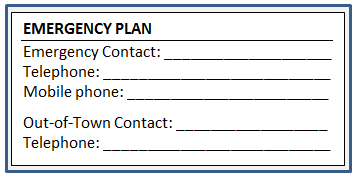
Everyone needs a wallet card that can be carried for identification and that will have the Out-of-Town Contact’s number.

Below is a sample Emergency Contact Card.  Include a similar card in backpacks, briefcases and purses.

Emergency Copntact Card

Sample Front of Card

 Special for Families with Children

Being separated from parents during an emergency will be an emergency itself for many children. If you have small children, your family plan needs to be more extensive than simply an Out-of-Town Contact name and number.

We recommend that you:

  1. Review the list of “approved people” that is on file at your child’s school. Should it be expanded?
  2. Confirm with neighbors or relatives that they are on the “approved list” and be sure they agree to be there.
  3. Go over the list with your children so they know what to expect in an emergency.

Update your information

Like all contact information, your emergency contact information needs to be regularly updated. Reaching an old, disconnected number may be more upsetting than not having one at all!

NOTEThis Advisory is only an overview. You can find more on what happens to phones in an emergency, which ones are best to have, where to look for missing family members in a wide-spread U.S. disaster, and a suggested agenda for a family meeting about emergency communications on our website.  Click here to jump to the three-page Family Communications Plan.


Emergency Supplies List

Share

If you’re looking for a checklist, you’ll find many, many of them online. FEMA offers up a 26-item list; the American Red Cross has a 36-item list, and different commercial companies (selling tools, pre-made kits, insurance, dried food)  have their own lists, some of which extend to hundreds of items.

Different lists serve different purposes

Comprehensive checklist

Page One of list

Over the years we have created or used different lists for different purposes. For example,

* At an introductory neighborhood meeting, you may wish to distribute a simple, one-page list with items that apply to everyone and that won’t appear too intimidating.

* In a community where people have had some training, a more comprehensive list would be a good idea. (We wrote earlier about the “door-hanger list” that we created for our community.) Naturally, adding items appropriate for the geography would make sense: rain gear, for example, or cold-weather gear.

* In a senior community, a list might focus on items that apply to older people: 14-day supply of medicines (and how to get your doctor to give you extras), extra eyeglasses, batteries for hearing aids, etc.

* A community with pets needs a completely different set of reminders. (You can get a copy of our Emergency Pet Supplies Kit here.)

* A quick reminder card, useful for teaching, might have only a half-dozen items or a specific, focused list of supplies (for example, what you need in your first aid kit).

Our Emergency Supplies List

The Emergency Plan Guide has prepared its own comprehensive list. We have found that breaking it into three sections makes it easier for people to focus on. The three sections are:

 17 basic items for a 3-day emergency

 11 more categories for managing an extended, 14-day emergency

 10 essentials to take if you must evacuate

What’s important is to get your list, and then take the time to see what’s missing from it based on your family’s needs. Add those items to the list, and start assembling!

Like many families, you may need to prepare not only for the three situations listed above, but you may also want to put together specialty kits to carry in your cars, for students away from home, or for the office.

Get started now!

There is no time to assemble emergency supplies after the earthquake, after the storm has hit, after the fire has forced you out of your home.  Action item:  Download the Emergency Supplies Checklist and get started.

Virginia
Your Emergency Plan Guide Team

P.S.  I am not called the “Queen of Lists” for nothing!  Stick around Emergency Plan Guide and you will discover a number of them. Lists help me think, and keep me on track.  I hope you’ll find them useful, too!


Terrorism and Situational Awareness

Share

Spotting Suspicious Activities is Your Best Protection

(Part three of a three-part series)

Awareness of surroundings
How aware are you of your surroundings?

As we conclude this series of commentaries, it’s important to clarify the definition of terrorism: violent acts that create terror in victims and non-victims.

The tendency is to think of terrorism as something that exists on the political level. But, while incidents like the Colorado movie theater, Tucson and Sandy Hook shootings, more recent racially-motivated shootings as well as the many workplace incidents may not qualify for a formal definition of terrorism, the dangers are real. We suggest you include these incidents in your self-defense thinking.

There are five identifiable levels of awareness commonly used by most authorities . . .

1. Tuned Out

How often have you walked or driven down a street and not been aware of your surroundings because your mind was elsewhere? This distraction from your present situation makes you vulnerable. Blaring radios, cell phones, over-tiredness and other distractions put you at risk of terrorist activities — and from all sorts of otherwise benign occurrences.

2. Relaxed Awareness

Comparable to defensive driving, this level of awareness allows you to switch from relaxed to cautionary mode as you observe things that are out of the ordinary, but not necessarily threatening. This is the least taxing level of awareness that you can practice for long periods of time without inducing fatigue. And, you can readily “ratchet up” to level three or four as appropriate.

 3. Focused Awareness

A lot like driving in a heavy rainstorm or other hazardous road condition, focused awareness requires a heightened level of attention. Because it requires greater energy, this level of awareness is also accompanied by added fatigue over extended periods of time.

4. High Alert

Here is where you experience that adrenaline rush that accompanies the threat that puts your survival at risk. On the edge of panic, this is a scary place to be, but you are still able to function, albeit for a limited period. Coming down off of this level of alert can be distracting as you readjust to your “normal” level of awareness.

5. Comatose

This is one level of awareness that you don’t want to experience in an emergency. It’s what happens when a situation is so threatening that you freeze. You may even pass out to avoid the reality you are confronted with. This level of awareness is comparable to being asleep with your eyes wide open.

Practice awareness!

Staying aware of your surroundings is more of a mindset than a skill . . . you may want to practice relaxed awareness on a regular basis. Not that terrorist threats are all around you. They aren’t. That’s why they will stand out.

But if you don’t practice situational awareness, you may not be conscious of what is ordinary and the out-of-the-ordinary activities that might be an actual threat.

(A side benefit of regularly flexing your mind muscle by practicing situational awareness activity might just be your hedge against Alzheimer’s Disease. :))

Joe Krueger
Your Emergency Plan Guide team

Don’t miss any of our articles. Subscribe below.

Gas Line Leak!

Share

High pressure lines are closely monitored by a number of agencies.  Your local utility or city will be the most familiar with the state of high pressure lines in your area, and with the monitoring guidelines and records.

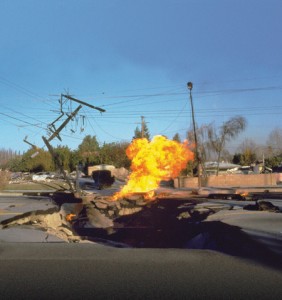
Gas fire in street.

Gas fire erupting through LA street after Northridge earthquake. (photo by M. Rymer)

No matter how carefully lines are monitored, however, leaks and breaks can happen.  Most often, they happen when construction equipment accidentally punctures a line.  They can result from a natural event like a storm, earthquake, tornado, or ice storm.  Sometimes an over-loaded, aged infrastructure is to blame.

Leaks could happen at any time.

How do your local gas lines stack up?

An online search using the National Pipeline Mapping system is a good place to start. Dig deep on that site to find the names of the various operators of the different lines in your area. Contact them to get more details about the age and condition of their lines, their monitoring and safety policies and plans, etc.

If you think you have an emergency…

If you see or hear any of these near a pipeline right-of-way, it could signal a leak:

  • A hissing, roaring sound
  • Dirt or dust blowing
  • Water bubbling or spraying
  • Dead or brown vegetation
  • Flames coming from the ground
  • “Rotten egg” smell

(Typically the “rotten egg” smell is added only to smaller distribution lines. It won’t appear in major transmission lines.)

What’s the right response to a potential gas leak?

Get out! But do it intelligently.

  • Turn off any machinery or motors.
  • Don’t turn on or use any electrical equipment that could create a spark. This includes turning lights on or off, making a cell phone call, closing a garage door, or using a battery-operated radio!
  • Do not allow any open flames, including matches, cigarette lighters, welding equipment, etc.
  • Evacuate the immediate area. If exiting a building, leave the doors open.
  • Keep bystanders away.
  • Do not try to find the source of the leak.
  • Do not operate any valves or other shut-offs.
  • Do not attempt any repairs.
  • Do not attempt to put out any fires.
  • From a safe distance, call 911.

Emergency Preparedness Training

Action Items: Train your Emergency Response Team to recognize this hazard and to respond accordingly. Invite an expert as guest speaker to one of your neighborhood meetings. Prepare a flyer (taken from this Advisory?) and include it in your “Welcome Wagon” handouts for new neighbors.

We consider gas line leaks and the potential for fire resulting from them as the number one threat to our neighborhood! Where do they fit in your list of top threats?


Can You Spot a Terrorist Before Something Goes Down?

Share

(First of a three-part series on terrorism.)

Before we jump into this subject we need to clarify what we mean by “terrorism.”  When most people think about terrorism, they’re really envisioning attacks by jihadists or other non-state actors like those who perpetrated the 9/11 attack.  In reality, we need to broaden our definition to include domestic terrorism and terrorist acts perpetrated by individuals or groups that are motivated by political or domestic “causes” . . . and persons who are mentally unstable.

Pre-Incident Indicators

From the standpoint of frequency of events, the domestic terrorism poses a greater threat than that perpetrated by international groups.  With that in mind, let’s explore some of the “signs” – or, Pre-Incident Indicators (PIIs) of a possible, impending act of terrorism at a target location . . .

Reconnaissance

Possible surveillance?

Serious terrorists – even would-be ones – are most likely to visit the target area in advance, conducting surveillance and even taking photographs to aid them in their planning.  It is often difficult to differentiate between terrorists and tourists since both are interested in the features of the location, but with just a bit more attention, you can notice these traits:

  • Tourists are likely to take photographs at random of the more interesting features.
  • Tourists often take photos with themselves or their friends in front of the interesting features.
  • Terrorists will likely be more systematic, taking multiple or series of photographs of areas of ingress and egress.
  • Terrorists will be making notes about security coverage, monitoring activities, drawing floor maps, drawing diagrams of the location, using a recording device, etc.

Elicitation (attempts to get information)

Everybody has questions and asking questions in unfamiliar surroundings is normal.  Would-be terrorists, on the other hand, will be interested in more than the casual answers.  While their conversation at first appears ordinary, they will attempt to gain  more detailed information to determine security procedures, vulnerabilities, etc.  Elicitation attempts are not always made in person.  They can be made by telephone, mail or email inquiry or research at a library, etc.

Examples of unusal questions might be, “When does the next shift (of security guards) come on?” or “Where are the electrical shut-offs?”  Surely a question like one of these should capture your attention!

Please watch for the next post in this series. Part two will cover the logistics of terrorism and the third part will delve into the tests of security, dry runs, etc.

Logistics of Terrorism

Share
Terrorist taking photo

Spotting Activities That Could Be Acts of Preparing For a Terrorist Attack

(Part two of a three-part series) 

While random acts of violence are difficult (if not impossible) to foresee, planning and preparation for a “terrorist’s attack” has certain characteristics that, when combined, can be used to identify a pending event.

Financing

Funding any significant act of terrorism will often require activities that are out of the ordinary or out of character for someone.  Typically, large amounts of cash involving unusual deposit or withdrawal activity are required.  Solicitations for money or collections for donations or even fraud and transactions involving counterfeit currency or goods can provide the funding for terrorists.

Acquiring Unusual Supplies

Unusual supplies?

Unusual or particularly large purchases of chemicals or supplies, weapons or ammunition by unfamiliar or non-regular customers are worth noting.  Attempting to acquire official uniforms, vehicles or other items that would give them access to restricted areas is another sign to look for.

A case in point was Timothy McVeigh’s and Terry Nichols’s purchase of a large amount of fertilizer that would be used to perpetrate the largest scale incident of domestic terrorism in modern US history.  A close look at McVeigh’s reading and entertainment interests – as well as his radical political views – would also provide worrisome behavioral characteristics . . . but, then hindsight is, as they say, 20/20!

Deploying Assets

Getting people, supplies and vehicles into position to commit a terrorist act is often overt and observable by people familiar with the area.  It’s also the most immediate indicator with the least amount of time to alert authorities of the possible danger.  A good example of this was the SUV full of inflammable materials that was parked in Times Square, downtown Manhattan and brought to the attention of authorities by a street vendor familiar with the area.

Situational Awareness: Being Alert to Your Surroundings

Your best defense against terrorism is staying alert to your surroundings without becoming overly paranoid.  (For more about “situational awareness” here.)

You also want to avoid “profiling” individuals.  There is no “typical” terrorist appearance (Again, think of McVeigh and Nichols.)  School shootings should make it clear that the perpetrators look just like your next door neighbors or that kid in the next classroom.  The appropriate way to protect yourself is not to profile appearance, but to profile behaviors. 

This series continues with part three, focused on a terrorist’s practices or dry-runs.

Gas Pipelines in Your Area

Share

One of the possible risks you face, whether at home or at work, is from a pipeline leak. A good emergency preparedness plan reminds you to find out where pipelines are located, what they carry, and how to respond if there is an emergency.

Step One: Look for nearby pipelines.

Warning sign for petroleum pipeline

Have you seen this sign?

Find local pipelines by watching for pipeline signs as you go about your daily business! They are typically posted at major intersections, railroad and water crossings, and at property boundaries. The sign shown here is only a sample; a real sign would give more information about the kind of material being carried by the pipeline – for example, “petroleum,” “high pressure gas,” “natural gas,” “oil,” “jet fuel” — and include the operator’s emergency phone number.

Action Item: Get all members of your team, or workplace colleagues, to watch for signs as they come and go from home and work. They can bring in photos and locations. Build your own map of where they are located, and of your vulnerabilities.

Step Two: Find a detailed gas pipeline map.

The National Pipeline Mapping System provides an online service where you can search for pipelines by state and county. The maps are layered, showing transmission lines, liquid natural gas plants and breakout tanks. Smaller lines (distribution and gathering systems) are not included in NPMS. You can print the maps, but you are not able to download the underlying data.

You don’t need a password to get into the site, but it does take a while to get through all the different layers. You will be able to see a map by county and then, by entering a specific address, you’ll see major carrier lines, the pipeline operators for the area, what is carried and whether it is “hazardous,” whether the line is in service or abandoned. You can also use a tool to measure how far you are from the pipeline.

Access the National Pipeline Mapping System here.

Action Item: As part of your Risk Assessment process, research your local geographic area using the National Pipeline Mapping System.

Step Three: Know how to respond to a pipeline leak or break.

Watch for the continuation of this article in an upcoming Advisory here at Emergency Plan Guide. Sign up below to be sure you get ALL the Advisories about Gas Line Leaks.

Virginia
Your Emergency Plan Guide Team


Emergency Supply Kit — Portable Radio

Share

A wide-spread emergency can result in a power outage that lasts for days or even weeks. Over that entire time, if you’re on your own, you’ll need an emergency radio — or perhaps more than one — to know what is happening outside your immediate area.

What’s the best radio for emergency purposes?

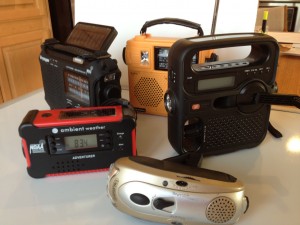
The photo below shows five radios that we have purchased and tested; find our comparison of these five emergency radios here. (Guess which one of the radios is a dud!)

What follows are the basics for any radio you decide to put in your emergency supply kit.

A portable AM radio will be your lifeline.

Five emergency radios

Which radio should you choose?

Local emergency services and radio stations will be broadcasting news that you will want. Be sure you know what channel they’ll be using!  (Put a label on each radio.)

 — Evacuation plans: schedules, staging areas, different routes, location and status of available shelters

 — Weather reports: temperatures, anticipated rain and/or winds

 — Location of areas to avoid: “hotspots,” traffic jams, roadblocks

—  Announcements from Police, Fire or other emergency services

Generally, all the above notifications will be broadcast over the AM band. FM and television signals are “line of sight,” so they can get blocked by tall buildings, mountains, etc., and usually dissipate after about 50-75 miles. AM signals, on the other hand, can bounce off the ionosphere and travel much further (even all the way around the earth!). So, in an emergency situation, you want a strong AM radio so you can tune in to local emergency transmissions.

Your radio needs to work for days or even weeks.

In a power outage, your radio won’t work by being plugged into the wall. It will need an additional source of power – typically batteries. When they wear out, how will they be re-charged?

  1. Replace the batteries with new ones from your supplies. Obviously, you have to have plenty of the right size: AAA, AA, D, C, etc.
  2. Recharge “rechargeable” batteries using a hand crank and generator, built into the radio.
  3. Recharge the batteries using solar power, either built into the radio or attached as a separate panel.

What combination of features will work best for you?

Check out our Emergency Radio Review. It has a series of questions that will help you select exactly what you need.  It also identifies the one radio in the group above that you should NOT buy!

Virginia
Your Emergency Plan Guide Team


Improving Building Safety – Chimneys

Share

Building Structures, continued . . .

Disclaimer: The following basic info comes from a number of sources deemed to be reputable.  BUT, be sure to get more information before you start making any changes to your home!

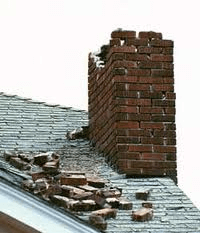
Partially collapsed brick chimney
Partial collapse damages roof

Chimneys are dangerous.

If you don’t have a chimney, you can skip this post – but only if your neighbor doesn’t have a chimney, either!

Chimneys are dangerous because they are usually constructed of unreinforced masonry or brick. In an earthquake, they can fall onto the roof of your house or to the ground.  In many cases, the entire chimney falls away from the wall, collapsing in a pile of bricks on the ground.

What’s the condition of your chimney/s?

Take these basic steps to understand the risk in your own home.

Action Item:  Check the condition of your chimney. Is the mortar crumbly? If yes, that’s a danger sign.  Check the attic. Is the chimney tied to the house with metal braces? If not, that’s a danger sign.

Consider these steps to make your chimney safer. 

  1. Check around the base of the chimney OUTSIDE to be sure there are no parking areas or play areas that would be threatened if the chimney came down.  Take a look at your nearby neighbor’s chimneys to see that they don’t threaten your yard or house, too.
  2. Consult with a professional to see if the chimney can be attached to the house.
  3. Consult with a professional to see if your roof or walls can be strengthened — typically with plywood sheets —  to protect against falling brick.
  4. Remove the bricks in the top section of the chimney and replace with a metal flue.

Again, any construction you undertake should be with the advice of a qualified professional.  But don’t procrastinate.  If your chimney is dangerous, it’s only getting worse with age.

Virginia
Your Emergency Plan Guide Team

If you are just coming across this Advisory, don’t miss the other Advisories that deal with improving your home’s safety:

Share these Advisories with neighbors, too.  Their home is likely to be as vulnerable as yours is.

Improving Building Safety – Windows

Share

Building Structures and Safety

If you live in a single family home, there are a number of things you can do to make your home safer. Of course, each home is different. The risks associated with YOUR home will depend, in part, on its age (which may determine what building codes were in effect when it was built), style (one or two story, big windows, overhangs, etc.) and quality of construction.

However, the safety of nearly every home can be improved.

Let’s start with a study of windows.

Large panes of glass can be the “weak point” of the home. If you have the chance, stay away from them!! during an earthquake, windstorm or tornado.

Improving your chances with windows.

Broken window with securty glass
Safety glass film holds pieces of broken glass

When windows break, shards may all or be thrown across the room. You can mitigate flying shards by:

a. Installing tempered safety glass. It breaks or crumbles into small pieces. They may cut but probably won’t kill. Since 1977 Federal law has required that tub and shower enclosures be made of safety glass.

b. Installing solar/safety film (“window tinting”). When properly installed, this film is invisible and has double benefits: it saves energy AND keeps the windows from shattering. If you sleep under a window, installing solar film is the easiest and safest preventive measure.

c. Pulling drapes or shades. If you know danger is coming, pull down and close shutters or draw drapes. They will offer some protection against flying glass.

Look up from your computer right now.

Are you seated near a window that could blow out or break?  Is there a safer place in this room?  Action item:   take a tour of your whole house to identify the safest place in each room, away from breakable windows — and preferably under a sturdy piece of furniture.

Virginia
Your Emergency Plan Guide Team

P.S.  Windows are only one danger point. In an earthquake nearly every movable item could become a missile! For more ideas about improving the safety of your home, check out this recent Advisory: Secure Your Space.

Improving Building Safety – Interior

Share

Preparing Inside the Home

There is no guarantee that you’ll be home when the “big one” hits. But if your home has been prepared to withstand an earthquake or storm, you’ll find more there to appreciate when you DO get back.

I rode through the 1989 quake in the S.F. Bay Area in a restaurant. We came out shaken but unhurt. A couple of hours later I dropped off my colleague at her apartment. I went in with her. It was amazing.

The kitchen looked as though a whirling dervish had gone through every cabinet and cupboard and just tugged and thrown things out into the middle of the room. Broken glasses of relish and jam were mixed with dishes and pots and pans; fruit was mushed in with books and flour and, I remember, a broken bottle of vinegar. Broken flowerpots, broken fishbowl. (Who know where the fish was?) Plates and cups smashed, with a colander lying on top of them. Half the leftovers from the refrigerator, its door hanging open. Everything already starting to smell and spoil.

What a mess!

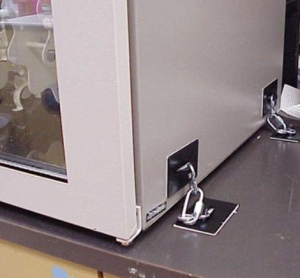
Large cabinet with metal tiedowns
Secure heavier items

Step One — Take a Safety Inventory.

To start to prepare your house, simply do a walkthrough and take an inventory of WHAT WILL FALL OUT OR FALL OVER?

Step Two — Build Your Action List.

Now, systematically begin securing your home against this potential damage. Here are some ideas and some of the tools or equipment you’ll need.

* Rearrange storage. Put heavy things on lower shelves, precious things behind cabinet doors. Keep dangerous or toxic materials in low cabinets, too.

* Get latches for your cabinets. Easy, cheap to install.

* Use adhesive putty (“Museum putty”) to pin down collectibles or art work on shelves.

* Strap down computers, monitors and TV screens. (Over 300 people were killed from falling TVs last year, not even in earthquakes!) Strapping kits are available at home improvement stores.

* Fasten bookcases and wardrobes to the wall. Our recent purchase of bookcases at Ikea automatically included earthquake angle brackets.

* Keep books on the shelves, even if the bookcase doesn’t fall over. String a piece of fishing line across the shelf in front of the books, or use specially designed elastic cords.

* Wine bottles?  Take a good look at your wine collection. Figure a way to restrain the bottles by enclosing them.

* Your refrigerator or dish washer may creep or fall in an earthquake. You can fasten it to the wall (to the studs) using plumber’s tape (metal straps with holes) or Velcro fasteners. Get some expert advice here before you attach anything to the refrigerator back.

If you’ve read this far, you realize that each house is different.

Action item: Do the walk-through today! If you have children, enlist their help. Start taking steps to make your home safer. (You’ll sleep better as a result, too.)

Virginia
Your Emergency Plan Guide Team

P.S. You’ll find some specific recommendations for safety fasteners, straps, etc. right  here.