Author: Volunteer

Welcome to the World of Drones

Share

Available for immediate delivery from Amazon . . . just click on the link to get full details!

Below left, white drone, at around $1,000: DJI Phantom 2 Vision+ Quadcopter with FPV HD Video Camera and 3-Axis Gimbal.

Right, at around $50: Hubsan X4 H107C 2.4G 4CH RC Quadcopter With Camera RTF – Black/Red

Hubsan Drone for Sale

Around $50

Why in the world would you want to spend a thousand dollars (or more) on a drone for your Emergency Response Team?

Drone for sale to public

Around $1,000

Answer: If you have money to burn, or if you have a large geographic area to cover or high value properties to document.

Drones are looming big on the horizon. . .

and the Federal Aviation Agency is scrambling to write the rules of use. They are worried (and rightfully so) about the danger drones represent to civilian and commercial aircraft.

But the rules haven’t been written yet and civilian, non-commercial use is growing by leaps and bounds (no pun intended here).

Surveillance of Disaster Areas

One good use for First Responders is to survey the area following a major disaster. Drones can be directed over specific targets and provide excellent photographic records sent in real time to a laptop computer.

This use could shortcut the first responsibility of the Fire Department after a major event, which is to  do a “windshield check” before responding to any individual fires or disaster scenes. The check establishes the passability of roadways and sets priorities for their next steps.

Using drones according to a pre-established grid matrix can accelerate the First Responders’ task, gather more specific and accurate data and allow them to more quickly respond to individual sites.

Delivery of Emergency Equipment

The Neighborhood CERT can use a drone in a similar way, albeit for a specific neighborhood. It could be especially helpful in covering a rural area or a widespread neighborhood geography.

Drones can also be used to deliver emergency supplies, such as a defibrillator, two-way radios, etc. They can also be used in a security setting for surveillance or serve as a deterrent to incursion by strangers.

Weapons of Mini-Mass Destruction?

So much for positive benefits. There is a negative side to drones as well.

While retailers are experimenting with package delivery by drones, it’s probably just a matter of time before some deranged person (or actual terrorist, for that matter) decides to try delivering harmful chemicals or explosives by way of a drone. (Ballistic Drones?)

While it’s doubtful that drones readily available for public purchase can carry large payloads, they do lend themselves to use by individual actors on local targets. And if this seems unlikely – or even a remote likelihood – consider how much fear and potential public hysteria the even more remote threat the Ebola virus created.

If nothing else, it’s something that should give the survivalists something to think about.


Joe Krueger
Your Emergency Plan Guide Team


Marketing Challenge for CERT

Share

Challenging the neighbors

A couple of weeks ago I reported that our local CERT group was

Run, Hide, Fight powerpoint presentation

PowerPoint presentation for group

scheduling a showing of “Run, Hide, Fight: Surviving an Active Shooter Event.”  Since it’s only 6 minutes long, we planned a brief half-hour meeting for intro, showing, and discussion.

(I embedded the downloaded video into a PowerPoint presentation – see photo — so I could create a complete talk, with intro and some follow-up questions.)

I announced the showing in our neighborhood newsletter (one small paragraph in a 20-page newsletter), on our neighborhood website, and also via email to my list of about 30 neighbors.

And I got a response I wasn’t expecting.

I’m sharing the story here because I’d like to hear YOUR comments.

As always, I try to create some curiosity with my headline to attract more readers. Here’s what I used this time:

“If it happens, you’ll have only seconds to react . . .”

Then I followed up with, “The chances of you finding yourself in the middle of an active shooter event are small, but that’s what the people in Ottawa probably thought, too.”  Details of the meeting followed.

Anyway, here’s a response that I received:

“Suspense, is that the answer to something so important to our lives?” 

 The writer went on for several long messages, criticizing me for not revealing immediately how to respond in an active shooter event.

 My reaction  . . .

  •  At first I was surprised at the vehemence of the writer.
  • Then I got defensive. (“I know from experience that simply reading a sentence or too won’t compare with making the effort to join a group to watch the video and discuss it.”)
  • Finally I figured this subject had simply triggered something for this particular individual.

The meeting came and went.

We had a modest attendance with a number of good comments and questions. This was a senior audience, so the discussion about “FIGHT” was different from what a younger crowd might have had. And it was also agreed that a new version of the video could profitably be made with the setting in a mall or retail establishment instead of in a workplace.

People were interested and participated, and several thanked us for “good information.”

With the meeting over, we went home. But I keep remembering that email exchange.

So now, it’s your turn to comment.

Have you shown the video to a group?  If so, what message did you use to attract attendance?  How did your promo work? How was the video received?

If you haven’t shown the video, please take the time to watch it now, and let me know how you would promote it to YOUR neighbors (work group, classroom)!

 You can go right to YouTube to watch it now: http://youtu.be/5VcSwejU2D0

A big part of our sharing these posts is to get MORE information to MORE people in such a way that they will INCORPORATE it into their daily lives.

It’s a big challenge . . . so I’d appreciate any suggestions or comments you have.

Thanks in advance!


Virginia Nicols
Your Emergency Plan Guide Team


Stocking Stuffers for the Whole Family

Share

Traffic was CRAAZY today, and it’s not even Thanksgiving! Everywhere the news is about early shopping (plus some football games, of course).

If you’re ramping up for some holiday shopping of your own, I’d like to suggest the following . . .

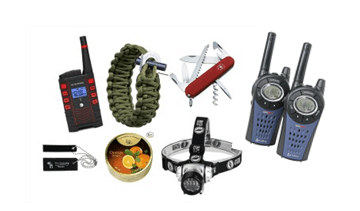
Emergency survival kit items

“Makin’ a list . . .”

Small, very cool, dual-purpose gifts

By which I mean, gifts that are fun to receive and even to play with, but which have a much more lasting value because they become important items for a survival kit!

Here are seven such treasures, each under $25

If you need a shopping list, just print out this page!  If you want to shop (which I recommend!), click on the links below each item description.

Clicking the links will take you to Amazon, where you can compare and combine items for the best possible pricing plus free shipping. Just so you know, if you buy from Amazon, we may receive a small commission.  It doesn’t change the price you pay.

 *  Headlamp – Of course you have a flashlight in every car and hopefully one in every room of the house. And, we hope, with at least 200 lumens. Now, consider how handy a HEADLAMP will be when both arms are full of blankets, children, toys, or other supplies!

LE LED Headlamp, 18 White LED and 2 Red LED, 4 Brightness Level Choice, LED Headlamps, 3 AAA Batteries Included

*  Magnesium lighter – Hold a fire-lighting contest for all your teens on Christmas Day. This 3-pack of magnesium lighters gives you the chance to compete – and learn an essential skill!

The Friendly Swede Magnesium Emergency Fire Starter Blocks (3 Pack), Black

*  Paracord bracelet – Totally cool, totally comfortable, and very handy in an emergency, these bracelets contain 17 ft. of strong cord and come in just about any color you – or family members – could want! This link is to a braid-it-yourself kit, which would be a great holiday activity. Or pick out an already-made one.

Paracord Planet 550lb Type III Paracord Combo Crafting Kits with Buckles (ZOMBIE)

*  Tin of hard candies – Chocolate melts, caramels ooze and stick, mints crumble. But hard candies withstand all sorts of weather and when you need a pick-me-up in an emergency – or on the long drive home after the holidays! – this will do the trick. Top quality, top flavor.

Cavendish And Harvey Candy (3 Pack) Fruit Hard Candy Tin 5.3 Ounces Imported German Candy (Orange Drops)

*  Swiss Army Knife, the classic – We all love our Swiss Army knives. Whether you get this simple, efficient one or a giant, every-tool-in-the-toolbox version, it will be a welcome gift. And a great addition to a survival kit.

Victorinox Swiss Army Camper II Folding Camping Knives, Red, 91mm

*  Walkie-Talkies — Favorites of children, parents and CERT members, these handy radios work for fun games around the house, at the mall for keeping track of the family, and in an emergency when all other phones are out!  (We have several pairs, with pre-arranged channels in case we are separated.) (As you shop, consider the range figures as approximations only, achieved under “optimal conditions!”)

Midland LXT118 22-Channel GMRS with 18-Mile Range, E Vox, and Channel Scan (Pair)

*  Water Bottle with Built-In Filter This may not fit in your traditional Christmas stocking, so add it after everything else has been opened. We know water is essential, but bottled water gets old, and is really heavy. What you CAN pack so it will always be ready is a reusable water bottle with built-in filter.

LifeStraw Go Water Bottle with Integrated 1000-Liter LifeStraw Filter

Now, if you’re VERY detail oriented . . .

. . . you will have compared this list with the photo and you will have discovered two discrepancies. First, the list contains a water filter bottle that isn’t shown. (Too big to fit in the sock, and too big to fit in the picture!) and Second, the image shows a radio that’s not listed.  This happens to be one of our favorites, so I included it because I do as often as I can.  Find out more here on our radio review page.

Do you have recommendations we can add to our list of “Favorite Survival Kit Goodies Under $25?”  Send them along!


Virginia
Your Emergency Plan Guide team


Don’t miss any of our free Advisories. Sign up below to get them every week.


Worried about power going out? Before you buy a generator . . .

Share

The terrible snow storms this week may have prompted you to consider buying a generator. Before you do, read this . . .

By way of background, Virginia and I have played a key role in building a Community Emergency Response Team (CERT) in our neighborhood. We even have a budget from our Homeowners Association. And a couple of years ago the group agreed to purchase a gas generator to support our emergency planning team.

We originally purchased two, each of which put out 6,000+ running Watts, with 8,000 Starting Watts. On sale, each cost about $800, and was compliant with California environmental laws.

Then reality set in.

First issue: “Pounds per Watt!”

Generator to power a whole house

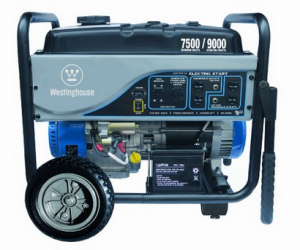
Portable generator with wheels, handles

Our big generators were deceptive. Their wheels and handlebars make them look portable. After jockeying one of them around it became painfully clear that their weight – as well as their appetite for fuel – was greater than we had foreseen. Also, they have to be started and run for 15 – 20 minutes every month or two or they will require resurrectional service (cost around $100 . . . if WE take it in to the shop).

We returned the unopened generator, and went back to the drawing board.

What had seemed like a good idea at the time turned out poorly. We kept the one generator and plan to use it to power our Command Post in an emergency. There, we’ll need it for lighting and computers and other communications. We’re still debating about purchasing any additional generators.

Second issue: Realistic output. 

You probably know that a portable generators isn’t going to power your home around the clock during an extended power outage.
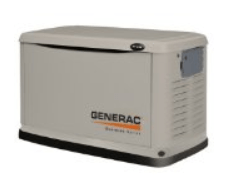
Generac Standby Generator

Standby, or permanently installed, generator

With careful management, however, an emergency generator can keep a minimum number of appliances operating in order to provide more comfort and convenience during an emergency. And with careful purchasing, you might be able to get what you need for less than $400.

For example, you can apply your power 3-4 times a day for 15-30 minutes to keep your refrigerator/freezer operating. (Exact times depend on the size of your appliance). Charging up electronic devices (laptops, tablets, cell phones, etc.) can be done at the same time since most generators have more than one plug-in socket. But plugging in an appliance that generates a lot of heat – such as a hair dryer or toaster or portable heater – may overload the generator.

Hence, managing run times and appliance combinations is required.

It’s up to you to do some homework by listing the power requirements of your various appliances, combining appliances for a reasonable total power requirement, then finding the smallest unit that will do the job.

Third issue:  What fuel to choose?

Most of the portable generators for sale at your local hardware store or online will be powered by gasoline. So, consider where and how you’ll store the gas you need. Gas is easy to get most of the time (though probably not during an emergency). But gas is messy, is highly flammable, and degrades after 12 months or so.

But what about diesel, you ask? Compared to gasoline, diesel is cheaper, lasts twice as long in storage, is more fuel efficient and less dangerous. But typically you’ll need to install a storage tank to hold it. So, while some generators are set up to burn diesel, they are mostly the larger, permanently installed models that are planned to run for longer periods at higher load.

Some portable generators burn liquid propane and some can burn either propane or gasoline.  Storing propane is easier than storing either gas or diesel; it can be stored in a tank or in cylinders. And propane is the cleanest burning fuel of them all. Naturally, a combo unit (running either gas or propane) is more expensive that a single-fuel generator.

You want to consider all three fuel options.

But, keep in mind that NOT ONE OF THESE MACHINES SHOULD BE RUN INSIDE!  They have specific directions for their use and warnings that should be respected by all users.

Some Guidelines to Help You Make Choices.

These examples come directly from Amazon, where you’ll find literally hundreds of different generators on sale.  We have picked these as having representative prices and positive customer reviews.  As you shop, compare:

  • delivery costs
  • warranties
  • environmental standards (for ex., CARB = OK to be sold in California)

Live in an apartment, condominium or modest home with access to an outside patio or small back yard, you’re looking at a small, portable unit that’s as quiet as you can find. (Propane generators are quieter than gasoline.) An example: the Champion Power Equipment 42436 1500-Watt Portable Generator, CARB Compliant costs $201.88 as of today. These items have to be shipped via ground so it may take longer than you’re used to for delivery.

Live in a Single Family Home, 3-5 Bedrooms, with outside access to patio or private yard? You can probably use a larger unit and won’t worry so much about noise or fuel storage.  For about $330, you can get something like the DuroStar DS4000S 4,000 Watt 7.0 HP OHV 4-Cycle Gas Powered Portable Generator.

Large Home or Small Business that still needs to continue running, even on a reduced basis, may require something like this model.  (It’s the one in the photo above, with wheels and handles that make it LOOK portable, but it weighs a good 200 pounds!Westinghouse WH7500E Portable Generator, 7500 Running Watts/9000 Starting Watts at $865, with free scheduled shipping.

Medium-Size Business that cannot afford to shut down for any sustained period, you’re looking at what’s called a “standby” generator. These are installed permanently and go on automatically even if you’re not there.  This example (shown in photo above.) runs on propane or can be connected to a natural gas supply (probably not the best idea if you live in earthquake country). Cost: $2,549 with extra $20 for shipping.Generac 6439 11,000 Watt Air-Cooled Steel Enclosure Liquid Propane/Natural Gas Powered Standby Generator (CARB Compliant) without Transfer Switch

This should be enough to get you started on some sensible shopping!

Joe Krueger
Your Emergency Plan Guide team


Looking for a bit more background? Here are a couple of Virginia’s recent posts:


Whoops, did you miss it like I did?

Share

(This article first appeared in 2014. As you can imagine, it has been updated since then — mostly because I have learned more about the ins and outs — or offs and ons and chirps — of smoke alarms!)

We remind everyone that when Daylight Savings Time comes round, it’s time to check the fire alarms.

So it’s now two weeks after the date, and I finally got around to practicing what I preach. Keep reading for what turned out to be an eye-opener!

Just looking up at the smoke alarm tells me nothing.

Testing Fire Alarm - Emergency Plan Guide

I seem to recall that my old alarms had a blinking light, but I see nothing like that on this one. My old alarm also once emitted a chirping sound — but I have heard nothing from this one.

Anyway, on with the test.

  • I haul out my trusty step stool, position it properly and climb up.
  • I look for the round test button (while being careful not to overbalance).
  • Hey, look there! I discover a green light, deep in a recess. Is this what I was looking for?
  • Well, since I’m up here . . .I press and hold the round button.
  • Eeeeehhhh!

O.K., we know it’s working!

Now what about the other alarms in the house? Before I take a look at them, let me do some quick research.

I always thought fire alarms were pretty straightforward.

Here’s what I discover about the alarms in my house.

  1. Code for fire alarms changes on a regular basis. My home is relatively new, so it has hardwired alarms that have a back-up battery. It’s that battery that we’re testing. (There are also alarms that operate solely on batteries. I used to have that kind.)
  2. In my home, all the alarms all connected. If one goes off, so do the others. Still, I have to check each one individually to be sure about the batteries.
  3. The requirement for alarms in California indicates that starting 2015 new battery-operated alarms must have a non-replaceable battery that will last for 10 years. After ten years, the whole alarm will simply be replaced. Some of those alarms are already on the market. So the question then becomes, do I have one of these models in my house? It’s back up the ladder. And the answer is no.

But here’s the discovery of the day . . .

I have always used the words “fire alarm” and “smoke alarm” and “smoke detector” pretty much interchangeably. It turns out that alarms are NOT all the same.

According to the National Fire Protection Agency (NFPA) there are two main technologies at work in fire alarms: ionization (alarm is set off when ion flow is interrupted by smoke) and photoelectric (alarm is set off when light is reflected off smoke).  (You can get the whole scientific description at http://www.nfpa.org/safety-information/for-consumers/fire-and-safety-equipment/smoke-alarms/ionization-vs-photoelectric

Ionization technology works best on a fast, flaming fire; photoelectric works better on slow, smoldering fires.

Logically, the very best fire alarm combines both technologies!

And also, logically, the combination models cost more.

So what alarm technology do I have in my home?

Ta da! . . .Looks like ionization smoke sensing technology! (This model seems particularly made for home builders, since it comes in a six pack.)

Where does all this take us?

  1. Check your own fire alarms to be sure they are working.
  2. Check to see how old the alarms are and if they are over 10 years old, get rid of them an install new ones.
  3. Get the best replacements you can.I just added the best photoelectric/ionization model I could find at Amazon to our own list of recommended products. Here’s a link to that model.

Let me know how your alarm testing goes!

Virginia
Your Emergency Plan Guide Team

Value of Employees . . . Before and After a Disaster

Share

If you’ve been following this blog for the past several weeks you know that we’re big on coordinating Personal Survival Plans with Business Emergency Planning.

The reasoning is simple . . .

Businesses depend on their Employees and Employees depend on their Employers.

But it’s pretty well known that most small businesses don’t have adequate Emergency Response Plans.  (Only around 67% have any plan at all.)

Small businesses never reopen after a disaster.

The future of your business?

Worse, statistics show that following a catastrophe, half of the businesses affected NEVER re-open their doors!

Why are businesses at such high risk?

  1. Owner attitude.

First is the attitude of some owners that they’d rather just cope with an emergency when it hits rather than make any plans to prevent or mitigate it. (We have to ask, if this is you or your boss, are you really a business person?)

  1. Emotional impact.

A second factor to business survival is that a major emergency has a dual emotional impact on employees.

Beyond their direct experience at the workplace, with damage and possible injuries, is the safety of their family members who may have been affected, too – but are spread out in the community somewhere.

Since communications are likely to be disrupted, employees will want to leave the workplace immediately to check on their loved ones. Once they disappear, the business has little chance of maintaining critical functions.

Improve the odds: integrate personal emergency planning with business survival planning.

Anything the business principals can do to facilitate employees’ family and neighborhood emergency planning will work to the benefit of all concerned.

One way to begin is by making sure that all employees have adequate Personal Family Survival Plans. This includes:

  • Personally-tailored survival kits at home
  • Kits at work and/or in their cars
  • Communication Plans for family members.

Take advantage of holiday timing.

Now might be a way to kick-start this by seizing on the holiday spirit.

Since we do not advocate buying pre-made, one-size-fits-all, survival kits — which typically include a lot of useless (or low quality) items – we strongly recommend that you consider getting them started with an empty backpack like this one from Amazon. It is big enough, but not too big, and has the advantage of opening from the top to give easy access to everything inside.  And if your company gift policy limits employee gifts to a maximum of $25, you’re in luck!  (Click on the image to get full details, price, etc.  Different colors have different prices.)

As a gift, the survival kit meets important criteria.

  1. It’s meaningful.

Every step that an employer can take to help employees prepare their own personal disaster plan will be meaningful for both.

  1. It’s personal.

Some people really like clothing with logos, or parties, but others don’t appreciate those gifts at all! Candy? Cheese? Wine? These all depend on people’s personal tastes.

The survival kit is a backpack waiting to be filled with items that the employee chooses!

How to add value to this gift.

The business can use the survival kit to kick-start a more in-depth discussion of preparedness. Setting up an emergency supplies fair at lunch or after work, for example, can improve the odds of employees actually building their kits.

The business can do even more by adding an item to go into the kit – for example, a flashlight or solar-powered or hand-crank radio. Here’s a link to our updated list of the top 10 survival kit items.

And an additional benefit. . .

If your business is one of the 37% of businesses without any business continuation plan at all, this whole campaign could be the impetus to get a company plan started!

If this idea makes sense, you can head directly to Amazon to take a look. Here’s the link: Fuel Top Loader Cargo Backpack (Black)

And if you want to talk over some ideas of how best to present the backpacks to your employees, or how to speak to your employer about providing them to the workforce — just give us a call.  We have a lot of good experience with “employee gifts” that we will be happy to share!

Virginia
Your Emergency Plan Guide Team

P.S. I mean that about the call!


Active Shooter Event at Your Business

Share

What are the chances?

A little over two years ago I wrote for the first time about “active shooter events.”  Yesterday I saw in a recent FBI report such events have doubled in the past seven years.

And more than 2/3 of them take place at businesses or schools.

Do you work, or do you know people who work in office settings? Are you a student, or do you know students?

If so, do they know what to do if they suddenly find themselves in the midst of a live shooter event, or even hear shots?

Over in five minutes or less.

Run Hid Fight, Emergency Plan Guide.org

Link to this video below.

Two thirds of active shooter events are over in less than 5 minutes, and one-third are over in less than 2 minutes.

This means If you find yourself in such an event, you have to make QUICK decisions.

Freezing or waffling or screaming are NOT good responses, and in fact may get you killed!

The City of Houston, with the assistance of a Homeland Security Grant, created a training video that is really worth watching. We saw it first at city hall, shown and discussed by our local police department.

The video seems to have become somewhat of a standard for how to respond – and my recommendation today is that you make sure your co-workers have seen it.

The Standard — Run, Hide, Fight: Surviving an active shooter event

 Run, Hide, Fight shows a simulated event taking place in an office setting.  The whole video runs only 6 minutes.

 CAUTION: Although the action is simulated, it contains some intense scenes.  Prepare your audience before showing it.

You can view the video on YouTube at:  http://youtu.be/5VcSwejU2D0?hd=1

The FBI report mentioned above has not gone unchallenged. Criminologist James Alan Fox at Northeastern University in Boston points to the fact that there is no official tracking mechanism for active shooting and mass shooting events. And USA Today’s separate report showed different totals based on their own news sources.

For this Advisory, it doesn’t really matter whether the FBI’s definitions or totals correspond to USA Today’s. What is important is to know how to respond  or even prevent such an event.

Can such events be prevented?

Of course, prevention would be the most desirable option. As someone in a work situation, here are some statistics from the 64 incidents documented by the FBI that should give you pause for thought:

  • All but six of the shooters were male, nearly always acting alone.
  • In about 10% of the incidents, male shooters targeted current and former wives and girlfriends.
  • Other family members were targeted almost as often.
  • Almost all of the shooters had a “real or perceived, deeply held personal grievance.”
  • Shooters were inspired by and copied other attacks.

Are there warnings?

As we have learned, many – although certainly not all – shooters have been identified by family, fellow students or co-workers as exhibiting disturbing behavior well before they go on their killing spree. Even psychologists or other professionals have known of these people’s troubles.

Unfortunately, most people do not say anything for fear of civil lawsuits or for fear of being branded alarmists.

Take a look at your own school or workplace. Are you all watching out for fellow students or co-workers?  Are you aware of some of the most common triggers for violence, such as divorce, financial problems, or other legal issues? Do you have someone to whom you can report unusual or threatening behavior without fear of reprisal?

You may not be able to stop a shooter event. However, you may be able to save lives by making sure everyone knows the survival principles illustrated in Run, Hide, Fight.

The principles aren’t difficult, but having them top of mind could make all the difference.

Share the video!

We are planning to show the video in two weeks as part of our regular neighborhood emergency planning meeting. Some of the audience members will be very senior citizens; it will be interesting to see how they react.  I’ll report on how the showing goes!

And if you show it to your CERT team or your co-workers or classmates, let us know what questions it brings up.  We want to share every good idea we can. Here’s the link to the video again, http://youtu.be/5VcSwejU2D0?hd=1

Virginia 
Your Emergency Plan Guide Team

Get all our Advisories delivered to your email inbox. Sign up below.

Whew, I’m alive! Now what?!

Share

Questions for SurvivalI admit, the word “preparedness” is pretty dull. Besides, it has too many syllables.

On the other hand, “alive” is exciting! Easy to say, easy to grasp!

How do we convert “dull and boring” into “interesting” if not actually into “fun and exciting?”

The answer: “Questions for Survival!”

If you’ve been reading our Advisories, you know that for the past dozen years Joe and I have worked closely with our community emergency response team.

And for 12 years, we’ve done our best to convert staid old “preparedness,” and its cousins “advance planning” and “disaster prevention” into bits and pieces of information that will help keep people interested – and alive.

I just counted: we’ve published 109 Advisories on these topics!

  1. We’ve tried guilt. “How will you feel when your children turn to you and ask why you don’t have any food for them?”
  2. We’ve used cynicism. “Oh sure, the authorities will come to rescue us . . .some day!”
  3. We’ve appealed to the universal love of gadgetry. “The best single tool you have ever balanced in your hand!”
  4. Competition works sometimes. “Don’t let someone else take credit for the work you’ve put in.”
  5. Then there’s plain old fear. “Buried under a pile of rubble, will you be able to signal where you are? Will people even be looking for you there?”

All these approaches work to a certain extent. When we see that people have been looking at our equipment reviews, or commenting on our blog posts, or actually buying emergency supplies, we know it’s all worth it!

But, of course, we can’t stop.

Awareness is a perpetual mindset.

If preparedness is important to you, YOU can’t stop reminding other people about its importance, either.

So here’s another tool for you to use to turn a preparedness conversation from something boring into something that could be really interesting!

Questions for Survival – Series One

Whew2This is a series of simple “problems” that you are likely to face if, for example, the electrical power goes out.  Some ways to use the list:
  • At home.

Bring up one or a group of related problems at the dinner table. Spend 5 minutes, or twice that, coming up with solutions. You’ll be amazed at what family members will come up with (or maybe WON’T come up with) – and having once talked about it, they’ll be ready to respond when the problem really occurs.

  • In a group.

Use a few of the questions to stimulate discussion at work, or in a group setting at your church, your child care center, your AA meeting, wherever. You may uncover some things that people have completely overlooked BECAUSE IT WASN’T THEIR JOB! Interesting how disasters don’t discriminate . . .!

  • Forward to others.

Our goal is simple: to make people aware of potential risks, give them a sense of confidence that they will know what to do and thus have the best possible chance of surviving whatever emergency arises!

Click here to get your free copy of “Whew. I’m alive! Now what?! — Questions for Survival”

And share it!  Simply forward this email to friends, or via Facebook. We’re busy putting the finishing touches on Series Two, and will have it out soon.

Don’t miss any of them!

Joe and Virginia
Your Emergency Plan Guide Team

When Less is More

Share

Let’s face it. We are spoiled. We enjoy our creature comforts and we’ve come to expect them. From ambient lighting, ever-present refrigerator and freezer to air conditioning and the convenience of cable TV, wall-to-wall wi-fi and, oh yes, let’s not forget the electric toothbrush and hairdryer – we assume they’ll be there when we turn to them.

But when the lights go out . . .

and the power company says it will be 5-7 days before power can be restored, what now?

In our CERT community, the logical answer seemed to be to go out and buy a generator. A 6-8,000 Watt model would power a whole house; it seemed like a reasonable action to take. We voted on it at our monthly CERT-Leadership Team meeting and decided to purchase one generator as a pilot project. If, after testing over a 90-day period, the generator performed as well as we anticipated, we would put forth a plan to acquire additional units to be rotated among the more critical homes in the community.

Sounds like a rational plan, right?

Generator to power a whole house

Large enought to power a whole house

The generator we purchased came in a large box. There were images showing wheels and handles, but the thing required assembly.

I thought two of us could handle it. I was wrong. We managed with the help of a third person . . . barely!

When we got the wheels on we were at least able to move it, but still, only slowly. Much to our disappointment it was becoming apparent that our original plan was lacking. Actually it was turning out to be downright unrealistic.

To compound the challenge . . .

As it turns out, these generators cannot sit idle for long periods. Once fired up, they must be run at least every 30-45 days. To store or sit idle longer than 30 days, it is recommended that you follow specific storage procedures to prevent damage to the machine.

The warnings also make it clear that the 8kW generator can be dangerous to run if you don’t follow safety instructions. It can, for example kill you in a matter of minutes if you run it inside! Or it can start a fire if you turn it on with appliances improperly connected.

And, since most modern homes include a wide array of appliances, it’s really questionable that even an 8kW generator will be able to power an entire home.

Here, for example, are some typical running wattage requirements for a number of common appliances:

Appliance Req’d. Watts Appliance Req’d. Watts
Ceiling Fans 750+ Radio/Stereo system 75 – 450
Computer & Monitor 275 Television (color), 27 inch 115
Computer, Laptop 60-75 Television (color), 36 inch 140
Dishwasher 1,200 – 2,400 Television (color), Flat Screen 125
Furnace 750 Toaster 750 – 1,500
Hair Dryer 1,200 – 1,850 Toaster Oven 1,250
Heater (Portable) 750 – 1,500 VCR/DVD 17-20/20-25
Microwave 750 – 1,000 Vacuum Cleaner 1,000 – 1,500
Refrigerator (18 cu. ft.) 750 Water Heater (Electric) 4,500 – 5,500

So maybe a smaller generator makes more sense.

If you look at this list of appliances a number of things become clear:

  • A smaller generator/inverter can handle most critical tasks, just not all at once.
  • If you run a high-output generator just to power a refrigerator/freezer for half an hour a couple of times a day, you’re wasting precious energy and using up fuel . . . fuel that’s expensive as well as difficult and even dangerous to store.
  • Smaller, lightweight units are far more portable and economical to run.

What about price?

Now, many will argue that the initial purchase price isn’t all that different. While you will likely pay $400 – $600 for a quality unit putting out 2,000 – 3,000 watts and $600 – $800 for a unit that produces 6,000 – 8,000 Watts of power, it seems like the larger output machine is a better bargain.

Whatever “savings” you might enjoy, however, will quickly disappear and be overshadowed by the large quantity of fuel you are required to store, and the rate it is consumed by the larger unit. Those, compounded by the maintenance requirements and lack of real portability, make the smaller units far more flexible and economical to operate.

In our estimation, this is an excellent example of where less is more.

Interested in more on Generators?

Let us know YOUR experiences.

Joe Krueger
Your Emergency Plan Guide team

Ultimate Emergency Communications Device

Share

PowerOutageIn earlier Advisories we’ve talked about how best to communicate during an emergency when the power is out. Here’s the likely drill:

  1. First, try an old-fashioned landline; it may work when your rove-a-phone doesn’t.
  2. Try your cellphone. But if lines are overloaded, you won’t get through there, either.
  3. You’re down to option #3, a text message. Because it requires so little bandwidth, it may get through. But if cell towers are down, too? No luck.

So what’s the one phone that is most likely to ALWAYS get through?

You guessed it – a satellite phone!

The sat phone bypasses wires and towers altogether, shooting straight up to one of the satellite networks positioned 500 to 1,000 miles above the earth.  Given their position, the satellites are seldom affected by storms and thus won’t be impacted by whatever has hit your local community.

I thought I’d really only seen satellite phones in the movies. Typically, they were boxy and big, with an awkward antenna. And they seemed to appear mostly in the hands of the government, military or quasi-military, and usually on a ship somewhere.

Over the past few years, however . . .

sat phone technology has become refined and phones are now found in the hands of civilians around the world.  (So I may have seen one without realizing it!)

There are a number of companies offering the service, with phones that are now not much bigger than your cell phone. (You can see two of the most popular, the Inmarsat IsatPhone Pro Satellite Phone and the Iridium Extreme 9575 Satellite Phone at Amazon. Each looks to be about half-again as long as a typical cell phone, and to weigh about twice as much.)

Different services, high prices.

Although the different networks work differently, and have different coverage and quality, they do have one thing in common:  a relatively high price.

To buy the phone, expect to pay between $500 and $1500.  That’s just for the phone itself. You can pay more to get more features, like GPS, tracking, Bluetooth and WiFi capabilities. Most basic models allow you to send and receive text as well as email messages.

In addition, you need to pay for airtime.  You can prepay for the time or you can buy a monthly contract. Satellite airtime can be less expensive than cellular roaming rates, or a whole lot more (up to $10 a minute!), depending on which service you have. So, it’s back to knowing in advance just what you need the phone for!

Other things to keep in mind:

  • A satellite phone won’t work inside a building. It needs access to the sky in order to “find” the satellite.
  • The antenna needs to be extended, so you can’t put the phone in your pocket and expect to know when you’re receiving a call.
  • Phone numbers seem to be more complicated. It reminds me of the work-arounds we used to see, where people dialed a local number to get to a trunk line and then another number to get to their desired party.
  • There may be dead spots, depending on where you find yourself. Trees, jungles, buildings and mountains can block signals.
  • Audio quality may not be as good as what you’re used to.

Even with all these imperfections, satellite phones have become standard equipment for business and for governments. A temporary rental (day, week or month) is easily managed over the internet, with the phone shipped right to you at home. Again, read carefully to be sure you get the accessories and the air-time bundle you need.

When it comes to emergency response, you may want a satellite phone for a particular period of time (say you’re going on a trip), for a season, or all the time.

It’s the ultimate in communications reliability.

As you consider your emergency communications needs, don’t overlook this technology. It could be the insurance you want. (Paying $6.50 for a minute of hearing your child’s voice – priceless!)

(My thanks to author Marc Weber Tobias, whose article in Forbes was the basis for much of what I have written here.)


Virginia

Your Emergency Plan Guide team

P.S. If you have used a satellite phone, let us know your experience!


Teacher, Worried About Your Kids’ Safety?

Share

Who takes top honors when it comes to emergency preparedness in the schools?

In September, Save the Children’s annual report card awarded Illinois the “most improved” title.

Disaster Master quizBut Illinois only “won” because the state had experienced tornados – and the old plans for tornado safety didn’t work!

What Illinois schools learned from November 2013 tornados:

  • The principal of Central Intermediate School in Washington, IL, said: “We had areas we thought were safe, but after the tornado, we looked at the debris and we thought, ‘No, we cannot put our kids in certain spaces.’”
  • He also reported that cell phones and even texting worked only sporadically – while there were injured people needing professional help. (Now the school is getting portable radios.)
  • At Washington Community High School, the assistant superintendent reported that “Hallways became wind tunnels, so now instead of shifting students into the hallways, we are moving them into interior rooms without windows.”

Where does your state stand?

The same Harris Poll that showed Illinois’ improvements showed that 21 states don’t even require schools and child care providers to have a basic emergency plan!

What about where you live?

You can head to Save The Children’s website and click on the map of the U.S. to find out what your state requires. (Click on your state, then on the report card to the right.)

Here’s the link to the map:  http://www.savethechildren.org/site/c.8rKLIXMGIpI4E/b.8777049/k.FE2A/Get_Ready_Get_Safe_US_Preparedness_Map.htm

(This is a very long link. If you can’t get there by clicking, go to www.savethechildren.org and simply type into the search box: “US Preparedness Map”)

Required or not, what can you do to improve your children’s chances?

If preparedness has been on your radar for a while, you are certainly aware of the various government websites that offer checklists and suggestions for family and business preparedness.

When it comes to school preparedness, your state department of education might have some resources, too.

As of today, my number one resource choice for teachers is . . .

DISASTER MASTER!

This quiz, available at Ready.gov, is fun to take and will be a great starter for a classroom conversation!

You pick the threat and go through a series of questions that train children how to respond.  (Of course, that’s why it’s my favorite. Knowledge is good; being ready to take action is a whole lot better.)

Hint: Be sure to save the secret password for each level to go on to the next.

Here’s the link: http://go.usa.gov/yqC5

As you can see from the illustration above, the quiz characters are modern and you’ll find the cartoon drawings themselves to be professional and compelling.

Please check this out for yourself, and forward this email to any teachers you know. Share it with your PTA or with your home schooling group.

We can never do too much to protect our children, and being charged with doing too little, when the information is readily available . . . well, that’s unthinkable.

Let me know how it works out!


Virginia

Your Emergency Plan Guide team

P.S. If you missed my earlier Advisory for parents, here is the link again:  https://emergencyplanguide.org/dear-parent/

Flaw in your emergency plan?

Share

f course, you hope nothing will ever happen.

Broken security glassAnd it’s painful to imagine yourself, a loved one or a co-worker buried in darkness under debris, fighting to stay alive long enough to be found.

Almost too painful to contemplate.

But if you’ve watched the news, you know that this has been a reality for dozens, even hundreds of people this year alone!

It’s also a reality that most lives that can be saved will be saved by neighbors or co-workers in the first 15-30 minutes.  In a big disaster, First Responders are simply overwhelmed.

In a big disaster, you and the people around you become the First Responders whether you like it or not!

When asked, about half the American public says they have considered all this and that they are prepared with a plan for disaster.

When questioned a bit more, though . . .

Even prepared families admit to a number of flaws in their planning.

How about you?

Flaw number oneDoing only the minimum.

. . . like storing some water and food at home and letting it go at that.

If this applies to you, perhaps you have the notion that bad things only happen to OTHER people???

The top three emergency supplies most commonly overlooked:

  • Medicines for at least 10 days
  • Emergency Communications for when phones are out
  • Light to see by at night.

Remember, when the electricity goes, phones don’t work, your cell phone can’t be recharged, there’s no internet, no heating, no lighting, no gas for the car, no ATMs, no cash registers at the market . . . the list goes on. Water and food are just the start of what you’ll need.

Flaw number two – Not thinking about where you’ll actually be when the disaster hits.

Where will your children be, where will other family members be?  How and when will you make it home?

There’s a really good chance that when the disaster hits you won’t be at home where your emergency supplies are stored!

Take a moment to think about your day:

At 7 a.m., where are your family members? What about at 8? At 9? Have they arrived at work or at school? Are any of them on the road? When do they start heading home again? How will they manage if they get home and you don’t?

Flaw number threeIgnoring planning at your work.

Statistics show that 3 out of 4 small business owners don’t even have an emergency preparedness plan. Without a plan, after a disaster half those businesses will fail and take the jobs of their employees down with them.

Other stats are even more sobering:

“If the company can’t get back to work within five days, there’s a 90% chance you’ll all be out of work within a year!”

This applies to an at-home or part-time business as much as to a full-fledged enterprise with employees.

Does the place you work have a plan to . . .

  • Take care of employee safety and survival?
  • Help employees connect with family members?
  • Maintain essential functions if the building can’t be used?

These are only three of the possible flaws in a plan. As you can imagine, every person’s plan is somewhat different.

What’s the solution?

Take it a step at a time. When it comes to emergency preparations for the family, start with one of the simple Top 10 Lists like this one. And make sure you have completed a Family Communications Plan. At work, get the conversation started using our simple flyer.


Follow up. Get these resources now and make sure you won’t be blamed for obvious flaws in your plan.

Or worse, hear one of your family members say, “Why didn’t you do something to protect us?”

When the emergency hits it will be too late to make any corrections.


EmergencyPlanGuide.org authors Joe Krueger and Virginia Nicols live in earthquake country.  They’ve worked with major corporations on disaster recovery programs and have headed up their neighborhood CERT team (Community Emergency Response Team) for the past 13 years. Both are graduates of the FEMA CERT, NIM and ICS programs.  In addition, Joe holds a General Class Amateur Radio Operator’s license and is certified by the American Red Cross in Emergency Shelter Management.  For more emergency preparedness ideas, planning guides and ongoing tips, visit:  www.EmergencyPlanGuide.org

The Secret to Surviving a Neighborhood Disaster

Share

. . . Goes Against Current Fashion

Every week survivalists and preppers spend millions of dollars on “survival gear” — including tents, flashlights, generators, radios, firearms and more. Do you ever think you should be doing this, too?

Survival Mentality

Your survival mentality?

But take a moment to consider this. If your efforts are all to prepare your family to “pull up the drawbridge” and “defend the castle,” you will be ignoring, if not actively alienating, the very group that will be in the best position to save you!

Who is that? It’s your immediate neighbors!

Remember Katrina, Superstorm Sandy, the earthquake and tsunami in Japan? It was hours or even days before official help got to many neighborhoods!

Lives were saved by neighbors helping neighbors.

Most lives are lost in the first 15-30 minutes.

Regardless of how prepared you are with emergency supplies, the first 15 to 30 minutes following a disaster are the most critical if you are trapped in a burning house, under fallen debris or in a mud flow.

And the only people on the scene capable of helping will be your immediate neighbors.

The Community Emergency Response Team (CERT) trainings that are available in many communities around the Country teach citizens how to best protect themselves and help their neighbors.

But in most cases – especially in more highly populated areas – the CERT training falls short of organizing trained members into functioning neighborhood units.

It’s up to you to organize your own neighborhood groups!

What about the aftermath?

Yes, you can store water, food and medicine to tide you over for the days or weeks it takes for the government and support organizations to recover.

But what good is it if your neighbors don’t do the same?

Are you prepared to fend off neighbors at gun point to protect your own supplies? Or are you going to stand by and watch them starve or die?

This is a terrible situation that you need to think long and hard about, because it could easily happen.

Once again, it’s up to you to remind your neighbors to build emergency supplies.

How to get your neighbors involved?  You can start by asking yourself, and then sharing with them, these important survival questions.

In an emergency, wouldn’t it be better if you knew . . .

  • The neighbors on either side of you, across the hall or across the street?
  • Are they families or individuals?
  • How many children do they have?
  • Where are family members normally during the day?
  • Are there any disabled members of the family?
  • What part of the house do people sleep in?
  • If people are missing at night, where would you look for them?
  • Do your neighbors know what part of your house you sleep in?
  • Would they know where to look for you in the middle of the night following an earthquake or tornado?
  • How long would it take them to find you?
  • Would you still be alive when they do find you?

In an emergency, you are your neighbors’ keeper – and they are yours.

Our current American emphasis on rugged individualism, our concerns for privacy, our worries about interfering – these views must be re-examined in the face of preparing for a neighborhood disaster.


Joseph Krueger
Your Emergency Plan Guide Team

P.S. Share this post with your Neighborhood Emergency Response Team, to get their reaction.  And let us know how it is received!

Emergency Radios – Updated Reviews

Share

Emergency Radio review

Where’s the radio?

The recent earthquake in Napa, California happened at 3:20 a.m. The electricity immediately went out, so no TV, no radio, no news! And for most people, no light. If you have seen any pictures of the insides of their homes, with furniture tipped over and everything strewn around, you can imagine how terrifying and how dangerous the situation was.

So it’s back to the basics. Having a good battery-operated or crank emergency radio HANDY will provide news and light to help you navigate the disaster. You can get a very serviceable radio for under $50, and more elaborate ones for less than $100. You probably want more than one radio.

I went back to our radio reviews to be sure that our recommendations still hold.

The best emergency radio of the bunch: Ambient Weather

The least expensive of the radios we tested is still the best, overall.  It’s the Ambient Weather Adventurer.  Sturdy, compact, lightweight. Charge it by cranking or with solar, and when fully charged it can power your phone. Use it to get NOAA weather alerts and local news.

As you know we use Amazon to deliver our recommendations, so I went further into the Ambient Weather site as well as the Amazon site to see what else I could find.

There are a couple of newer, more powerful models.

Add a siren: The original model 111 that we own has been upgraded to the model 112 with the addition of an emergency siren, a flashing red light (there’s already a really good   regular LED flashlight), and some internal improvements for charging. You have the option of getting a whole “connections” package to hook up to your various electronic devices.

Add AAA batteries:  The 333 models add AAA batteries to the mix, giving you a sixth way to charge the radio. (It already comes with a Lithium-ion battery, has solar, connects to AC — the wall — and DC — car battery — can charge from your computer, and, of course, cranks.) In direct sunlight the 333 will charge itself and play continuously, which means it’s pretty strong. (No solar charging at 3:20 a.m., of course.)

Add Shortwave:  All these radios have Digital AM/FM and NOAA Weather Alert channels; the 335 models add shortwave. According to the description, the 335 can charge your cell phone, MP3, MP4, Kindle, iPod, iPad, and iPhone. And your computer. The package comes with various adapter cords including, of course, an AC adapter.

From our experience with shortwave radios, if this is important to you, you may want to spend time looking at some of the other radios on our list that specialize in shortwave.  Professional shortwave (with fine tuning ability, for example) adds cost and you really want to be sure you have top-rated equipment if this is what you need.

We’ve added more to the reviews of the other radios in our list, too.

We have added new remarks to all our Radio Reviews, and upgraded to newer models.  Before you buy, take a look at all the comments here.

But do buy. Having an emergency radio that works is essential. And knowing you can get to it in the dark at 3:20 a.m. makes sense, too.

Virginia
Your Emergency Plan Guide team


P.S. Don’t let your good intentions fade.  Sign up below to get regular reminders and tips.


How secure is your job?

Share

Small business no emergency planGot a flyer in the mail, today. On the front, this statistic:

  • 94% of small business owners believe a disaster could seriously disrupt their business within the next two years!

And then, reading on a bit further:

  • 74% of small businesses do not have a disaster recovery plan.
  • An estimated 40% of businesses do not reopen following a major disaster.

So if you own or work for a small business, let me ask you,

Just how secure do you think your job is?!

The chances that you DO work for a small business are pretty good. According to the U.S. Census Bureau, in 2011 99.7 percent of all businesses had fewer than 500 workers, and 89.8 percent of them had fewer than 20 workers!

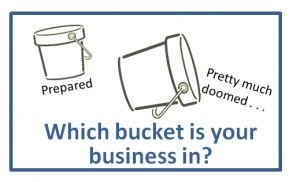
So combine the statistics from the flyer with the statistics from the government, and you can see why I am addressing this message to the small business owners and employees in the big bucket.

Disaster Preparedness Academy

But back to the flyer that started this off. It is a promotion for a 2-day conference being held in October in Anaheim, California (home of Disneyland – one of the sponsors).

The DPA has been in business for some 30 years; this year’s Academy presents 23 workshops in eight tracks.  Two of the tracks are specifically for business: Workplace Preparedness and Workplace Recovery. 

Some of the sessions for business:

  • Communicating the Unexpected “through the chaos”
  • Maximizing Your Disaster Cost Recovery; Lessons from Joplin, MO. (“Cost recovery can last years . . .”)
  • Where Do Your Emergency Management Professional Skills Stack Up? (“Are you beginning, intermediate or advanced?”)

Other tracks include Seismic Safety, Terrorism/Active Shooter and School/University Preparedness.

Now, I would certainly attend this conference if they offered a “trade show floor only” ticket.  (That’s often the most valuable part of any conference, in my opinion!) The list of presenters – 27 of them – is impressive, and the cost is reasonable: under $250 for the two days.

Getting out of the big bucket

But the question I have for you today is . . .

What is YOUR business doing to get out of the big bucket that is NOT prepared, and into the smaller bucket – that is, the bucket of businesses that have emergency plans, have invested in emergency supplies, and practice emergency training on a regular basis?

If you think you’re still in the big bucket, there’s a lot you can do, even if you don’t own the business. For example, you can . . .

  • Find out about conferences being held in your local area and ask if someone from the company is attending. If not, ask if you can attend.
  • Sign up on your own for Community Emergency Response Team (CERT) training either with a local group or online. If you can get a whole team interested, they may put on a course just for your company!
  • Download our Emergency Plan Guide Seven-Steps poster, talk it up and post it up in the coffee room. https://emergencyplanguide.org/work/seven-steps/

Something’s going to happen one of these days.

At the risk of being too blunt, I can say that you will feel pretty dumb if you have done nothing to prepare your company to survive an emergency.  And you’ll feel even worse when you and your family discover you are out of a job.

Let’s work on creating awareness and action together. Let us know what YOU are doing this week to raise the issue of emergency preparedness at work by leaving a comment in the box!

We are ALL looking forward to what you have to say!

Virginia Nicols
Your Emergency Plan Guide team