Author: Volunteer

Organize Your Community To Respond to Emergencies

Share

The first few minutes following a disaster (earthquake, fire, etc.) are the most critical for saving lives and minimizing disabling injuries. Historically, neighbors are the first on the scene and willing to help.

The unfortunate reality

Unfortunately, most communities are not organized and residents are not sure how to react.

What do do in an emergency


There is no time for training at this stage and people who are not pre-trained may follow the wrong instincts!


When pre-planning counts

Contrast this scenario with a community where residents have at least some basic training in how to react to save lives, turn off gas and electricity, etc. And, since phone service is likely to be interrupted, consider the value of knowing how to communicate within the disaster area, using inexpensive walkie-talkies.

This acute aftermath is followed by a period of post-disaster survival, which lasts until official help arrives . . . which, in the case of a major earthquake event, could be a number of days or weeks. More pre-planning is required to be sure you have enough water, food and medicine on hand for all members of the household (including pets) for at least 10 days, and preferably longer.

Where to get training

All things considered, advance “Community Emergency Response Team” (CERT) planning and training – which is offered at no cost by many cities and counties – can mean the difference between life and death for you and your pets.

And, it’s equally important to you to have your neighbors prepared as well. You can’t be expected to provide food and water (much less medicines) for the whole neighborhood.

It’s much easier to help neighbors prepare in advance than it is to turn them away after the fact . . . especially if they’re bigger than you are!

Here’s a quick 2 minute video that emphasizes the importance of training: Who Can You Really Count On In An Emergency?

Joe Krueger
Your Emergency Plan Guide Team

P.S. This is a good article to share if you have someone you care about who hasn’t done any planning!


Getting the Word Out!

Share

Dear Loyal Subscriber,

Each week, when I sit down to send out a new Advisory, I picture you, my loyal subscriber, waiting eagerly for the message to arrive.

Maybe I’m fooling myself about the “eagerly,” but it’s a great pleasure to know that there are people out there who care about emergency preparedness enough to follow at least one person’s learning curve!

This week I tried something different in an attempt to get the word out.

I put up two Emergency Plan Guide videos on YouTube!

Who can you count on in an emergency?Build Your Custom 72-hour Survival Kit

Why go to the effort?

On the one hand, I thought this would be an opportunity for me to figure out just “How to Turn a Power Point Presentation into a Video.”

I’ve used Power Point for years to create business presentations, training materials, and one-page flyers. This seemed like the next logical step. As you can imagine, it wasn’t without some effort – but I figured it out!

The second reason I made the videos was because I want to have more ways of getting the word out to the 50% of the world that has done no planning! I’m thinking, since everybody else is using video, maybe it will work for us, too.

So here are my videos. Not perfect, but workable! (I still have to master the timing of the voice-over and the slide turning . . .) Please check them out. Feel free to comment either here or on YouTube. And send me ideas for more of them, or direct me to YOUR videos. I’ll be happy to share!

Thanks!

Virginia
Your Emergency Plan Guide team


Don’t miss any of our Advisories! Sign up here to get them automatically.


Nothing Like a Good Cup of Latte Following an Earthquake

Share

If you read our posts regularly, you know we’re all about stocking up on food, water and medicines to tide us over in the case of a major disaster or emergency event until over-taxed emergency services can arrive.

 A Small Generator and a Camping Stove Can Be a World of Luxury in an Emergency!

If you have a small generator (say, 3,000 watts ) that you can run for an hour or so a day, you can probably continue to utilize your refrigerator and freezer. (This is particularly good since I don’t like being without my sour cream herring!) And, since we enjoy our coffee and are big latté drinkers in our house, we began experimenting with packets of instant latté. Most were pretty dismal . . . but, one turned out to be exquisite . . . exceeding our hopes.

Vinacafe 3 in 1 Instant Coffee Mix, 20 Sachets (Pack of 3)T

The surprise was that the brand, Vinacafé®, is actually a Vietnamese brand.

And then I remembered that The Vietnam of today used to be “French Indo-China.” (Yes some of us are old enough to remember ancient history.) And, if anyone knows how to make a good cup of latté (or should I say Café au Lait) it’s the French (no slight to the Italians intended).

It’s now all we drink. We’ve packed up the latté machine and forsaken Starbucks except when we are on the road.

Not All of Us “Up-Scale Survivalists” are Ready to Grab the Knife Between Our Teeth and Stalk Wild Animals for Dinner!

If there are any cool-headed, luxury-inclined “survivalists” within earshot, (wordshot?), I warmly recommend you try Vinacafé®. It only costs about 20-30 cents a packet, depending on where you buy it. (Compare that to $3.00+ a cup) So far, the only places that carry it are some Vietnamese grocery stores and Amazon.com. (Go back and click on the image to get current price at Amazon.)

If you don’t have an outside barbecue, you’ll probably want to pick up a one or two-burner camping stove (we chose a Coleman out of loyalty ) that runs on butane. In addition to boiling water for your coffee, you can also cook some of that food you have stored up.

The point to this dissertation is simply that there are some things in life you don’t have to give up, even in difficult times! 🙂

What are your favorite “luxury” items that you’ve stashed in your survival kit or among your emergency supplies?


Joe Krueger
Your Emergency Plan Guide team

Fire in a High-Rise – How to Avoid, How to Survive

Share

I think we all can bring up an image of flames shooting out of an apartment or hotel room in a high-rise, with smoke billowing. It’s so that when I travel, I request a room on a lower floor, and near the stairs – all because of those images!

high-rise apartment building

Where are the exits?

The recent fire in West LA got me to look into the realities of emergency preparedness for people living in high-rises, however, and the results weren’t exactly what I was expecting.

Here’s some of what I learned.

The danger of fire in a high-rise is LESS than in other structures!

The National Fire Protection Agency, excellent resource for all things fire-related, reports that only 3% of structural fires are in high-rise buildings. (They define high-rise as 7 stories or taller. There are other definitions; I’m defining high-rise as anything above the height of the local fire department’s highest ladder.)

A fire in a high-rise results in statistically less damage.

Modern hotels and apartment buildings, where about half the high-rise fires occur, are far more likely than other structures to have:

* Construction that resists fire. Steel with spray-on coatings or encased with concrete resists fire far longer than wood construction. If you’re familiar with fire insurance, you know that buildings are rated for how resistive their construction methods are.

* Systems to protect against fire. Depending on size the building, it may have fire alarms and automatic sprinklers. Larger buildings may have camera surveillance, controlled access and even 24-hour monitoring.

OK, that’s great for statistics. But what about me?

If you actually plan to live in a high-rise apartment, what should you find out about the building?

Take a tour of the building with management, and get answers to these five questions:

  1. What fire safety systems does the building have, and who maintains them? Don’t assume anything! The LA fire happened in a building with no sprinklers.
  2. Are exits clearly marked? In an emergency, elevators won’t be available.
  3. Are the fire exits unlocked? Are fire doors kept closed, not propped open?
  4. Does the building have a fire evacuation plan? What about fire drills?
  5. Does the fire alarm system have a public announcement capability?

And if a fire breaks out, what should you do?

The U.S. Fire Administration, part of FEMA, offers guidelines for how to protect yourself and how to save yourself. Here are highlights:

  • Call the fire department yourself to report a fire. Nobody else may have called!
  • When you hear a fire alarm, feel the exit door of the apartment with the back of your hand.

a. If it’s cool, open the door carefully. Do you see smoke or flames? If all clear, head for the nearest exit. If you encounter smoke, turn back! According to FEMA, smoke and toxic gases kill more people than flames do.

b. If the door is warm, or you see smoke, do not go out! Stay in your apartment. Stuff the cracks around the door with towels or bedding. Turn off the air conditioning. Keep smoke from coming into the apartment. To quote again from FEMA, “Asphyxiation is the leading cause of fire deaths, exceeding burns by a three-to-one ratio.”

  • Call the fire department to let them know where you are. Signal from a window. Don’t leave it open if smoke is coming in.
  • Listen for instructions from the fire department.
  • Be patient. It may take hours for a high-rise to be fully evacuated.

Do you live now in a high-rise apartment? If not, who do you know that does?

Since nearly 40% of Americans are renters, and the majority of them live in apartments, you are bound to have friends or family in this category.

Action Item:  Please share this information. You can simply forward the blog post, or copy and paste it into an email or onto an attachment or link to it on your own Facebook page.

Thank you.  Your action may save lives.


Virginia Nicols
Your Emergency Plan Guide Team


“Says who?!” — Best Sources of Info for Emergency Planning

Share

As you can imagine, writing an article or two every week about disaster preparedness requires that I do some research. I don’t already know EVERYTHING! Let me tell you about some of the best sources I’ve found.

Best sources for emergency planning informationFirst place goes to my neighbors.

I note what they do, and don’t do. Sometimes, I’m impressed, and share the good ideas. Sometimes I’m appalled, and I try to turn that into some sort of lesson, too. “Names have been changed to protect the innocent.”

Second place goes to online forums and websites.

I do try to spend an occasional half-hour on the big “prepper” forums. (Just type into your browser a key word – such as “survivalist” – followed by the word “forum.”) Always interesting, not infrequently overtaken by expressions of fear and hate – not what I’m trying to generate or stoke with my articles. Emergency Plan Guide aims to get neighbors to work together effectively, leveraging their knowledge and equipment for the benefit of all.

Third place goes to my Google Search tools.

I have Google Alerts set for “Emergency Preparedness,” “Survival” and “Disaster Recovery.” Every day I am fed about two dozen articles. Usually, 9 out of 10 are press releases from cities, and they read almost identically. For example: “[City] Holds Emergency Preparedness Fair.” Good news, but ho hum as far as stimulating me to write!

That tenth article is the one I’m looking for! That’s where I get the latest report from the National Fire Protection Association (www.NFPA.org) – this week, their newsletter is about Thanksgiving Cooking Fires. Or I get an expose about the New Jersey city employees who used municipal resources to get generators delivered to their own homes during Hurricane Sandy. (?!) Or, like earlier this week, I found a blogger from Oregon who wrote about using a fire extinguisher as a self-defense device! Thanks for that great idea, Dave. (You can see more from Dave at http://www.disasterprepdave.blogspot.com .)

UPDATE on a source that I was testing.

I had a link on my home page for about a year to current press releases provided by PR Newswire. And while the releases were professional ones, the fact that they focused almost exclusively on health care issues (Ebola, influenza, etc.) made them less valuable for me and my users, who are generally “ordinary citizens” and not health care workers.

So, I’ll keep checking PR Newswire on my own, but I’ve removed the full-page link for now.

So here’s my question for today: what are YOUR sources of information for emergency preparedness ideas? How would you rate them? Let me know by leaving a comment, and I’ll be sure to follow it up with my own research.

Looking forward to your input!

Virginia

Dear Friend – Disaster Recovery Message

Share

(Joe sent this letter out this morning to our whole email list . . .)

10,000 lives lost in the storm-ravaged Philippines is just another wake-up call about the realities of surviving major catastrophes, on the heels of the devastating earthquake in Haiti as well as Hurricanes Sandy and Katrina.

The popular TV shows about Doomsday Preppers, extreme survival with 100-lb “bug-out bags” and building arsenals of automatic weapons to “protect your stash” are not only ridiculous fantasies, they’re actually diverting people’s attention from the actual realities of survival:

  • 1. Government cannot possibly respond to everyone in need at once following a major catastrophe. The logistic challenges are impossible to surmount and it may be days before “official help” can be mobilized.
  • 2. The first few minutes and hours of a disaster are the most critical for saving lives. YOUR BEST HOPE OF BEING RESCUED OR HELPED ARE YOUR IMMEDIATE NEIGHBORS! And you are their best hope as well. Period!
  • 3. The easiest way to prepare – together with having your own 10-day supply of Water, Food and Medicines – is to take advantage of the Free training offered on line by FEMA as well as local cities and fire departments: CERT, Community Emergency Response Team. This fabulous training is “community focused” and deals with the ordinary citizen realities of disaster situations.

The fact that we have been able to get over 40 of our neighbors trained and equipped through our city (Irvine has trained literally hundreds of people who work or live here – all for free!) has made it possible for us to organize actual teams to respond to emergencies. Our biggest concern here in California is, of course, the likelihood of major earthquakes and the probability that family members may be in various parts of the community when a quake strikes.

If you want to give yourself, your family, your neighbors and co-workers a better chance of survival in an emergency, Virginia and I urge you to look into the programs offered by your city, fire department and Red Cross. We list a number of organizations, links and tips for survival on our website: www.EmergencyPlanGuide.org. And we urge you to share this information with your family, neighbors and employers. It’s the best way we know of to protect what’s most important to you. You can simply forward this email.

P.S. If you want to help out in the Philippines, go to the Rotary.org website and make a donation to the Rotary ShelterBox program. They have stockpiles of 10-person tents & survival tools ready to be airlifted to disaster zones as well as standby volunteers. Rotary’s ShelterBox program is one of the most widely recognized and respected projects in the world.

Sincerely,

Joseph Krueger &  Virginia Nicols

Joe Krueger and Virginia Nicols

Joseph Krueger and Virginia Nicols


EmergencyPlanGuide.org
www.EmergencyPlanGuide.org

4790 Irvine Blvd., Suite 105
Irvine, CA 92620
JKrueger@MktgMach.com
Telephone: (949) 733-3778
Direct: (949) 733-1778
Fax: (949) 559-6993

Are you, your family and your business
Fully prepared for the next natural disaster?

Download our latest Advisory! . . . it’s totally Free!


Emergency Communications for Neighborhood Groups

Share

 A Vital Role in the Effectiveness of a CERT program

In a serious emergency where power is interrupted, landline telephones are often affected and even cell phones become unreliable due to central computer outage, damaged antennas and/or over usage by the populace.

So what is the answer for emergency communications for neighborhood CERT groups — to warn of dangers? Call for help for injured? Share news?

Emergency radio communications protocol

In an emergency use standard radio protocol

The answer for most teams becomes the two-way Family Radio Service . . . the inexpensive walkie-talkies that are used by campers, modelers, children at play and at a variety of club and athletic events.

The FRS/GMRS (Family Radio Service/Ground Mobile Radio Service) radios typically have 22 separate channels and the more elaborate ones have additional “privacy” settings on these channels that extend them into the hundreds of “channels.”

Two Classes of Radio for Local Neighborhood Groups

Simple Radios

We have equipped every one of our team members with a simple radio.  (The team leaders, who have the need to communicate with other leaders, have more sophisticated radios with slightly longer range.) Regular team members in each Division or neighborhood of 50-75 homes only have the need to communicate within their Division — over distances of less than a mile.

Having a less-sophisticated radio is actually an advantage since one that is too “sensitive” is likely to pick up interference from outside the immediate neighborhood, where frequencies are open to all citizens.

Each of our Divisions has two designated frequencies (primary and backup) and we have special frequencies assigned to team leaders for coordinated efforts. This allows us to manage everything from Search & Rescue Operations to First Aid/Triage, Security and Logistics, etc.

The two brands we have found most satisfactory for our purposes are the Uniden and the Midland.  These both perform well and have a variety of models. Our homes are close to one another and the six neighborhoods all fall within a relatively compact area so these units work well for us. You can get details on each of these on our walkie-talkie review page.

Radios with Wider Range

If your neighborhood/s and homes are spread out in suburban or rural areas, you may find it necessary to invest in more expensive units with greater range. We have tested all manner of these radios in a wide range of prices and “claimed” range of operation.

If the claims are accurate, they probably tested them on flat ground in deserted areas with little or no interference. From our perspective, all claims have to be treated as inflated! In other words, purchase several pairs and test them before you commit to a volume purchase.

In addition to the general communications, we have three licensed Amateur Radio Operators (HAM operators) on our team who are authorized (and equipped) to communicate with the emergency radio organization/s that work within our city and county. We also have a few Citizen Band (CB) Radios that have a somewhat greater range than our FRS/GMRS units.

Ongoing Emergency Communications Training

Radio Drills

We have monthly training drills on the radios and ongoing training for new team members.

You’d be surprised — or maybe you wouldn’t — at how easy it is for adults to forget exactly how to change channels and volume on a little radio that only has two buttons!  Children seem to have no difficulty.

We follow a standard radio protocol in our communications and in a real emergency have specific people assigned to record the subjects of messages for a log.

Radio Batteries

We also schedule battery-replacements along with our drills — typically, twice a year when the time changes.

We prefer to use regular (not rechargeable) batteries since in an emergency there may be no recharge capability. After several rigorous tests, we have concluded that Energizer brand batteries generally last longer than any others.

As you can tell, we take our emergency communications very seriously. We recognize that in a real emergency, time is of the essence and good communications within the neighborhood are likely to save lives and preserve property.

This post is part of a series. Don’t miss a single one — sign up now to get them all automatically!


Neighborhood Planning for Emergencies

Share

Do you have plans for your neighborhood?

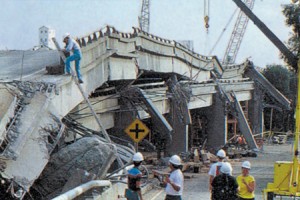
Rescue workers in earthquake

Who will get there first? Neighbors!

Certainly, preparing yourself and your household for emergencies is important. But, as we’ve said many times, your single most important link to survival is your immediate neighbors.

Their proximity to you (and yours to them) means that they will be the first people on the scene in a real emergency. The more you and they know about surviving a disaster, the better the chances for everyone.

So, do you have plans underway to form a neighborhood Community Emergency Response Team (CERT)?  And making sure its members are trained, and ready? Encouraging you to do so – and providing help in this regard – is the real purpose of this website.

Organize the neighborhood team.

Here’s what our neighborhood Community Emergency Response Team (CERT) looks like. How does this description compare to yours? We have close to a hundred team members in various stages of training. About a third of our members have received city-sponsored CERT training. There are over 350 homes in our group, divided into six divisions, with six Block Captains under each Division Leader. We have six special teams: First Aid, Communications, Search and Rescue, Operations, Logistics, and Training.

Increasing the Effectiveness of the Team.

We are currently evaluating a number of options to provide our Team Members with advanced training and equipment that increases our capabilities. Among the areas we are focusing on . . .

  • Communications – probably the most critical component in our emergency planning
  • Standby/Emergency Power – High on all of our members’ lists
  • Transportation – Related to communications; different communities have unique needs
  • First Aid/Triage – Helping injured people has a protocol
  • Temporary Shelter – Caring for neighbors who’ve lost their home in an emergency
  • Search and Rescue – Here again, there is a protocol and Pets complicate matters
  • Emergency Equipment – Water, food and medicines are individual responsibilities; the neighborhood can invest in more substantial items
  • Security — Tricky, but necessary. Training is essential!

The series of posts that accompany this one will discuss each of these eight categories. We will cover the usefulness and the drawbacks of several pieces of equipment as well as the servicing requirements of each. And we’ll discuss ways to finance these purchases.

Our hope is that this information will give you a head start on your team planning.   We’ve chosen to start with the emergency power since that seems to be what most people think is their first consideration.

But first, consider the following Action item:  What constitutes YOUR neighborhood?  If you haven’t really begun neighborhood planning for emergencies, and need to decide on the boundaries for your neighborhood, check out this article:  Who Will Be There To Help?

Don’t miss a single Advisory.  Sign up below.

Turn Off The Gas!

Share

 “OMG, I smell gas, don’t you?”

“Must be the result of that earthquake we just felt!  Do we need to turn off the gas?” 

O.K., this is you.

You have determined that yes, there is a real gas leak in a home in your neighborhood. You smell that rotten-egg smell, you hear gas escaping, you even see where the line has broken. You are concerned that gas is accumulating to the point there could be an explosion.

You have moved people a safe distance away and called 911 and/or your system operator, so help is on the way. But that “earth tremor” may have been widely felt and official help may be delayed.

YOU AND YOUR TEAM MEMBERS FEEL YOU CANNOT WAIT.

So you need to turn off the gas. Now what?

If the break is in a line on the home side of the meter, turn off the gas at the meter.

1. Find the meter! If it’s dark, use flashlights, NOT lanterns, matches or candles.  An open flame may set off an explosion if gas has accumulated!

Gas meter turn-off

Where’s the turn-off?

2. In this setup, the turn-off valve is in the lower left corner, 6-8 inches above the ground on the standpipe. When you look at it straight on, you can tell the turn-off valve by its distinctive shape: a circular face with a rectangular section sticking out.

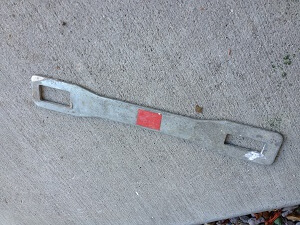
3 . Now, how to turn it off? Fingers just won’t work. Search for the gas meter wrench.  Below is a photo of my wrench. Note the rectangular cut-outs.  One cut-out should fit over the rectangular section on the pipe.  (You can also use a 12 inch crescent wrench.) I store my wrench near — but not directly on — the meter.  (According to one of my experts, “Metal attached to, or hanging on, the meter can disrupt the cathodic protection system that helps to prevent underground gas pipes from corroding.”)

GasWrench

Gas wrench has two options.

4. Fit the wrench onto the valve. Turn one-quarter turn. (You may actually need to step on the wrench to get enough leverage to get the thing to turn.)

Open or closed?

Open or closed?

5. Confirm that the valve is closed — see the right-hand diagram above.

Should I practice opening and closing the valve?  NO, NO, NO!

DON’T TURN OFF THE GAS unless it’s a real emergency. Why? Because you can’t turn it on again!

“Only gas company field employees are allowed to turn on the gas to the meter.” It’s not just a question of the gas in the line. The gas company will have to go through the house to relight all the pilot lights!

We had a gas main leak in the street outside our community last year.  All the gas to the neighborhood was turned off — 360 homes.  It took the gas company a full day and a half, with a DOZEN EMPLOYEES (all being paid overtime), to get everything turned back on!

Again, you should not practice turning off your gas. You should discourage people from THINKING they should turn off their gas at the least suggestion of a leak.

Remember, step one is to get away from the leak without creating a spark. Step two is to call 911 and the system operator.

But, in a big emergency, you should know how to turn the gas off if there’s a leak.

Share this information with family.

Share it with neighbors, since a gas leak next door could impact you.

Invite your local First Responders and/or your system operator to speak to your group on this topic.

Here’s to safety!

Virginia Nicols
Your Emergency Plan Guide Team


Legal problems surface as flood waters recede: Four questions to answer BEFORE disaster hits

Share

Over the past month we’ve seen heartbreaking photos from Colorado: homes washed off their foundations, stores filled with mud a foot deep, livestock perched on islands in a sea of brown water.

Insurmountable legal problems

Pain of dealing with legal problems

Our first concern is for the lives of the people involved. Then, typically, the news coverage moves on, and we are left to our imagination to consider the mess left behind.

Physical mess we understand. But what about the legal mess?

Physical mess we understand. Mud, water, shovels, sweat.

But every picture of a damaged car or home, of a business or farm or highway, represents a potential legal problem, a problem that could last weeks or months and complicate that family’s life forever.

Can we prepare for legal disasters? Yes, we can.

Here are a few questions every family needs to be able to answer.

1. Can you prove who you are?

These days many, many “families” are not legally related. Some family members may not be legal citizens. In an emergency, your problems will be magnified if you don’t have the documents to prove who you are and your legal relationships to others. These documents may include a rent agreement, custody for children or powers of attorney for parents. Have copies of these documents made and store the originals in a bank safety deposit box if possible.

2. Can you prove that you own the lost or damaged property?

Several years ago when a mobile home park in California was evacuated at 4 a.m., residents had no time to gather important papers. 80% of the homes burned to the ground. Months later those homeowners were still having problems proving they had owned the property! Again, add ownership documents (car, home, insurance) to your “Go-Bag” so you can grab it and take it with you even if you have only minutes. Electronic copies work as well as originals in this case.

3. How will your personal obligations be handled if you are out of work or out of your home?

Bills don’t stop just because your house has been flooded. If you pay by check, your check and checkbook may have been lost. If you pay bills automatically, you’ll at least have a few days reprieve. In any case, you’ll need to notify all your creditors of the situation. Do you have a list of who they are and how to contact them?

4. What about business contracts if your business is shut down?

Once you’ve ascertained that your employees are safe, you’ll turn to keeping the business alive. Do you have standing orders for delivery of product – either to or from the place of business? What happens when you default on those contracts? Does your business emergency plan include contacting all employees regarding the work schedule, contacting all vendors and customers to tell them what to expect? What about being ready with an announcement to the news media? These communications plans need to be set up BEFORE anything happens.

These aren’t all the legal problems that may come up, but if you have made preparations to handle at least these four questions, you’ll be in a lot better position to make it though a natural disaster.

THIS IS AN IMPORTANT TOPIC.  PLEASE FORWARD TO FRIENDS.

Copy and paste this link:  https://emergencyplanguide.org/legal-problems-surface/.


Temporarily Out Of Service

Share

Ever happen to you?

Last week we got the notice. “On Tuesday your utility service will be temporarily out of service.”

spilled coffee

Clean it up!

We live in a community with a fragile infrastructure. We’ve had electricity outages, burst water mains and even four natural gas leaks over the past few years. (Actually, three of the gas leaks were because of construction, so they weren’t because of the infrastructure. But hey, an outage is an outage, no matter how caused.)

Anyway, this time it was our water service, “Off starting at 8 a.m., until the leak can be found and repaired.”

You realize what happens when there’s no water, right?

No shower or bath, of course. (Easy to do without.)

No flushing the toilet. (Less easy.  It takes GALLONS of water to flush a toilet.)

No rinsing of dirty dishes. (A nuisance only.)

No rinsing hands after picking something up off the floor, or pulling a weed, or wiping up spilled coffee. (Yuck.)

No rinsing the counter after wiping up the spilled coffee. (Sticky!)

You get the picture!

Of course, we were warned, so we were prepared.

It wasn’t even an emergency. Here’s what we did:

  • Made sure we had plenty of clean drinking water.
  • Filled up the plastic trash cans and set them beside the toilet to allow for flushing.
  • Filled up some large pots and pans and set them on the kitchen counter for cooking and rinsing.  (ended up labeling them as “drinkable” or “rinse only”)
  • Filled the dishpan with warm water (heated on the stove) and dish soap and put the dirty dishes to soak for the afternoon.
  • Opened a couple of packages of handi-wipes and placed them strategically.

I was amazed at the number of times I started to turn on the tap and then had to remember – no water!  But this was a planned event, for a limited time only, so no real problems for us. What would it be like if this went on for a whole 24 hours, or several days?

What sort of water outages have you experienced?

What did you do to plan? What was it like if unplanned? Share your stories in the comment box. We want to hear about it!


“Water, water everywhere . . . nor any drop to drink”

Share
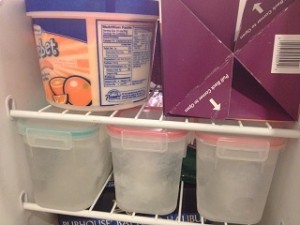
Ice in plastic containers

How many containers of frozen water would fit in your freezer?

This well-known quote comes from “The Rime of the Ancient Mariner,” written in the mid-1700s by Samuel Taylor Coleridge. His poem tells of a ship becalmed whose crew dies of thirst. In a big storm or other emergency, we are not likely to find ourselves in the middle of a salt-water ocean, but we certainly could find ourselves facing serious thirst with only questionable or clearly dirty water available. So once again, I want to address the issue of where to find drinking water. By now you know that you can live for days without food, but not long at all without water.

Here are  four more ideas for where to find water in an emergency:

1. Buy and store water that comes in regular commercial containers. You can buy water in all-sized bottles, cans, and foil packets. Store as much as you can, and refresh regularly. Avoid storing water in plastic directly on cement. According to the LA County Dept. of Public Health, cement can pass through the container into the water.

2. Capture water from alternate sources.

  • Your water heater holds 40-80 gallons, and if you have kept it reasonably clean by regularly draining off silt and calcium build-up at the bottom, it can be a life-saver.
  • The toilet tank (not the bowl) can be another source of water, it you haven’t used chemicals or colors in it.
  • A swimming or decorative garden pool might give you water for washing or even flushing the toilet.  Don’t drink it without treating it first.  (See below, number 4.)

3.  Still more ideas for storing water.

  • Freeze water in clean plastic containers and fill in spaces in the freezer, as shown in the photo.  Ice will keep your freezer cooler, save energy – and provide a source of clean water as the freezer defrosts in a power outage. Don’t use plastic that has had milk or meat products in it. And leave space at the top of the container for the water to expand. (I take mine out once in a while and dump the ice in a flower bed, then refresh the water supply.)
  • Buy large storage containers that fit the space you have available. If you can put a barrel outside, get a 55-gallon drum with spigot. If you don’t have that option, consider “WaterBricks.” An 8-pack of these 3+ gallon blue plastic containers stack and connect for compact storage of 28 gallons.  (Lying flat, they might fit perfectly under a bed.)

4. Don’t forget agents to turn dirty water into drinkable water!

  • The LifeStraw is a personal water filter that would allow you to drink from a puddle or stream.  Simple, light, easy to store, filters over 250 gallons of suspect water. Get one for every person, and every survival kit, particularly your car kit.
  • Water treatment tablets or drops are widely available. They take about 30 minutes to purify contaminated water. Be sure to follow instructions exactly.

Let us know YOUR good ideas for storing water for emergencies.  Just drop them into the comment box to share!

Virginia
Your Emergency Plan Guide Team

Subscribe below so you don’t miss any of these good ideas. One of them could save your life!  

The Meaning of Green: Wisdom From The Parking Lot

Share

I mentioned in my last post that we had staffed a table at a local neighborhood Emergency Preparedness Faire. (See “Lessons Learned.”)

Well, over the weekend we did some more outreach – this time at our local Chinese grocery store.

Set up in the Parking Lot

Set up in the Parking Lot

This activity was planned by the City’s paid Community Emergency Response Team leaders, who set up tables in front of six different retail locations. We took on the 99 Ranch Market because it’s literally across the street from where we live.

(You’ve heard our mantra before: “The more prepared the people around us, the safer we’ll be in an emergency!”)

The Setting:

This event was completely different from last week’s event. Instead of many tents and tables and a full complement of police cars and fire trucks, we had a lone table in the middle of the busy grocery store parking lot. Instead of music and balloons and professional demonstrations, we had eight volunteers, three of whom knew each other. Instead of neighbors out for a comfortable Sunday stroll, we were faced with busy citizens getting their shopping done early in the weekend.

The Advance Guard:

We stationed our most capable people at the two doors of the grocery store, ready to hand out booklets about earthquake preparedness. They greeted shoppers on their way INTO the store, reminding them to visit the main table ON THEIR WAY OUT.  (This, to give them time to think about it.)

Key words that caught people’s attention: “Free. City-sponsored. Sign up for the class.”

The Main Table:

At the main table, people approached guardedly. Generally, they pretended to speak no English. I heard our Chinese -speaking colleagues address people this way: “Hi! Ni hao!”

AFTER they realized we had nothing to sell, suddenly we could switch to English, no problem!

Dried rice emergency rations

Dried rice emergency rations

We showed CERT training schedules, emergency equipment, and people began to sign up for the next classes. Some people were young, others clearly older. One woman told a long an impassioned story about her experience in the 1999 Taiwan earthquake – which had happened exactly 14 years ago to the day. That earthquake killed 2,400 people.

On Saturday, in about 3 hours, we handed out over 300 earthquake pamphlets and signed up 20 people to take the next CERT training class. We ate Chinese “donuts” (fried batter, no sugar). We laughed at the story about a green hat signifying that a man’s wife is having an affair. (The CERT color is, of course, green!) We all shook our heads at the guy who walked quickly by, and when we called out, “Are you prepared for an earthquake?” he answered, “I don’t live here.”

It was another great outreach event. I was proud to be a part of the team!

(Oh, and we learned that the CERT color isn’t really green.  It’s “emerald.”)

Did you take part in  any special activities during National Preparedness Month?  Leave a comment!


Virginia Nicols
Your Emergency Plan Guide Team

Sign up below and get ALL our stories!

Neighborhood Preparedness Faire — Lessons Learned

Share

As part of National Preparedness Month, Joe and I staffed a booth at a local neighborhood Emergency Preparedness Faire on Sunday. It was held in a street that ends in a cul de sac, and we were one of about 20 different organizations trying to raise awareness among folks in this neighborhood.

How effective was it?

How effective was it?

Generous Support from Local Agencies

The police department was there with two cars and a child fingerprinting set-up; the fire department brought one of its engines and let kids crawl into the cab. The gas company was demonstrating utility shut-offs, and the electric company had a truly terrifying display (aimed at children!) that zapped when its puppet people approached a live overhead wire.

Other booths sold emergency supplies, first aid supplies, and ice cream. There was even a display of how to splint a broken arm using newspapers.

Reactions from Neighborhood Residents

We were there helping sign people up for the next Community Emergency Response Training class, and to talk with passers-by about emergency supplies. Here’s what we discovered:

  • The word “emergency” evoked no response other than glazing of the eyes – even though these people had come knowing this event was supposed to be about emergency preparedness.
  • The word “survival” worked much better. Particularly when we asked, “Do you have a survival kit? In the car?” (This is southern California, where everybody commutes.)
  • The best response came from the children. When we asked, “What do you do in an earthquake?” the kids all responded automatically, “Drop, cover and hold on.” Their parents looked on in wonder.

Some percentage of the people absolutely would not approach our tent; they just smiled and kept walking. (You gotta ask yourself, why did they even show up? Well, it was a beautiful day, and there was music and balloons . . .)

Recommendations from the Field

1. Children —  Many of the families had children, and those booths that had something for children fared the best.

2. Mystery — In our booth, where we talked about the need for a survival kit, I pulled items one by one out of a backpack to show them. Again, children were eager to see what would come out next.  They were most interested in the space blanket, the solar-powered/crank radio, the whistles and the LifeStraw. They actually asked questions while the parent/s looked on.

3. Give-aways — A number of people didn’t seem to have time to actually talk about their preparedness, or our display, but they happily took one of our postcards that listed our website for more info.

At the end of the day, we had accomplished a number of things, including making an excellent connection with the local newspaper reporter and his photographer. We were again reminded about how difficult the “preparedness message” is to deliver.

But if we got just a half-dozen families to take action, that’s more people who will stay alive and survive when the big one hits. So, was it worth it? You bet.

Virginia Nicols
Your Emergency Plan Guide Team

Could you use a friendly reminder once in a while to assure your family’s safety?  Sign up below to get an Advisory every week.