
Whoops, did you miss it like I did?

(This article first appeared in 2014. As you can imagine, it has been updated since then — mostly because I have learned more about the ins and outs — or offs and ons and chirps — of smoke alarms!)
We remind everyone that when Daylight Savings Time comes round, it’s time to check the fire alarms.
So it’s now two weeks after the date, and I finally got around to practicing what I preach. Keep reading for what turned out to be an eye-opener!
Just looking up at the smoke alarm tells me nothing.

I seem to recall that my old alarms had a blinking light, but I see nothing like that on this one. My old alarm also once emitted a chirping sound — but I have heard nothing from this one.
Anyway, on with the test.
- I haul out my trusty step stool, position it properly and climb up.
- I look for the round test button (while being careful not to overbalance).
- Hey, look there! I discover a green light, deep in a recess. Is this what I was looking for?
- Well, since I’m up here . . .I press and hold the round button.
- Eeeeehhhh!
O.K., we know it’s working!
Now what about the other alarms in the house? Before I take a look at them, let me do some quick research.
I always thought fire alarms were pretty straightforward.
Here’s what I discover about the alarms in my house.
- Code for fire alarms changes on a regular basis. My home is relatively new, so it has hardwired alarms that have a back-up battery. It’s that battery that we’re testing. (There are also alarms that operate solely on batteries. I used to have that kind.)
- In my home, all the alarms all connected. If one goes off, so do the others. Still, I have to check each one individually to be sure about the batteries.
- The requirement for alarms in California indicates that starting 2015 new battery-operated alarms must have a non-replaceable battery that will last for 10 years. After ten years, the whole alarm will simply be replaced. Some of those alarms are already on the market. So the question then becomes, do I have one of these models in my house? It’s back up the ladder. And the answer is no.
But here’s the discovery of the day . . .
I have always used the words “fire alarm” and “smoke alarm” and “smoke detector” pretty much interchangeably. It turns out that alarms are NOT all the same.
According to the National Fire Protection Agency (NFPA) there are two main technologies at work in fire alarms: ionization (alarm is set off when ion flow is interrupted by smoke) and photoelectric (alarm is set off when light is reflected off smoke). (You can get the whole scientific description at http://www.nfpa.org/safety-information/for-consumers/fire-and-safety-equipment/smoke-alarms/ionization-vs-photoelectric
Ionization technology works best on a fast, flaming fire; photoelectric works better on slow, smoldering fires.
Logically, the very best fire alarm combines both technologies!
And also, logically, the combination models cost more.
So what alarm technology do I have in my home?
Ta da! . . .Looks like ionization smoke sensing technology! (This model seems particularly made for home builders, since it comes in a six pack.)
Where does all this take us?
- Check your own fire alarms to be sure they are working.
- Check to see how old the alarms are and if they are over 10 years old, get rid of them an install new ones.
- Get the best replacements you can.I just added the best photoelectric/ionization model I could find at Amazon to our own list of recommended products. Here’s a link to that model.
Let me know how your alarm testing goes!
Virginia
Your Emergency Plan Guide Team


 I admit, the word “preparedness” is pretty dull. Besides, it has too many syllables.
 This is a series of simple “problems” that you are likely to face if, for example, the electrical power goes out. Some ways to use the list:
 In earlier Advisories we’ve talked about how best to communicate during an emergency when the power is out. Here’s the likely drill:
 and the
  at Amazon. Each looks to be about half-again as long as a typical cell phone, and to weigh about twice as much.)
 But Illinois only “won” because the state had experienced tornados – and the old plans for tornado safety didn’t work!
 And it’s painful to imagine yourself, a loved one or a co-worker buried in darkness under debris, fighting to stay alive long enough to be found.
 Today is September 1. Today, in Japan, hundreds of thousands of people are taking place in a disaster drill on the anniversary of the 1923 Great Kanto Earthquake. And this year, they are being encouraged to stockpile toilet paper.
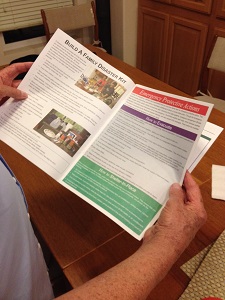 • My friend Russell sent me a copy of a booklet passed out at his kids’ school. You’ll see it in the picture. It is packed with valuable information, pulled from a variety of sources. Because it IS so packed, though, no child would ever start reading it. Even a parent would be hard pressed to get through it. The booklet could answer questions 1 and 2 above.
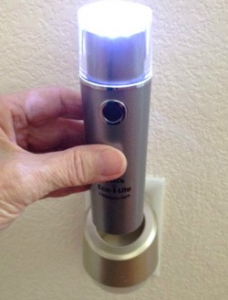 At about 4:30 p.m. last Saturday, with temperatures hovering around 92 degrees, I was working at my desk when WHAM!, the power went off.
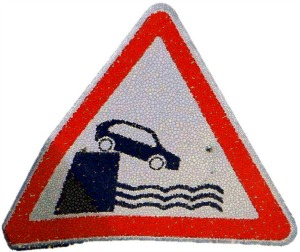 Some 400 people drown each year in the U.S. from being trapped in sinking cars. Don’t be one of them.