Author: Volunteer

Financing Neighborhood Emergency Equipment Purchases – Updated


Share
heavy emergency equipment
Something your group needs???

Emergency equipment can be expensive!

Considering an equipment purchase for your neighborhood group?  Something BIG, like in the image above?

Not that you’re considering purchasing a log mover — I used the picture because it makes the point.  This probably isn’t something you could afford by yourself.  You certainly wouldn’t want to buy it and have it sitting around “just in case.”

But what if your group does need neighborhood emergency equipment?

On one hand, buying as a group makes it easier.

If you are part of a group, you can look at buying big items from a different perspective.

  • You and your neighbors can get access to items you wouldn’t otherwise be able to afford.
  • Your neighborhood can achieve a whole new level of resilience.
  • Sharing in the purchase decision automatically creates a stronger network of neighborhood first responders!

However, big purchases are not all about big benefits.

Neighborhood emergency equipment decisions take a lot more thought.

For example, here are some of the decisions you’ll have to make about that purchase:

  • Who will be the named owner – for tax purposes, for registration purposes, etc.?
  • Which neighbor/s will be responsible for maintenance and repairs?
  • Where will the equipment be stored and who will have access?

Here’s some of what we’ve experienced when we started buying materials for the group.

Some people don’t want to play.

People may be willing to show up to meetings. But being a member of the group isn’t enough to make everyone volunteer to spend money for the group’s welfare.

Honestly, we have found nothing that will change a “me” focus to an “us” focus. It’s either there, or it isn’t. So, if some of your group members seem unwilling to participate in group purchases, after appealing a couple of times to the concepts of cooperation and mutual support, you’ll have to let them go their own way.

Others are willing to buy for themselves and share when necessary.
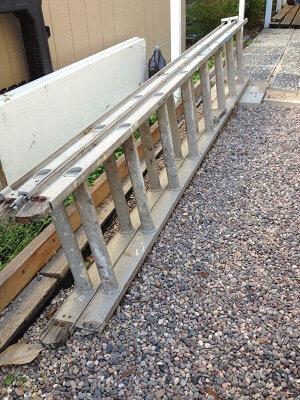
Ladder
The shared ladder

In our local neighborhood, when we began to organize our group, it just so happened that we were already “sharing” a number of items. For example, Joe and I had a tall extension ladder that was left behind (too tough to pack) when a neighbor moved. The ladder ended up behind our house (see the photo!), and was used by any of a handful of people on the street. They just came and got it and brought it back when they were done.

After our first neighborhood emergency equipment inventory, we discovered that one contractor neighbor stores a heavy duty pry bar (six feet long) that he would be willing to share. Another neighbor has a pair of giant shears, good for breaking open chained gates. We have solar battery chargers.

We all learned about these items, and where they are located, and in an emergency we plan to share for the benefit of the group.

Getting money for “REALLY BIG” purchases.

When it comes to more expensive items, you may have to look at other options for financing them. Whatever you decide on, start now to put together your “wish list” of equipment your group could use effectively. Your list will be different from other groups’ lists. Just the action of making the list will involve more people and likely uncover creative ways to turn it into reality.

Option One – Funding from within the local community.

In our case, thanks to a committed and enlightened homeowners’ association board, our emergency team gets money every month via association dues. Emergency Plan Guide readers who are renters have told us their groups have received financial support from their property owners.

Some of our readers are members of groups incorporated as non-profits – and they have been the recipients of donations from local stores and local insurance companies. One group buys and resells radios at a profit.

Option Two – Funding from local or national grants.

Naturally we have looked for grant money. As a community we’ve been the grateful recipient of a grant co-sponsored by the Fire Department and First Alert. Three years ago, over a 2-day period, our team helped install donated smoke alarms in every single residence in the neighborhood!

As for getting grants on our own, we have had no luck so far. We have researched — and here’s some of what we have discovered.

  • It helps,  and often is required, that you be an established group, with an official non-profit status, ID number, etc. Federal (FEMA) grants usually go only to official government agencies – fire departments, etc.
  • Private foundations usually have a specific focus (which may change from year to year) and may have a minimum award that is higher than you can justify asking for.
  • Your request for money to solve a particular need with a one-time purchase of equipment — for example, communications equipment for handicapped or senior members – may be more positively received than a request for money for operations.
  • Many grants are announced on a specific date. The organizations involved have a strict application procedure that may take months, so you need to start your investigation now. (See this Advisory about the grants from State Farm.)
  • Your city may offer grants for specific activities. And, of course, your city or county may offer CERT training to all your group members, with no real strings attached.

Remember that grants, unlike donations, always come with strings attached. You have to meet the grant’s requirements and then show that you spent the money the way you promised you would.

Option Three — Sponsoring a fundraiser for your group.

This is the tried and true way for any community group to raise money – money they can spend any way they like. There are SO MANY ideas of how to put on a good fundraiser!  You could probably write this section of the Advisory yourself!

Here are a few questions to get the conversation started . . .

What’s the purpose for the fundraiser?  Sometimes it’s easier to have one specific goal (“$450 for walkie-talkies for our group”) rather than a generic “support our group” message.

Who would be a natural partner for the fundraiser?  Usually, this means a commercial entity that would benefit from the exposure, or from direct sales. We have had good luck getting support from emergency equipment manufacturers and local hardware stores. If the commercial group is going to sell their products, you’ll have to figure out how your group will benefit!

What will attract visitors and make them want to pull money out of their pockets!

  1. Fun fair! If your audience has kids, parents will bring them along if there is plenty for kids to do! (“Oh, a good Saturday afternoon outing for the family.”) In all the years I’ve done events, the ONE MOST POPULAR ACTIVITY has always been “Spin the wheel and win!”  Obviously this requires a wheel, lots of little prizes, and a few big ones!
  2. Bake sale – always popular in a venue where there’s lots of foot traffic
  3. Ice cream social – Get donated supplies!
  4. Yard sale with proceeds to benefit the group. (Combine with other community event or annual sale?)
  5. Speaker/local band willing to perform for the publicity
  6. Raffle for a great prize (Be sure you know the GAMBLING RULES for your state!)

What sort of location do we need, and where can we find it?

Do we have the equipment we’ll need? Tents, tables, chairs, microphone

How will we manage publicity?

What and how many volunteers do we need, what skills, with what schedule?

You’ll find many more resources online or at the library. If you would like a copy of my own well-tested Master List for Event Planning, just drop me a line!

How we’ve made neighborhood emergency equipment purchases for our own group.

Over the years we’ve held events like the ones suggested above. Some were really profitable — like when we sold a bunch of donated furniture at a yard sale. Others were barely profitable. But with the help of fund raisers plus budget from our HOA, our group has purchased medical supplies, walkie-talkies and their batteries, and pop-up tents. Our group also owns two natural gas “sniffers,” two refrigerators, a generator,  a portable loud-speaker, three loud-hailers and some big floodlights. (We have chosen not to store food or water. We encourage our families to manage their own supplies for sheltering in place.)

Naturally, it takes an organized campaign to get a financial commitment of ANY SORT. In our case,

  • We apply professional marketing planning and presentations. (Joe’s and my background is in direct marketing!)
  • Fortunately, we have a couple of neighbors who love the challenge of coming up with donated gift cards!
  • A couple of our members have jumped in to take on money management.
  • Other members are enthusiastic HAM radio operators, and they provide guidance and training for the rest of us.
  • Working with the fire department makes it possible for us to get a ladder truck and fire engine once in a while for “show and tell!”

Working together, we have been able to get financing for the big equipment we’ve needed so far for our group. It will take another Advisory to discuss how we set the priorities for using the equipment!

Virginia Nicols
Your Emergency Plan Guide Team

P.S. What sorts of fund-raisers have you been successful with?  Let us all know by jumping down below the subscribe info and leaving a comment!

Everyday Household Supplies as Tools for Survival

Share

Tin Foil Frying Pan

Don’t you love lists? I see them everywhere I turn online.

And I read a lot of them, particularly those in the survival niche. Mostly, they confirm what I already know. But every once in a while I find survival ideas I hadn’t really considered before.

What follows are some ideas using everyday household supplies as tools for survival. Maybe you can add them to your list, too!

Six reasons to have aluminum foil in your survival supplies.

Who knew all the things it can do in an emergency – and, for that matter, every day!?

  1. Cooking over a campfire? Wrap smallish pieces of food in a foil pack, cook over or buried in coals.
  2. Add a foil reflector to block the wind from your fire, and to direct its heat.
  3. Position a foil sheet to reflect and enhance the light from the sun or from your lantern.
  4. Use crumpled foil under a bar of soap and under a scrub pad to keep them from getting gunky or rusting.
  5. Fold a small piece of tinfoil and stick in your flashlight between the battery and spring to improve a loose connection.
  6. And this, from Reader’s Digest. (And see my image, above.) Make a temporary tin foil frying pan by covering a forked stick with a double layer of foil. Make a slight depression in the space in the V of the fork — that’s where you’ll put your food for frying!

Four more survival uses for everyday household supplies using everybody’s favorite — duct tape.

I’m sure you have plenty of duct tape at home. I hope you have some in your survival kits, too. The “flat packs” are much lighter and more convenient than the heavy roll. (See below.)

You can use duct tape to fasten just about anything, but here are a few more ways to use it as a survival tool:

  1. First aid supply – Use thin strips to close a wound. Use thicker strips of tape plus small branches or pieces of wood to create a splint for a sprained ankle.
  2. Twist a length of tape to create a rope for tying anything. Fold a length of tape in half onto itself to create a strap – for a belt, a sling, a carrying handle.
  3. Keep out cold air by closing leaks in clothing using tape. (Don’t tape to your skin. )
  4. Tape together Mylar blankets or large size plastic bags to make a sleeping bag or a shelter.

And while we’re on plastic bags, here are seven ways to put these everyday household supplies to use as survival tools.

Different weights of plastic have different uses. And, of course, the heavier the weight, the more they add to the weight of your survival kit. Here are some often overlooked survival ideas using bags and baggies. (More info, with prices, at the end of this Advisory.)

  1. Trash compactor bags are very thick – and thus work well to manage human waste in a survival situation. Place the bags in the toilet, or in a plastic bucket. (When full, add kitty litter or some disinfectant, close and dispose of.)
  2. Use ordinary plastic bags from the grocery store to line boots (over socks, inside boots) to keep your feet dry. (Probably won’t work in a stream but does fine through wet grass and puddles.)
  3. Use plastic bags as temporary gloves to protect your hands from germs, blood, yucky stuff, etc. (I used one just last week to dispose of a dead rat.)
  4. Large garden size bags can be used to line your pack to keep it dry. Raining? Cut a hole for your head and turn the bag into a poncho. Tape a couple of bags end to end for a makeshift one-person tube tent.
  5. Ziploc bags of different sizes are helpful for sorting clothing (clean, dirty, wet), protecting foodstuffs and matches from the damp, and keeping first aid items readily visible. And you can use a baggie to start a survival fire. A fire?
    1. Fill the bag with water.
    2. Twist to create a tightly filled plastic water “ball.”
    3. Position the ball over fine tinder and use like you would a magnifying glass. The sun shining through the ball of water can heat tinder sufficiently to start a fire! Here’s a great YouTube video from the King of Random showing just how to do it: https://youtu.be/vMcgs7Tx3Hs
  6. And from Primal Survivor, this idea for using a plastic bag to catch fish. Find a stream with fish. Create a sort of funnel in the stream by building a V with stones. (Open end upstream. ) At the tip of the V fasten a plastic bag with its mouth open and a few holes cut in to allow water to flow through. Go upstream and scare the fish so they head downstream – into your funnel and then into your plastic bag!
  7. And a final idea – using a clean clear large-sized plastic bag to capture water from a plant or tree. Pick a NON-TOXIC plant with large leaves. Pull a bag over a large branch with lots of leaves and tie it tightly. Be sure the lowest point in the bag is below the tie. Over time, the plant will release water vapor. The vapor will condense, run down the sides of the bag and collect in the bottom, where you can capture it to drink.  This will take time and patience, but could save your life in an emergency.  You can find an easy to follow picture-by-picture explanation here. https://www.instructables.com/id/Extract-Clean-Drinkable-Water-From-Plants/

I’ll soon be testing both the baggie-full-of-water-as-magnifying-glass and the bag-to-collect-transpiration-from a tree. (No streams with fish near me . . .) I’ll let you know how it goes.

Maybe YOU can test these two ideas with your own kids or other members of a group – Scouts? Sunday school?  Your neighborhood emergency response team?  (Watch the video and check the how-to-pictures first. They include a couple of safety messages you don’t want to overlook.)

Three ways to get everyday household supplies for your survival kits.

  1. Start by going through your cupboards and pull from your regular supplies. You’ll probably have aluminum foil, duct tape and a few assorted bags. If you find ties, pull some of them out, too.
  2. Make a list of other items you might want: flat packs of tape, trash compactor bags, heavy-duty large black trash bags, maybe even that very light-weight see-through bag that will work to capture water from a plant.
  3. If you are part of a group, consider pooling your money and making a bulk buy. By buying in bulk you’ll be able to save money and give everyone a chance to get a few of what they need and not overbuy.

Here are some suggestions from Amazon, where we often go first for our shopping. Since most of these everyday household supplies are probably readily available in your local stores, you may want to shop specials. I’m including price info from Amazon so you can get an idea of costs if you’re shopping for a group. And if you are a prime member at Amazon, all the supplies could be delivered at once, making it easy to get everything distributed.

Buy over time!

Not everyone can run out and immediately buy everything on every survival list. But items like the ones on this list are pretty inexpensive, so you can buy one or two every so often until you have everything you need.

It’s the same with assembling ALL your survival supplies — emergency radio, batteries, food, etc. Slow and steady means when the disaster hits you may not have everything, but you will have more to help you get through than you did last month . . .!

Good luck with your shopping!

Virginia
Your Emergency Plan Guide team


Wildfire Prevention Starts Now

Share

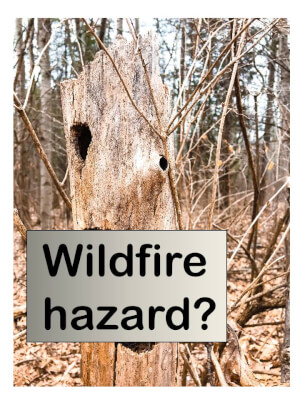
Wildfire hazardWildfires are now a year-round threat

We used to consider “fire season” to be summer into fall, and then winter rains came along. These days, wildfire season seems to be year round!  So we should be taking steps for wildfire prevention year round, too.

Here are 5 Action Items for wildfire prevention. Let’s look at them right now, even while cold January rain is falling outside my window . . .

Wildfire prevention on your own property

I hope that you are pretty familiar with what to do for your own property. Action item #1: Confirm you’re following these basics of wildfire prevention.

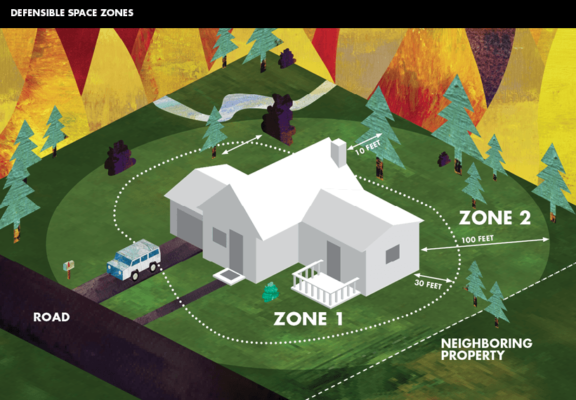
1Maintain defensible space. Maintain an area around the home cleared of brush, dead tree limbs, and flammable plants. In the areas close to your home, chose fire-resistant plants and keep all plants properly irrigated. The image below, showing different defensible zones, comes from the CalFire website: http://www.readyforwildfire.org/Defensible-Space/ .

CalFire zones

State law in California requires properties in wildfire areas to maintain a 100 ft. defensible space. In 2015, The Los Angeles’ Brush Clearance Program set more specific – and more stringent — standards for clearance:

  • 10 feet of roadways
  • 10 feet of combustible fences
  • 200 feet of structures

2Use fire-resistant building materials. Use brick or stone for walls and garden borders. Build decks of noncombustible materials. Re-roofing? Choose fire-retardant shingles. Obviously, you might not be able to make dramatic changes immediately. But at least be aware of changes you should plan for.

3Block embers. Most fires start from embers that catch on the house, not from a wall of fire! Install screens over vents and block access to eaves and under decks, etc.

This is only a partial list! 

I’m in California, where fire danger is particularly high. You may be in a less vulnerable location, or have different issues. So, Action item #2: Check with your own fire department for recommendations or programs for your neighborhood.

For another good overview resource, get this pamphlet from Farmers Insurance. https://www.farmers.com/content/dam/falcon/pdf/catastrophe-brochures/wildfire.pdf

And while we’re on insurance, be aware that your premium may reflect what you’ve done for fire prevention. Some companies may even offer a discount for defensible space and/or fire retardant building.

Action item #3: Talk with your insurance agent about your personal fire insurance coverage.

Wildfire prevention in your neighborhood

It’s one thing to take steps to protect your individual home.  After all, by law you are responsible for it.

But what if you live in a neighborhood of closely spaced homes, condos, or in a mobile home park? What about nearby community buildings? Local schools?  Parks? If they catch fire, you may be threatened, too.

Action item #4: Find out who is responsible for neighborhood properties. Do they know best practices for fire prevention, and are they following them?

You may need to contact a city or tribal agency, a property manager, or a neighborhood association. Once you have a contact, put on your leadership hat.

Are you on or can you attend a governing board that hires landscapers and/or gardeners? Make sure that your board and the landscapers are aware of basic fire prevention techniques for their site. Do they know what to plant, what to clear, what to trim – and do they do it? (Your fire department will surely be happy to send an expert to one of your board meetings.)

Your own HOA or emergency response team can help individual families understand the safest way to maintain private patios and gardens. Hold a meeting. Draft a notice to include with the rental invoice. Train a couple of your team members as “consultants” for people who have questions or don’t seem to get with the program.

Of course, even with well-maintained defensible space, a property can still burn. But if there’s a choice for fire fighters to protect a prepared space vs. an overgrown and unprepared space, which do you think they will choose?

Consider a community project for wildfire prevention

Since 2013, The National Fire Protection Association® (NFPA) and State Farm Insurance have been sponsoring Wildfire Community Preparedness Day.

This is a national campaign that encourages people to come together ON A SINGLE DAY to reduce wildfire risk. This year, Wildfire Community Preparedness Day is on May 4, 2019.

The idea is to get a group to work together on a project or event. Their efforts may be supported by $500 grants from State Farm.

Here’s what some groups have done in the past:

  • 20 volunteers from the Red Cross, AmeriCorps and the tribe prepared a defensible space around the residences of 3 tribal elders in San Diego County.
  • The local fire department and a youth organizations spent 3 days clearing out dead trees and underbrush from Colorado Mountain Zoo.
  • An elementary school created a “Firewise garden” in front of their school.
  • Boy scouts and local residents worked together on a clean-up day, cleaning roofs and gutters, removing vegetation and debris.
  • Four towns in Colorado banded together to rent equipment to remove 66 truckloads of slash from home sites!

What about your emergency response group taking the lead on a project?

A community project might be a great way to motivate your group! At the same time you could help promote wildfire safety and strengthen relationships among residents, local fire department,  community leaders and elected officials.

To get one of the 150 awards being made by State Farm, you’ll have to submit a plan for your project by March 1.

Action item #5: get all the info about Wildfire Community Preparedness Day, including the application for the grant, at this website:  https://www.nfpa.org/Public-Education/Campaigns/National-Wildfire-Community-Preparedness-Day

With the government shutdown still ongoing this week, the whole concept of reducing fire risks seems particularly important. Why? Because thousands of agency employees are not able to do the cleanup and training they would normally be involved in.

Time for us to step up ourselves. Even starting in the rain!

Virginia
Your Emergency Plan Guide team

P.S. This Advisory focuses on preparations you can make BEFORE a fire threatens. Evacuating and fighting fires are separate topics in themselves.

How to Improve Your Chances of Survival

Share

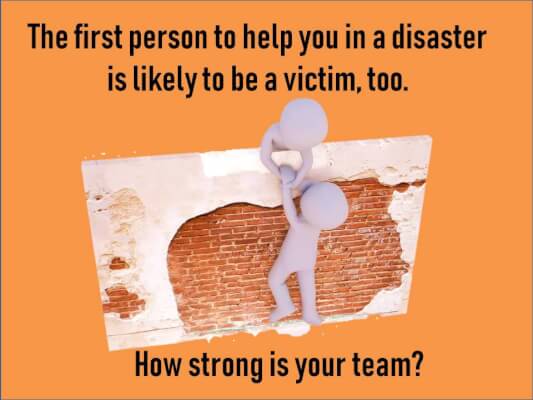
First person to help is probably a victim

Start a new year, strengthen your team.

The first rescuers in a disaster are others who are right there. Your neighbors. Your co-workers. They know you. They know where you are likely to be, and whether they should search for you!

Improve your chances of survival by building a stronger team around you – in your neighborhood and at work.

If you’ve got the start of a team . . .

Last year (2018 was so long ago!) we focused on creating what we think are some helpful blueprints for building that team. To make them more useful, we customized by type of neighborhood you might find yourself in.

Each of the books in our Neighborhood Disaster Survival Series addresses a different type of neighborhood:

  • An apartment or condominium neighborhood, where neighbors come and go, storage space may be limited, and since you don’t own the entire building, some preparedness options are limited. Improve your chances of survival by sharing and working together.
  • A mobilehome community, where building standards vary so homes may be more vulnerable to certain natural disasters and top infrastructure threats include broken gas and water lines.
  • A suburban neighborhood where options may be more varied but homes are so far apart you may not even know your neighbors or where families may have a “My home is my fortress.” attitude.
  • A small business whose owner is typically torn between meeting current profitability necessities and providing for what feel like only potential business or employee losses.

Steady wins the race.

You can’t build a team quickly. The guides go into great detail about building teams. They focus on identifying leaders to start the process, and suggest that the leaders get Community Emergency Response Team training so they share some of the same skills and approach emergencies in a systematic way.

Once this core group is ready to go, its members can begin to pull in other neighbors. The guides have plenty of ideas for ways to attract neighbors and get them involved. Your team will find it easy to arrive at emergency preparedness recommendations for the whole neighborhood. They may even come up with a written plan. All this will improve your chances of survival.

Many, many neighborhoods around the country have followed a similar road to improving their resilience.

But what if you don’t have a team?

What are you doing or planning, at home or at work, to improve your chances of survival?

  • If you have trained CERT graduates in your neighborhood, maybe they have stepped up to take on a leadership role. Or maybe you could encourage them to do so?
  • If you have a property manager or business owner who is tuned in to emergency preparedness, has that person taken some steps for more resilience? Maybe you could suggest and support those efforts? (Lots of ideas here at Emergency Plan Guide!)
  • What if nothing is happening in your neighborhood, and you feel like a voice in the wilderness?

Here in our community our team has shrunk. So we’ve decided that it’s time for a renewed neighborhood effort. We’re starting – again – from scratch!

Set the tone.

won't you be my neighborRemember this cartoon from the Advisory a couple of weeks ago? We’re using it to set the tone for our 2019 team-building effort. Friendly, not threatening or guilt-inducing.

Simple first step.

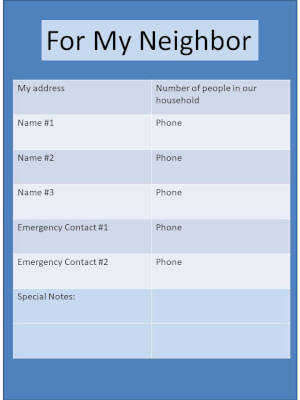
This week, we’re following up with the next step, providing neighbors with a simple form that they can fill out and share. The form is a simplified List of Emergency Contacts aimed at bringing neighbors together who may never really have met.

Emergency Contact InformationHere are instructions we’re sending along with the form:


Fill it out this form WITH YOUR INFORMATION.  Maybe your emergency contact is your daughter. Mention that. And under “Special notes” you could add your pet.

Make a few copies of this information about you, and make a few blank copies too. (You don’t need a form; a simple piece of paper will do.)

Then, step next door and introduce yourself and share this information. Ask neighbors to share their info in return. Exchanging info doesn’t mean you’re promising to be best friends. What you are doing, though, is making our neighborhood a friendlier place, and making it safer and more secure, too.  

A good way to start the year, don’t you agree?

Neighborhoods change, and neighbors change. Here in our own household we’ve noticed one thing that happened in 2018   – we’re getting older!

But no matter the exact circumstances, having good neighbors, and being a good neighbor, will improve your chances of surviving a disaster. We are all in this together!

Virginia
Your Emergency Plan Guide team

P.S. How well do you know your neighbors? Have you exchanged important contact info? Let us know how you went about it! We need all the suggestions we can get, because this seems to be one of the biggest challenges to starting a neighborhood group!

Covered for a natural disaster, or not?

Share

Covered for natural disaster

Time for an insurance review.

I’m putting together my to-do list for the holiday vacation. After all this year’s natural disasters, first on the list is an insurance review. I started the review, and more and more questions kept coming up! Naturally, this led to an Advisory!

Ask your insurance agent these 7 questions to see how well YOU are covered for a natural disaster.

“How many of your clients are under-insured? Am I one?”

This is a tricky question, of course! Maybe you could soften it starting with this quote from Nationwide:
“I understand that 60% of American homes are under-insured by an average of at least 20%. I want to be sure I’m not one of them!”

“I’m worried about all the recent (fill in the blank: wildfires, storms, tornadoes). Am I covered for a natural disaster? What if my house is totally destroyed?”

This is the main question you want answers to. Start with these sub-questions . . .

  • What is the amount of my home coverage?
  • Is that based on the value of the house, or replacement cost? (Be careful. “Value” of a home could include the value of the land, in which case your coverage might not be enough to replace the house.)
  • Exactly how is replacement cost figured in my policy? (It turns out that there is “replacement cost” and then there’s “extended replacement cost.” Make sure your agent can explain which you have, and the difference between them.)

“If I have to live somewhere else while the house is being rebuilt, will my policy cover additional living expenses?”

How much and for how long? Any restrictions on where I stay? How do I get the money in my hand?

“Will my policy cover (fill in the blank: floods or storm surge from a hurricane, earthquake, land slide following rain, volcanoes)?”

You will probably NOT BE COVERED for a natural disaster from the list above!

I love this paragraph from esurance

Homeowners insurance typically doesn’t cover landslides or mudslides. That’s because both are considered a form of “earth movement”, and like an earthquake or sinkhole, they’re generally excluded from a standard homeowners insurance policy. Flood policies often don’t cover damage from landslides or mudslides, either. And earthquake policies only offer reimbursement if an earthquake caused the events.

Quiz your agent closely on coverage for natural disasters. Be sure you know just where “water damage” (covered) leaves off and “flood water damage” (not covered) starts, where “rain damage” (covered) ends and “mud damage” (not covered) starts – on YOUR policy!

Perhaps you need separate policies to be sure you are covered for natural disasters?  We have addressed some of these special threats, including insurance policy info, in earlier Advisories about Volcanoes, Earthquakes , and Floods.

“What else don’t I know about? What about . . .”

  • Mold
  • Sewage backups
  • Debris removal after a disaster
  • Lightning
  • Hail
  • ????

Get your agent to mention some of the frequent problems he or she has encountered here in your neighborhood. Some of these may be covered by your policy, others not. You may want to add an endorsement to your policy to cover a specific risk.

“This is adding up. What can I do to reduce premiums?”

The first thing to discuss are your deductibles, particularly if there has been a change – from dollar amounts to percentages, for example. A 5% deductible may sound better than a $15,000 deductible, but not if your house is worth $400,000!

Generally, the higher the deductible, the lower the premium. You want the highest deductible you can afford.

And you may want to check with your agent to see if you can make changes or improvements to your home that will improve your coverage for natural disasters while lowering the insurance company’s risk. These might include replacing the roof, upgrading the electric system, clearing brush around the house, retrofitting for earthquake, or installing storm shutters. Ask for a list of all the home discounts you’re eligible for, not just those associated with natural disasters!

Now, I don’t review my insurance every year – but this year I’m going to with the help of these questions. I hope you use them, too!

Virginia
Your Emergency Plan Guide team

P.S.  If you discover that you seem to be well covered for natural disasters (Hooray!), you still might want to pose this last question:

“Is the bill for my current homeowner’s policy going up?”

If the answer is YES, and it’s more than 5% or so, ask why. You might hear these reasons:

  • Recent disasters have made prices rise for all insurance companies.
  • Risks have gone up in your neighborhood.
  • Your personal risk profile has changed. (Confirm what’s changed – is it your credit score? That could have an impact in some states.)

P.P.S. Consumers Reports says that people who shop for better deals on property insurance can save hundreds of dollars a year. You can get quotes for free through insure.com or InsWeb.com. (as recommended  by This Old House)

And finally, a disclaimer. I am not a licensed insurance agent, hence all the links in this Advisory to what I trust are reputable sources. Be sure to get advice on insurance from professionals.

Help Your Neighborhood Prepare for Disaster

Share


The Constant Challenge

I write often about CERT – the Community Emergency Response Team – and the great training that CERT provides.

People who become CERT graduates are almost always up to speed on what’s going on with the weather. CERT grads have basic emergency equipment including radios and walkie-talkies. They are people you can count on when things go wrong.

But CERT grads just aren’t enough to help most neighborhoods prepare or get through a major disaster because there aren’t enough of them!

So when the disaster hits, you’re going to be counting not on First Responders, not on CERT grads, but on your neighbors – trained or untrained!

Here in my neighborhood, we’ve built a neighborhood emergency response  team with the help of CERT grads – but we’re constantly trying to strengthen neighborhood resilience just by getting more neighbors involved in planning for disaster.

Earlier this month I wrote an article on the issue for our neighborhood newsletter. I tried to make the message a friendly one – not just about emergencies and disasters!

I’ve received some positive feedback so I thought I’d share my article here. Maybe you can cut and paste and use some of it for YOUR neighborhood? Can you pull out a couple of the suggestions as the basis for a meeting?

Do with it what you will!

I just hope it will be useful to help your neighborhood prepare for disaster!

Here’s the article.

won't you be my neighborWon’t you be my neighbor?

Over the past year we’ve witnessed so many tragedies and none worse than what’s still happening now in Northern California – thousands of homes destroyed, dozens of people dead, and 3 still missing more than a month after the start of the Camp fire.

We’ve heard great stories of neighbors helping neighbors in disaster situations.

Some of the stories are awe-inspiring.

  • The Cajun Navy towed their private boats from Louisiana to Florida and launched them to help pluck hurricane victims from floodwaters.
  • Neighbors with chain saws worked hour after hour to clear roads after devastation caused by Hurricane Florence.
  • A food truck owner drove 50 miles into a disaster area and fed everyone as long as the food lasted.
  • People spontaneously added clothing to a pile in a Walmart parking lot to create a place where displaced families could collect necessities.

There are many stories just like these – stories of ordinary people finding the will to step up in a disaster.

At the same time right here at home we’re lucky to have stories of neighborhood volunteers who help out all the time!

Here in our neighborhood we see residents who are willing to give time and energy to make a difference for our community throughout the year. We can look back and count dozens of activities, groups meetings, special events – all organized for us by caring volunteers.

But here’s The Constant Challenge. . .

This group of dedicated volunteers is reaching fewer and fewer people – partly because we lose community members, and partly because new residents are not being integrated. And as always, because no disaster has actually hit us, people find it easy to postpone taking any preparedness steps.

For the New Year, our homeowners association has made a commitment to build an even stronger neighborhood.

Building a stronger neighborhood starts with knowing your neighbors.

This means knowing names, having the name and phone number of a neighbor’s emergency contact or family member, maybe exchanging emergency keys. It means keeping a watch out for water leaks, escaped pets, etc.

When you know your neighbors . . .

  • You know who “belongs” in the neighborhood and who might be an intruder – and if you should call the police.
  • You notice when you haven’t seen a neighbor for several days, so you can do a quick check or make a call to a family member.
  • If a neighbor is having a problem getting around, you are ready to add a few items to your shopping list to help them out.
  • You have someone to call if you can’t get home to care for your pet.
  • In a major emergency, you know you won’t be overlooked or forgotten even if you don’t get an official “alert”  – because your neighbors know you are there!

Here’s the first step:

Just introduce yourself and learn the names of at least a half dozen of the people who live around you!

For the next step:

Exchange a simple form that lists names and contact information.

We’ll come up with a sample form in our next article, so watch for it. In the meanwhile, get out there and meet that first new neighbor!

* * * * * *

OK, that’s the first article in the series I’m intending to write for my community. The next article will have that little emergency contact form I mention. It will also have a place for people to list pets, medical conditions, etc. But sharing that kind of info doesn’t happen at the first meeting. It requires trust – so we’ll start with just introductions.

I’ll let you know how things go here.  Please let us know what steps you’ve taken in your community to help involve neighbors!

Virginia
Your Emergency Plan Guide team

P.S. If you’re new here, you may not realize that our main emphasis at Emergency Plan Guide is on what we call “wholistic” planning! We believe that the impact of every big emergency extends well beyond your family. We are all in this together — and the more we work together, the safer we all will be. Does this sound like something you agree with?  If so, take a look at our Neighborhood Disaster Survival guidebooks. Each offers a path to organizing an emergency response team within your neighborhood,whether it’s made up of apartments, mobile homes or single family homes.

Better Business Security Over the Holidays

Share

better business security

Closed and Shuttered for the Holidays

Thanksgiving is over;  Christmas shopping has started in earnest. And many of us are looking forward to some time off over the upcoming holidays.

Before dashing out and locking the door behind you, take a moment to consider the increased chance of criminal activity that takes place precisely during these next four to five weeks. (Increases are seen mostly in robbery – taking by force  —  and larceny – no force involved.) It’s worth a close look at better and better business security.

What should you as business owner* be doing to protect yourself and the company?

1-Review cyber security procedures with all employees.

It’s easy to get distracted – and attracted! – by online sales, personal schedules, party planning, etc. During this busy period, don’t get suckered into fraudulent requests for payment or funds transfer, pfishing emails, or using an unsecured hotspot (coffee shop!) for a quick business transaction. Don’t let your kid use the work computer you’ve brought home!

Cyber QuizHave a list of cyber security policies and go over it with everyone. (Your IT team should have prepared such a list. If not, here’s a basic business cyber security quiz we’ve put together, updated for 2018.)

2-Take another look at your physical surroundings with holiday security in mind.

Decorations — We go through these reminders every year for the residents who live in our community. They also work for better business security.

Put up safe decorations!  No live candles, period. Use outdoor–rated electrical wires for outdoor lighting. Don’t overload circuits. Keep cords out of high-traffic areas. Be sure holiday lights aren’t left burning overnight.

Locks and lighting – Holidays attract thieves. Be sure all your workplace security equipment is working: outdoor and emergency lights, locks and access control systems, panic buttons, surveillance cameras. Don’t forget to let your security company know your holiday schedule. And be sure to provide them with appropriate contact names and numbers (knowing that a lot of people will be out of town). (A lot of these surveillance items are being featured in special deals online this year. CLICK HERE for an Advisory that will help you figure out what you need so you can get the best prices. )

3-Keep people out of trouble.

We all tend to get excited during the holidays, and it’s easy to forget some of the basics. One prime example – letting strangers in or inviting friends into the building when they usually don’t belong there. As you lock up each night, check to be sure no one is lingering in restrooms, storage rooms, etc.

And if you’re hiring temporary employees during the holiday period, do criminal background checks on them before allowing them onto the team.

You may find it’s time to do a review of all aspects of security at the front door. Our Advisory about that topic is a popular one.

4-Review your policies for dealing with cash.

Lots of sales and lots of shopping mean people are carrying more cash than usual. Your business may be handling more end-of-year purchases than usual, whether cash or credit. Take steps to protect current business activity so you don’t come back to problems in January. Some suggestions for better business security involving cash:

  • Insist on careful credit card use.
  • Periodically remove extra cash from registers and put in a safe. (No safe? Consider installing one now. The Advisory about security at the front door mentions a couple of different model options.)
  • Don’t openly carry cash to the bank. And make deposits before it’s dark.
  • Check records for suspicious refunds, discounts, over rings, etc.
  • If you’re open longer hours than usual, be sure to keep back doors locked and alarmed. Keep parking lot lights on until after employees have left.

5-Protect the Company from a Holiday Party Disaster.

I suspect we’ve all heard the stories of companies being sued because at the holiday party, under the influence of alcohol, some employees act inappropriately, embarrassing photos get posted on Facebook, or a driver leaving the party under the influence is involved in an accident.

Every one of these incidents could result in a crushing lawsuit.

I attended a New Year’s party a couple of years ago that had some good ideas about better business security as it relates to employment law.

My friends (actually, my employer) hired a professional bar tender who poured the drinks and was prepared to stop pouring for people who had too much to drink. They closed the bar a good hour before the party was over and switched to serving coffee. When we came in the door, we were quizzed about designated drivers, and reminded that taxis would be available. And the party had some very important clients there, too, which kept the atmosphere more businesslike than it might have been otherwise. It was a great party that got repeated the next year!

After the holiday you deserve the chance to come back to work refreshed and ready for the new year. Good business security will help kick off 2019 that much more easily!

Virginia
Your Emergency Plan Guide team

* Occasionally I get an email from a reader saying something like, “I am not a business owner so I’m not interested in this topic.” Yes, some of these Advisories are addressed to business owners. But nearly all of them, just like this one, have implications for all the employees. If there’s a break-in, a theft, or a lawsuit at the place you work, it could easily become a disaster for the whole company, not just the owner! Please share these suggestions with your business’s owner if it makes sense.


Are you vulnerable to landslides?

Share

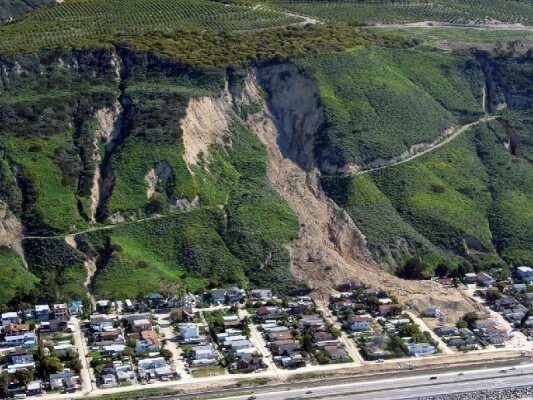
Southern CaliforniaCalifornia Landslide

Santa Barbara County, California – Landslide Photo – USGS

Landslides can occur in all 50 states. They can be sudden and shockingly deadly. Are you vulnerable?

It’s Wednesday November 28th. I’m watching the weather reports today. Here’s a sample of the local headlines  – this one from ABC. today:

Storm system will bring rain to SoCal starting Wednesday evening with heavier downpours expected overnight and into Thursday morning, causing flooding concern for residents in the recent burn areas.

This led me to an older news report. This one was also from California, back in January 2018:

For days, officials advised residents in areas burned by the Thomas fire that a coming storm could bring major mudflows. Several neighborhoods were under a voluntary evacuation order. Many residents decided to stay. Some assumed the threat was overblown just weeks after the fire triggered similar calls to evacuate.

And the result: At least  21 people were killed by the flooding and debris flows at followed the heavy rains.

Have you experienced heavy rains yet this season? If yes (or even if no), are you vulnerable to landslides?

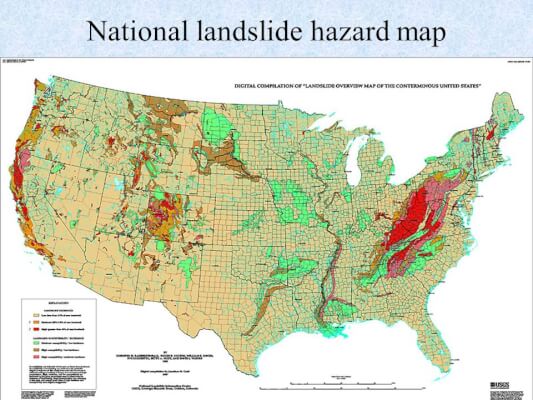
Take a look at this map from the US Geological Survey, showing regions of vulnerability. As you can see, they are mostly along the west coast of the US and also in the eastern mountains.

The bright red Appalachian Mountains area is labeled as having 15% of the land vulnerable to mud and landslides!

vulnerable to landslides

How do you protect against landslides?

Much of the following information was provided via resources suggested by one of Emergency Plan Guide’s readers. Thanks, Bradley Davis at DisasterWeb.net. !

Learn more about your risks beforehand.

  1. Check on detailed maps like the one above from the USGS to see if you are vulnerable to landslides, and if so, just how vulnerable you are. Maps are based on geographic features, soil properties and historic and anticipated rainfall.
  2. Second, be aware of recent fires that may have raised the risk in an area that otherwise might not have been so risky. Note: you may be traveling into a higher risk area that will make you more vulnerable. Find out what’s been going on there recently!
  3. Check with your insurance agent to find out if you have coverage for mudflows. Unless you have Flood Insurance, you probably don’t!

Be ready to evacuate.

Have an evacuation plan and evacuation kits. You may have very little notice so be prepared to leave IMMEDIATELY and know where you’re headed or at least how to get in touch with other family members. (That out-of-state emergency contact, remember?)

Take action now to protect your property.

You can’t stop the rain. But you can take steps to control and redirect water on your property. Some examples:

  1. Consider plants and trees that have deep roots, to control erosion and to help absorb and filter water.
  2. Landscape to include depressions/channels to direct runoff. The water needs to end up on your property, remember.
  3. Build a “rain garden” to catch and hold water, where it can soak into the ground within 24 hours. Plants in the garden need to be wet-soil tolerant and have deep roots. Get professional assistance in planning this depression. Find more info and great photos of rain gardens at the Groundwater Foundation.
  4. Divert water from rain spouts so it doesn’t collect and make puddles.
  5. Build up grass and natural barriers at the perimeter of your property to keep water out or redirect it.
  6. Install permeable paving and porous surfaces in driveways and walkways.

Know the signs of impending danger.

As always, be alert to your surroundings. Some indications that land may be starting to shift, signalling a potential landslide . . .

  • Strange sounds – trees cracking, rocks clashing, water flowing rapidly.
  • New cracks or bumps in roads, on slopes.
  • Soil moving away from foundations, road bed dropping.
  • Saturated ground where it is usually dry.
  • Tilted trees, decks, fences or walls.

Watch the weather reports, and be ready to leave at a moment’s notice!

Finally, if you do have to evacuate as a result of landslide, before you head back in . . ..  

Even if things look OK at first, be cautious before you assume anything. Check with authorities that are on site to see if Personal Protective Equipment is required or desirable. (Direct Relief,  a disaster relief organization, is providing coveralls to victims of California fires right now.)

At the very minimum, wear heavy rubber boots, long pants and long sleeves, heavy work gloves, and use a mask (N95) to protect against breathing in contaminated dust and/or ash.

Approach your “re-entry” step by step.

  • If your home suffers structural damage, take photos and contact your insurance agent. Keep receipts for any clean up and repairs.
  • Utilities may be off or damaged. Check for gas leaks, broken wires or the smell of burning insulation. Check for broken water and sewer pipes. Call on professionals for help turning these back on.
  • Everything that got wet may be a health hazard. Disinfect (Bleach is the best) and then dry. Wear gloves, mask and eye protection against dust, chemicals, mold.
  • Watch out for rashes as a result of exposure to debris. Watch for “trench foot” as a result of having wet, cold feet hour after hour.
  • Any cut or even breathing contaminated air may turn into a serious infection. Check your condition frequently and don’t delay in seeking medical advice.

When many people are displaced and living in local shelters, the chance of contagious diseases is also increased. Again, use respiratory and eye protection to help prevent the spread of germs, and be aware of hygiene at all times.

Wow. So how vulnerable are you?

What started out as an extended weather report has turned into quite a lengthy discussion. If you are outside of a potential slide area, perhaps you can forward this Advisory to friends elsewhere. If you’re not SURE whether you are in a slide area, head back to the USGS and see if you can dig into their maps for more detailed info about YOUR location.

If you’ve been affected by recent fires in California, you may also want to check out some of the FAQ (Frequently Asked Questions) at the USGS. Here’s one specifically about wildfires and debris flows. And here’s even more detail about Southern California susceptibility.

The latest weather update . . .

So I just checked with the National Weather Service. They have issued a FLASH FLOOD WATCH  for my area and in particular for burn scar areas, for tomorrow, Thursday morning through Thursday night.

Here’s the message:

Heavy rainfall could cause debris flows in recent burn areas according to rainfall thresholds provided by the USGS. Debris flows are extremely dangerous and happen suddenly often with little time to act. It may even not be raining at your location to be impacted by a debris flow. You should monitor the latest forecasts. Heed any advice given from local authorities.

This is real life.

Virginia
Your Emergency Plan Guide team

How do YOU shop for the holidays?

Share

holiday gift

Have you succumbed to the excitement of Black Friday?

Whether yes, or no,  how do you compare to other Americans when you shop for the holidays?

  • According to accounting firm Deloitte, 50% of last year’s holiday shoppers said they prefer shopping online to going into a brick and mortar store. Which do you prefer?
  • And although this is supposed to be the time to shop for the holidays (i.e., gifts for others), apparently much of the early spending is on things people want for themselves rather than what they’re buying for others. What’s on your personal list?

Do you shop for holiday gifts with a purpose?

Here at Emergency Plan Guide our major focus isn’t on selling things, but we we definitely believe in gifts.  That’s because . . .

We see gifts as a way to introduce more people to the importance of being prepared for emergencies.

So, following national trends, we take a few days – and particularly at this time of year! — to aim you toward some online purchases to emphasize the value of preparedness . . .

  • For family members
  • For employees or workplace colleagues
  • For yourself!

Let our Top Ten Lists help you shop for the holidays!

Last week we updated our TOP TEN lists to some of the latest best-sellers in the category of Survival Starter Gifts and also in the category of Exclusive Preparedness Gifts. Two different lists, two different price ranges, two different PURPOSES!

If you haven’t yet, please check them out!  Join in the holiday buying tradition!

And we also are pleased to introduce a whole new online source of interesting and inspiring items –a new website!

Announcing  — a new resource for shopping!

Over the years you’ve seen that we are eager, always curious readers. We go in depth into many topics to be sure we understand the whole science behind it. At the same time, we also enjoy not-so-formal articles and books, and we often include links to them.

Every once in a while we come across a book that is just too good to own and not share!  That’s what started EmergencyPreparednessBooks.com

Spread the word about preparedness

On the site we review books that we’ve enjoyed and books we think are essential for your library.

  • We add a new book every once in a while – you’ll see them under “Latest Additions.”
  • We also have a section with ideas for using books to “Help us spread the word” about preparedness. This section is written in particular for people belonging to neighborhood groups or who are part of a business where preparedness plays a role — or SHOULD play a role!

I invite you to find a few moments to browse through the website, read some of the reviews, learn more about why we created the site, and see if any of these ideas or these books fit your list as you shop for the holidays!

And I welcome any comments or recommendations YOU have for great, inspiring, engaging, educational, exciting or fun books YOU would like us to add to our list for your fellow readers!

Here’s the link to the new site. You’ll recognize it as looking just like the image above!

Thanks – and happy shopping!

Virginia
Your Emergency Plan Guide team


A Tsunami of Threats

Share

Too many threatsThe number of threats can be overwhelming.

In just the past 2 weeks we have been bombarded with stories of threats that turned into disasters and near disasters.  I’m sure you’ll remember these:

October 10, 2018Michael makes landfall as a Category 4 hurricane in the Florida panhandle. 50 people dead, billions in losses.

October 15, 2018 – 60,000 without power as PG&E shuts down lines over more wildfire fears.

October 24, 2018– Police intercepted suspected pipe bombs sent to high-profile Democrats, in what New York officials described as an act of terrorism.

October 29, 2018Eleven people were killed and six others were injured on Saturday when a gunman opened fire in a synagogue in Pittsburgh, Pennsylvania.

October 29, 2018 –Boeing jetliner crashes after take-off in Indonesia, all 189 aboard presumed lost.

This is just a short list. There were more. And throughout the country people suffered from local tragedies that didn’t make the national news.

How can we do a realistic job of preparing for so many threats?

Consider a systematic approach.

1-Start with a written list of threats.

In writing our Neighborhood Disaster Survival Series we found ourselves assembling multiple lists of potential threats. Ultimately we put together one list for homes and a different and considerably longer list for businesses.

You can build your own list. Get your team together in front of a BIG white board or easel (plenty of pages of paper) and brainstorm all the threats that you could possibly face. We have done this a number of times in our group, and we usually come up with 20-40 threats. (This is a great exercise to get people engaged. )

2-Narrow it down to threats that are realistic for you and your community.

Go back over your massive list (!) and start paring it down by removing threats that may be POSSIBLE but really aren’t PROBABLE.

Usually it’s simply a matter of replacing emotional response with common sense and some history.

For example, here’s a short list of threats with some thoughts that can get you started on the paring down process.

  • Every day challenges like power outages – the most frequent disaster in the U.S. (and increasing in frequency). In our local neighborhood we have to include water main breaks and gas line breaks and/or shut-offs, because of the age and quality of our infrastructure.
  • Potential localized dangers to your neighborhood, like transportation accidents – particularly high risk in industrial areas. If you live or work near an airport or beside train tracks, near chemical plants or certain industrial processing installations, threats of accident might be high; otherwise, you could probably take these threats off your list.
  • Natural disasters like floods or storms, earthquakes, tsunamis, and wildfires – likely tied to your geographic location. These are always first on everybody’s list, and their likelihood is pretty easy to evaluate.
  • Mass shootings and workplace violence – nearly always the result of personal motives and/or mental illness issues. Very difficult to anticipate or prepare for, but you could be blamed for negligence if you ignore the possibility.
  • Attacks with weapons of mass destruction – suddenly appearing on our list after decades of being absent. We’re talking here about the threat of nuclear explosion or biological or chemical attacks. If you live and work in a major metropolitan area, particularly a government center, your risk would be higher.
  • Cyber attacks – almost 3.25 billion data records were compromised in the U.S. during the first half of 2018; new vulnerabilities are being exploited as data moves to the cloud. As you read this, attacks ranging from simple virus infections to ransom claims are happening to individuals and businesses around the world.
  • Lawsuits – becoming more frequent but one of the easiest threats to protect against.
  • Terrorism – Whether international or domestic, terrorism results in dramatic news coverage. It is still relatively rare in the U.S., but the number of incidents has been rising.

3-Begin preparing for these selected threats.

Pick the most likely threats and start with those. What can you do to find out about the threat in advance? Can you mitigate (lessen) the impact by making changes NOW? What processes, tools and people might you need to recover once the threat has materialized? What’s the plan for assembling these resources, training, etc.?

Warning: Don’t let your emotional reaction prejudice your efforts.

During the “threat analysis” exercise you may find that people’s individual biases and emotional reactions are likely to emerge. Their experiences may make it tough for them to think dispassionately about a given threat.

Moreover, research has shown that most people seem to find man-made disasters more frightening and rate them as more severe than natural disasters. Terrorism tops the list for emotional reaction, even though it is very low on the probability list.

Try not to let these biases get in the way of making good decisions as to which disasters you actually prepare for!

Reminder: Plan to repeat.

Analyzing threats is something you’ll want to do more than once, because circumstances change. Build a repeat look at threats into your plan!

Virginia
Your Emergency Plan Guide team

P.S. We were hit this week by another of those “local” disasters. It had to do with a Windows 10 update. Our entire network just threw up its hands and quit.  So while I would normally have offered you our list of over 80 threats to business, I just haven’t been able to make it happen!  If you can’t wait, please just buy a copy of Emergency Preparedness for Small Business and you’ll find that list in the Appendix, along with a multi-page Risk Analysis Worksheet that can help you set priorities!  I’ll report in later about how we recover!

Prepare Your Pet for an Emergency

Share

Pet in emergency

Last night our neighborhood response group hosted a special presentation from a local non-profit, SoCal Animal Response Team. The group’s mission is to help animals in disasters and to educate owners to have a pet emergency preparedness plan.

They stress preparing yourself but also how to prepare your pet to come safely through an emergency!

Here are some things to keep in mind as you prepare your pet for an emergency.

Everyday emergencies can keep you from getting home to your pet.

Even on a regular day, there are a lot of reasons why you might not make it home to your pet . . .

  • There’s a broken pipe at work and you have to stay to help clean up.
  • You get in a traffic accident on the way home and end up in the hospital.
  • A gas leak threatens your home neighborhood and you are trapped OUTSIDE the safety perimeter. No one is allowed in.

OK, so this emergency lasts all day and all night and well into the next day. In the meanwhile, what is going on with your small house pet?

Baby is wandering around in the dark, no lights, no heating. Baby finished off food and water a long time ago. Time to pee – where to go?  Time to poop – no one to take Baby for a walk! Baby whines, whimpers, howls and then gets mad and tears into a few pieces of furniture and starts destroying them.

You get the idea!

Prepare your pet with a Pet Buddy.

This is a friend or neighbor, someone who . . .

  • Knows you have a pet and notices you don’t get home as usual.
  • Knows and likes the pet, and the pet knows the Buddy.
  • Has a key to your house, knows where food, leashes, and pet medicines are kept.
  • Would be willing and able to get your cat into a pillowcase and thus into the carrier.
  • Has been authorized to take your pet to the vet for medical care if the pet gets injured. (Probably the vet will require a signed release for this.)

Being a Buddy is a big responsibility. But if you don’t find and train that Buddy, you could arrive home to a sick and hostile pet and a wrecked and reeking house.

Action item: Plan a meeting of a few neighbors (with pets) to see if you can come up with some Buddy pairs. Everyone’s pet will be safer and you will all feel better!

Prepare your pet for immediate evacuation!

Some emergencies hit without warning, but in many cases you will have some time to get packed up and into the car and headed for safety.

If you have 15 minutes, you will not have time to run through the house to grab everything you need, much less what your pet will need.

Heck, in 15 stressful minutes you may not even be able to find your pet! (Our speakers told horror stories of pets crawling into unreachable spaces.)

The plan for bigger emergencies:

  • Have your pet’s emergency kit already packed and sitting right there next to your own survival kit. (Need a reminder of what all should/could go into that kit? Here’s our recommended supplies list.)
  • Know where your pet is likely to hide and have a good way to call it to come out – for example, shake the food bag!
  • Keep important ID papers in a waterproof container (folder), along with the pet carrier. (See list of important pet papers here.)

If you are directed to a shelter, keep in mind that no matter what the law says, not all shelters will accept pets. If you’ve done your homework, you will already have a list of “pet friendly” hotels or kennels in the region. Clearly, if the disaster is widespread, these facilities will fill up fast. If you can, evacuate early to have the best chance of finding shelter for your pet.

Two-week plan for managing your pet after the hurricane, earthquake, etc.

Of course, there’s no one-size-fits-all for disaster response. Your home could be fine, but the power is out. Your home could be partially damaged, or cut off by floods, snowed in roads, etc.

To prepare your pet for a two-week emergency, at a minimum you’ll need food, water and medicines not just for yourself but also for your pet. How much will depend mainly on the size of your pet. Of course, you’ll need warmth, light, etc.

In addition, our speakers gave us important reminders about what we might watch out for in the way of expected pet behavior in an extended emergency situation.

If your home is damaged, your animal will be disoriented, just like you are. Long-standing pet “markings” (with urine) may have disappeared or moved so your pet won’t recognize his or her territory.

Remember – your house pet is likely so domesticated it cannot protect or defend itself from danger. You have chosen your pet to be your companion. Now it’s your job to be your pet’s protector.

Some things to keep in mind:

  • Inside, keep the pet in a bathroom. Safe, able to be closed up and cleaned up, no place for pet to hide.
  • If you go outside, keep the pet closely leashed to protect it from injury or from being attacked by other animals. If there is debris — broken wood, broken glass — make sure your pet is wearing booties.
  • If you’re in a group setting, you may need to muzzle your dog to be sure it doesn’t injure other people or animals. (If your dog is injured, it may bite YOU. Muzzle it.) Your cat can’t be muzzled, but injuries caused by a cat’s scratches or bites are particularly dangerous. Our speaker said that anytime their workers are bit or scratched they go immediately to the emergency room! Control your cat.
  • If your pet does escape, a couple of things can happen very quickly. First, your small pet is likely to become a victim of other hungry animals. Second, it may take only a few days for it to “revert to wild.” If you see the pet again later, it may not recognize you, may react aggressively, and may have become part of a dangerous pack of other animals. Approach with extreme caution.

Action items to prepare your pet to make it through an emergency

1-Have a pet emergency kit packed and ready to go. Include items you might not normally need, such as booties or muzzles.

2-Build and maintain a list of pet-friendly hotels and kennels – not just in your own town but wider afield in case you need to evacuate some distance away.

3-Update important identification papers for your pet, including medical information and photos.

4-Familiarize your pet with its carrying container. (Many animals find their cages/containers a very comforting place to sleep in, particularly when they have a favorite blanket or piece of your clothing.)

5-Plan a way to help organize neighborhood Pet Buddies.

Clearly, this Advisory does not cover the whole picture. But it’s a start –  with more to come! Please share with others who have house pets – and that probably means over half of your neighbors!

Virginia
Your Emergency Plan Guide team

P.S. Knowing your neighbors’ pets is important. If the pets are always in the house, you may not realize just how many of them there are, or what KIND there are, until the walls fall down!

How do you answer when . . .?

Share

Answers

Do you have an answer when people ask, “Why are you involved in Emergency Preparedness?”

If you’re like me, you’ve been asked that question many times, in a variety of ways.

Common questions – do they sound familiar?

  • What’s so great about emergency response?
  • How do you even know where to start?
  • What if your family really isn’t interested?

Frequent put-downs – tough to come up with an answer!

And then there are some people who don’t even pose a question, but come up with a comment designed to shut the whole conversation down.

  • I don’t believe in scaring people.
  • Nobody has that kind of money.
  • Nothing bad is going to happen here.

The best answer? Facts!

The trick I’ve found is to have at hand a few facts to counter the emotions in these comments! And since Joe and I are planning to be at a big emergency preparedness community fair this weekend, I decided I needed a few updated facts.

I am sharing them below as the Emergency Preparedness Fact Sheet, with this month’s date. Obviously the fact sheet can get out of date mighty quickly!

I hope you will find these facts useful in casual conversations. You can use them to answer a question like one of those above. You can use them to start a substantive discussion at work or with a group you belong to. (Your neighbors may not agree with everything!) Share them with the press.  Customize, add, subtract.  But use the fact sheet contents when you can, and let us know how it works!


Emergency Preparedness Fact Sheet – October, 2018

Why I stay involved . . .

  • More disasters: Weather-related disasters are increasing, quadrupling since 1970 to almost 400 per year. Hurricane Harvey was called the 3rd 500-year flood in 3 years. Hurricane Michael is strongest to hit Panhandle of Florida in recorded history. https://www.economist.com/graphic-detail/2017/08/29/weather-related-disasters-are-increasing; https://www.vox.com/science-and-health/2017/8/28/16211392/100-500-year-flood-meaning; https://www.cnn.com/2018/10/10/us/hurricane-michael-wxc/index.html
  • Higher costs: The cost of disasters continues to go up. With three devastating hurricanes, extreme wildfires, hail, flooding, tornadoes and drought, the U.S. tallied a record high bill last year (2017) for weather-related disasters: $306 billion. . CBS News, Jan. 8, 2018
  • Fewer deaths: The number of deaths caused by natural disasters is falling:
    • Cities invest in safety measures, advanced warning systems, better buildings.
    • Response organizations deliver food, water, sanitation, and medicine more quickly.
    • People have access to social media, GPS, television, radio to warn them to get out of the way or get prepared for impending disaster.
  • Delayed response: However, in a widespread emergency, governments and aid organizations cannot always help communities immediately.  A new emphasis has arisen to promote “community resilience.” https://www.fema.gov/community-resilience-indicators
  • Public apathy: Study after study says that Americans recognize the threat of natural disasters, but fewer than half of them have done anything to prepare. Statistics for small business preparedness are similar. https://today.yougov.com/topics/lifestyle/articles-reports/2018/07/17/americans-disaster-preparedness-2018
  • Limited citizen engagement: Since 1993 CERT (Community Emergency Response Team) training has educated volunteers in basic disaster response skills such as fire safety, light search and rescue, team organization and disaster medical operations. Nationwide, in over 2,700 communities, more than 600,000 people have gone through the FEMA program. That’s 600,000 in a population of 325 million = 1 CERT grad for every 500+ neighbors! https://www.ready.gov/community-emergency-response-team
  • Community organizations: Some local governments also create and support neighborhood preparedness groups, often based on CERT and operating under the office or department of Emergency Management. Examples are LA’s Ready Your LA Neighborhood (RYLAN) and Hawaii’s Hazards Awareness and Resilience Program (HHARP).
  • Filling the gap: In most cities, when CERT graduates finish their training, they continue to train with other CERTs but go back into their neighborhoods without tools to help involve their neighbors. Emergency Plan Guide resources are meant to fill that gap:
    1. EmergencyPlanGuide.org regularly publishes articles and reports on various aspects of preparedness. The authors assume subscribers to the regular weekly Advisories have an interest in building more resilient neighborhoods, so most Advisories are designed for group leaders to share in a formal group (church, homeowners’ association, business, school) or informally.
    2. The Neighborhood Disaster Survival Series adds a new tool for building more resilient communities. Each book provides a thorough, step-by-step program, again based on CERT principles, to help community leaders and their neighbors understand vulnerabilities of their particular type of community and work together in a more organized fashion to prepare for and respond to emergencies. The goal of each book is to help a group develop a PLAN for PREPAREDNESS that will have some staying power; the small business book is also designed to keep a business out of legal trouble.

What “facts” or emotions keep YOU involved? Are you able to get other people engaged by describing your own feelings or concerns? What “arguments” have worked best for you in getting others to take action?

Let us know in the comments!

Virginia
Your Emergency Plan Guide team


Simple Survival Signals Can Help Speed a Needs Assessment

Share

Survival signal flare

Wham! Your neighborhood is hit by an emergency! Before you do anything else, you check immediately on your own condition and the condition of the place where you are.

Then, if you are a member of a CERT or NERT team, you set out to check on others and help come up with a Needs Assessment(Our team members, like others, use checklists to record and walkie-talkies to report on how many people have been impacted, who is injured and to what degree, and what’s the status of neighborhood structures.)

The full needs assessment may take quite a while.

  • You and a partner can try to hurry to every single house on the street, interviewing residents and noting damage. But that may be beyond your physical capability.
  • You can try to call everyone on the street. However, even if you know all their phone numbers, that, too, would take a long time — dialing, hearing their story, answering questions, leaving messages, etc. (Besides, in a big emergency the phones may be down or overloaded.)
  • If you had a drone, and knew how to make it function, and it was daytime, you could send it up to view the houses. Of course, you wouldn’t be talking to residents.

Time is of the essence!

Here are three simple survival signals that might speed the needs assessment in your neighborhood.

These signals are in use by various neighborhoods in our Southern California area. Obviously, every region/neighborhood is different. But if one of these makes sense for you, or a version of one makes sense, bring it up with your group. Of course, not one of these will work without NONE of the signals works unless people have been  have come up with different ways to SIGNAL they are OK. All of these “systems” have come into play after group discussion, and they only work if people have been trained to use them in advance of the emergency.

Simple Survival Signal #1: White Towel Over the Mailbox

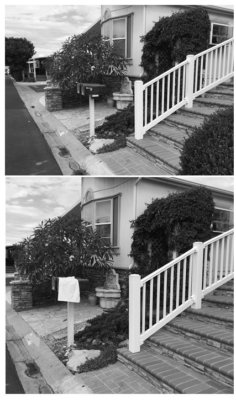
In closely-spaced neighborhoods like ours, we can stand at one corner and see all the way down the street to the corner. Many residential neighborhood developments around the country are laid out similarly.White towel signals OK

In an emergency, if people would SIGNAL THEY ARE OK by putting a white towel over the mailbox. A quick glance would tell rescuers to head to the next house.  (Note how the white towel in the photo stands out!)

Advantages of the white towel system:

  • Everyone has a white towel or rag or can get one. (White cloths are sold inexpensively in packages, as rags.)
  • Towel won’t be damaged by getting wet or dirty.
  • White towel is visible day or night.

Disadvantage of this system:

  • Won’t work if you don’t have mailboxes or other structure at curb in front of each house.

Simple Survival Signal #2: Red Card, Green Card in the Window

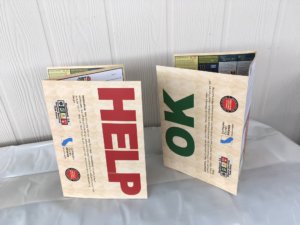
At a recent meeting sponsored by the Earthquake Alliance here in Southern California, we were shown a great printed resource designed to be handed out to everyone in a neighborhood. It’s an oversized tri-fold brochure printed on heavy paper, with all kinds of interesting facts and tips about preparing for disaster.

Two of the panels are signaling devices. One has a big OK in Green. On the reverse is printed a big red HELP! In an emergency you put the appropriate sign up in your window to let first responders/neighbors know what’s what. (The image shows two of the brochures so you can see both red and green panels.)

Emergency Signal SignAdvantages of the colored card system:

  • A sign inside the house won’t get blown away or damaged by weather or vandals.
  • This sign is big enough and heavy enough that it won’t be accidentally tossed.
  • Resident won’t have to go outside to place signal.

Disadvantages of this system:

  • All residents in the neighborhood would need to be provided with the signs (cost).
  • Someone has to design, write and print the signs, which would be different for every region.
  • Window sign is probably only visible from directly in front of the house or window.
  • Probably not visible at night.

The green/red signal doesn’t have to be printed. It could be as simple as two pieces of construction paper, one red and one green. Store them near the front window, of course.

Simple Survival Signal #3: Survival Whistle Calling For Help

Ok, what if you are trapped under fallen debris? You certainly can’t place the red (HELP!) card in the window. And depending on ambient noise, time, etc., you may quickly become exhausted calling for help.

But nearly everyone would be able to use a whistle to signal their need for help – as long as they can get the whistle to their mouth.

The universal signal: three loud, short blasts followed by a pause, and then three more loud, short (3 seconds?) blasts.

Advantages of having a survival whistle:

  • Whistles are small, light-weight and easy to carry – on a key chain, connected to your purse, on a lanyard fastened to your backpack, etc.
  • Whistle can be large, small, colorful or discreet. You can find the style you like.
  • Whistles can be used for other purposes, too – calling kids, scaring away animals, warning drivers, etc.
  • Nearly every whistle I’ve ever seen costs less than $10.

Disadvantages of a survival whistle:

  • A poor quality whistle will NOT serve. A cheap whistle (the kind with a round “pea” inside) can jam. (I have experienced this!) The sound made by cheap whistles can also be too soft. You want 90 to 120 decibels of sound.
  • Super loud whistles may require earplugs.
  • Even though they cost less than $10, buying whistles for a whole group can become expensive.

There are so many whistle choices! I personally have a half-dozen or so different whistles, because I keep seeing ones I want to try! A couple of them are just to fat or ugly to make me feel like carrying them. (I use them for show and tell at our meetings!) But I have found a couple that I really like, and I have them with me all the time. Check out the whistles below for yourself, your family (great little surprise gifts) or your group. Click on the images or the links to go directly to Amazon.

Perfect for EDC — Every Day Carry

I really like this brass whistle! It’s neat, attractive, sleek, reaches 120 decibels.  It’s truly mini — small enough to fit in the palm of my hand. Of course, I’d want to attach it to a key chain or add some sort of lanyard; the gold ring looks sturdy and well made. AND the whistle costs less than $5 as I write this!

Mini Whistle Premium Emergency Whistle by Outmate-H62 Brass Loud Version EDC Tools

Businesslike and flexible

The whistle below comes as a two-pack, with carabiner and lanyard included for a variety of fastening options. Still, it’s not too bulky. This is the loudest of the three examples. Its stainless steel double-tube design can achieve 150 decibels — that sound carries farther, too! Also less than $5 each.

Michael Josh 2PCS Outdoor Loudest Emergency Survival Whistle with Carabiner and Lanyard for Camping Hiking Dog Training (Gold)

Fun and sporty

This third example also comes as a 2-pack. The whistles are dual tube, made of colorful, unbreakable plastic, waterproof. (Plastic doesn’t stick to your lips in the cold, either.) Matching lanyards are also sporty, would attach well to backpack, sports equipment. These whistles might not blend in  so swell with business attire (!), but look great for sporting events, camping, etc.  Loudness: 120 decibels.

HEIMDALL Safety Whistle with Lanyard (2 Pack) for Boating Camping Hiking Hunting Emergency Survival Rescue Signaling

I hope you’ll take a serious look at these simple survival signal ideas, and share them with your neighbors. And let us know how your tests work!

Virginia
Your Emergency Plan Guide team

P.S. Of course, you will likely turn to your cellphone as your very FIRST signalling tool in an emergency. Even if the phone does work, it would take a long time to dial up all your family and neighbors. Better? Pre-program your phone so you can send a TEXT MESSAGE all at once to a group, with just the push of a button!  (If the president can do it, we can too.) I’m researching programs for this right now. Do you have any recommendations?


Will Your Business Survive a Disaster? What About the Employees?

Share

Updated 2018, after Hurricane Florence. Note: this Advisory touches on a number of very significant issues that all employees and their employers need to be aware of. Everyone is urged to talk directly to their employer to get specific answers to the questions raised. Different states have different rules; different industries may have different requirements. Will your business survive a disaster? Know more about what to expect!

A second update, from 2020. Business closures as a result of the pandemic are not likely to reflect all the general guidelines described in this article. Still, it’s worth knowing questions to ask.

If you evacuate, and your work shuts down, will it survive?

evacuate ahead of storm

When Hurricane Irma threatened Florida and Georgia just about a year ago, over 7 million people were under mandatory evacuation. This year, as Hurricane Florence approached the Carolinas, officials ordered over a million people to pack up and leave.  As I write this Advisory today (September 27, 2018) thousands more people in South Carolina are closing up and getting out to avoid historic flooding.

Most if not all of the businesses that employed all those evacuating people were closed; some are still closed.

Questions to consider:

Survival Question 1 – How long will it take to get the building back up and functioning?

If the business is damaged by winds, flood, contamination, fire, or even if it was not physically damaged, how long will it be before it can be re-opened?

  • Getting electricity and other utilities back up is only the first step — and that may take days or even weeks as we have seen.
  • Repairs to roads, bridges, etc. may be required before repair crews, equipment and supplies can reach individual business or residential communities.
  • Construction supplies and crews will be in short supply, which means you will have to get in line — and their prices will go up.

Survival Question 2 – Once the building is up, what about the employees?

  • Some employees may be unable to return to work because their homes have been damaged.
  • Some employees may be unable to return to work because roads are still closed.
  • Family issues (injury, child care, medical, etc.) may keep employees at home.
  • Some employees will have run out of money and will not have been able to wait for the business to reopen.

Survival Question 3 – Even though the business is now ready to re-open, what about customers and suppliers?

  • Your regular customers may not have returned from having been evacuated.
  • Some may still be struggling with their own disasters and not want or be able to use your services.
  • Your regular vendors may still be struggling, too — and you may not be able to get your usual deliveries of supplies.
  • The entire economy may be depressed. (The tourist economy of Puerto Rico has not recovered after Hurricane Maria.)

Where will the money come from to make survival and rebuilding possible?

Timing is everything. If you can’t get the doors re-opened within 10 days, your business has little chance of surviving. In fact, about 40% of companies hit by natural disasters never do re-open.

And for small businesses, the chances of going under are even greater because not only is the workplace damaged or destroyed, but local customers have been hit by the storm, too.

OK, those are statistics. But stick with the scenario a bit longer.

Big storm hits – and thankfully you get through unharmed. Your family is shaken, but safe and back together. Unfortunately, your workplace was flooded and needs some major repairs. So now, the real emergency begins, because . . .

Income Question #1 – Will employees get paid during the evacuation and the re-building process?

If you are an employee, here’s what you need to know first about getting paid during and after a disaster.

  1. Are you paid on an hourly basis and eligible for overtime? Or are you “exempt” from overtime?
  2. How long is the business likely to be down?
  3. Can you work from home?
  4. Does your employer have an Employee Assistance Program (EAP) that will help?
  5. Do you have a personal retirement plan – 401(k) – that you could borrow from?

As you can imagine, answers to these questions may vary company by company, and state by state. Here we are publishing general guidelines.

Income Question #2 – What does the Federal Government require of your employer?

According to the Fair Labor Standards Act (https://www.dol.gov/whd/flsa/), employers must pay covered non-exempt employees (hourly workers) for hours worked, and overtime to those workers who work more than 40 hours in one week. So, if you work, expect to get paid.

If you DON’T work because a disaster shuts down the business, don’t expect to get paid.

If you are a salaried employee, and the business is shut down for less than a week, you will probably get paid for that time. However, your employer may deduct those days from your leave bank. If the business is closed for a full workweek, your employer isn’t required to pay you.

If the workplace is completely destroyed from the disaster, you may be eligible for unemployment while you look for work or the company is being re-built.

If the company re-opens, but you can’t make it back to work because your own home has been damaged, or someone in your family has been injured, your absence is considered “a personal day” and it will likely be counted against your leave bank or deducted from your salary.

Your employer may have set up an Employee Assistance Plan (EAP) that in addition to referrals and counseling might provide short-term financial help – perhaps advancement on future wages. Note my use of the word “might” in that sentence . . .

Income Question #3 – Does your employer have the resources to hold things together?

If your employer has planned for emergencies, and made sure the company has the right insurances, funds may be available to keep the business and employees going while the business regains its footing. Applicable insurances may be property, flood, business interruption, added expense, etc.

For example, insurance coverage may allow for essential operations to be moved to a temporary location. There, office or other equipment can be rented so the company can provide regular or at least a skeleton service. Employees may have to be put up in a hotel. New temporary employees may have to be hired. Or, a few key employees may be called upon to work from home if they can get upgraded broadband, etc.

These additional expenses can add up quickly and many may have to be paid in cash, so this will require advance planning.

What’s the best answer?

Of course, you can’t predict a disaster, but the more you and your company prepare, the better the chances you’ll make it through the disaster and get back up and running before it’s too late.

So, even if emergency planning isn’t part of your official job description, you are advised to find out what planning your employer has done. It’s very possible that you could help improve whatever plan exists.

We have resources right here at Emergency Plan Guide.

  • Use the search bar to find specific topics.
  • Click on Business Planning in the Build Your Survival Skills section of the sidebar to page through some of the recent Advisories specifically for business owners and employees.
  • Consider getting and sharing a copy of Emergency Preparedness for Small Business. Like this Advisory, it asks a lot of pertinent questions, and has many, many resources in its Appendix.

Even if the business ultimately survives a disaster, the people who worked there may experience their own, personal disaster. Smart planning may help everyone involved.

Virginia
Your Emergency Plan Guide Team

P.S. In the midst of a disaster, employment issues can quickly develop. We are not legal or licensed insurance experts. If this Advisory has raised any questions about termination, discrimination, wage or hourly pay, insurance benefits, etc., please consult with a qualified adviser for answers that fit your individual situation.

Firsthand Account of CERT Response in Hurricane Florence

Share

The following is a . . .

Special Report from North Carolina

It’s from one of our readers in North Carolina. Sparky Wilson was a guest author a Emergency Plan Guide a couple of years ago, so when Florence hit I knew he was in the affected area. I wrote and was gratified (and pretty amazed!) to get back this detailed assessment of what he and his fellow CERT members have been going through.

I’ve attached some of his photos from the area, too.

You will see that the report suggests a number of ideas for building your team. I’’ll be developing some of them in future Advisories.

In the meanwhile, read on . . .!

Wednesday, September 19, 2018

Virginia, here’s some hurricane news from the Sandhills of central North Carolina!   My wife and I live in Carolina Trace, a gated community of 3,000+ people living in 1,750+ homes, situated on 2,500 acres of heavily forested rolling hills with a 330-acre lake in the middle of the community.  It is both beautiful and a challenge when disasters hit – like hurricanes, tornadoes, wildfires, chemical spills, heavy rains, and snow and ice storms.

Tree falls on roof Carolina TraceHurricane Florence is the second hurricane our CERT has been involved with.  Two years ago, we were activated for Hurricane Matthew – high winds, heavy rain, over 500 downed trees and some damaged homes.  We learned a lot from the Matthew experience and identified areas where we could improve performance.
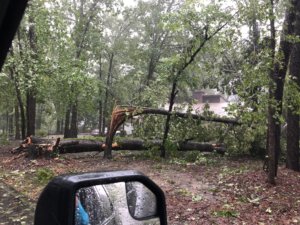
I would like to share some of the lessons we have learned.

I am convinced CERT should . . .

Create Emergency Operations Plans for their neighborhood(s) and coordinate them with key players.  The key players include, but are not limited to: the emergency services office, fire department, ambulance service, local shelter, HOA/POA(s), power, water and sewage connection points, and the agency charged with evacuating residents.

Carolina Trace tree downCoordinate frequently with the organization directing your team.  Our team reports to the Director of Emergency Services.  Learn who else will be out there responding and what can they do for you and vice versa.  There are many organizations in your community that will be operating during a disaster response – EMS, fire departments, Red Cross, law enforcement, neighborhood security forces, transportation agencies, Baptist Men’s Group, and the list goes on.  You’re going to see them all when the disaster strikes – get to know them now.
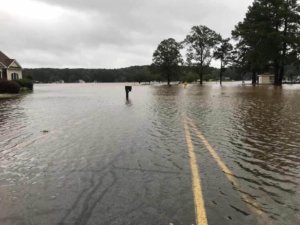
Carolina Trace flooded roadGood radio communication is extremely important and never seems to go the way you want.  Carolina Trace CERT issues a MURS radio (short-distance Multi-Use Radio Service, limited to 2 watts power) to every team member.  It’s our go-to radio for intra-team operations because they are relatively inexpensive, we can add more powerful antennas for increased range and there is no licensing requirement.  We encourage our CERT volunteers to become Amateur “Ham” radio operators.  Ham radios are great when it comes to reaching out to others in an emergency.
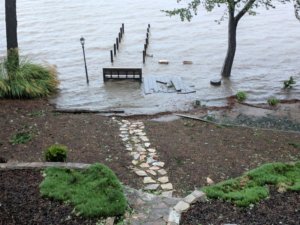
(Note though that Amateur Radio Operation requires licensed operators so plan ahead.  We are fortunate in that we have a narrow-band digital radio that allows us to communicate directly with the Emergency Operations Center (EOC) and our fire department wherever they are in the County.)

Know your team’s strengths and weaknesses.  We have learned a lot about our strengths and weaknesses during exercises and especially during Hurricane Matthew.  We have worked hard since Matthew to improve our capabilities in those areas where we found weaknesses while maintaining proficiency where we were already to standard.   Our field exercises have garnered recognition from our first responders and has led to more training with and from them, thus creating good communications and a better understanding of roles and capabilities for us and them.

Carolina Trace flooded dockWe were prepared when the cone of uncertainty indicated we were at risk. Florence brought us tropical storm force winds and fifteen to twenty inches of rain (depending on where you lived in the County).  Some homes were damaged, many trees were toppled and several roads are still impassable due to flooding.  We offered support to the county shelter and checked on neighbors when it was safe to venture out.  We also provided damage assessments to the fire department and the county Emergency Operations Center.

Next steps in our CERT response in Hurricane Florence

Carolina Trace clearly “dodged the bullet” when Florence dipped South and skirted us.  That said, our preparations through hands-on monthly training sessions and radio checks, field exercises and partnerships with the professionals have led our team members to feel confident in knowing how and what to do when disaster strikes.  They understand that If things don’t go well in training they are not likely to go well when it’s for real.  Our next step is to conduct a Hot Wash (AAR – After Action Report) to identify areas where we can do better and focus future training on those areas.

Virginia adds: You can see that Carolina Trace has a pretty well organized neighborhood CERT team, with a history of training, connections with local officials, current equipment, etc. Not every community has this level of neighborhood commitment and support, but it is something we can all aim for. A team of trained volunteers in our neighborhoods could make all the difference in how we get through any emergency.

Thanks to Sparky for this timely and valuable information. Please share it — and share YOUR story, too. This is how we know what’s really going on.

Virginia
Your Emergency Plan Guide team

P.S. If you liked this Advisory, sign up below to get one every week.  Disasters aren’t going to stop coming.