Author: Volunteer

Medical Device Back-up Power

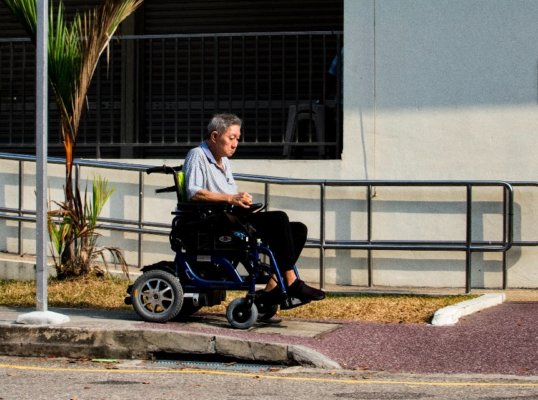
Share
medical device with battery
What happens if the battery can’t be recharged?

Do you or family members depend on electricity-powered medical devices?

Before you jump ahead, or jump off altogether because you think you don’t need “medical device back-up power,” please think again.

You may not use a medical device right now, but it’s certainly possible that at some point you, your parent, or a neighbor will look forward to having one of these very common “devices:”

  • Motorized scooter or wheel chair
  • Tilt-up recliner chair
  • Adjustable bed

It’s also very possible that family members and neighbors already have devices you don’t even know about, like . . .

  • Humidifier
  • CPAP machine
  • Oxygen concentrator

What will happen to these machines when the power goes out?

Unless the device has some sort of back-up power, it will stop working. End of story.

So imagine your aging father in his recliner, stuck half-up and half down! Or your husband who can’t sleep a wink without his CPAP machine! These are examples from real life.

Do you have a plan for your own medical device back-up power?

That power could come from a gasoline-driven generator – but that’s really overkill (and potentially dangerous) for a simple device like a humidifier.

Power could come from a solar generator – but only if that generator has been set up with a battery to store electricity during the day so it can be fed to your device at night.

Power could come from the right sized battery backup.  Here’s a sample of what I have found out.

Electric beds

Adjustable beds are plugged into the wall and their motor is operated with a hand-held remote. These beds should have an “emergency power down” function. If power goes out, the power-down function can be activated. All it takes are 2 or 3 small batteries inserted specially into the power-down device. The bed will come down until it is flat. The batteries will be exhausted. So, the question for you: if you have or are considering an electric bed, WHERE is the power-down controller and WHERE are the appropriate batteries for it? And if someone is trapped in the bed, could that person activate the power-down safety feature? (If you’re worried, be sure you get answers before you buy!)

Lift chairs and recliners

Tilt-up chairs also seem to have a battery back-up feature that can plug into the wall for charging. (Some people use the battery all the time to avoid having visible cords.) Again, the question. Does your chair have back-up power and do you know how it works? If it doesn’t have a back-up, what size/type does the manufacturer recommend? (Prices for these back-ups seem to hover around $100.)

Portable battery-back-ups for CPAP and other smaller machines

The back-up batteries for these devices are really just oversized “power banks,” designed so you can take them camping or traveling. Of course, you can use them when the power goes out, too.

But they are amazingly expensive! I saw prices starting at $200 and heading quickly up to $600. Still, if you need the CPAP machine, you need the battery back-up! Here are a couple of examples to get you started shopping. The first is sturdy and flexible with three ways to charge (plug into the wall when you have electricity, use a solar panel – not included – or plug into your car’s dashboard). The second example, smaller and more compact, weighs half as much – and costs around 3 times as much at Amazon. Click on the images or links to see details.

200W Peak Power Station, Flashfish CPAP Battery 166Wh 45000mAh Backup Power Pack 110V 150W Lithium Battery Pack Camping Solar Generator for CPAP Camping Home Emergency Power Supply

This second model, below, provides important information about exactly which models of CPAP machines it will work for. As you shop, be sure you are looking for back-ups that will fit your own product.

CPAP Battery/Backup Power Supply for Philips Dream Station, System One and other 12V Devices. Pilot12 Lite is the Smallest, Lightest and Longest Lasting Battery on the Market Today!

Since your utility is responsible for the outage, what will it do for you while the power is out?

This is the question that actually kicked off this whole Advisory. I was invited to attend a webinar about the subject. And after that webinar and some wide-ranging research, my answer is, “Not a lot.”

I searched out and reviewed a dozen or so “programs” offered by utilities across the country. The programs have names like “Medical Baseline Allowance Program” (CA), “Medical Support with Devices” (AZ), “Lifelight Service” (MA), “Medically Essential Service” (FL), and “Life Support Equipment Program” (WA).  I couldn’t find programs at all in several states.

Here are typical services. Not all programs offer them all.

  1. Extra notifications (when possible) in advance of a shut-off (email, phone call, letter)
  2. A lower monthly energy bill (extra kilowatt-hours every month and/or a discount on the bill)
  3. Extra grace time before power is shut off due to bill not being paid

And here’s a statement that I saw, in one form or another, on nearly every site.

PLEASE NOTE: Backup generators and transportation services are not part of this program. Participation in this program does not mean your electric power will be restored sooner than others.

Now, if you do have medical equipment and would like to sign up, here’s how it works.

Go to your utility website and get the application. Basically, your doctor has to attest that you have a “qualifying medical condition” and require a “qualifying medical device” to treat your condition. (The application has to be renewed every year or every two years. Exceptions apply this year because of the Coronavirus.) Here are excerpts from the application site for the program where I live in California.

Some qualifying medical conditions include:

  • Paraplegic, hemiplegic or quadriplegic condition
  • Multiple sclerosis with special heating and/or cooling needs
  • Scleroderma with special heating needs
  • Life-threatening illness or compromised immune system, and special heating and/or cooling are needed to sustain life or prevent medical deterioration
  • Asthma and/or sleep apnea

And, some qualifying medical devices include:

  • Motorized wheelchair/scooter
  • IPPB or CPAP machines
  • Respirator (all types)
  • Hemodialysis machine
  • Iron lung

Here are examples of devices that do NOT qualify:

  • Heating Pads
  • Humidifiers
  • Pool or Tank Heaters
  • Saunas or Hot Tubs
  • Vaporizers
  • Whirlpool Pumps

(A link on this site leads to a list of 23 different devices that could qualify. It’s in the Find out if you qualify section.)

I did NOT see electric beds or chairs on any of these lists. Nor did I see any answer to the problem of needing to keep medicines refrigerated.

Since the utility can’t help with medical device back-up power, what do they suggest we do?

All the utilities stressed the importance of having a “personal emergency plan” for outages, and sharing that plan with family and friends.

Some specific recommendations included identifying people who will help if you need to evacuate, collecting names and locations of alternate doctors and pharmacies, and being sure you are signed up with any governmental and local programs that support people with disabilities.

We have addressed plans for people with disabilities and will be doing more. This Advisory on the topic was written for members of our local neighborhood emergency response group:

So should you sign up for a medical device program with your utility?

If you can save on your utility bill, why not? Just be sure you understand exactly how the program works before making any assumptions. And be sure whatever “medical devices” you have or are contemplating will qualify you.

Above all, program or not, it’s up to YOU to have a plan for medical device back-up power when the utility power shuts down. You’ll have to become the expert on your own equipment. Before you start shopping for a battery back-up or uninterruptible power supply (UPS) you need to know:

  • Exactly how much current your equipment requires (amps and wattage)
  • How long it has to run continuously (or how long you want it to run)

The more capacity you want, the bigger the unit (and the more expensive).  I’d recommend you get your specifications and then head to Amazon to see what is available. Below is a link to a medium-sized model (1500 VA) from APC, a well-known and respected manufacturer. This will get you started.

APC 1500VA UPS Battery Backup & Surge Protector with AVR, Back-UPS Pro Uninterruptible Power Supply (BR1500G)

And finally, don’t forget to have your device plugged in to the UPS so it can take over when the power goes out!

OK, that’s it for now. Summer is here, with a higher risk of power outages. Don’t overlook preparing for back-up power sources if you need them.

Virginia
Your Emergency Plan Guide team

P.S. What about Medicare/Medicaid? From the research I have done so far, it looks as though they won’t pay for back-up power supplies, even if they will pay for the medical device itself. What do you know about this?
Solar For Back-Up Power

Share
Solar Panels for back-up power
A realistic option?

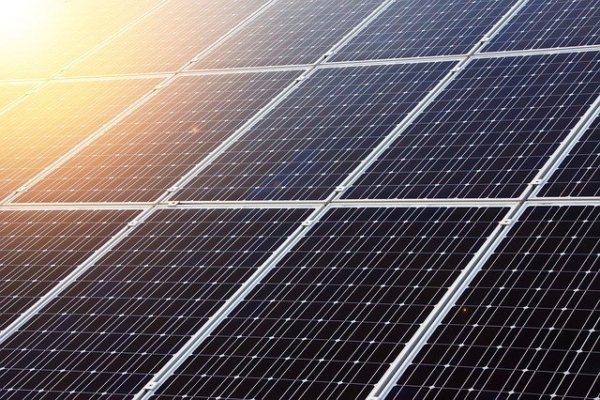
We write often about how to be ready for power outages. The conversation may start with battery-operated emergency radios and/or flashlights, but it almost always moves to solar for back-up power.

A couple of weeks ago, our Advisory was about smallish “solar tools and appliances” that can be put to work when it’s dark, at home or outdoors.

This week, we’re continuing with a look at larger solar systems, the kind that can actually substitute for lost utility power.

Here’s an aside: You may not realize that starting in 2002 I worked for nearly 10 years with an energy consulting firm. One of our major projects was to introduce solar electricity systems to families, schools and businesses in southern California. When the program started, I remember the cost of solar being $9-$10 per watt for a residential roof-top system. Today, the average price across the country is more like $2.50-$4.00 per watt! That’s a 60% drop!

Price drop per watt makes solar of renewed and continuing interest. And it would be natural if your first question were, “So how many watts do I need?”

The correct question would actually be, “How many kilowatts do I need?” (How many thousands of watts?) For your reference, the average installation in the U.S. is around 6 kW. In 2020 the average system cost (after tax credits) was between $16,000-$20,000.

But that’s actually NOT the first question. In fact, there are several questions that come before that one!

So let’s take a look at some of the questions you’ll be asking, and finding answers for, if you are considering solar for back-up power. Along the way I’ll share some stories from the “old days,” some current resources, and some cautions.

Does solar really work?

Yes, it really does. Panels and their various connectors have become a lot better. Proof: Some panel warranties extend to 25 years! But keep in mind that it still takes lots of solar panels and accompanying equipment to produce the amount of electricity you would need to power your whole house. We’re talking thousands of dollars, not hundreds.

That’s why most people start with just a modest system – maybe as small as just two or four panels! — and add as they get more familiar with the technology.

(I spoke last week to a long-time EPG reader. He had just finished doubling the size of his 10-year-old system because of our utility companies are warning about “safety outages.” In California, wildfire season has started!)

The point is, solar is flexible.

How hard is solar to install?

Let’s look at some examples:

1. Hooking up the panels is straightforward. You can certainly learn to build a back-yard or RV-roof system yourself if you are willing to put in the effort. (See more on this, below.)

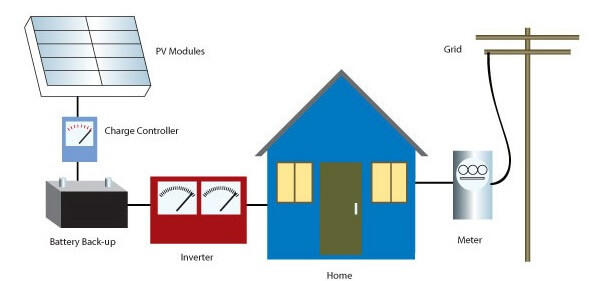
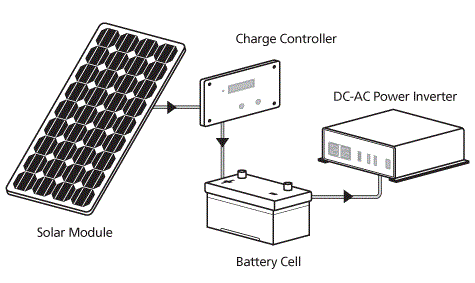
Here’s a diagram of a simple back-yard system. Direct Current (DC) is generated by the panel. It goes through the charge controller (to prevent any overloading) and is fed into the battery. From there, it heads to the inverter, where the DC current is changed to Alternating Current (AC). Most household appliances run on AC. Your AC appliances or devices can be plugged directly into that inverter and will have power as long as the battery remains charged.

Solar panels for back-up power
1. Simple back-yard, stand-alone system

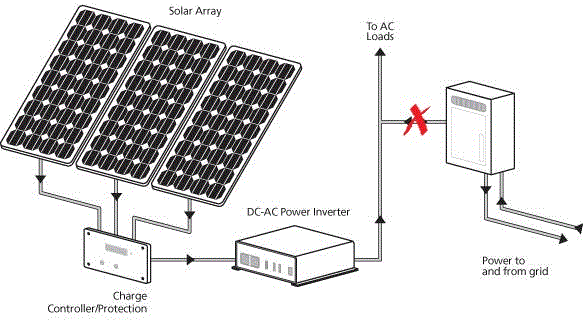
2. Now, if you want to connect your system to your house, things get more complicated. Your house has power coming from the utility grid. If power from the grid fails, your home solar system has to shut off so it blocks any of your solar power from feeding back into the grid. (It’s actually a matter of life and death, because you can assume that somewhere on the utility grid people are working to fix whatever has gone wrong. “Your” solar power could electrocute them.)

Here’s another image, showing a “grid-tied” system. There would be a switch near (or part of) the meter (my red X) to protect the grid in the case of a grid outage. Note that this solar system is meant to supplement grid power. When the sun goes down, the solar stops.

solar for back-up power
2. Grid-tied system. Thanks to Samlex Solar for these two images.

3. Now let’s look at a hybrid system, that is, a grid-connected solar system designed with back-up battery power. Power for the home can come from either the solar panels or the utility grid or from both. In a utility power outage, a switch at the meter would turn off the grid. The amount of power usable in the home would then depend on the size of the solar system and its battery capacity.

Grid-tied, hybrid solar for back-up power
3. Hybrid system. Thanks to ArizonaAccurate for image.

Whew! So which type of system should I pick?

 In this Advisory, we’re talking about solar for back-up power. So you’d want either the simple back-yard system or the full-fledged hybrid system. (The grid-tied version, number 2., is meant to cut your electricity bill, not provide back-up power.)

How much is it going to cost?

As you can imagine, it’s all going to depend on the size of the system. The bigger the system, the more parts and of course the more cost.

So your first challenge is to decide how much of your home you want to be able to power if the grid goes down.

Whole house?

Calculating how much capacity you’d need for the whole house is worth another whole Advisory. You’ll need to start by taking a look at your usual hourly energy requirement, how many peak sunlight hours are available where you live, whether your panels can be positioned to get the most of that sunlight, and how much overall space you have for panels and batteries. (Here’s a simplified description of how to figure everything from one of our local solar installers. )

The reality for most home-owners? Your solar system will probably NOT be able to power your whole house. A system that large will take a lot of space and will be just too expensive.

Just the essentials?

Experienced solar-system users pare down when it comes to sizing their system for back-up power. They know how to pick only the essential appliances (refrigerator, TV, medical device), how to measure the appliances’ kW requirements, and how to schedule when appliances will take their turn, so as not to overwhelm the system.

If you’re trying to size a system for essentials only, check out this article. It will give you an idea of how many panels it takes to run particular appliances.

What should my next step be?

Based on my research and my experience, I recommend you (1) do some homework and then (2) talk to professional installers to get some advice and some quotes.

Professional system installers will want to know:

  1. Do you want a grid-tied system or a stand-alone system or a hybrid system? (For emergency power, it’s either of the last two options.)
  2. What appliances do you absolutely need to be able to run if there is a power outage? (Type, size, amps, how often and how long, etc.)
  3. How much space do you have for panels, batteries and associated components? (Solar contractors will likely take an image of your roof and yard and start with that, but of course they don’t know about your garage, etc.)

You will want to ask them:

  1. What panel options do I have? (Why do they pick the ones they use?)
  2. What inverter options do I have?
  3. How many batteries will I need to store energy for the appliances I want to run in an emergency?
  4. What warranties are available on the equipment?
  5. Will I be able to add to the system at a later date?
  6. What building or other permits are required?
  7. What tax benefits are available in my community?

If you are more of a DIY person, or want to know more before you reach out to a salesperson, consider these three steps.

First, go to Amazon and buy this book by Will Prowse. (We are affiliates at Amazon, as you know, so we’ll get a small commission.) Get the paperback version so you can mark pages, take notes, etc.

Hands down, Will has the best solar material for enthusiastic beginners. You’ll want to refer to this book often. (I have found that I need to review the watt/volt/amp equation on a regular basis!) The info works even if you aren’t installing your system on an RV. Here’s the link:

Mobile Solar Power Made Easy!: Mobile 12 volt off grid solar system design and installation. RV’s, Vans, Cars and boats! Do-it-yourself step by step instructions.

Second, go to YouTube and watch a few of Will’s videos. I’ve watched a half-dozen of them and every one is first-rate! Here’s one for beginners that will explain all the components mentioned above in my article, and show how they fit together.

Finally, take a close look at some of the “solar kits” or “all-in-one” solar power packages that are available for people starting out. (Search online for those words in quotes.) Kits are attractive and make sense, since you wouldn’t be buying all the individual parts separately. The video above shows a small kit. Below is a link to a larger kit (from the same company, Renogy) with 12 solar panels.

Renogy 3600 Watt Monocrystalline Solar Cabin Kit for Off-Grid Solar System with 12 Pcs of 300W Panel and Midnite MPPT Controller

For all kits, do be careful to check what is included. Many “starter kits,” even the ones above, do not include batteries.

I think solar is a great addition for any energy-conscious person to consider. It has become ever more affordable and reliable, and is no longer considered “cutting edge.” Solar is here to stay!

From a preparedness standpoint, it’s also a reliable source of power for emergency communications and lighting, not to mention security.

Stay tuned. You’ll be reading more about solar here!

Virginia
Your Emergency Plan Guide Team

P.S. We’d like to hear about your experience with solar for emergency back-up. Leave a comment! (Give us an idea of where you live so we can make adjustments for our own experience.)

I need more reviews. Can you help?

Share
Write a review for my book.

Dear Reader,

The last few weeks have been so terribly distracting. This morning, though, I got some really good news.

When I checked my Kindle author’s account at Amazon I saw that several copies of our latest book were purchased, right in the middle of all that is going on.

THANK YOU to everyone who bought a book this week – or whenever you bought one! You are helping support our mission of preparedness. And you’re keeping my enthusiasm up for the hard work that goes into it!

And now I have a favor to ask.

As you know, when people shop at Amazon, many look closely at the reviews. But of course, most buyers don’t leave reviews. I need more reviews on all my books!

If you have bought one of our books, I would really appreciate it if you could please click at your book below and leave a review.

The links go right to the “Leave a review” form. (You do have to have spent $50 at Amazon in the past year to get your review published.) Your review can be just a few words. Or you can write a longer commentary about the book and how it fits with the work you do. Everything is legitimate and will help others make their own decisions . . . in many cases decisions that could change their lives.

Thank you for helping!

Our Q&A Mini-Series

Mini-series

Short Questions and Answers around one particular topic, designed to review your progress and stimulate your thinking.

We continue to add new titles every month or so. (Coming up next — Personal Safety and Save Your Pet)

Shelter in Place – Our newest mini-book, pretty timely, don’t you agree?

Pre-Disaster Plan – The “big picture” of why and how we prepare.

Pee ‘n Poop! Not exactly my favorite, but right up there in importance:

Emergency Communications – We use radios and walkie-talkies nearly every day at home and in our neighborhood group.

Custom Go-Bags – Always worth another look because everyone needs a slightly different bag.

Emergency Cash – Aspects and options you may not have considered.

Evacuate! There’s no time to prepare when your hear this word!

Car Emergency Kit – Anything can happen when you’re on the road!

Power Outage – No need for this common emergency to become a disaster.

Prepare Your Home for Earthquake – Not just in California.

Our Flagship Series

Neighborhood Disaster Survival Guide Series

for Organizing your Home AND your Community

Each of these books has an accompanying workbook for those folks who find it hard to get started or want help to stay on track. (The workbooks also lend themselves to working with a group.)

Emergency Preparedness for Apartment and Condo Communities

Emergency Preparedness for Mobilehome Communities

Emergency Preparedness for Homeowner Communities

Emergency Preparedness for Small Business

Emergency Preparedness
Meeting Ideas

Emergency Preparedness Meeting Ideas

My favorite because it brings back memories of so many great meetings!

Review here: http://www.amazon.com/review/create-review?&asin=1072342820

Thank you again. If you enjoyed a book, it would mean the world to me if you left a review. Your comments help spread our shared preparedness message to more and more people.

Virginia
Your Emergency Plan Guide team


10 Solar Tools for Preppers

Share
Sun going down at campground. It will be dark soon.
“It will be dark soon . . .!”

As we head into summer, our thoughts just naturally turn to outdoors activities – camping, hiking, picnics, travel in an RV.

If any of these is on YOUR list, even if it may have to be postponed, you’ll enjoy this week’s Advisory because it highlights some of the handiest, smartest and most useful tools you can find for outdoor, off-the-grid activities.

In summer, we can also expect power to be out because of storms, fires, etc. So solar tools and equipment are popular with preppers because they all operate at home when there’s a power outage!

Solar tools give you twice the value!

Joe and I have used versions of nearly every one of these items. Like everything else, there’s a new model nearly every time you turn around. And, like everything else that’s based on technology, prices keep coming down.

So let’s take another look at 10 of our favorite small solar tools and accessories, starting with items that everyone should own.

1 – Solar Powered Emergency Radio

Because we believe every household needs at least one emergency AM/FM radio, radios land at the top of our list. Once again, I have reviewed our own collection, and taken another look at our Emergency Radio Reviews page, and I come back to this radio as being one of our favorites.

Why? Briefly, it operates with power from AA batteries, a rechargeable battery, AC current (the cord is extra), DC current (plug into the car), hand-crank and solar! So, you can use it for music at your picnic, or as a light source in the campground, or to check in with the weather report.

Note that this radio isn’t tiny. It’s about 9 inches tall by 5 high by 2 wide. Check out all the features by clicking on the image or link below, which will take you directly to Amazon. Again, shop carefully to be sure you are getting what you really want. If necessary, take another browse through our Radio Review page to see all the features of emergency radios that you might want to consider.

2 – If a solar-powered radio is first on our list, then a solar-powered lantern or other light source will have to be second.

And here’s something new! You’ve seen before, perhaps, that we have really fallen in love with the expandable battery-operated emergency lamps made by VONT. Now here’s a very similar product that adds SOLAR as a way to keep the lantern charged and functional for longer.  

3 – Solar Powered Flashlight

We review flashlights practically once a month! (We buy them, too, because new models keep adding more features.) Check these out for yourself, your car, your kids. Our motto is a flashlight in every room or in every hand when camping.

This flashlight is rechargeable, waterproof and, you guessed it, powered by solar. (I really like the bright color, too.)

Hybridlight Journey 300 Solar/Rechargeable 300 Lumen LED Waterproof Flashlight. High/Low Beam, USB Cell Phone Charger, Built In Solar Panel Charges Indoors or Out, USB Quick Charge Cable Included

4 – And another new Solar Powered Flashlight with multiple accessories

Otdair LED Flashlight Solar Power Tactical Flashlight,Ultra Bright Flashlight,Safety Hammer,High Lumens Tactical,USB Rechargeable,5 Modes for Outdoor,Camping,Hiking

5 – Solar battery charger for all your devices

We’ve used and reviewed these regularly. They get better and better and cheaper. Here’s a new one. The charger itself gets charged up from the sun or from the wall plug using an adapter (not included), can serve as a lantern at night, and then can charge 3 of your devices at the same time, with 25,000 mWh! No reason for you not to know what’s going on!

6- This simple and lightweight solar lantern can charge your devices, too.

Hybridlight Solar Rechargeable Lantern/Cell Phone Charger. 150 Lm. Built in Solar Panel, Hi-Vis Yellow

7 – Solar security lights for home or for camping

When the power really goes out, not only do you lose your house lights but streetlights are out, too. And when you’re camping in the wild, you KNOW it will be totally dark!

Without any light , you’re going to feel – and be — a lot less secure.

Of course, you can carry a lantern or flashlight with you wherever you go, inside or out. But there’s a certain sense of relief to know that if someone or something approaches your campsite or home, they’ll be visible.

We use permanently mounted security lights in a couple of places at our home: in the car port, and also at the front steps. This solar-operated light is PORTABLE so you can hang it over a simple screw or nail at home or when you’re camping.

You’ll want to set the appropriate mode: turns on when motion activated, always on, or “smart” mode (dim gets bright when activated).

Solar Lights Outdoor, 3 Optional Modes Wireless Motion Sensor Solar Light, IP 65 Waterproof, Security Lights for Front Door, Yard, Garage, Deck, 1 Pack

8 – Solar powered pool pump

Don’t have a pool?

In an upcoming Solar Advisory we’re going to cover “bigger” systems, and that will include a roof-mounted solar system big enough to power your pool pump. Watch for that Advisory.

In the meanwhile, smaller water features also are quickly compromised when their pumps fail. I’m thinking about garden fountains, greenhouses, animal watering troughs, hydroponic gardens, etc. If your emergency preparations include a “survival garden,” you surely wouldn’t want to lose it just because the power goes off!

Therefore, time to consider a solar pool pump. This one might be the starter equipment you need.

Solariver Solar Water Pump Kit – 360+GPH Submersible Pump with Adjustable Flow, 20 Watt Solar Panel for Sun Powered Fountain, Pond Aeration, Hydroponics, Aquaculture (No Battery Backup)

9 – Solar oven for the adventurous!

I have to admit this is one tool I have never used. I have seen them being used (and smelled the delicious odors) at fairs, by Girl Scouts, at energy efficiency demos — and I have been threatening for years to get one for myself as a present! If kids can use ‘em, then so can I!

I find this model the most intriguing. It’s lightweight, folds up, comes with trivet and pot. Keeps the food protected as it cooks, has a thermometer so you know what’s happening. (Heats up to max 285 degrees.)

This is the mini-version, probably best for small groups of diners.  There’s also a larger one from this same company that comes complete with pots, pans and dehydrating racks. 


Sunflair Mini Portable Solar Oven

10 – End the day with a warm shower!

Looks like a UFO, doesn’t it? But no, it’s a warm shower, perfect for your campground or as adjunct to your RV or, in an emergency, when you have no other way to get hot water to get clean!

This shower holds 2.5 gallons. (You’ll have to act faster than usual, perhaps, to get all the soap off. ) The company also makes larger versions, but I know how much 2.5 gallons weighs and that’s just about as much as I want to struggle with.

I liked this brand for one particular reason: it has a temperature gauge!


Advanced Elements 2.5 Gallon Summer Shower / Solar Shower

Well, that is quite a list of solar tools! I hope you’ve found some ideas for gifts. Maybe your gift could start a conversation about renewable energy!

Again, we’ll be addressing larger solar systems in a coming Advisory. In the meanwhile, let’s look forward to some sunny summer days!

Virginia
Your Emergency Plan Guide team

P.S. If you have favorite solar tools or gadgets, let us know about them in the comments!

Your new emergency plan — How is it shaping up?

Share

Dear Friend,

Last week was so tumultuous that I couldn’t focus long enough to draft a traditional Advisory. This week hasn’t been any better. The “photo op” episode in Washington D.C. can only be described as over the top.

We are all being forced to take a look a developing a new personal emergency plan!

Throughout all this turmoil, however, I have continued to think about my neighbors and my Emergency Plan Guide friends. So my first question:

How well are you managing during these challenging times?  

I trust that you are doing some of the same deep thinking I’m doing. It’s not easy. In fact, it can be exhausting! In any case, here’s some of what’s been on my mind that I want to share with you today, thinking that some new personal emergency plans or at least some adjustments to the “old” plans are necessary.

What I’m hearing from friends and colleagues.

First, as a matter of interest, nearly all the messages I am getting from long-standing preppers are focused on protecting families. I am receiving email after email describing how to barricade your home (or make it invisible), add to your firearm or other weapon collection, and revisit your plans for bugging out. Do you get these messages, too?

Second, nearly all the messages I am getting from non-prepper friends and family are also focused inward. But they don’t (yet) include plans. Rather, they develop the theme we were working on a few weeks ago in the midst of the coronavirus shut-down, namely, “What can I do that will be useful and helpful?”

Being self-sufficient is one thing. And it’s good. But being able to lean on, get support from others and give support in return – now that makes life even more powerful.

So if you’ve asked yourself “What can I do?” here are a couple of suggestions you can consider that have to do with building a more resilient community. (This focus on community is what distinguishes Emergency Plan Guide from most of the other survival/preparedness blogs out there, in case you hadn’t noticed.)

What actions here might work as part of your own “new emergency plan?”

  1. For us emergency preparedness always begins by helping take steps to improve your personal readiness. You know that we regularly suggest people find out about and take local CERT (Community Emergency Response Team) training. Question: Have you taken the CERT training? Have you taken a Red Cross class on CPR or emergency first aid? How about car-pooling to a class with a neighbor (once classes start up again)? (Next on our own list: Stop the Bleed.) These skills will serve for years!
  2. The next step is sharing information with and helping neighborhoods take action for the benefit of all.  Question: What informational flyers can you download or pick up and share with neighbors? (It’s hurricane season, and fire season, and earthquakes can hit at any time! There are also new groups forming online to examine policy changes in our justice system. Lots of good info on the Internet.) Can your local HOA or scout troupe or church group help pass out or otherwise share this information? (Retirement communities often have internal TV stations that could broadcast valuable alerts.) “The more we all know, the safer we all will be.”
  3. In some communities, leaders start a local Neighborhood Emergency Response Group whose volunteer members meet regularly to learn and practice new skills. Question: Would a neighborhood volunteer group help create stronger relations in your community? How much safer would your community be if more neighbors knew each other and knew what to do in case of an emergency? Can you take advantage of the current activist momentum to start or support a group? We have several workbooks just for people wanting to set up a group and keep it going.

Some final thoughts . . .

I do have to make one final comment about another group of messages that I have received. I guess I can call them “business as usual.”  Cheerful messages exhorting me to “Make it a great day!” Intense phone calls telling me “Not to miss this one-time business opportunity!” Neighbors waving and hollering out, “How you doing?” expecting “Fine!” as an answer. It’s as though these people haven’t even noticed the upheaval going on around us. Or maybe these messages fall into the automated message-delivery service category? 

Whatever, I find it impossible to pretend that what’s going on isn’t significant.  

Getting “back to normal” isn’t the right expression. We all are being faced with having to look at things we’ve taken for granted — and to make some changes. Joe and I sat late last night over our kitchen table to figure out what we will do, personally, to help our community move forward into a future that is safer and fairer.

I’d love to hear from you what your latest emergency plans are.

Virginia
Your Emergency Plan Guide team

P.S. And yes, I WILL have a “regular” Advisory out next week. It’s half finished already, and on the topic of solar-powered tools and equipment. Watch for it!

Plans for re-opening

Share
Plan for reopening during coronavirus pandemic
What does your plan look like?

At the end of last week’s Advisory I let slip a couple of paragraphs that expressed my frustration. States were taking action with no consistent plans for re-opening to protect as many people and businesses as possible.

Thankfully, over the past week, a lot has happened. Plans for re-opening have emerged from states, industries and even the federal government.

Of course, plans change. You have probably heard this oft-repeated quote from 19th century Prussian military leader Helmuth von Moltke:

No plan survives contact with the enemy.

Still, while plans change, at least we can turn to them to give us some framework by which to operate. Here are some resources that I believe are worth taking a look at.

State plans for re-opening vary.

Click here to find your state’s current plan.

Industry plans address the working environment.

Many organizations and in particular, professional industry groups, have provided guidelines for their customers and members. Their guidelines are mostly focused on hygiene and designing safer working environments.

Resources to help you make your own plans.

Potential job: From Johns Hopkins Bloomberg School of Health comes a 5-hour course giving participants the key skills for COVID-19 Contact Tracing. This course starts today (May 14) and is FREE. https://www.coursera.org/learn/covid-19-contact-tracing

Social distance marking: If you need to set up visual guides to help customers with social distancing, consider floor marking tape. (Download the Floor Marking Best Practices booklet there, too.) https://www.graphicproducts.com/blog/floor-marking-helps-maintain-safe-distances/

Managing stress: The American Red Cross is offering a free online class: Psychological First Aid: Supporting Yourself and Others During COVID-19. I completed it earlier this week. Useful review, great pictures to support all the text. Start here: https://www.redcross.org/take-a-class/online-safety-classes

Your family’s plan for re-opening.

As “suggestions” and “requirements” change over the next few weeks, you’ll want to discuss your own family’s “rules.” I’m sure they will include topics like going out, using face masks, social distancing, etc. You’ll probably be faced with questions like:

  • “Why are we doing this?”
  • “Why are we doing it when others aren’t?”
  • “What should we do when others don’t follow the rules?”

These are perilous and difficult times, and they require new and sometimes uncomfortable behavior. Learning new information, making decisions and taking action are important to being prepared.

As always, my very best wishes in this effort. I include myself in this effort, because we are all in it together!

Virginia
Your Emergency Plan Guide team

P.S. I’m sure you have found many useful resources, too. Don’t hesitate to share. This will be an ongoing effort.

Drones for Emergency Response Teams

Share

The market for drones for emergency response teams continues to expand.

Drone for emergency response team

Updated 5-2020

We started reporting on drones about 5 years ago. At that time, drones were mostly high-tech toys. Two years ago we updated our reporting, and today it’s time for another update because . . .

Drones for emergency response teams are becoming more common. 

Before you start looking at drones for use by your neighborhood emergency response team, however, it’s a good idea to listen to the advice I got from an excellent training film put on by the Pacific Northwest Economic Region  Center for Regional Disaster Resilience. Here’s the link to the video: https://vimeo.com/296920234  One of the speakers said: “Before you decide on a project, become the local expert and understand how to collect and manage data. ” By the time you’ve done that, you’ll know what equipment you need and the rules you’ll need to follow.

The video mentioned above was by and for a governmental agency. You may not be part of a governmental agency; you may be a hobbyist. But you need to know all the rules!  Here they are as of 2020 . .

Rules for hobbyists, commercial and non-governmental use of UAS (unmanned aircraft systems) . . .are changing!

You need a pilot certificate.

If you’re operating your drone as a hobbyist, that means hobbyist. You’re not operating as a service, or planning to be paid for your services, or to sell your photos, etc. In the past, you didn’t need a certificate but it looks as though you WILL need one soon if not already!

Getting a Remote Pilot Certificate from the FAA requires that you pass a test as well as meet other requirements. Here’s a link to find out more: https://www.faa.gov/uas/getting_started/part_107/remote_pilot_cert/

Register Your Drone.

Whether being flown by a hobbyist or for another reason, any UA must be registered. If it weighs less than .55 lbs you can register it online; otherwise, go to the FAA website to get started registering it on paper.  Here’s the link:  https://www.faa.gov/licenses_certificates/aircraft_certification/aircraft_registry/UA/  

A drone weighing MORE than 55 lbs. falls into another category altogether. (That 55 lbs. includes any cargo that the drone is carrying.)

Pilot Your Drone Safely.

Even though rules change, the main thrust for hobbyists and commercial operators is always on safety. You can check in on a regular basis to monitor any changes, at http://knowbeforeyoufly.org/

Here’s a summary of the current rules:

  • Drones must remain in visual line of sight of the pilot or a sighter — no first-person-view cameras. (This means no flying by what the camera shows as opposed to what you actually see from where you are standing.) You can only fly one line-of-sight vehicle at a time. Maximum distance from pilot is 3 miles.
  • Maximum speed is 100 mph and maximum altitude is 400 feet.
  • Pilots must be at least 16 years old and hold the “remote pilot airman certificate,” mentioned above.
  • Operation is only allowed during daylight hours or twilight with appropriate lighting.
  • Pilots must avoid flying over cars, populated areas or over specific people not involved in the operation.
  • You must understand airspace zones and respect them. Manned aircraft always have the right of way.
  • You must be aware of no-fly zones. (The best drones have “no-fly” zones built into their software.)
  • The big issue, of course, is privacy. While there don’t seem to be clear cut rules regarding privacy, you’ve got to remember that there is a concept called Expectation of Privacy. This usually translates into giving people a warning if you’re going to be flying, not capturing “private” footage if you don’t need to, and deleting it if you’re asked to. If you’re part of a group, you would do well to have a privacy policy to protect your members. Here’s a reference that might be helpful: https://www.ntia.doc.gov/files/ntia/publications/voluntary_best_practices_for_uas_privacy_transparency_and_accountability_0.pdf

Please note — again! – rules keep changing! Some changes have been promised and awaited but are now on hold as a result of the Coronavirus. Get the rules at the FAA.

Using Your Drone as an Emergency Response Tool

While not commercial, and yet not recreational, here are some uses your team might be considering. Before you actually decide to implement any, be sure your use is legal.

  • Use a drone to provide overhead lighting when searching an area at night
  • Inspect upper levels of buildings or structures (in industrial or high-rise residential areas)
  • Film damaged areas or obstructions following a disaster (as long as you don’t interfere with First Responders)
  • Identify “hot spots” after a fire (using infrared technology)
  • Map area covered by the CERT team to segment into manageable areas
  • Find a missing person
  • Search areas for survivors
  • Identify pathways for access or escape or to to safer positions
  • Drop markers to designate specific damages or routes to follow
  • Monitor teams during training exercises with filmed records for group critique
  • Transfer supplies, first aid items, batteries, replacement radios, etc.
  • Transport high value items over a distance, reducing the need for multiples of expensive equipment (e.g., gas sniffer)

You can probably come up with many more.

Challenges for Emergency Teams

1-Rules may limit your emergency response team’s use.

When you look at even this short list of uses, you will see that a number of these uses would be against current rules! Let’s look again . . .

  • Can’t fly at night.
  • Can’t let drone out of your sight.
  • Can’t fly higher than 400 feet.
  • Can’t fly over people.

From our standpoint as emergency responders, these restrictions limit the use of the technology. In a serious situation the safety of our neighbors in the community is more important that the actual altitude of the drone looking for them!

You may request a waiver of some of these restrictions if you can show you can conduct your operations safely. And we have confidence that some of these restrictions may be lifted or clarified, so we are not letting them stop our analysis.

2-Battery life may limit your team’s use.

Most drones have a flying time of only around 20-25 minutes. As technology improves, that will improve. To get a couple minutes more of flight can cost a couple hundred more dollars in purchase price. No matter which model you get, plan on getting at least 3 or 4 extra batteries right along with the machine so you can rapidly put the machine back in the air.

3-Set up in advance to be able to share your images and videos.

Clearly, the emergency planning and response ideas above would generate information you’d want to share with the rest of your team or with First Responders! There are several options available – the obvious one being sending footage to YouTube or Vimeo.

However, the FAA may label your video as “commercial use” if it appears with an ad on it, whether or not you wanted it!  (Again, in an emergency, I’d probably not worry about that. But be aware . . .) Other sharing options include apps provided by Facebook, Dropbox and certain drone manufacturers.

Moreover, if you share any photos, issues of privacy raise their head. Understand how you will manage your data to maintain privacy. Review the resource above in the long list of bullet points.

If you goal is to share your work, find out more before purchasing.

OK, with all this in mind,

Which drone is best for our Neighborhood Response Team?

In our community, we already have some guys who race electric cars. And there are a couple who build and fly model airplanes. The skills they bring to the table will be valuable – but not all of them are on our emergency response team, of course.

So, as we shop for a drone, we have to add “ease of set-up” and “easy to fly” to our shopping list.

Here’s the whole shopping list so far:

  • Big enough to fly outside, in somewhat inclement weather (Cheap toys won’t work.)
  • Strong enough to carry something to a designated location
  • The best battery life we can get for the price
  • Proven performance (not bleeding edge technology)
  • Reasonable image and video quality, though not necessarily the highest
  • Easy to set up and start flying
  • Compatible with variety of hand-held mobile devices

We’ve done a lot of comparing of different machines to get to this point! I hope the data above will be helpful to you in your own search.

See our top choices for drones in Part Two of Drones for Emergency Response Teams.

Virginia
Your Emergency Plan Guide Team

P.S.  I found these important additions. Become an expert before you buy or fly!

  • “Report to the FAA within 10 days of any operation that results in at least serious injury, loss of consciousness, or property damage of at least $500.”
  • “Failure to register an unmanned aircraft that is required to be registered may result in regulatory and criminal penalties. The FAA may assess civil penalties up to $27,500. Criminal penalties include fines of up to $250,000 and/or imprisonment for up to three years.”

Getting the Message Out to Neighbors While Shut In

Share

I started this Advisory as a piece on “Hear no evil, see no evil, speak no evil.” It was a reflection of the importance of communicating these days in the midst of the coronavirus pandemic. But I decided that theme would focus too much on “evil,” so I dialed back to “getting the message out.”

Certainly, our ways of communicating have changed! Here are three events from just the past week that relate to getting the message out. I wanted to share them to see whether they parallel some of what you’ve been experiencing.

1 – “Love looks not with the eyes but with the mind.” Shakespeare, Midsummer Night’s Dream

Wednesday I was part of a conference call. Big deal, you yawn. Everybody knows that conference calls, and particularly Zoom calls, are the way communications are taking place these days.

But this one was different, because it was a call among members of our community who are blind or visually impaired.

Think about that for a moment.

If you can’t see well, you certainly can’t see those Blue Angels streaking across the TV screen, much less across the sky. You can’t binge on Hulu or Netflix. Even when your children call, all you may get is their voices – no smiling faces or gurgling babies, or whatever images would be showing on FaceTime.

People with vision problems are often isolated anyway. We have a group that meets every month, just to give friends a chance to get out and get together safely.

Because of the coronavirus, of course, our meetings have been cancelled.

So yesterday’s UberConference® call was a new experience – and the first time most of these senior citizens had been on such a call.

The call turned out to be a home run!  

Everyone figured out how to get aboard (Dial, type in the call ID number), handled “mute” and “unmute” at the right time (“Press star twide”).  

Best of all, friends whom we normally see/hear only at a monthly meeting got a chance to hear each other’s voices! We laughed and laughed at the stories people told –

  • “My son came to visit and went shopping for us. He seems to have forgotten that we are just two people, because he came home with a gallon of sour cream and 10 pounds of pasta!”
  • “I’m glad I’ve retired from teaching! I had enough trouble with this call. I don’t know how I would have managed the “online learning” technology.”
  • “As I heard your voices, I pictured you all sitting around the table at our usual meeting.  Then it hit me — we are all in separate houses!!”

So, this was a first – and now, something we will use again. This truly was a message of love looking “with the mind.”  Who do you know who might appreciate being able to join in a group call?

2 – “Hear no evil, speak no evil, and you won’t be invited to cocktail parties.” ~ Oscar Wilde

I couldn’t resist this quote and had to fit it into this Advisory! It’s a bit off the topic, but hey. We’re sharing ways of communicating, right?

So here’s another communications first, one you can share in.

Just about a month ago, one of my emergency preparedness contacts on LinkedIn asked if Joe and I would do a podcast for his “radio station.”

“When I saw you had published a book on how to build community preparedness, I knew I wanted to hear the story,” said Preston Schleinkofer. President and Founder of Civil Defense Virginia.

Preston has developed his own program to encourage more community members to join in with local government authorities to “preserve safety, security and constitutional government functions” in the case of natural disasters and man-made catastrophes. (Us oldsters will recognize that Preston has come up with a new definition for “Civil Defense.”)

You can read about Preston’s 501©3 organization at https://civildefenseva.org/ and get more about his philosophy of Continuity of Community. You can also hear the interview he did with Joe and me at http://CivilDefenseRadio.com! You’ll see Emergency Plan Guide right there at the top of his list of podcasts!

What helps get communities to work together?

As we listened to our voices (always a sort of out-of-body experience) I heard us identifying some of what has helped us build our local neighborhood groups. In the past you’ve heard how we based our organizing on CERT. But we also brought our own background to the table. Namely:

  • Both Joe and I have done door-to-door selling! (There’s nothing like it for building self-confidence.)
  • Both of us have trained and taught students, employees, and professional colleagues.

Since we’re both writers, too, it has been a natural for us to translate our 20 years of business and community experiences into some do-it-yourself guide books. The first series was to help communities improve their level of preparedness. Our newest series is aimed at personal preparedness.

As Preston says, “Everyone is more of a preparedness expert now, as a result of the coronavirus.”  I invite you to take a listen to all of his podcasts for info about even more emergencies we ought to be concerned with, including grid failure from electromagnetic pulse.

3 – “Ignoring isn’t the same as ignorance, you have to work at it.” Margaret Atwood,The Handmaid’s Tale

Earlier this week the White House rejected CDC guidelines aimed at getting the message out about how best to manage a phased re-opening of the economy. Apparently the guidelines were “too prescriptive.”

Sorry, but I read “too prescriptive” as “too hard for ordinary Americans to understand and follow.”

So the guidelines have been removed from the CDC website!  (Go there looking for them and you get an “Oops, can’t find that!” message.)

With thousands of people dying every day, I believe that most of us would WANT the chance to see some expert information to make our lives safer. Dumbing it down just doesn’t make sense to me – that is “working” at ignoring, as Margaret Atwood says.

I hope these three examples of “getting the message out” have inspired you as we continue to cope with this astonishing historical development, the COVID-19 pandemic. What can you add about communicating?

Virginia
Your Emergency Plan Guide team

What will your re-opening look like?

Share
Re-open business after coronavirus. What will the business look like?

Our daily conversations are focusing on three things: health, mental health, and re-opening.

“What are the latest numbers of people sick and dying from the coronavirus?”

Even though there is controversy and even antagonism among neighbors about how these numbers are being reported, the numbers are high. They are getting higher every single day. Over sixty thousand Americans gone forever!  Enough to make me cry every day and have trouble sleeping nearly every night.

“How can we get through this shut-down with some degree of grace?”

Websites, TV shows and YouTube videos have exploded on how to spend time at home – engaging with children, learning new skills, practicing reflection and meditation, exercising, making music, renewing communications with family and friends, etc., etc.  Many of these recommendations are useful and encouraging, and we share them on our blog.

“How soon will stay-at-home orders be lifted?”

Re-opening has been a hot topic for the administration since the first days of the shut-down. Lately opening has actually been declared in a number of places (with no obvious rationalization).  As it turns out, today (April 30) is the last day for the social distancing guidelines set by the President back in March. At the same time, governors have set their own guidelines.   

No matter when it happens, we do expect every community to go through a “re-opening.”

What will a realistic re-opening look like? How should we be preparing?

Earlier this year, we were all thinking of “getting back to normal.”

Now, however, we realize that “normal” includes images of crowded beaches, sweaty basketball games, kids head to head in classrooms, party-goers with drinks in their hands, church members holding hands as they pray . . .  Does this make sense now that we know how the virus spreads?

Probably not. Certainly that definition of re-opening is not what public sentiment seems to support at this time.

Now it looks as though “re-opening” will be phased.

A phased opening uses statistics (new cases, hospitalizations, etc. plus testing with rapid results) to track what’s happening and guide the steps.

Phase one would allow “openings” of lower-risk workplaces and some public spaces. Later phases would open higher-risk workplaces and public gatherings (weddings, for example). Finally, everything would be open.

No matter how it’s done, “open” won’t be “back to normal.” We need to prepare ourselves and our kids for . . .

  • Continued wearing of masks, maybe even adding other personal protective equipment at work where it was never considered before.
  • A lot of testing to see whether we are healthy. Different types of tests (nasal swabs, saliva tests, blood tests) at various places and various times.
  • Regular taking of temperatures. Before you go into school, before you enter your workplace, before you can visit a place of business.
  • Required medical treatments (as they become available), such as anti-viral treatments and/or vaccines.
  • Different travel arrangements. For example, instead of taking the bus or train, using ride sharing or taxis.
  • A “new look” at school and in the workplace: furniture spaced out, physical barriers between desks and people. “Isolation rooms” for people with symptoms. Every other stall in the restroom closed off.
  • A “new look” for cafeterias and lunch rooms in the way food is packaged and served.
  • New and different schedules, such as staggered breaks, revised hours, smaller groups, etc. A lot more time devoted to cleaning.
  • Continued “work at home” and “learn at home” using online resources. (Do you or your kids need more powerful devices? More bandwidth? Do you need better security?)

Successful re-opening will require expert communications.

In a world that routinely offers up confusing and even contradictory messages, it’s going to be a challenge to let people know what to expect when society is re-opened.

We’ll need expertise to make sure these new “realities” are clearly communicated. If you are a business or community leader, start considering how you might use these professionals.

  • Graphic artists can illustrate the new room layouts and new schedules. Just talking about “more social distancing at work” doesn’t really prepare people to find only half the number of desks they are used to.
  • Video experts can give people virtual walk-throughs before schools or workplaces are reopened. Children in particular want to feel secure when they head back to a school that doesn’t look the same as the one they left behind.
  • Professional copywriters can explain the HOW and the WHY of changes to make sure re-openings go smoothly and safely. It takes skilled writers to give people confidence and get their agreement to follow new procedures.

If you are a parent, it is up to you to prepare your children for the upcoming changes. Start now!  “When you go back to school, I bet you’ll find . . .”

Unlike most of our Advisories, this one isn’t based on actual experience. The description of re-opening may not be accurate in every detail. But we do know from experience that preparing for change gives us a better chance of getting through it without major upset.

We hope you can share the thoughts in this Advisory to help others understand that “re-opening” will be oh, so welcome — but it won’t be “back to normal.”

Virginia
Your Emergency Plan Guide team

April – Month of Action

Time for a new start!

Share

Staying at home has stopped so many of our ordinary activities!

At the same time, it’s opened the door to new activities.

Have you started exercising in new ways? Are you learning – or teaching! – in new ways? What about finding time to reflect on what’s really important?  And have you found new ways to be help meet needs of people outside your immediate family?

So at the same time that staying at home feels like everything has slowed down, it has also been a . . .

Time to start or re-start some new activities.

Here are a few that we’ve been focusing on.

Start calling.

Our communications with family members, particularly younger ones, seem to have become ever shorter. In fact, many of the digital messages I get are made up almost exclusively of a photo, abbreviations and emojis!  So we’ve started telephoning much more frequently. We’ve also started participating in more Zoom calls. My calendar is filling up with calls!

Start your car.

Even if you are not a member of a “vulnerable population,” you may not be going out regularly.  In fact, some of our neighbors haven’t budged for weeks, now. So for them and maybe for you, it’s time to start and run your car! (Take it up to 50 mph on the highway; don’t just creep around the block.) If you don’t, a car website called Drifted says:

  • Your car battery could lose its charge.
  • Tires can develop flat spots.
  • The gas tank can develop moisture.
  • Animals can build comfy nests in your car. (Rats particularly like the rubber on electrical wires.)

You can check out recommendations for “cheap drifting cars” at that website, too! (If you haven’t ever drifted, well . . . you have missed out on one of the most exciting things ever!)

Start exercising.

You can walk and walk inside the house but that’s not the same as exercising. Now if you have room and energy you can bounce around as part of a YouTube exercise class. (There are great ones there. Just type into your browser: “Best exercise videos for _____ ” (kids, seniors, etc.)

But everyone can do simple modified squats in front of a chair, using the arms of the chair for extra support (and then turn around and sit down to rest when you’re done!) Or try simple push-ups. You don’t have to get down onto the floor. Do push-ups against the wall, or use the edge of a sturdy table or even the kitchen counter to make push-ups easier! The point is to get your blood moving!

Start the water.

You know that if you don’t use a shower at home for a while, the drain can start to smell. What about in your business? With the business closed, water is sitting in pipes, in the toilets, in the refrigerator and air conditioning systems. Still water can allow sediments to build up, chemicals to dissipate, rust to develop and germs to spread!  Refresh the water supply in your home and your business at least once a week. Here’s a link to more info.

Start preparing for summer.

Spring has been pretty much of a blur for us – with one day blending into the next (and still no payment from the government). But warnings are becoming more frequent.

  • Time to start preparing for fire season. Clean up dead branches, leaves and debris around your home. Clean out gutters and get branches off the roof. If you live in a suburban or rural area, clear out underbrush and “ladder” fuel – low bushes that allow flames to climb up into trees. Here’s more on preparing for fire season.
  • Prepare for hurricanes by installing shutters – either permanent shutters or the hardware that allows you to quickly install stored shutters. Pack evacuation supplies. Review evacuation routes. (More below.)
  • Floods can happen any time. In fact, some 90% of damage from natural disasters comes from flooding! What could cause flooding in your neighborhood? Flash flood from heavy rains? Hurricane surge? Tsunami? What is your “flood” plan? Does it include flood insurance?

Start improving your level of emergency preparedness.

 If you’re here at Emergency Plan Guide, you will have seen that we are constantly trying to spread the word about preparedness. You could call it a passion of ours! We do it in a variety of ways, and our current project is to develop a series of small, cheap, one-topic booklets. We call it the Emergency Preparedness Q&A Mini-Series, and we’re now up to 8 titles, with another one coming on line over the next few days!  (It always takes a while for Amazon to get everything listed and linked.)

This week we published Evacuate! So many people have questions: when to leave and where to go? But because there are never easy answers, those same people never get around to thinking it through before it happens!  If you live in parts of the country where hurricanes or wildfire make evacuating a possibility, please get and go through the questions in this little book!

(Next week we’re coming out with Emergency Cash. Also difficult to be specific about – but hardly anyone has enough. We hope this will help put a number on your need – and the booklet has ideas for options other than cash, too.)

Lots to do these days even though we are staying at home! Hope you are feeling that you’re getting things accomplished.

Virginia
Your Emergency Plan Guide team

April – Month of Action

Walkie-talkies leverage our Neighborhood Emergency Response Group

Share

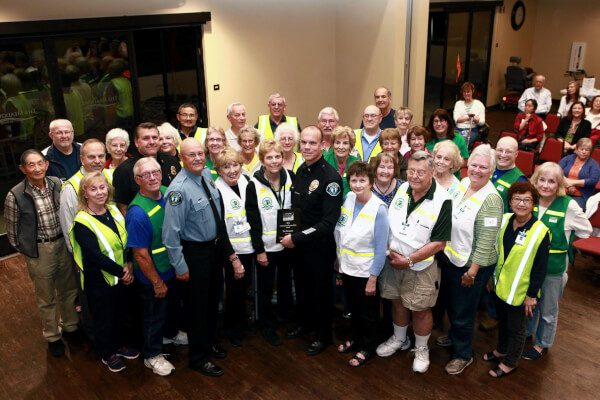
For nearly 20 years we have been a part of our Neighborhood Emergency Response Group. Here’s a historical photo to show some of our smiling faces!

Neighborhood emergency response group

During these 20 years we have dutifully collected the items that belong in a home that’s well-prepared. We have also learned a lot. In particular,

  • What disasters to expect given where we live (Southern California)
  • When and how our local government is likely to react (See those government officials in the photo?!)
  • Who we can count on when “the sh*t hits the fan.”

One simple sentence pretty much sums it up:

In a big emergency, it’s our neighbors who will be the true First Responders.

Now, our particular threats – in likely order – are power outage, wildfire, and earthquake. And in just the past two years I’ve reported on how we’ve been impacted by all three! (You can click on the links to see some of that reporting!)

Fortunately, our neighborhood hasn’t been physically damaged. We haven’t had to evacuate. But throughout, our Neighborhood Emergency Response Group has continued to train, to educate and to watch out for neighbors.

The COVID-19 pandemic has re-charged our neighborhood group.

I’ve written over the past couple of weeks about our neighborhood activities associated with facemasks, food distribution, etc.

Today, I want to talk about a renewed role for one of our favorite pieces of equipment: our walkie-talkies!

We have used our walkie-talkies lately more than usual!

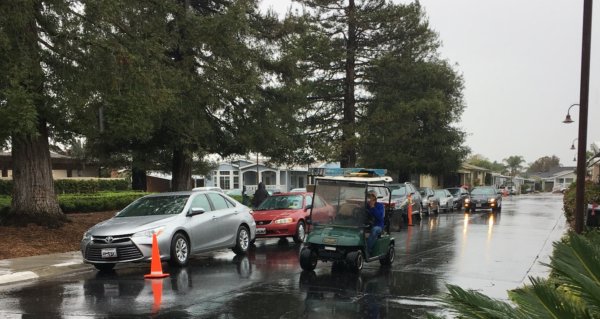
  • For last week’s drive-thru food pick-up, our traffic control volunteers used their walkie-talkies to manage the cars as they lined up, make decisions about how to direct traffic at intersections, and, ultimately, when to stand down.
  • In checking on neighbors and doing “senior shopping,” Joe and I have used walkie-talkies to coordinate our shopping routes and progress.
  • At our monthly “walkie-talkie roll call,” I was able to give everyone the latest news via walkie-talkie, handle some questions from the group, and make plans for an upcoming test – in fact, it became a virtual meeting with attendees calling in from front porches all around the neighborhood!

If you have ever thought about adding walkie-talkies to your emergency supplies, now might be a perfect time. You can order them online (be sure to get plenty of batteries) and test at home with family members. 

Now don’t be fooled. The radios that you see Police and Fire Fighters using are not the simple walkie-talkies that we use in our neighborhood emergency response group. But simple or more expensive, all walkie-talkies have one great advantage:

When you talk to your group via walkie-talkie, every person hears the same thing at the same time!

  • If your “group” is your neighborhood emergency response group, everyone on the same channel is brought up to date at once. They all hear the same instructions.
  • If your “group” is your family, they all hear the same call to dinner – or the same call for help. (And everyone hears their answer, too!)

We have used walkie-talkies for years – on hikes, when shopping, attending conventions, trying to back up a stubborn trailer into a tricky camping space!. So much easier than having to dial, wait for the phone to connect, listen to ringing, waiting for someone to answer. A walkie-talkies provides is instant communication.

  • Yes, the signal doesn’t carry very far – it’s not like a cellphone. (You have to test.)
  • And yes, you need to take your turn to talk. (Only one person can talk at a time.)
  • And yes, you’ll probably want to learn some of the of the “lingo” like “Say again” and “Over.”

And yes, walkie-talkies are fun!

If walkie-talkies are something you should look into please head over to our WALKIE-TALKIE REVIEWS page.

You’ll find key questions there to help you decide what you really need. We’ve added and updated everything for 2020 – without any idea of how valuable these social tools would become this year.

Virginia
Your Emergency Plan Guide team

April – Month of Action

What can I do to help others?

Share
washing hands to help prevent coronavirus - is it all you can do?
Is this all I can do????

I keep hearing neighbors say, “If only I could be doing something to help others!”

I feel the same way, because this staying at home gets mighty tiresome. So I turned to one of my favorite resources: Google Alerts.

(Anyone who writes for a living or for a hobby is always looking for resources – history, current news, people in the news, etc. So we all know Google Alerts.)

One of my alerts tracks the expression “CERT.” And I have been collecting story after story about how CERT teams are being activated to help others in their communities.

Are you familiar with CERT?

By now you are likely to be familiar with CERT, but if not, here’s your chance to find out more. Community Emergency Response Team (CERT) volunteers have taken a national course in citizen emergency response sponsored by FEMA. The actual training is delivered locally by your city or county. It’s a 20 hour course, usually free or at low cost, and it covers basics of emergency management, first aid, fire safety, disaster psychology, etc. Trainers usually come from the local police and fire departments.

The training is meant to educate volunteers so they know what to expect and how to respond to help their community for the first 72 or so hours after a big disaster. Why 72 hours? Because that’s how long it might take for professional First Responders to get to you! (I will repeat what our Fire Department says to us regularly. “In a big emergency you are not high on our priority list.”)

Here’s a short YouTube video about CERT.

CERT training is valuable – and fun! Joe and I were part of our city’s 3rd graduating class, back in 2001. They are now up to Class 78!  (It’s been cancelled for the time being, as you can imagine.)

One you’ve graduated, you are encouraged to continue to support your community in various activities. For example our CERT team has been called upon to search for lost citizens (at night). We have spread a message about auto theft in a particular neighborhood. And we support our police and fire departments in a variety of outreach events every year.

With the coronavirus creating new needs, CERT teams are being activated all across the country.

Here are just a few of the articles I have captured on my Google Alerts about CERT volunteers helping others in their communities.

  • Longmont (CO) CERT members are hosting a mask and glove drive for workers on the front lines of the coronavirus.
  • In Nebraska, the Hall County CERT has been helping with Strategic National Stockpile Hubs.
  • The Hall County CERT teams have also been called up to assist in county elections, where regular poll works have been lost.
  • New Jersey CERT volunteers are helping train food distribution workers in safety measures as groceries are collected in local food pantries.
  • CERT volunteers are serving in support roles at the Emergency Operations Center of Stafford County (VA). They are also staffing at the county’s PPE drop-off center.
  •  In Walton County (FL), CERT members are helping with a drive-thru food distribution program.
  • Hoboken (NJ) residents are able to call for an appointment for testing, thanks to the CERT volunteers staffing the call center.
  • CERT volunteers are providing traffic control for a drive-thru testing clinic in Fairbanks (AK).
  • In New York City, CERT volunteers are assisting in food distribution programs, canvassing senior centers and tracking and distributing sanitary supplies for childcare and early childhood centers. They are also helping deliver individual grocery and pharmacy necessities.

In each of these cases, their community called upon vetted CERT volunteers to provide essential support.

In some communities, CERT groups have not been formally “activated” but they find ways to help others anyway!

Because CERTs have skills, training and are by definition leaders, they are finding ways to volunteer without it being a formal effort.

  • Last week, for example, two CERT groups in our Southern California area were invited to participate in a PPE collection by donating extra personal supplies.  (You may have received the notice I sent out about that.)
  • Individual CERT volunteers supported a “face shield assembly” project set up by a local Rotary club.
  • Here in our neighborhood CERT grads have been sewing face masks for seniors and helping direct traffic for a drive-thru food distribution program sponsored by a local church.
  • And you’ve heard about our CERT volunteers doing telephone outreach to neighbors.

The point of all this?

You don’t have to be a “member” of any group to find a way to help others during this crisis.

And you don’t have to necessarily be physically strong, or have to commit to hours on your feet. Take your time to find a volunteer job you can manage and enjoy.

If you do, you won’t have to go around saying, “If only I could do more to help others!”

Virginia
Your Emergency Plan Guide team

P.S. And when we are “back to the new normal,” consider taking the CERT training in your own city. You, your family and your neighborhood will all benefit for years to come! (Here’s another description of CERT written by one of our readers who went through Hurricane Florence.

April – Month of Action

Get out of a contract because of coronavirus

Share
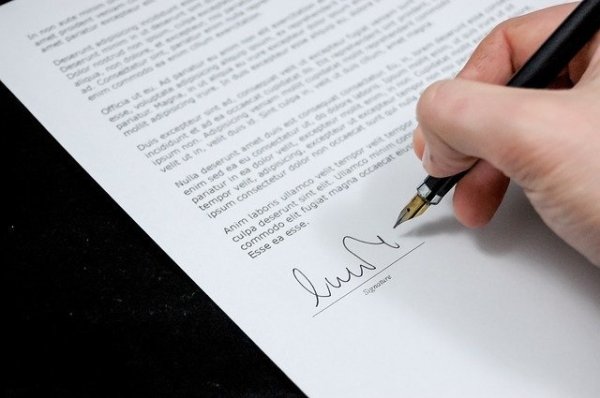
Signed contract
You signed in good faith, but . . .

If your business being shut-down isn’t bad enough, you are being sued because you didn’t fulfill a contract! Is there any way you can get out of a contract by blaming the virus?
I’ve been reading and hearing about the problems businesses are having because of the COVID-19 pandemic. (Naturally, I thought first about business insurance. We reviewed the major types in our Emergency Preparedness for Small Business Book. But this article isn’t about insurance!)

As I read specifically about contracts, though, an expression kept coming up: “Act of God.” I thought I understood what that meant, until I started seeing references in many of the same articles to another term, “Force Majeure.” That expression was only vaguely familiar to me so I did some research, and here’s what I discovered.

I’m sharing what I’ve found here because if you are in business, you need to know both these terms right now.

You may need a way to get out of a contract you can’t fulfill.

A contract seems so simple. You make a promise in exchange for money. By law and common sense, even if the job turns out to be a lot harder than you thought, that contract is enforceable.

But what if something unanticipated and extraordinary makes it not just hard, but impossible to fulfill your promise? Something like COVID-19?

How can you get out of a contract?

It all depends on how your contract was written. (Any surprise there?)

Many contracts do contain a particular clause that may make it possible for you to wiggle out from under, or at least to delay fulfilling on your promise. This is the Force Majeure clause.

The Force Majeure clause is the key.

Force Majeure translates roughly to “greater force” or “superior force” and refers to natural and unavoidable catastrophes that are so great that they keep participants from fulfilling their obligations – and thus make it possible for them to escape from the contract.

Sometimes the Force Majeure clause is called the “Act of God” clause, but the two terms are not synonymous.

Force Majeure is the broader term dealing with the event that interrupts the normal course of business. Act of God is a subset of Force Majeure, and usually refers more narrowly to natural disasters that are unexpected and couldn’t be avoided or prevented.

Before you assume your Force Majeure clause allows you to get out without penalty, however . . .

Review the wording of your contract very carefully, and contact your attorney right away. Here are some of the things to watch out for (by no means a complete list!)

  • Does your contract even have a Force Majeure clause?
  • If so, how is Force Majeure defined? Is it restricted to events due solely to natural causes (hurricanes, tornadoes, etc.) or does it include human events such as acts of war, strikes, pandemics, terrorism, etc.?
  • Which of these events could release you from liability? Which events do not allow you to get out?
  • Are there any time requirements – for example, do you have to declare by a certain date or time that you intend to use the Force Majeure clause to get out of the contract?
  • Do you have to prove that you have made efforts to fulfill on the contract? What is needed for that proof?

Of course, there’s more to be considered . . .

The more I dug into Force Majeure, the more exceptions and or permutations I found. I found references to contracts being broken or delayed because of fraud, impossibility of performance, misrepresentation, frustration of purpose, and because they were against public policy.

These words may seem familiar or understandable, but they all have years of law behind them (and laws from other countries) so they don’t necessarily mean what you might think at first read.

You will need an attorney to help you sort your way through this! Your attorney is probably getting lots of practice in coping with business contracts as you read this, so you better set up an appointment now!!

Virginia
Your Emergency Plan Guide team

P.S. Now I have many business books in my own library, and several are on the basics of business law. If you are looking for more on contracts or how to get out of a contract, I’d recommend this one first. Unlike most books on the topic, it is written for people signing contracts, not drafting them! (Click on the image to go to Amazon – where we are Associates — to check prices.)

And if you need something a bit more rigorous, but still readable, check out this one from the Dummies series. I have always found them reliable.

One of the reasons I always have legal resources at the ready is because the more you know before you go in to meet with the attorney, the less you’ll have to pay for time getting educated . . .!

April – Month of Action!

Retirement community gets a little too quiet

Share

During ordinary times many of my neighbors in our retirement community live pretty quiet lives, by choice. But since there are a handful of us who organize and put on social events —  theme dinners, guest performers, Bible study, Friday night bingo — people have a chance to get out and mingle if they want.

The stay-at-home order has changed everything.

No more face-to-face gatherings of any kind!

These days, we may see a neighbor and call out a greeting from our porch, but since it’s been raining for the last few days, even that contact is gone.

Many are home alone with no one to talk to.

As you might imagine for a retirement community, more than half of our neighbors live alone. We knew when the coronavirus hit that this was going to be a tough time – a time when older people living alone could get lonely, frightened or, worse, get sick or even die.

And in the worst of cases, no one would know.

So two weeks into the stay-at-home order our Emergency Response Group set up a “Good Neighbor Check-In” project. We enlisted volunteers willing to call neighbors on the phone “just to check in.” The project took shape over a single weekend, and it’s been going strong. I just got an update report from another of the callers today.

We try to help callers by feeding them information to share, such as what transportation is available, and phone numbers to call for medical and mental health help. (If you’d like copies of the planning documents we used for our Check-In project, drop me an email.)

Some neighbors are unwilling or unable to shop for food.

Shopping has become a big effort for many of our most elderly neighbors. Stores have instituted “senior shopping hours,” which help. (“We may check your ID!” generates good stories!) But seniors are vulnerable, by definition. So shopping becomes a scary event.

In light of all this, parts of our retirement community step up.

Of course, we share, one household to another. (I think I wrote about how Joe and I had traded two rolls of toilet paper for a jar of mayonnaise.)

The food deliverers . . .

Today a local food pantry and church kitchen arrived with a truck full of boxed meals. In the pouring rain our Emergency Response Team volunteers organized a drive-thru line. We set it up using cones, DO NOT CROSS tape and strategic arrows so people wouldn’t be able to cut in line – and would be able to pick up food without getting out of their cars. (People who don’t drive made reservations via our automated OneCall system, and received a box on their doorstep delivered by volunteers from the church.)

First cars in line — two hours BEFORE the designated time. Later, the line extended as far as you could see and disappeared into the distance . .

I can’t say the whole thing went perfectly smoothly. It rained and it poured. If you’ve dealt with elderly drivers the popular expression “herding cats” springs immediately to mind! But it did take place, and 130 or so households got food.

The mask makers . . .

All our Emergency Response Team traffic volunteers arrived with walkie-talkies, gloves and masks. We always have the radios, but gloves and masks came from other neighbors. Another stay-at-home group here in the neighborhood has been sewing masks for just this purpose! (We have had to put together a strict system for requesting and then picking up masks. It has included emails being sent out in Chinese as well as English!)

We heard today that as of Friday, every person going about “essential business” in California will need to be masked.  So, our sewing team will be doubling up their efforts to provide masks for all the people they can!

Frankly, when I got home today I peeled off my wet clothes, washed my hands, heated up a can of chicken noodle soup for a late lunch, and then both Joe and I took a nap. I’ll be writing up a real “after action” report for the event today, but I thought maybe you might like hearing what it was like.

Here in our quiet, oh so quiet, senior community . . .!

Virginia
Your Emergency Plan Guide team

April – Month of Action

A New Sense of Urgency for Writers

Share
Woman writing with sense of urgency

If you are a regular blogger or copywriter, poet or essayist, educator or consultant – you probably find yourself, like me, writing all the time. Projects. Lists. Instructions. Presentations. Speeches. Lately, though you may be experiencing a new sense of urgency.

For me, nothing much changes when I “work at home.” I may use a different chair or a different desk but that computer screen is right there, poised to welcome my every key stroke!

I’m finding it tough to break away from the computer, actually.

The virus has given me a new sense of urgency.

Oh yes, I take a few minutes to move wet laundry into the dryer. I clean off the counter in the bathroom, with special attention to the faucet handles. After that, though, it’s back to my desk – to answer a few emails from friends, or draft a message to the volunteers of our Neighborhood Emergency Response Group who are making daily check-in calls.

And without a pause I find myself again adding to one of my current manuscripts. Even though . . .

I have already published another book on Amazon, just this week!

It’s the next title in our mini-series – a collection of short books, fast reads in question-and-answer format, each focused on just one aspect of emergency preparedness.

We began the series early this year, before the Coronavirus really got started. As it turns out, this simplified Q&A format fits perfectly with the way my brain is working lately – slightly disjointed, moving from one topic to another.

At any rate, may I introduce to you . . .
(drum roll)

Latest in the Emergency Preparedness Q&A Mini-Series!

Our goal with this series is to make it easier for people to think – and take action – to improve their preparedness for emergencies. Surely, this COVID-19 disaster has shown us how ill-prepared the country as a whole was for something so dramatic and wide-spread. We are still struggling to find a cohesive, concerted plan to combat it.

The virus has made individuals rethink their own personal situation, too, with what I hope is a new sense of urgency.

Whether it’s supplies of grocery staples, or the basic painkillers or cold remedies we always want to have available, or a desperate worry about running out of toilet paper, the order to stay-at-home has pressed some sort of “reset” button.

I’d like to think that we’ll remember this, and take action now so we will be less desperate because we are more prepared next time an emergency hits.

Now, you probably still have running water, and all the conveniences of electricity, cell-phone communications, and of course whatever you use for writing. So you probably aren’t really concerned today about safely managing human waste — Pee ‘n Poop.

But if an earthquake hits, or a tornado threatens, or a hurricane begins to form . . . Will you know what to do if you can’t use the toilet?

What else do you want to become more expert at?

Check out all the booklets we’ve completed so far, here at our website: https://emergencyplanguide.org/books I am confident you will find some of what you need to answer that question in the gold box!

Virginia
Your Emergency Plan Guide team

P.S. I say “we.” That refers to me and my partner Joe. He tends to have the ideas and the questions for these current materials. I tend to do the research and the writing. It works pretty well!

P.P.S. Oh, and if there is a title you’re really like to see on the list, but it isn’t there yet, let me know! We have 15 total on the drawing board – yours may be coming soon, or we could add a new one, just for you!

April — Month of Action