Author: Volunteer

Does Business Hold the Key to Community-wide Preparedness?


Share

Anyone who is active in the world of emergency preparedness recognizes these simple truths:

  • Disasters, whether natural or man-made, are becoming more frequent and more serious. And more deadly.
  • People with a personal survival plan have a better chance of surviving a disaster than those with no plan. Same for businesses and for communities with active neighborhood emergency response groups.
  • Getting individual Americans to make a plan is an uphill battle!

How Can We Help More People and More Communities Be Better Prepared for Emergencies?

The government plays a role in preparedness.

FEMA was formed in 1979 with good intentions. When disaster awareness took front stage after 9-11-2001, FEMA’s efforts ratcheted up.

Actually, even before that, FEMA had seen the efforts of Los Angeles Fire Department to train civilians in earthquake preparedness. The LAFD program was adopted in 1993 as a national program and called Community Emergency Response Team (CERT).

CERT training is now available in all 50 states. Thousands of citizens have been trained and now serve as valuable interim backup to official First Responders. Training is at minimal cost and in some cases is free.

For the past decade or so, shifting from its traditional top-down approach, FEMA has looked at improving resilience at the community level. But here we are today, having gone through Katrina, Sandy, Harvey, Irma, Maria and Michael. We’ve experienced hundreds of mass shootings, thousands of acres of historical flooding, massive wild fires, and millions of data breaches — and the level of preparedness in American families hovers unchanged at around 50%!

Why don’t individual Americans prepare for emergencies?

After 30 years of working with our individual neighbors all across the country, we have found it boils down to this: the comforts of urban living have overtaken the urgency to develop survival skills.

And there’s a secondary reason, too. While people understand that working together will give them an advantage in an emergency, our increasingly diverse and ever-more-mobile society makes working together harder. 

So while people will always agree that they SHOULD be preparing, and that working together will give them an advantage, most lack the necessary leadership skills or they just aren’t willing to make the effort.

CERT Volunteers do their best to engage neighbors – but . . .

CERT training attracts a special breed of people, people who recognize risk and are eager to take action to reduce it for their families. When they have completed the CERT training they have a unique understanding of how their community and in particular how their First Responders work in a disaster. They also have skills to help save lives on the ground until those First Responders arrive.

But CERT training does not include a module on “community organizing.” Without the aptitude for sales or sales training — and lacking backing and financial support – individual CERT volunteers who want to build neighborhood groups around themselves inevitably run into a wall.

Businesses have preparedness advantages that individuals don’t.

Are you familiar with the statistics for business survival after a disaster?

FEMA reports that up to 40% of businesses never reopen after a disaster, and those that stay closed for more than 5 days are unlikely to last more than a year.

With a solid emergency preparedness or Business Contingency Plan, chances improve dramatically for a business to make it through or re-open more quickly.

But small businesses, like individual families, still lag behind in planning. They may not recognize the powerful advantages they already have for effective preparedness:

  1. A business is already an existing group. Its members are typically in close physical contact. They know each other. They are used to working together as a team to meet a common objective.
  2. Businesses have a built-in network of resources to call upon for help in planning for emergency. Those resources include other neighboring businesses, partners like suppliers, city governments, utilities, and professional advisers like accountants, attorneys, insurance agents, etc.  And CERT training is available to business usually at no cost.
  3. Every business has a duty to protect lives, and everyone in the business has an incentive to protect their livelihood!  Even if the doors of the business are closed, the business has to make sure regulatory and legal commitments are met. A proper plan can assure this continuity, keep employees paid and deflect legal assaults.
  4. The owner or employer sets the tone and can require and ensure that the business develop a preparedness culture.
  5. Where the business’s plan includes well-thought-out emergency communications with employee families, it reduces employee anxiety and gives employees an incentive to stay or at least return to work during the critical minutes and hours immediately following an event.
  6. And the prepared business actually adds a bonus for the whole community. Employees will take knowledge and training home and spread it within their local neighborhood.

Businesses start ahead of the game. All they have to do is get into it! 

Logically businesses might first turn to their existing team of professional advisers for help in putting together a plan. These are the accountants, attorneys, bankers and insurance brokers who currently advise them on their business issues. Each has valuable expertise.

But these professionals may not see themselves having a role in emergency preparedness. So without that guidance, how can businesses turn the corner on preparedness?

Businesses can use CERT to jumpstart preparedness training at their location.  

Once the business has been exposed to CERT, building a more comprehensive Business Contingency Plan will be a natural. And once employees have been exposed to CERT, they will automatically take new awareness and skills home with them right into their neighborhoods!

Spreading CERT from the business into the community at large isn’t a guaranteed or proven answer to more community resilience. But, given the uneven track record that many communities experience in trying to organize neighborhoods, this would certainly seem to be an approach worth testing.

Let us know what you think!

Here at EmergencyPlanGuide.org we’ve been committed for years to preparedness at the community level. To help businesses get started, we have published a simple guide to preparedness for small businesses. We are making it available to professional business advisers, too, along with reference materials and more resources from that particular service perspective.


How to Inspire Readiness

Share
Do your neighborhood group meetings feel like this???

If you are what we could call a “solo preparedness devotee” (or perhaps “voice in the wilderness?”) you know it’s hard to stay inspired and to maintain any momentum in learning new stuff, keeping your supplies up to date, etc.

And if you are involved with a group of neighbors or even trained citizens, you experience the same problem — only worse!

How to keep people interested and inspire readiness?

A close call works.

For example, a 4.5 earthquake works well here in California. News of disasters in other parts of the country or even the world also catches people’s notice and can inspire readiness. Even an announcement about a change in course of FEMA can be useful.

But close calls usually indicate that someone is suffering, so we certainly don’t like waiting for them or depending on them . . .

For a group, we look to regular meetings for inspiration and engagement.

So then the question: What should be on our meeting agenda this month?

I’ve been organizing or helping organize our neighborhood emergency response group meetings for about 16 years now. Even if we figure only 4 meetings a year during that time, that adds up to A WHOLE LOT OF MEETING AGENDAS! Every meeting is an effort — and a challenge! – to inspire readiness through training, door-prizes, entertainment, examples, stories . . . whatever works.

Fortunately, other groups share their meeting agendas with me.

If you’ve been sticking around here at Emergency Plan Guide for a few years, you’ve read about a number of meetings – and not just ours, but also meetings I’ve heard about from other CERT or neighborhood groups. For example, just this week I got these three reports that have already helped suggest meeting topics here in my neighborhood:

  • A friend in a Northern California coastal town reported that she is putting on an earthquake tabletop exercise for a neighboring town. Both those towns are in the way of tsunamis if/when there’s a big Pacific Rim earthquake. Here in Southern California a tsunami is less likely, but an earthquake?  You bet.
  • Another leader in a different Northern California city wrote to tell me that her neighborhood group had planned and executed a Fire Prevention Clean-up Day – removing Juniper trees (very flammable), trash, leaves, fallen branches, etc. from around the homes in their mobile home park. Hearing about this group’s enthusiasm was certainly inspiring to me! We’re working on a similar project right now! (Watch for more.)
  • Still another formal CERT group got this media mention yesterday: Lafayette, CA: The Lamorinda Residents Guide to Wildfire Preparedness & Evacuation. a joint effort that included the Lamorinda Citizens Emergency Response Team (CERT) was mailed to more than 62,000 residents in critical wildland fire hazard areas of the East Bay (CA).

Emergency Plan Guide tries to share as many good ideas as possible!

In the past I have put out many individual Advisories about successful meetings we’ve held. And I’ve also published two downloadable books with meeting planning ideas, with about 75 plans for easily-repeatable neighborhood meetings.

Note – these aren’t official CERT trainings. Rather, they are ideas stressing readiness that can be used with “ordinary” groups of neighbors, some of whom have had CERT training but most of whom have not.

I am in the midst of updating them with more meeting agendas and will soon be republishing them in a new format.

And this brings me to a request.

What can YOU add to our list of meeting resources that will help other neighborhood groups inspire readiness within their own ranks?

Have you held meetings that have been particularly interesting, fun or productive? And that lend themselves to being copied? If so, could you please send a description so I can include it in the next version of the book?

I’m thinking that together, we can produce something like “Chicken Soup for Great Emergency Preparedness Teams!”

Here are some simple questions that might work for telling your Great Meeting story:

  1. What was the title/theme of the meeting and what was your objective?
  2. How did the meeting unfold? Any surprises? Any laughs? Any hiccups? What was particularly inspiring or engaging?
  3. Did you need props, handouts, show-n-tell items, other materials?

Please send a story! If you want to remain anonymous, or your group wants to remain anonymous, just say so/ But let us know what sort of neighborhood you’re in, to help readers adapt your great meeting to their neighborhood.

Sharing strengthens volunteer groups and thus whole neighborhoods!

As you know, FEMA’s most recent push has been for Community Resilience – as opposed, I guess, to national response capability. I’ve been working at the community level for years, and I think most of you have been, too. Sharing ideas to help organize communities and inspire readiness among their residents is what we’re about.

I welcome your ideas for great meetings to share!  Please send them to Virginia@EmergencyPlanGuide.org.

Virginia
Your Emergency Plan Guide team

In case you’ve missed them, here are a couple of Advisories from the past about meetings that worked to inspire readiness. At least, I have received repeated assurances that they made a difference!

Personal Information Databases and Your Privacy

Share
Privacy - Image of person being examined by magnifying glass

My shocking personal information story

Last weekend I got a text message from my daughter. She had been online and had found one of the personal information databases that had my name in it.

There are a couple dozen popular sites like the one she checked. They all offer background and personal information about anyone, usually including phone number, address (and past addresses), email address, relatives, pictures, social connections, court records, etc. While you usually can get one or two pieces of information just by typing in someone’s name, for a fee you can get all the records.

Well, my daughter got my whole record and sent it to me. IT WAS SO, SO INACCURATE!  Wrong birth date. Unknown foreign “friends.” Places I’d never been to! When I got to the (false) court records I shut the phone in horror!

(Now my daughter being who she is, she sent me specific instructions of how to cancel the account, which I was able to do within 24 hours. At no charge.)

Still, it was a shock. While I spend a lot of time online, I simply don’t use personal information databases and have never looked myself up.

But since we talk about cyber-security a lot here at Emergency Plan Guide, it seemed important to share more about it today. These personal information databases are legal. They have found information about you without breaking any laws. There have been no “leaks.”

But your privacy is certainly threatened by them.

The Big-Daddy Personal Information Databases in all our lives – the Credit Bureaus

Most everyone is familiar with the credit bureaus that track 9 of every 10 adult Americans: Experian, Transunion and Equifax. A fourth seems to have been added to this list: Innovis.

While we often speak of “your credit rating,” or your “credit score,” you really have one from each company.  

But each credit report will be different. Why?

All four companies track money that you owe: mortgages, bank loans, car loans, student loans, and credit card debt. Credit bureaus also get information from public records, like property tax rolls or court records.

But businesses are not required to report the loans they make to you, so many businesses report to only one or two of the credit bureaus. That explains the variations in the reports

Action item: Check your credit reports.

If you haven’t checked your credit scores lately, you may want to. According to the Federal Trade Commission “You’re entitled to one free copy of your credit report every 12 months from each of the three nationwide credit reporting companies. Order online from annualcreditreport.com, the only authorized website for free credit reports, or call 1-877-322-8228. You will need to provide your name, address, social security number, and date of birth to verify your identity.”

According to the Innovis website, they offer a free credit report, too.

I have checked my own records in the past. Every time I found errors. Once it was a misspelling that dropped someone else’s debt into my file. If you see debts you don’t recognize, or other strange information, you can work with the credit bureaus to get your report cleaned up.

The “people-finder” sites track even more personal information.

Wikipedia says there are close to 4,000 “information brokerages.” This probably includes the credit bureaus. All of these companies are for-profit organizations that make money by charging for certain services and by selling your personal information to marketers – and to each other.

The people-finder sites are giant personal information databases. They start with names and aliases. They list addresses where you have lived and currently live. Some have reverse directories – enter an email and they’ll give you a phone number to go with it, or enter a phone number and you’ll get an address.

That is just the start. You may find lists of your children. Other relatives and ex-relatives. Lists of friends. Where you’ve traveled. Property you own. If you’ve been in trouble with the law or owe taxes. If you are a sex offender. Have declared bankruptcy. You may find photos of yourself!

How much of this information do you want to be available to anyone willing to shell out a few dollars? What if there are errors in the data? How can you protect your privacy?

When I found out about being on one of these sites, I immediately jumped into action to find out more.

How the people-finder information databases work:

  • You usually can’t get a complete look at your people-finder record  — or the record of someone else — without paying at least $1 for a “trial.” If you sign up for a trial, read the fine print. Trials typically turn into a “regular monthly subscription” unless you cancel within the specified time, which may be just a few days.
  • If you want to update or clean up your record at the people-finder site, you will run into challenges. They get your information by scraping the web – that is, by finding publicly available info. Obviously, you can’t “change” public information, although you can delete some of it. (Looks as though you can’t delete court records that aren’t officially expunged.)
  • Once the site is updated, you will be offered the option to subscribe for a monthly fee to monitor your account to keep it clean and also to be able to search for other people. Subscription prices seem to vary starting at as little as $5/month (for a multiple-month contract) but most are more in the $20-30/month range, with an extra fee for what has been termed the “juicy stuff” – criminal records, tax records.
  • Like me, you may want to close the account and remove all the information. Every site’s requirements for opting-out of the site are different – but from what I am reading, it is possible but your patience will be tried. You should not have to pay anything to get off the site but you may have to jump through hoops.
  • Even after you are successful at having the account closed, it may reappear again in the future when they “find” new information . . .

Here are some of the sites I came across in my research.

 I used an old email to check on a couple of them and found myself in every one I looked at. My photo was there, too! I am not recommending any of these sites — they are just to help you get started on your own research!

  • Peoplefinder
  • Beenverified
  • Mylife
  • Instant CheckMate
  • Spokeo
  • Anywho
  • Truthfinder
  • Whitepages
  • People
  • Peoplesmart
  • Intelius
  • US Search
  • Radaris
  • SeekVerify
  • Pipl

Can you remove yourself from these online databases?

How to get off the credit bureaus. The only way to get off them entirely is to become one of the 26 million or so people in the U.S. that have no debt profile. That means they have no credit cards. No mortgage. No car payment.

Most of us couldn’t function without at least some of these. So the best thing to do is to be sure your credit report is at least accurate.

How to get yourself off the people-finders. It looks to me as though getting totally off is impossible. You would need to have no online banking accounts. No social media accounts. No websites. You’d have to avoid using public wi-fi, and if you went online, use a Do Not Track browser. (Apparently Google does have a Removal Tool but it sounds as though they make it tough to use.)

Best thing to do here? Go to as many of the people-finder sites you can and ask that your information be deleted. Go there regularly. This is a lot of work.

Hire a “reputation manager” to help?  You can hire a “reputation manager” company that will search out negative info on your behalf, then remove or suppress it. Some of these companies specialize in business reputation management, others work for individuals. Fees for their services depend on the complexity of your situation, but customized plans seem to start at around $400 – 500/month.

“Privacy is dead. Get over it.”

You have probably heard this quote. It is attributed to the co-founder and CEO of Sun Microsystems, Scott McNealy – and he said it way back in 1999!

Obviously, the more we rely on digital communications to run our lives – essentially everything on the Internet of Things — the less privacy we will be able to maintain. Is there an answer – or is the genie out of the bottle, never to be returned?  I’m afraid the genie is dancing in triumph right now!

But in being conscious of what data you’re making available by participating in the digital society, you can at least be better prepared for what might come!

Virginia
You Emergency Plan Guide team

P.S. I am not an expert in this topic. If it interests you, YOU need to become your own expert. If you already have stories to tell, please share them with us by leaving a comment below!

P.P.S. We have written pretty regularly about security and privacy. Here’s an earlier Advisory that talks about why home electronic devices are so vulnerable to hacking.

Take an Insurance Inventory

Share
How to file insurance claim after fire? You need an insurance inventory.
“How will we ever remember what we lost?”

Take an Insurance Inventory Before You Need It

After last week’s Advisory about spring cleaning, with the comments on updating insurance, I felt obliged to take action and create an inventory of our stuff, once and for all. First, I looked for some advice about how to begin. Here’s what I have discovered so far about inventories.

What goes into an inventory?

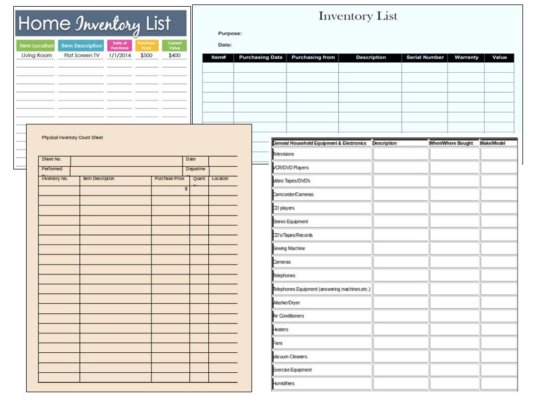
I started by looking at several paper inventory sheets that are meant to be filled out by hand or, in some cases, by computer. Here are examples.

Example of insurance inventory sheets.

What layout do I prefer?

What you see immediately is that there is no one format that works for every home or every business.

Determine what information to include.

What I did find, though, is that if you are doing an insurance inventory you want to include at least these items, in whatever format you prefer:

  • Date of the inventory
  • Item type
  • Item description (manufacturer, brand)
  • Where item is located now
  • Cost when originally purchased

If you are doing a business insurance inventory, you will want to include this information also:

  • Make/model
  • Serial number
  • Warranty
  • Current value

Organize by category or location?

Some people lump all similar items together in categories– for example, they’ll do a list of electronics, one for books, one for appliances, one for musical instruments, etc.

Others organize the inventory by location – everything in the living room, office, kitchen, etc.

However you do it, don’t forget things you own that are not inside the home! For example, do you have items in a bank safety deposit box? A storage unit? Digital items stored only in the cloud? What about patio furniture, tools in the garage, etc.?

Just this far in, and the thought of writing it all down seems overwhelming.

So I looked into other options.

Video-tape an insurance inventory!

This makes sense. Go through the house or office, starting outside the entrance and going through every room, carefully filming everything and commenting on the tape as you go.

Depending on how much stuff you have, you may need or want to supplement video with still shots.

Here’s some thinking I did for two sample categories in my house.

Office inventory

In our office, I will start by panning around to show furniture, certificates on the wall, book cases, file cabinets and the supplies closet.

Then I’ll stop the filming to prepare the desks and supply cabinet for the REAL inventory – opening drawers and boxes so supplies and files are visible, and then taping the whole area again.

Our network setup (routers, modem, controller) is worth another whole series of shots with commentary.  Same with phones, computers, monitors and printers.

Special collections

You can guess that we have a lot of emergency supplies and equipment.  Some of this will show up in the office, but most is stored on shelves in the laundry room and two different closets!  I’ll have to go through these to film emergency radios, HAM radios, emergency lanterns, batteries and more batteries. We also have survival kits, CERT helmets and miscellaneous camping gear. Lots of stuff for the insurance inventory!

Note about collections. This I already knew! If you have valuable collections (art, jewelry, collectibles) you may want to get them appraised and add a rider to your policy to be sure they are adequately covered. Most regular homeowner policies have a surprisingly low limit on specialty items. There’s also a limit on coverage for home business equipment that may not be enough for you.

You get the idea!

In an emergency, if the house were flooded, tumbled by an earthquake or simply trashed by intruders, just these two categories alone – office and emergency — would be almost impossible for us to reconstruct without help from pictures!

Moreover, without some picture proof, we would be unable to put together a decent and fair insurance claim. And guess what – You may be asked for a list of what is missing within the first 24 hours of the incident!

Can I make an inventory using my phone?

If you are like me, you turn to your cellphone for a lot these days.  Can you use your phone to create the insurance inventory video?

Take photos.

There are apps (iOS, Android or both) designed specifically for inventories using photos. Take a picture, then label (tag) and put into a folder and file.  You can add just about as much info as you want; the app may even calculate the total value of the items in the inventory! Some apps allow you to transfer your inventory data to a spreadsheet or pdf. And at least one app creates QR labels so you can stick them to moving boxes!

As you can imagine, many of the inventory apps are free; the ones with the most options have a monthly or annual fee.

Make a video.

Since I am not an accomplished thumb typist, I looked at option 2 –narrating a video of my stuff.

Depending on the phone, the video will be limited by . . .

  • how much total storage the device has
  • how much data is already on the phone (programs, photos, etc.)
  • what resolution video you’re shooting.  (Higher resolution takes up more space.)

Use a camcorder.

Personally, if it comes to taking pictures, I think I would opt for using a camcorder. I have an old camcorder and it fits a lot better in my hand. I can see just what I am filming. It also has a better microphone.

It used to be that camcorders were considered “expensive.” Take a look at these models – way less than half as much as a new smart phone!  (Of course you can spend thousands of dollars on high-quality cameras for film making. We’re talking here about easy-to-use models perfect for everyday – and for inventories.)

The first one is very small, very compact, fitting right into your pocket. It offers zoom and wide angle. You can choose resolution: higher resolution uses up your battery faster. You can connect the camcorder to the TV and show your videos, or send to your computer. Click on the image or the link to get to Amazon for full details and prices. Obligatory disclaimer — we are Amazon Associates.

Sony – HDRCX405 HD Video Recording Handycam Camcorder (black)

Right in the middle of my research for this Sony camcorder at Amazon, I also got an ad from a big box store for the exact same item. There was a price difference of $40!  (Amazon was the better deal; well under $200.) It pays to shop!

Here’s a second example, with more zoom power, a two-channel microphone and what I would call movie effects.  Probably more fun for family and sports videos! Again, under $200 at Amazon.

Panasonic Full HD Camcorder HC-V180K, 50X Optical Zoom, 1/5.8-Inch BSI Sensor, Touch Enabled 2.7-Inch LCD Display (Black)

Final point. Protect your inventory.

Your inventory is useless if it is washed away in the flood, burned up in the fire, or stolen along with the collectibles. Be sure to keep extra copies off premises (with a family member?), in a fireproof safe and/or saved online in the cloud.

Now I have to admit that I haven’t actually STARTED on my inventory yet. But now I know what the next steps will be. How far along on an inventory are you???

Virginia
Your Emergency Plan Guide team


Spring Cleaning for Preppers

Share
Spring cleaning means washing windows

If you are a dedicated spring cleaner, you’ve already taken care of the windows. You may have done some spring cleaning in closets or in the garage, too. And when the time changed a few weeks ago, you undoubtedly checked the batteries in the smoke alarms. (You did, didn’t you?)

With summer coming up quickly, it will be easy to get caught up in end-of-school parties, vacation plans, etc. In the midst of that, your spring cleaning may get interrupted, along with some of your good preparedness habits.

Here are a few quick reminders for your family and your neighborhood team. Click on the images to get more details on these items from Amazon.

Walkie-talkie spring cleaning.

Yesterday we picked up my daughter at the airport. While Joe circled, I hopped out with a walkie-talkie so we could keep in touch. This is one of the most convenient uses for these hand-held radios!  No dialing, no busy signals, no dropping of the signal. Just push to talk: “OK, I see her! “OK, we’re at gate 3, right at the crosswalk.”

But the walkie-talkies have to have good batteries! Actually, we have added walkie-talkie battery replacement to our twice-a-year Daylight Savings Time checklist.

Last week we also added 10 more walkie-talkies to our supply for our neighborhood group Block Captains. The Uniden model continues to be our favorite, and prices haven’t gone up much at all. Here’s the model we buy – less than $25 for a set of 2:

Uniden GMR1635-2 Up to 16-Mile Range, FRS Two-Way Radio Walkie Talkies, 22 Channels with Channel Scan, Battery Strength Meter, Roger Beep, Call Tone, Keypad Lock, Black Color

If you are building your emergency team, or are planning family outings that will involve keeping track of each other in crowds (like a theme park) or in the woods, consider Walkie-talkies for your own family use. For short-distance communications they really can’t be beat.

Spruce up safety clothing.

Some clothing items seem to find their way into dark corners and onto the floor of the trunk of the car. I’m referring to sweatshirts, gloves, hats, etc.

With summer coming, it’s time to clean out and be ready for warmer weather. But don’t forget the safety gear that you KEEP in the car.

For example, we have found that having colored shirts and/or reflective vests are smart additions to our usual car survival kits.

  • Heading for Disneyland? If everyone in the family — Mom, Dad, Grandpa, Kid 1, Kid 2, Kid 3, etc.! — is wearing the same bright-colored T-shirt you will be a lot easier to spot!
  • Being on the street in the dark next to a disabled car is terribly dangerous! A reflective vest becomes an important safety item on the street and a reassurance in a campground at night.

Last week when we put in our order for more walkie-talkies for our team we also bought 10 more reflective vests for our neighborhood group Block Captains. They are amazingly modest in price!  (It’s not like we are wearing these every day, so they don’t need to be top of the line.) I chose these because they have pockets, and the package came with an extra vest in child-size!

Click on the link below the imageto get full details.

CIMC Yellow Reflective Safety Vest with Pockets, 10 Pack, Bright Construction Vest with Reflective Strips,Made from Breathable and Neon Yellow Mesh Fabric,High Visibility Vest for Working Outdoor

Battery replacement.

How many flashlights and emergency radios do you actually have, when you add up all the ones in the cars and in the house?

Guess what, they probably all use batteries! And have you noticed the rule that says batteries will whimper and die just when you really need them?

So, the competent Prepper adds a flashlight check and battery replacement exercise to the spring cleaning list.

Over the years we have tested and tested different batteries. The best ones one year seem to lose place to another manufacturer the next year. So we simple buy batteries on a regular basis.

Again, you probably need different sizes. Here’s a convenient pack with the AA and AAA sizes most common for our flashlights and walkie-talkies. Click on the image for exact pricing.

You may want to separate batteries and put a set of extra ones – of the right size – in a plastic baggy that you store alongside the item they belong with. When the power is out you can’t be searching through your battery box . . .!

Here’s an image of one of our flashlights. Note the green batteries in the holder which will be replaced with the gold ones stored in the bag.

Replace batteries with right-sized batteries stored in plastic bag
Always replace all batteries when you replace one.

Car survival kit spring cleaning.

We’ve spent time before on everything to consider for the survival kits you carry in your car.

For spring cleaning, it may be enough to simply refresh.

  • Go through your first aid kits and replace old bandages, anything that has cracked or gotten wet. Recycle old medicines and put in new ones. Add anything you’ll need for summer, including sunscreen and dark glasses.
  • Replace all your snack food with new packages. Canned stuff may last a while longer, but why not eat it up now and put new things in its place?
  • Remove kids’ items that they have outgrown, and replace with more appropriate things – we’re talking games, toys, etc.
  • Consider adding a new battery-charger for your devices. As we’ve written before, the “power packs” store enough to charge your phone more than once. (Scroll to the P.S. in that Advisory for an example of a popular power pack.) And solar-powered chargers are now ubiquitous. Both make good gifts, too.

Communications update.

Do all family members have updated phone numbers? Do all response team members have updated phone numbers for their neighbors? Now’s a good time to refresh this info.

And test family members’ memory. Can they recite the phone number of your out-of-town contact?  (Make it a contest as you are driving to that vacation spot. . .)

Insurance review.

We see so many ads on TV about saving money by switching auto insurance. Maybe you have switched, and actually saved money!

When it comes to other insurances, it’s important to shop and compare, too. Given the past couple of years’ dramatic storms, fires and floods, you may discover that the coverage you thought you had has changed, or is going up in cost. Or maybe you thought you were covered and you haven’t been covered at all! Or you are now required to have coverage that you didn’t have to have when you bought your house years ago!

Check out these Advisories for important questions to have ready when you talk with your insurance agent.

OK, this Spring Cleaning review could actually take some time. You probably can’t do it all in one week.

But every item you check off the list means you are in better shape to avoid an inconvenience, not to mention an emergency.

Good luck!

Virginia
Your Emergency Plan Guide team


Inventory Worksheet for a Resilient Community

Share
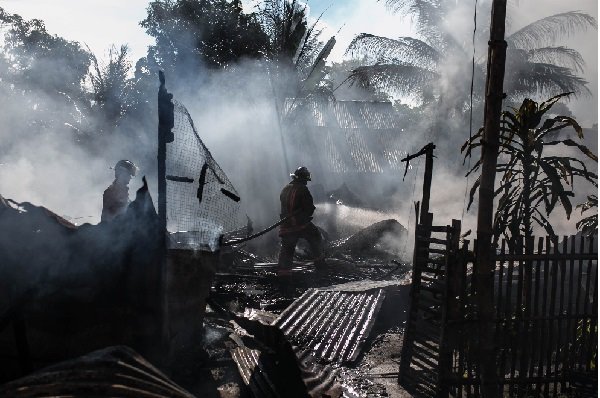
Resilient community after a hurricane
How well will your community fare in a disaster???

The emphasis from FEMA these days seems to be on building “resilient communities.” 

This includes improving cooperation among the various community agencies and organizations like cities, counties, fire departments, hospitals, the Red Cross, CERT programs, etc.

It also means a new focus on individual citizen and neighborhood preparedness. Here’s a new resilient community element that has been added to the CERT program in our city.

As CERT grads, we are being asked to serve as ambassadors to reach out more deeply into our community.

At Emergency Plan Guide we’re of course delighted with this development! We’ve been doing this grass roots work for years, and we welcome new resources!

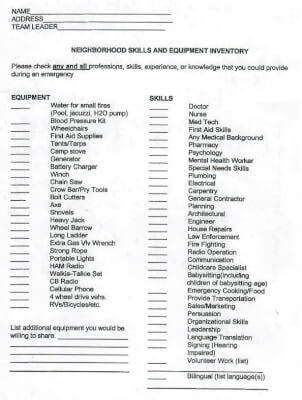
Today, I’d like to share an inventory worksheet that our CERT team received after the orientation to the new outreach program.

An inventory worksheet can add important knowledge for a more resilient community.

Have you received or used a similar worksheet? Perhaps you’ve found out some of what we have . . .

  • In our experience, people are hesitant to share information about personal skills and/or equipment until they have developed a certain level of trust with their neighbors. I think you’ll get better response by planning the inventory exercise only after your group has been established for a while and people know each other.
  • As always, we think you’ll improve participation in the list exercise by introducing it with stories that apply to your neighborhood or property. When people see a photo or take a walk out to the back gate that’s always chained shut, then they will be more comfortable sharing that they own bolt cutters!
  • Having a prepared list is great to start the discussion about a resilient community, but we have found that other important items emerge only after discussion. So now we use a “short list” as a starter and let the group brainstorm and build its own list on a white board or easel.  Then we share our “custom list” with all current members of the group.

No matter how you build it or introduce it, though, getting a list of skills and equipment is important. And you’ll want to update it regularly because people come and go and they tend to buy and get rid of stuff. In any case, and to continue the discussion,

Here’s the inventory worksheet we were given by our CERT program.

Inventory worksheet
Click here for a full sized, easier to read image!

Leverage your inventory worksheet for even more benefits to your community.

Here are more discoveries we’ve made using the inventory exercise. Perhaps they will emerge in your group, too.

  • When you know what equipment is located in the neighborhood you’ll have a head start on preparedness and won’t have to plan to buy more, often expensive, items.
  • Knowing where people with special skills or equipment are located means your neighborhood can have quick access to these assets, maybe saving lives that otherwise would be lost. (Make a map, and have a discussion about confidentiality.)
  • People who own equipment usually know how to use it. They may be pleased to lead a training session on that equipment for the benefit of the whole group. (We’ve had trainings on gas sniffers, fire extinguishers, and furniture bracing, for example.)
  • A discussion of equipment and skills may reveal gaps in your group’s preparedness “coverage.”  Can you create a sub-committee to seek out a donation, find special training, or establish a new partnership from within the community?
  • Neighbors may be inspired to sign up for more training – like the full CERT training or to become a HAM radio operator — thereby adding significantly to the strength of the team. What would YOU like to learn more about?

This worksheet was the first training piece that our CERT outreach group received, and we haven’t finished with it yet. But I wanted to get it out to you right away in case you find a way to use it with your group.

And if you do, can you please write back and let us know how it is working! We all look forward to hearing from you.

Virginia
Your Emergency Plan Guide Team

P.S. This list isn’t exhaustive. A few items that aren’t here but that might find their way onto a customized inventory could be boats, golf carts, and pop-up tents! What items does your group come up with? 

P.P.S. If you are just starting a CERT outreach program in your community, you might want a copy of the “Start-Up Suggestions” we provided for our own Southern California program leader. I’d be happy to send you a copy. Just drop me a line.


Power Outage in the Workplace

Share

Updated March, 2019

Power Outage in the Workplace

A Common Emergency Than Can Turn Into a Disaster

It’s Friday morning, you arrive at work and are greeted with . . .

“Guess what! Power is out!”

As people pull in and start to crowd around the front door, questions ring out. . .

  • “Who’s in charge?”
  • “Don’t we have a generator somewhere?”
  • “What about next door, is their power out, too?”
  • “Has the outage been reported?”
  • “How long will it last?”
  • “Does the boss know?”
  • “Shouldn’t we turn stuff off so it doesn’t all go on when the power comes back?”
  • “What was on?”
  • “What about the deliveries we’re expecting?”
  • “I have appointments today. Should I cancel them? Can we meet somewhere else?”
  • “Who’s in charge?”

Power outages are happening more often and lasting longer.

Inside Energy reported that in 2014 in the United States, the five-year annual average number of outages doubled every five years from 2000 to 2014.

Three years later, according to the US Energy Information Administration, the length of the average power outage nearly doubled from 2016 to 2017 – to almost 8 hours. Then came this addition: “. . .and the total duration of interruptions caused by major events was longer.”

Why the increase? Most notable: more and stronger hurricanes, massive winter storms, raging wildfires.  And lurking behind it all, the vulnerability of the grid itself.

We’ll be watching for statistics from 2018, and later for 2019, which has started out as bad or worse than ever before.

Note: Are you familiar with Allianz, the global insurance company? Their 2019 Allianz Risk Barometer now adds cyber incidents to the list of top business interruption risks.

A power outage in the workplace is a lot more problematical than one at home.

You may be able to get along at home because you have immediate access to extra food, clothing, etc. But to respond to a power outage in the workplace YOU NEED TO HAVE PREPARED IN ADVANCE!

Here are three simple questions you can use to start the preparedness conversation.

  1. What equipment will go off? Will it be damaged or dangerous if it shuts off suddenly?
  2. Who needs to know about the power outage? How quickly do they need to know?
  3. How will we communicate with employees, customers, suppliers, regulators and the news media when the power is out!? Who will do the talking?

Resources for planning for workplace outages.

Fortunately, there are some super resources out there to help out in this regard. One of the best is: Agility Recovery. Started 30 years ago, Agility is now serving businesses of all sizes in 44 states. While you may or may not be a candidate for their services, be aware that their website’s library has excellent videos and checklists for every business. The case histories of specific industries (banks, healthcare) are particularly interesting.

Agility has been on my radar for a couple of years now. I’ve attended their training webinars online and talked to several of the sales people, with very useful results.

Four suggestions for taking action to prepare for power outages in the workplace.

1- If the questions in this Advisory have hit any nerve at all, head over to Agility and grab Agility’s free Power and Generator Checklist. You’ll see a complete list of things to do BEFORE an outage, with specific questions to ask your electrician. The checklist adds safety recommendations as well as steps to increase security during an outage.

2- If you’re concerned about having some basic equipment available to help you through the outage — like lighting, power for computers, or a generator — check out our Emergency Plan Advisory: Fire related power outage

3- If it’s time your company considered the bigger picture, I recommend our own book: Emergency Preparedness for Small Business

It too has checklists – many of them! They start at the very beginning to help you get over procrastinating, identify ALL the possible risks (not just power outage), and get you started on pulling together a real business continuity plan step by step. (We describe Joe’s secret weapon that he discovered and developed when he was in military intelligence.)

4- In any case, consider assigning someone from your company to attend the upcoming webinar being offered by Agility on May 15, 2019, 12 – 1 p.m. MT. These webinars last just one hour, and are crammed with interesting info. May’s topic:  Ask the Business Continuity and Disaster Recovery experts. You can reserve your spot here: https://www.agilityrecovery.com/event/free-webinar-ask-the-bcdr-experts/ 

(In case you’re wondering if I have any particular affiliation with Agility Recovery, I don’t. As you know, I am constantly researching resources, and I simply feel very comfortable recommending them.)

With 70% of businesses anticipated to lose power sometime in the next 12 months, this is an important topic for all of us at Emergency Plan Guide. I urge you to take steps now to protect yourself and to keep an outage from becoming a disaster.,

Before you leave, please read the P.S. for just a few more examples of what happens when power goes out at work!

Virginia
Your Emergency Plan Guide Team

P.S. We all have a good idea of what happens when the power goes out. At least, what we notice immediately. BOOM!  No lights! Meeting rooms, offices, halls, closets, bathrooms, stairwells – all dark except for emergency lighting.

But look a little further, and you may discover . . . .

  • Automatic gates and doors are frozen open, so you have no security.
  • Communications are down.  No landlines, no internet access, and the heightened potential for increased cyber vulnerability.
  • Bathrooms don’t work if you have power assisted toilets or water faucets.
  • UPS systems everywhere are pinging, pinging, pinging. (How long will they last?)
  • There’s no power to the kitchen = no coffee, no microwave, no refrigerator. (Medicines may be compromised, food starts spoiling immediately.)
  • Time clocks and timers may shut off.  (How to track employee time, industrial processes, scheduled communications?)
  • A/C and air handlers go off, same with pumps in the basement and any electricity-driven medical devices (Environment may become uncomfortable, even unsafe.)
  • Your out-of-gas vehicles can’t refill their gas tanks or recharge their batteries.
  • The only tools or pieces of equipment that work are those with battery backup or that run with rechargeable batteries. (What about dental drills? Auto repair tools? Restaurant stoves and freezers?)

What will happen in YOUR workplace when the power goes out? You need to know, so you can be prepared. Otherwise, this outage could truly become a disaster for the business.


Stuck In Your Car? A Kit To Get You Home

Share
Stuck in car away from home

How many cars do you have in your family? Which car do YOU take when you head out? How many people usually ride with you? How far from home do you get on a regular basis?

Have you ever been stuck in your car?

On any given day if you are more than a couple of miles from home, being stuck in your car could become an emergency.

Imagine any one of these things happening, to you or to a family member . . .

  • You run out of gas coming back from a sporting event. You are on a strange road.  And it’s dark.
  • Fog causes a massive pile up on the interstate and you are caught in the middle of a mile-long traffic jam.
  • A freak snow storm closes the pass. You can’t turn around and head back down. All you can do to pull over onto the shoulder of the road and hunker down.
  • A downtown political rally turns into a riot and you need to find a safe way around the violence.
  • You are heading back to the office from a remote client meeting when you hear on the news that a chemical spill has blocked the road home.

In all these cases, you are physically OK. Your car may be out of gas, or close to it, but it isn’t damaged.

But it looks as though you may be stuck in your car for HOURS. What do you have with you that will make this an adventure, instead of a disaster?

When you are stuck in the car you will turn to your Get Home Bag.

There are two aspects to each bag: EQUIPMENT and SUPPLIES. Let’s take a look.

Let’s look first at emergency EQUIPMENT for your Get Home Bag.

When I was a kid the only emergency stuff we carried in the car were tools, a jack and a spare tire. (We used a screw driver from the tool kit to pry off the hubcaps so we could use them as buckets for picking wild blackberries.)

Today cars are a lot more reliable. It’s rare that we get a flat tire or a breakdown. But incidents like those listed above – storms, accidents, out-of-control crowds — are in the news every day! And hundreds if not thousands of people are caught up in them.

If you’re one of them, you are going to be a lot more comfortable and safer if your Get Home Bag has some if not all this equipment:

  • Lights for seeing and reading (flashlights, lantern)
  • Flares for signaling.
  • Radio reception so you can find out what authorities are doing. Your car has a good radio, but not if you run down the battery. You can also supplement with a battery, solar-powered or hand-crank emergency radio. Not knowing is scary and may lead you to make a dumb decision.
  • Phone so you can call for help. Same issue with the battery. Do you have a power bank or solar charger? (That traffic accident could happen on the long desert road between Las Vegas and LA. Solar would work perfectly – though there may be limited or no service!)
  • Some basic tools – pliers, wrench, tape – and a shovel and traction tracks for snow or sand. Samples below of each of these. Click on the images for full details and prices at Amazon.
Sahara Sailor Folding Shovel Camping Survival Shovel, Collapsible Tactical Shovel – Tri-Fold Handle, High Carbon Military Steel – Entrenching Tool with Storage Pouch ,Camping Survival Gear

I took a look at several shovels. I was looking for something small enough to fit in the trunk, but sturdy enough to be useful. The shovel above seems to fit the bill, plus it has a case. This same manufacturer also makes a more complete “kit” with multiple attachments. Check it out when you get to Amazon.

ALL-TOP 4×4 Recovery Boards – 2 Pcs Off Road Traction Tracks Mat for Sand Mud Snow 4WD Track Tire Ladder + Storage Bag (Red)

If you could be caught in snow or sand, having a set of traction tracks makes all the sense in the world. They come in varying sizes and weights, but I liked this set because of its orange color. One smart marketer has actually packaged these tracks with a shovel.

What about emergency SUPPLIES for your Get Home Bag?

Now we’re back to survival kit basics that you ought to be able to rattle off. Here are 6 main categories for every kit, including the get-home-bags in your cars:

  1. What you need to keep you warm and comfy: clothing, blankets, gloves, comfortable shoes, hand warmers.
  2. Food for energy and comfort: snacks, protein bars, raisins, hard candies.
  3. Water to maintain hydration.
  4. Towels or wipes to keep you clean in the car. Plastic bags for trash. Toilet paper to allow you to stay clean when you have to head outside the car. (Use that shovel to bury your waste!)
  5. First aid kit for any scrapes, headaches, sunburn, etc.
  6. Personal items: chap stick, sun glasses, pills, tampons, etc.

OK, those were the basics. Now, for two often overlooked items . . .

First, check out that guy in the image at the top of this page. What’s he holding? In this digital age, paper maps of your city and the larger surroundings may be forgotten. Your smart phone may be great for directing you to a specific address — as long as you HAVE a specific address. In an emergency you may not have an address. You may be trying to understand a much bigger picture, see all the options for getting around a barrier, a compromised bridge, etc.

There are many maps available, from state to region to city. Two major publishers are Rand McNally, and Delorme. Maps are harder to find than they used to be, so start your search now!

And the single most important supply of all:
A full or almost full tank of gas.

With plenty of fuel you avoid emergency #1 above altogether. You can turn the motor on to keep the car warm and check the news. You can drive the LONG way around the riot or the accident without worrying if you have enough fuel.

Should I carry or try to “borrow” extra gas?

It’s not a good idea to carry extra gasoline. In fact, it may be illegal. If you are determined to carry extra fuel, you’ll want to buy appropriate gas cans, fill them properly, and install a frame on the back of the car where they can be locked down for transport. (Be sure you have competent help with this.)

What about siphoning gas from another car? Newer model cars have a valve that blocks the gas tank from leaking if the car tips over. It will block you from siphoning in the old-fashioned way, too.

So an item for your “additional survival gear list” might be a siphon kit that uses a hand-pump instead of your mouth – lots easier and certainly safer. You’ll have to know what you are doing – attach the hose the right way, understand how gravity works to place the source and the container, etc. If you are shopping online, read all the reader comments!

The siphon above looks to be one of the best moderately priced siphon kits on the market. (Based on comments, the cheap versions don’t seem so reliable.)  Click on the image to get to Amazon.

The upshot: extra gas is hard to get.

So make it a new preparedness habit to stop frequently to top up your gas tank.  All it will cost is a little extra time.  But when you need that extra gas, the payback will be huge!

Wait, you’re not quite finished!

Now, back to our first four questions: How many cars do you have in your family? Which car do YOU take when you head out? How many people usually ride with you? How far from home do you get on a regular basis?

If you are stuck in the car, you want that car to have an emergency kit. But what if you discover this car has the wrong kit?

If you commute to work, and always in the same car, then you can pretty much review this Advisory, pack up what makes sense for you, and you’re set. (Of course, if you use a company car for travel during the day, then you’ll want to transfer your kit to that car for every trip!)

If one of your tasks is to haul the children locally to and from school and sports and whatever else, then THIS car needs a totally different kit. It needs to have a lot more clothing, more food, more water, etc. because “locally” may mean 30 or more miles in any direction!

In fact, you may want to pack one “family” bag for this car and then a small bag for each family member — including one for the pet that always rides along!

Get Home Bags are pretty easy to assemble, don’t cost much, and they will make life a lot easier if you’re ever stuck in the car. Put Get Home Bags on your To-Do list for next weekend!

Virginia
Your Emergency Plan Guide team

P.S. I expect you’ve been thinking of yourself and your family as you read this. But if you are a business owner or manager, stop right now and consider — are your EMPLOYEES prepared with Get Home Bags? Chances are just as good that an emergency will happen during their workday as when they are at home.


Preparedness Story with a Twist

Share
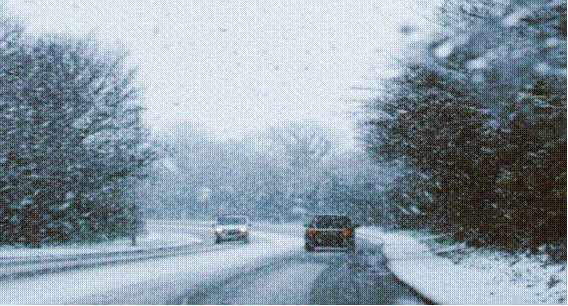
Cars driving in snow
OK, what’s a little snow?

As you can imagine, sometimes – in fact, many times – I send an Advisory out into the blogosphere and it’s never clear what impact it has, if any.  

So when something like the following happens, it’s great!

What started everything off

Last week’s Advisory was a simple list of good preparedness ideas that we’d like to see become second nature for everybody.  

I had thought the list might be just too elementary for Emergency Plan Guide readers, who seem to be pretty knowledgeable. Some of them are recognized experts.

So I hesitated before publishing, but knowing there are new readers out there, I figured . . . what the heck. A reminder once in a while can’t hurt.

Results of my post

First, I got a quick note from one of our long-standing readers who has actually written guest posts for us from time to time. Sparky’s note read: “Excellent list.”  I was gratified!

Then I got a whole long preparedness story from a reader who describes herself as “the well-prepared one.”  It made me shake my head and smile. I even laughed out loud to read the footnote. This was such a great story that I decided to turn it into the keynote for this week! 

Here’s Clare’s story, word for word. Hope it resonates with you like it did with me!

The preparedness story

Hi, Virginia, and thanks again for all you do.

I consider myself well prepared for most perplexities. Usually I’m the person others call for help. I stay informed and stay aware.

How funny is it that I was recently in a situation where I was UN-prepared?

We live in an area (Maine) where weather is a daily concern. I decided to spend Presidents day shopping 2 hours away from our home in a metropolitan area. I watched the weather reports (slight snow in the morning but clearing and the temps above freezing). I cleaned out the car so we could have room for purchases.

As I neared the shopping area it was still snowing but I wasn’t going to run home; after all, this was going to let up, the weather report said.

Well, it didn’t. It snowed and snowed and visibility got bad. The turnpike speed dropped to 40 mph.

We decided if we could find someone to care for the dogs at home we’d be better off finding a motel and staying the night where we were.

That’s when I realized one of the things I’d tossed in the house before leaving was—my every day carry bag, with all my emergency supplies inside it. A change of clothes (which I could also use as pajamas), hotel sized toiletries, extra meds, cash, reading book, even some energy bars, raisins and packets of instant oatmeal. The only thing I left in the car was the first aid kit and spare tire. After all, we were only going to be gone a matter of hours!

Luckily the motel where we stayed gave us toothbrushes and toiletries but our clothes were so wet we had to stop and buy some marked down pjs to change into and spend more money for dinner (which neither of us enjoyed, since by then quite a few restaurants closed early and we were left with bad take out).

How could I get into such a pickle? The worst part of the trip was how helpless I felt, and how angry I was with myself. I was dependent on others, not on myself. True, the hotel had a microwave but how much better I’d have felt having my familiar things with me.

The next day we drove home slowly after a hot breakfast and all’s well that ends well—but you better believe my EDCB will never leave my car again.

And then Clare added a list of what’s in her Everyday Carry Bag . . .

  • cash in small bills and a roll of quarters
  • energy bars, small boxes of raisins, instant oatmeal, small bottles of drinking water, packets of dried cocoa, teabags and sugar packets
  • Sterno, metal cup & disposable lighter
  • toiletries in small sizes plus 2 days of extra meds
  • change of clothes (we keep tee shirts, thermal bottoms, extra sox and underwear) We also keep a bright orange extra-large sweatshirt in the car–as a rule! It’s been used for everything from changing a tire to making a bed for a dog en route to the vet
  • individual flashlights & whistles
  • multi-tool
  • bandanas
  • reflective armbands
  • reading book and puzzle books in paperback form, small notebook with marker
  • first aid kit (separate in the car) with space blankets 

And this all fits in one medium-sized backpack.

The following day, I got this footnote . . .

I’m the well prepared one….and I nag others to plan and prepare. My son had even asked that morning, “Don’t you want that backpack?” and I said, “No, I’ll be home by dark and I’m going to Sam’s Club so I need the room in the car.” My family has not stopped teasing me!

Do you have a preparedness story to share?

When it comes to preparedness, we are all trying to do our best. Hearing how others handle it is so useful – and reassuring.

If you have stories of triumph or setbacks, please share them!  We can always change a detail or two to protect your privacy – but REAL stories go a long ways to keeping up our energy levels.

You can drop a story into the comment box at the bottom of the page, or write to me personally. We all look forward to hearing from you!

Virginia
Your Emergency Plan Guide team

P.S. Here’s the link to that original “good ideas” list. You might want to read it again – and forward to friends and family. 

Automatic Survival Habits

Share
Automatic survival habit - looking for exits at the theater

How would you rate your everyday survival habits?

It’s such fun to get caught up in whether your next knife should be full tang or folding, or maybe assisted folding. Whether you need a sleeping bag that has synthetic insulation or goose down. Whether to buy last year’s model hand-held radio (to save a lot) or splurge on the very latest version.

These are fun decisions and here at Emergency Plan Guide we engage with them just like you do.

But these decisions are one-time. What we want to talk about today are:

Simple survival habits as second nature.

As you know, we are part of a neighborhood emergency preparedness group. A lot of what we do is aimed at getting other neighbors to take even their FIRST step toward preparedness!

Actually, we work on at least a dozen survival habits, trying to turn them into second nature to improve the readiness and resilience of the whole community.

Below is a recent list of survival habits we’re trying to instill in everyone around us. As you look through the list, ask yourself.

  • How well do you measure up?
  • What steps would you add for your neighborhood group?
  • How will you share the list with them?

20 Easy and Smart Automatic Survival Habits

1 – Heading to the grocery store? Buy just one or two extra cans of food for your emergency supplies. You don’t have to stockpile everything all at once!

2 – Adding to your emergency food supplies? Be sure to get things you like and eat regularly. That way, you can eat from the front of the shelf and replace at the back.

3 – Building a better emergency kit for your car? You may be able to get a used backpack or tote bag at Goodwill – cheap, serviceable, and unnoticeable.

4 – Keep your car half full of gas all the time. (I keep mine 3/4 full!) Nothing worse than being caught in a traffic jam, watching that gas gauge go down and down!

5 – Keep your car locked when it’s parked, even at home. An unlocked car is an invitation a passerby might not be able to resist.

6 – Whenever you go into a building – theater, store, school – get in the habit of noting the location of other exits. In an emergency you may want to avoid the way you came in. This survival habit may save your life in an active shooter situation.

7 – Update the emergency info on your refrigerator at least twice a year, when the time changes. Have there been changes in your medications? The phone numbers of your emergency contacts?

8 – Don’t have the Vial of Life info on your refrigerator? Here’s what we did with our group.

9 – Need help? Can’t call loudly enough to be heard outside your home? Consider adding a simple whistle to your key ring or someplace else where you can reach it in an emergency.

10 – Flying? Keep your shoes on for the first 3 minutes after take-off. That’s the most dangerous time, and if you have to evacuate you don’t want to do it bare-footed!

11 – Teach your grandchildren their first name and last name. Absolutely necessary if they get separated from their parents.

12 – When you’re planning for emergencies, start your planning with the most likely emergencies, not the most severe. For most people, the most likely emergency is a power outage. Not too hard to plan for! All you need right away is emergency lighting and a way to keep warm.

13 – Heat wave and no A/C? Don’t try to tough it out! Put up shades to block the sun coming in the windows. Take a cold bath. Drape yourself with wet washcloths and towels.

14 – Power out during cold weather? Pick a small room, hang or tape blankets over the windows and door, get into bed with blankets.

15 – Best emergency lighting? Inflatable solar lanterns and/or battery-powered lanterns. It should go without saying that you have a flashlight in every room, with extra batteries handy.

16 – After a couple of days of eating out of cans, you’ll really appreciate having condiments to spruce up the taste! When you are out, collect packets of BBQ sauce, honey, jelly, soy sauce, ketchup, syrup, etc. for your emergency food stash.

17 – Canned meat may not taste so good, but it will give you the same protein as fresh meat – and will last for years. Add canned chicken, tuna in oil, and spam to your supplies.

18 – Don’t forget to refresh your first aid kit. Throw out dried up bottles or anything that’s gotten wet. You may want to add liquid skin as a new way to treat scrapes and cuts.

19 – Be sure to store an old pair of shoes, comfortable for walking, in your car. Heels or flip-flops won’t work if you have to hike for help!

20 – If you haven’t done it yet, freeze some plastic containers filled with water. (Leave space at the top for the water to expand.) Use the containers to keep your freezer fully packed. Saves energy when you have electricity, provides emergency water when you don’t!

Do all these ideas sound familiar?

Have you taken any of these steps and/or practiced them more than once? Have they become automatic survival habits?

I hope the answer is yes!

Virginia
Your Emergency Plan Guide team

P.S. Here’s something that you may find it interesting in light of the things we’ve talked about lately.

It turns out that Amazon (where we are Associates) has a service called PRIME PANTRY where you can buy everyday first aid, household, cereals, packaged items, etc. – what they call “everyday essentials” – and have them delivered for free. You don’t have to buy huge quantities, either.

Click on the ad to find out more. This may be a convenient way for your group to stock up on some of the things you want for your survival kits.


Specialty First Aid Kit

Share

Are you ready for these unusual threats?

First Aid for Everyday Emergencies

Before we get to our specialty first aid kit discussion, here are a couple of safety rules to live by:


Do not allow a large knife to fall handle first into the garbage disposal while the disposal is running.

What you will discover, if all the stars are aligned, is that that knife will fly out of the disposal and scythe its way through the kitchen, slicing anybody in its path.

In our case, the person in the way was Joe. Specifically, the back of his right hand. (Do not ask for more details.)

And here’s another rule based on personal experience plus a LinkedIn post I read earlier this week:


Assume that, as you set up for an important business presentation, the hinge of a piece of equipment will strike back, gouging a nice chunk out of a finger.

Not exactly everyday accidents, but not unheard of, either! Certainly, breaking the first rule, and then reading about the second rule, made us rethink our own first aid kits — and consider at least one specialty first aid kit as our next project.

Have you considered the state of your own first aid kits?

Where are they?

If you are at home when the wayward knife strikes, your first aid kit is probably in the bathroom. So before you head there to get it, you grab a clean dish towel or a handful of paper towels, and tell the injured person to “apply pressure” to keep more blood off the floor.

If you are in the conference room of a client when the equipment attacks, you may have NO first aid kit handy!

 You certainly don’t have a dish towel and probably don’t have paper towels, either!  (Maybe there will be some napkins over on the table with the coffee.) You grip your bleeding hand with the other hand, getting both of them covered with blood.

Now, if you’ve been through a CERT course, you may have a first aid kit in your car, which is about 2 blocks away in a parking structure. In this case, 2 blocks away is too far away!

How about adding a specialty first aid kit?

Since experts seem to agree that the kitchen and the bathroom are the two most dangerous rooms in the house, why not have kits in each room?

A kitchen kit

In the kitchen, cuts and burns are probably your most likely emergencies.  Your kitchen kit has to have the necessary to respond for all sizes of each.

In our case, a simple band aid wasn’t adequate for the cut on Joe’s hand. And the cut seemed too deep for that handy liquid skin.  We needed to stop the bleeding and close the cut. So, we used folded gauze and several strips of tape, cut to fit. (Which means we had to have scissors, too.)

So, our new kitchen kit will include all those, plus band aids and burn spray.

Traveling kit for business meetings

Our event planning list always has a tool box (for larger events) and a first aid kit. But that’s when we expected a team to be in action.

Now even our smaller meetings – at least, those with presentations! – will contain a specialty first aid kit for pinches, gouges and scrapes! It needs to be small enough to fit into a tote or briefcase.

I picture a ziploc bag with essentials: gauze, tape, band aids, antiseptic cream.  And from the LinkedIn post that I mentioned, this great idea: a RED washcloth to absorb and/or wipe up blood and make it less noticeable!

Your “master” first aid kit — that one in the bathroom — can have dozens of items, depending on your location, your skill level, etc. The list below has suggestions for one of the simpler specialty first aid kits described here.

What do you need for YOUR kits?

Of course, by now you may have thought of a specialty first aid kit that YOU need – like for the kids’ sporting events, or for the woodshop, etc. Each kit might need other items, but you can start with the list below, and have them assembled and IN PLACE with little delay. Click on the image to go to Amazon where you’ll find other styles and sizes.

1-A selection of band aids. These are fabric, which I think holds better than paper.

2-Liquid skin is great stuff. (Some people use crazy glue, but I prefer the “official” item!) Use when a bandaid will get in the way, get dirty, or can’t cover the scrape. This is a pack of two.

3-Gauze pads for cleaning, absorbing. They come in sterile and in non-sterile packs.

4--Antibacterial cream. You probably already have a tube or two of your favorite cream. This one is ours.

5-Spray for burns. Comes in a pressurized can, like this, or in a pump version. If you’re building a specialized first aid kit that will be traveling a lot, you might prefer the pump version.

6-First aid tape comes in different widths, made of different materials, can be self-adhesive, etc. This one is basic, breathable and works pretty well for any use.

7-You may already have scissors at home, too. For your traveling kit you’d want a small, slim pair like these.

I don’t always show prices, but in this case I was trying to show that with a relatively modest outlay you can have WHAT YOU NEED – in the kitchen and in your briefcase — to stop the bleeding, relieve pain, and take the first steps to get the situation back to normal.

If you already have a good supply of everything you need, just divide things up and you’ll be set! Otherwise, grab a couple of the missing items and complete each specialty first aid kit on your list. It will be worth it!

Virginia
Your Emergency Plan Guide Team

Update from March 7. Following my own advice from last month, I went out last week and added a can of first aid disinfectant spray to my new kitchen first aid kit. I have already used it twice when I grabbed a hot pot handle with bare fingers. You can also get mini-sized sprayers, perfect for your purse or key ring. Click on one of these recommendations from Amazon and shop there to see what might fit your kitchen needs.


Seniors Struggle with Emergency Preparedness

Share

Seniors struggle with preparedness

How will these seniors cope in an emergency?

Focus on Senior Citizens

This week I wrote an article for a newspaper being delivered to over a hundred Southern California “55+” mobilehome communities.

The topic was emergency preparedness, and it turned out to be about how seniors struggle to prepare for and to respond to emergencies. The article seems particularly timely given the terrible loss of property and lives in mobile home park disasters across the country in the past couple of years.

The most recent tragedy, of course, was the fire in Paradise, in northern California.

If you have done any research at all about this fire, you will discover that of the 86 people who died in that fire, 53 of them – 77% — were over 65! (If you want to read a full article about that fire and the people who were affected, get this one from the Los Angeles Times.)

The question is:

Why were seniors affected so disproportionately?

We can all probably agree that the basic steps to preparedness are pretty much the same for every audience.

But when you look at these basics, you realize that some proportion of seniors struggle with making any headway.

  1. Seniors may not have easy access to information about the risks they face.
  2. They may not have the discipline to come up with a reasonable plan.
  3. If money is tight, they may not be able to afford the emergency supplies that everyone recommends.
  4. In a violent emergency (flood, earthquake, fire), seniors may not be strong enough or mobile enough to save themselves. (Just look at the women in the image above.)

But when we look even more closely at why seniors struggle with the concept of preparedness, we see that . . .

Seniors may be a “different breed.”

For example, in my own senior community, when there’s an emergency we immediately hear cries of:

 “Who’s going to take care of me?”

Seniors have taken care of others during their lives. Now they expect others to take care of them. The problem with this thinking?

Realities have changed!

  • Families no longer live in close proximity.
  • Property owners and managers are under no obligation to protect their senior residents.
  • We’ve seen how local authorities can be overwhelmed.
  • And Federal authorities can be just too late with too little.

Counting on someone else leaves seniors more vulnerable than other groups.

 “I’ve made it this far and I’m not changing the way I do things.”

Sound familiar? There are jokes, even movies, about stubborn, crotchety old men.

When it comes to preparedness, though, this is no joke.

  • Seniors who refuse to look at risks or to take steps to prepare for them are more likely to become victims.
  • Some seniors even actively protest against preparedness announcements – “You are trying to scare me.”

This mindset endangers those people and puts their neighbors at greater risk, too.

“If it’s my time, it’s my time.”

What is there to say to this?!

What can we do to improve this situation?  Can you help?

Of course, I have done a lot of searching for different official programs aimed at seniors. But when it comes to conclusions, so many of the reports say that results are, well, inconclusive or downright dismal.

So I’d like to ask YOU to think about the seniors you know, and the ones you’ve worked with, and see if you have suggestions that we could share.

Action item: Please consider the three questions below and include a comment at the bottom of this page or write directly to me at virginia@emergencyplanguide.org.

  1. When it comes to seniors you know, what attitudes do you encounter toward emergency preparedness?
  2. What sorts of existing programs or incentives have you seen to be most successful in getting seniors to take an interest in preparing?
  3. If you ran the world, what would you suggest to improve the odds for seniors facing an emergency?

I’ll be collecting everything I can and will share in later Advisories. (Of course, I’ll maintain confidentiality.)

Thank you.

Virginia
Your Emergency Plan Guide Team


What To Do When You Discover a Gas Line Leak — Part Three of a Series

Share

(Part Three of a series aimed at neighborhood or workplace teams)

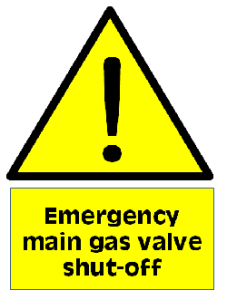
Gas main shut-off

Where and how?

“OMG, I smell gas!”

In the first two segments of this special article we talked about where gas lines run, why they leak and how to recognize a leak. Now, let’s talk about what to do if you actually discover a gas line leak!

What to do depends in large part where you find the leak.

When you discover a gas line leak in the home

Don’t forget Rule #1. If you detect a STRONG smell of gas in your home, leave the house immediately. Do not do not switch on or switch off lights or appliances. Do not make a telephone call from within the house.  Do not start the car.  When you are at a safe distance, now call 911 and/or your utility to report the smell.    

What’s most likely, though, is that you will get a weak smell of gas. In that case, remain calm. Think.

You may be able to solve this problem yourself and safely.

Possibility #1. Pilot light

Nearly every home has a couple of pilot lights – usually in the gas furnace or water heater, gas stove or oven. The pilot light is really a “starter” flame. When you turn on the appliance, the pilot light ignites the gas coming out of the main burner.

In older appliances, the pilot light burns 24/7. In newer ones, it is turned on when needed by an electronic igniter. (You may hear a clicking sound as it activates.) Fortunately, when the pilot light goes out, it triggers an automatic shutoff valve to the gas supply. So you won’t usually smell a gas leak from this source.

However, in older systems, your pilot light could go out from something as simple as a draft or spill. If the system doesn’t have an automatic shut-off valve you would smell leaking gas.

In this case, you can attempt to relight the pilot light yourself by following instructions on the appliance. They are likely to be something like this:

  1. Turn off the appliance and wait at least 5 minutes for any leaked gas to dissipate.
  2. Be sure you know where the pilot flame is located. (It may not be near the on/off knob.)
  3. Turn the knob from OFF to PILOT.
  4. Hold down the reset button (could be the knob itself) and light the pilot light with a long match.
  5. Keep holding the reset button until the flame is burning steadily, maybe a minute.
  6. Turn the knob to ON.

If the light doesn’t stay lit, try again. If it still doesn’t work after a couple of tries, quit and call for professional help.

Tip: You can’t light an electronic pilot system using a match! If the electronic system isn’t working, be sure the appliance is turned off and call for professional help.

Action item: Check all your home appliances now, before there is any leak!  See where you have pilot lights.  Are they ever-burning or do they have electronic ignition?

OK, so much for pilot lights. You’ve checked, they are working, and you still smell gas.

Possibility #2.  Appliance connection

Most often, if it’s not the pilot light, when you discover a gas leak in your home it will be from an appliance with poorly designed, faulty or damaged connection.

  • Sniff to see if you can detect where the rotten egg smell of leaking gas is coming from.
  • Coat a questionable pipe or connection with soapy water. Bubbles will appear where the leak is located.
  • Look at the color of the flame on the appliance. Is it blue (good) or orange (not so good, could suggest a leak)?
  • Check the outside of the appliance for soot or scorch marks.
  • Do you have excessive condensation on the inside of your windows?

In these cases, if you identify the culprit appliance, get assistance from a qualified expert – probably your gas company. You may be advised to shut off the gas to the appliance, or even to the whole house. In either case that expert will have to re-set the system once the leak is repaired.

Action item: Do any of your appliances have shut-off valves? Look for them when you’re looking for pilot lights. Usually the shut-off is a handle that turns 90 degrees.

When you discover a gas line leak in a larger pipe or larger system

If you discover a gas leak in a larger pipeline or facility, move to a safe distance and notify your gas system operator or property owner and/or 911. (Review signs of a major pipeline leak in Part 2 of this series.)

Do not attempt to find the exact location of the leak, to shut off the pipeline or to fight any gas main fire. Dealing with a large pipeline leak is the business of professionals.

However, in a BIG disaster . . .

You may be called upon to shut down an entire system to protect against fire or the spread of fire.

The more you know about where gas lines run and the shut-offs on those lines, the more options you will have.

1-Building or home shut-off. In an emergency, shutting off the gas to the building likely means shutting it off at the meter. To do this, you’ll need to know where the meter is. You will also need a wrench and an understanding of the ON vs. the OFF position of the valve. Here’s a sample of what a typical home shut-off valve looks like. The shut-off consists of a rectangular piece sticking out of a round valve.

Gas meter turn-off

And here’s an illustration showing the ON (open) and OFF (closed) positions of the valve.

Open or closed?

You can turn a shut-off valve using a regular crescent wrench. Or you can use a non-rusting tool specially designed for the purpose, like the one shown on the ground in the photo or the one below. (Click the image or the link to go to Amazon, where you can buy this tool — less than $15. As always, full disclosure: We are Amazon Associates and may get a commission.)  In either case, you must store the tool near the valve. And you may need to stand on the wrench to get the valve to turn!

SurvivalKitsOnline 515100 On-Duty Emergency Gas and Water Shutoff 4-in-1 Tool for Earthquakes, Hurricanes, Fires, Floods, Disasters and Emergencies

Action item: Find your home and building shut-offs and place a wrench at each location. Figure out a way to attach the wrench nearby to keep it from disappearing.  Suggestion: Consider a bulk purchase of shut-off wrenches for members of your neighborhood group. It’s an easy and valuable way to recognize their volunteer efforts. And it means they will be better prepared to help neighbors in an emergency.

2-Automatic valves. Some valves, such as seismic gas shut-off valves, operate automatically. They aren’t required, and many professionals don’t trust them – but you may have them on your system. Action item: Find out if any automatic valves are installed on gas lines leading to your home or in your place of work.

3-Gas main. When it comes to shutting off gas at a larger line, the shut-off may be a larger version of the wrench turn off, or it may operate with a large wheel and gear. It may be locked. Often, these valves are painted red. Action item for your group: locate the pipes and the shut-offs leading to your building or community. Larger line shut-offs may be marked with a sign like the yellow one at the start of this article. Or they may not be marked!

What procedures are in place for shutting off the gas?

As we have emphasized, shutting off the gas is a major event to be taken only with due deliberation. It will require professional assistance to get the gas turned back on again. It may take days for all gas service to be restored.

You or your group may have to make decisions about shutting off the gas. In our case, members of our community actually took official training in how to shut off the main valve. All residents have been shown how to shut off the gas to their own homes.

Questions you need to have answers to BEFORE something happens

  • Who is authorized to shut off the gas?
  • Which valves are they authorized to shut off?
  • What training and tools do these authorized people need? Do they have what they need?
  • How likely is it that authorized and trained people will be on hand in an emergency, when immediate action may be required?

With this info, you will be far more prepared in case of an emergency.

Getting even more answers

Over the years we have found that “the authorities” are loathe to share gas line information. However, as we have built up our own skills and knowledge, we have better luck at getting more. Above all, we have a better understanding of just what our role should/could be in an emergency.

One of our most effective guest speakers was a representative from the Fire Department who talked about the various gas lines in our neighborhood. (We have the usual mains and feeder lines PLUS a high-octane aviation fuel line running beside our community.) Action item: Get a speaker on natural gas safety from your own fire department or local utility. Prepare some questions in advance and send them to the speaker.

Your invitation will cause that fire official to update his or her knowledge about your neighborhood or building, as well as remind your neighbors and/or co-workers to be more alert. (In our case, the fire department speaker was NOT up to speed on gas mains that had recently been installed near us as part of a construction project!)

_______

We started this 3-part series with the question, “Are you sitting on a gas leak right now?” The question still is pertinent. We hope that by now you have a better idea of how to respond!

And one last disclaimer. We are not professionally trained experts on gas main construction, maintenance or procedures. We offer this special series for informational purposes only. Any time you consider messing with your gas supply or gas lines, we recommend that you do it with the assistance or under the supervision of professionals. Gas is inherently dangerous so treat it with all due caution.

But as emergency responders, you can’t ignore it!

Virginia
Your Emergency Plan Guide Team

Here are the three parts of this special series. Please read all three parts.

Part One: Are you sitting on top of a leaking gas line?

Part Two: Detecting a gas line leak

Part Three: What to do when you discover a gas line leak


Detecting a Gas Line Leak — Part Two of a Series

Share

(Part Two of a series aimed at neighborhood or workplace teams)

“Do you smell gas?”

“Could this be leaking? What is it carrying, anyway?”

If you are concerned about the potential for a gas line leak, you probably want to start by finding the location of gas lines in your neighborhood. You will discover that this takes some time and effort!

Still, using the online resources and your local utility, as described in Part One of this series, you can usually get a good start.

You will note that there are three main types of gas lines:

  1. Transmission lines — Long-distance lines, typically more than 10” in diameter (can be as big as 42”), move large amounts of gas under high pressure (200 – 1,200 psi).
  2. Distribution or main lines –- These lines operate at intermediate pressure (up to 200 psi) and are 2″ to 24″ in diameter.
  3. Feeder or service lines – These are the lines that actually connect to your home. They are not so easy to track once they disappear underground. Typically they are less than 2” in diameter, and they carry odorized gas at low pressures, below 6 psi.

For a local emergency response group, your feeder or service lines are probably what you’ll be looking for. But we have to repeat, utility companies are concerned about vandalism and sabotage or even terrorism, so they don’t publicize the location of these lines. Think persistence and relationships!  We were actually able to get the construction drawings showing location and sizes of the gas lines for our community.

Action item: create a map of your neighborhood, showing the different gas lines as you identify them. If possible, note the location of shut-off valves.

Should we assume we’ll experience a local gas line leak?

Yes!

The gas distribution system is made up of thousands of miles of pipelines, and they operate safely most of the time. Still, all of the time, the system is under one or another source of stress.

Stresses include:

  • Built-in weaknesses from poor connections, bad welds or incorrectly installed equipment
  • Corrosion or wear from aging
  • Weather-related shifts (winter freeze-thaw cycles) Think of the extreme weather events we’ve experienced in the past couple of years!
  • Seismic shifts or earthquakes

And, of course, there are construction accidents where a hand shovel or large piece of equipment punctures a line.

Just to give you an idea, I cut this out of the news yesterday.  There are notices like this every day!

Gas line leaks reported

. . . from the news yesterday

It is the responsibility of the system operators to monitor and maintain the pipelines under their jurisdiction.

In some states legislation has been introduced to require the utilities and/or operators to report on leaks and on their progress in fixing them. As you can expect, the utilities oppose this legislation, saying that the number of leaks is exaggerated and that fixing more leaks faster would be too expensive. Find out about legislation in your own state!

Can we prevent a gas line leak in any of these pipelines?

No.

But you can do your community a service by finding out what sort of gas line maintenance takes place.

And, you may be able to prevent a disaster by detecting and reporting a leak!

How can we tell if there’s a leak?

1-Use your nose in and around the house!

The most common indication of a leak is SMELL. An odorizer called Mercaptan is added to feeder lines for the very purpose of making a leak noticeable.

What does Mercaptan smell like? Most people compare it to “rotten eggs.” In any case, it is distinctive and obvious.

If you just aren’t sure what natural gas smells like, spend a few dollars for some “scratch n’ sniff” samples! Makes a great addition to a meeting about gas leaks! Here’s a link to Amazon – 30 stickers like the one shown as the left, only $3.00 when I checked today!

Natural Gas Mercaptan Stickers

2- A gas sniffer will help pinpoint the leak.

If your environment may have more than one suspicious smell, or if you sense you might easily get used to a smell and stop noticing it, consider investing in a gas sniffer. This is a simple hand-held gadget that can identify a leak for sure. Some sniffers tell you what gas is leaking. They use a meter and/or an audio sound (“tic, tic”). As always, the more you pay for equipment, the more functions you get.

Our local emergency response groups own a couple of different ones. The “pen” model (less than $40) is used by one group to check around their emergency gas generator when they start it up.

The “tube” model (around $150) adjusts from broad to fine sensitivity in order to pinpoint the precise location and type of gas that is leaking. We have used this model with startling success, using it to identify a propane leak from a gas BBQ, among other leaks. (We also have a neighbor who insisted she smelled leaking gas. It turns out it was smoke from marijuana coming from a nearby shed. We didn’t pursue to see if its use was legal or illegal!)


Pen style

General Tools PNG2000A Natural Gas Detector Pen


Tube model

UEi Test Instruments CD100A Combustible Gas Leak Detector

Action item: If you suspect or are plagued with frequent leaks, you may want to add a gas sniffer or two to your collection of safety equipment. They are easy to operate and can add a degree of confidence to your suspicions. In a big emergency, a gas sniffer might make it easier to decide to shut off the gas entirely.

Be on the lookout for signs of leaks from larger pipelines.

You’re not likely to find yourself walking along the route of a larger underground pipeline, but a leak can show up anywhere. (We experienced a gas-line break right in front of our community. A back-hoe hit a line that according to the construction crew “wasn’t on the map.” )

Here are some ground-level signs you might notice:

  • An unexpected hissing, roaring sound
  • Dirt or dust blowing up from the ground
  • Water bubbling or spraying
  • A spot of dead or brown vegetation when it’s green everywhere else
  • Flames coming from the ground

As a reminder, the gas in these larger pipes may have no odorants added.

What should we do when we discover a leak?

When you do identify a leak, you need to act quickly and decisively. Your goal is to avoid a build-up of gas around a leak or a build-up from gas “migrating” to a nearby area (such as a basement) – creating conditions for an explosion.

Your first response should be to get safely away from the area (hundreds of feet away!) and then CALL 911 or the gas line operator to GET THE GAS SHUT OFF.

As you move away, warn other people about the danger, too, and encourage them to move to safety.

Above all, DO NOT CREATE A SPARK by flipping a light switch, lighting a cigarette, starting an engine, turning on a battery-operated light, etc.

Action item: Discuss with your group where a break might logically occur in your neighborhood. Identify some ordinary actions that someone might take that could start a gas fire. In our community, starting up the car to “get away from the danger” is likely to be the most dangerous action possible. The catalytic converters of cars in a traffic jam can reach 1,600 degrees – plenty hot enough to start a fire if there is the right mixture of gas!

Is that all we can do? Shouldn’t we turn off the gas?

Calling 911 from a safe distance is the first and most important step. Not creating a spark is the second.

Every member of your family and of your workforce should know and be able to follow this rule.

However, as an emergency response group, there is more you should know and consider when it comes to getting the gas shut off.

We will address some of these options in Part Three of this series.

Virginia
Your Emergency Plan Guide Team

Got any stories about gas line leaks or explosions? Feel free to share . . .! And don’t miss the first article in this series.


Are you sitting on top of a leaking gas line? Part One of a Series

Share

(Part One of a series aimed at neighborhood or workplace teams)

An often-overlooked threat

Be safe from leaking gas line

Read before you toss as junk mail!

The word “disaster” usually makes people think about natural disasters like tornado, flood, or earthquake.  You’ve probably already talked in your group about how to prepare for these threats.

But unless we’re reminded by notices from our local utility we may never even think about the gas lines that run under or near our homes or places of business.

And if we take the time to learn even more, we will discover that any gas line could be a leaking gas line! Moreover, a big enough gas leak can be deadly.

Time for your group to be asking: Where are the gas lines around us?

Finding out where the gas lines run in your neighborhood will take some effort.

In the years that we’ve been studying our own community we have run up against resistance from a number of sources. As can be expected, cities and gas line operators are concerned about sabotage and/or terrorist activities. They protect the details of their systems from everyone, including residents.

Moreover, a leaking gas line may or may not be repaired even though it has been noted. As you can imagine,  a utility company really doesn’t want you looking over their shoulder when it comes to their maintenance policies!

Still, a good emergency response group wants to understand its community’s risks, and so the group perseveres . . .!

Three places to start your research.

1-The National Pipeline Mapping System (NPMS) is an online map provided by the Department of Transportation. As a member of the public you can search by your State and COUNTY to get an idea of where gas transmission and hazardous gas pipelines are located.

I say “get an idea” because the public viewer is good only to +/- 500 ft.  (If you are actually going to dig, then you need to contact your local pipeline operator – or call 811 – to find out exactly where the pipes are.)

Here’s the link to the map (“Public Map Viewer”):  https://www.npms.phmsa.dot.gov/Default.aspx

2-Your local gas company

Here in California we have two of the largest public utilities in the country, and our local utility provides a map showing transmission and distribution lines. Once again, the authors of the map stress that the maps are accurate only to +/- 500 ft. Still, we can easily identify the “hazardous liquid” line running along the railroad tracks very near our home.

My research on other utility companies shows that there is no consistency. Many of the utility company websites simply refer readers to the National Pipeline Mapping System.

3-Your local pipeline operator

The pipeline operator is not necessarily the same as the utility.

Keep your eye open for pipeline signs. They are not required, nor are they necessarily placed in the same way every time. What they seem to have in common is the gold color.

The round warning sign will tell you who the pipeline operator is. (You’ll see a round sign on the brochure in the image above, too.) Write down the name and emergency phone number. You may be able to get further information about that particular pipeline and what it carries from the operator.

Kinder Morgan is the largest pipeline operator in the country. Its website says it transports nearly 40% of all piped natural gas, refined petroleum products, crude oil, carbon dioxide (CO2) and more. I found this map at their website. It shows just their biggest pipes. As you might expect, Kinder Morgan has a number of competitors.

Kinder/Morgan PipelinesThe point of all this is that with some digging (bad joke!) you can discover a lot about where pipelines are in your community and who is responsible for them.

How we got information about our own community.

This Advisory is meant to give you an idea of where to start. Different members of our neighborhood emergency response group took on different tasks in researching our gas pipelines.

  • I tracked down online maps like the ones shown in this Advisory.
  • One member hiked along the nearby railroad tracks and photographed a construction project. His photos show the size and exact location of gas lines.
  • One member went to city hall to get the original construction drawings for our community. These drawings show not only the location but also the size of the various pipes in the network, plus shut-off valves.
  • As a group we queried the management of our community regarding make-up and maintenance of our local system.
  • Our group invited the fire department, the police department and our local utility to special meetings on gas safety. (You will not be surprised to learn that they don’t always agree on where the lines are, what information to share or how to respond in an emergency!)

OK, so we now have an idea of where the pipelines are and what they are carrying.

And we found that gas is leaking from all these systems all the time!

With over 200,000 miles of pipelines, and many of them decades old, it’s to be expected that there will be leaks. In fact, distribution companies track something called “lost and unaccounted for” product.  One report has their measurements ranging from under 1% to over 4%!  (https://www.scientificamerican.com/article/how-much-natural-gas-leaks/)

What causes the leaks? Common causes are simple deterioration, overgrown and over-stressed systems, defective equipment, incorrect hookups, code violations, faulty manufacturing of tanks and/or appliances — and natural ground shifts due to floods, earthquakes, etc.

Most of the time gas that escapes isn’t even noticed (except by the atmosphere, of course, since methane – the main component of natural gas – is 30 times more potent as a heat trapping gas than CO2.)  But any time there’s a leaking gas line, there’s a potential for explosion or fire.

The key is to keep gas from building up until it reaches the level where it can explode — that is, to where it makes up between 5 and 15% of the atmosphere. A whiff of gas won’t explode.  A mix that is too rich won’t explode. There is a 10% window in which it can ignite.

Good to know!

In Part Two we’ll share what we have learned about finding leaks!

Click here to move right on to Part Two.

Virginia Nicols
Your Emergency Plan Guide Team