Look up! Clear your head of coronavirus news for just a minute. Notice the sky, and the light. Feel the breeze. It’s spring! What’s coming next?
As someone always conscious of preparing for the future, I have recently been reminded by friends and experts that some unusual events are just around the corner.And we need to be ready!
What am I referring to? Why, dramatic weather!
Do you live in “Tornado Alley?” Tornado season has started – with April, May and June being the peak months.
The wildfire season is just around the corner, too. Traditionally most dangerous in the fall, the fire season in California has lengthened by 75 days. Fire departments are urging people to take the time now to “fire harden” their homes.
The official hurricane season for the Atlantic Ocean, the Caribbean Sea and the Gulf of Mexico runs from June 1 to November 30. Experts have already named 16 tropical storms – and 8 of them are expected to reach hurricane status.
In the Northeast, mosquito season will be starting before April is out, and will last until the first frost in the fall, typically in October.
And while it’s not exactly related to the weather, everyone in the Pacific Northwest needs to keep one eye out for earthquake activity in the Cascadia Subduction Zone. It stretches from Vancouver Island to Northern California and has a lot more pent-up power than the famous San Andreas fault.
Oh, my!
Virginia, why are you giving us more to worry about?!
I’m not meaning to add to your worry. I want to add value — because I have the feeling that you may be one of those people not ready to bury their heads in the sand. For people like you, these weather-related events are another aspect of ordinary life and while they are challenging, they are welcome in their very ordinariness.
And you can take advantage of their coming!
Smart preparations you can make for what’s coming next will hold you in good stead for nearly all that’s coming! So now is maybe a good time to review some of the basics of your emergency plan. For example:
Do you have food supplies over and above what you need right now? Yes, it’s tough to shop when you are “sheltering in place,” but I’ll bet you have a much better idea now of what’s really essential!
Can you take some time now check out your home? Do you need to clear out weeds or dead plants? Secure a porch or patio to withstand the wind? Finally, you’ve got time!
With the family at home, now would be a good time to practice some safety drills – like where to reassemble after an emergency, or what to do if there’s a fire. Turn these into family learning experiences!
It’s scary and depressing being overly focused on the bad news from the coronavirus.
Taking positive action can make you feel a whole lot healthier.
And in the case of emergency preparedness, taking action will give you a measure of peace of mind.
Have you been working at home as a result of the coronavirus and orders to shelter in place? Do you have employees working at home? Are you confident you and employees are working securely at home and your company’s secrets are as safe as they need to be?
It’s probably time to take another look at security in your home office.
Of course, you may not have time or resources to set up the perfect work-at-home situation. But the survival of your company may depend on its at-home workforce. You can’t afford a simple mistake that could bring the whole enterprise tumbling down.
The following checklist is meant to be a quick way for you to confirm the strengths of your at-home set-up, and identify any weaknesses that need to be corrected. If you’re the boss, you can apply some of these ideas to your at-home troops. If you’re an employee, you can certainly ask about them
So, here we go.
Good habits for managing remote teams
Do you have a schedule for regularly communicating with your team?
Everyone in your company is experiencing uncertainly and even fear. Not being in regular touch will make that worse. A daily virtual meeting can keep people in the loop and on track. (Most of the people we talk to are using Zoom. They like seeing the faces of friends and having the advantage of “reading” their emotions.)
Make some of your communications “staff meetings” that deal
with business. Other meetings can be “virtual coffee breaks” for informal
sharing.
Whether via virtual meetings or email blasts, are you getting frequent factual updates?
These could be about the status of the business, what’s happening politically that will impact your industry, or even health updates for your co-workers, city or state. Of course, your updates need to be as accurate as you can make them. When you find useful, reliable resources, encourage ALL employees to relyon those quality resources so everyone gets the same info. For example, if people are worried that they may be coming down with the virus, they can head for help to https://www.cdc.gov/coronavirus/2019-ncov/if-you-are-sick/index.html
Are employees working securely at home? Are you monitoring security while employees are working from home?
The security you have worked so hard to set up at the office may be impossible to recreate by employees at home. But the risks of user error, data breaches, scams, or cyber-crime remain just as high – or even higher. Working securely at home requires a new security mindset that applies to a whole range of issues. Which of these suggestions can you and your co-workers implement?
Are computers safe at home?
Are take-home company computers limited to company business only? (That little kid in the image above is just waiting for a chance to press a few keys the minute you step away to go to the bathroom!)
Have you created strong NEW passwords to protect your at-home devices that are used for work? Consider using multi-factor authentication. For sure, don’t let the computer itself store your new business passwords.
Do all at-home devices have anti-virus and malware protection? Here’s an earlier Advisory with more about cyber-crime and passwords.
Are all operating systems and programs updated?
Does your home network use WPA2 or WPA3 for security? Have default usernames or logins been changed?
Are you communicating effectively and professionally with colleagues and clients?
Can you make calls and check voicemails from home?
If you can’t forward calls, have you left an “out of office” message?
Are you avoiding social media platforms (Facebook, LinkedIn, Whatsapp) for business communications?
Are you protecting confidential paperwork? If you don’t have a locking office, make sure confidential work-related papers aren’t spread around the room for visitors to see.
When you participate on a video call with a client or supplier, do you make sure all confidential papers are covered or in a drawer so they are not visible? What about your white board (that happens to have your recent income figures clearly identified)? Do you remind your team before meetings?
On every kind of call, do you protect yourself from listening ears – including Alexa, Siri and Google Home?
Actually, if you expect to be on the phone a lot, with calls and/or meetings, you may want to consider business headphones with a microphone. A good set dampens the noise of the kids for both you and for the people you are listening to. You can get sets that fit over or in the ears, are wired or operate wirelessly.
Below is a good example of a mid-range headset model . It’s from Jabra, a company with a long history in headsets and electronics. If you think a headset would be useful, click the link to go to Amazon where you will find other models ranging from as low as $30 to well over $300. (As you probably know, we are Amazon Associates.)
Do you have the appropriate levels of security set for the company files you and employees need to access, whether on the company server or in the cloud?
Can you support the tech needs of your employees working at home? Do they know who and at what point to call for help? Is that person set up to use remote diagnostic and repair software?
Are you reminding your employees about pfishing and other scams? They may be more vulnerable during this emergency, where everyone is so eager to hear and respond to “good news.” By the way, the official website of the Department of Homeland Security, CISA, wants to hear about security incidents. Report pfishing and malware at https://www.us-cert.gov/report
Is everybody backing up their work? (How often? Where? How do you know?)
If you are used to running a business from home, most of these reminders will be just that — reminders. For employees who haven’t done serious work from home, we hope this will become a to-do list, as appropriate.
Be safe. Stay healthy.
Virginia Your Emergency Plan Guide team
P. S. Working at home may actually become part of the way you run your business in the future. Keep that in mind as you go through this checklist! Let us know what you would add to it for the perfect office in home.
This has been a dramatic week, with my emotions ranging from confusion and concern to frustration and shake-your-head disbelief as we figure out how to manage as we head into our second week of “stay home.”
You may be coming under that order too, if you haven’t already. So, some input to consider while you figure out how to change your habits.
“Stay Home” has generated some interesting and varied calls
and emails from family and colleagues, telling me what THEY are doing. Sharing
some of the highlights might make interesting even if disconnected reading.
Besides, I know you are probably home looking for things to
do!
So here goes.
Seven Stay
Home Questions and Answers — one of my favorite formats.
Q1. (This is for the kids.) Why is soap called the virus ANNIHILATOR?
A. Because .. well,
because oil doesn’t mix with water! Wait a minute. What’s the whole story?
Q2. Where does the word “Quarantine” come from?
Direct quote from
the CDC website:
The practice of quarantine, as we know it, began during the 14th century in an effort to protect coastal cities from plague epidemics. Ships arriving in Venice from infected ports were required to sit at anchor for 40 days before landing. This practice, called quarantine, was derived from the Italian words quaranta giorni which mean 40 days.
(The picture below is NOT from the CDC. I found it myself. I think it’s a pretty good image that suggests a 14th century Carrack.)
What is this type of ship called?
Q3. How can I entertain my kids and myself while we are stuck at home?
A. So many good ideas out there, and they are multiplying
rapidly! Here are just two that I’ve seen (and I’m not looking hard because I
don’t have kids at home!):
Q4. Entertainment doesn’t work for me. I need to make some money. Any ideas?
A. Maybe now’s the time to consider an at-home job. Here are some online jobs that might be worth following up. Before you do, though, click to get a copy of “Do you have what it takes?”, an entrepreneur’s checklist from our company, The Marketing Machine®. Spend some serious time assessing your strengths and weaknesses, your accomplishments and failures. Any new business takes guts, organizing ability and follow-through.
Podcast transcriber
Website builder (Be sure you set the terms and scope so you don’t get pulled into a job you’re not able to manage.)
Graphic designer (Same comment as above.)
Editor/proofreader (Check Carol Tice’s various courses and blogs.)
Online tutor or coach (Maybe YouTube video lessons on how to play guitar?)
PowerPoint designer
Consulting on something you are an expert on
Affiliate marketer (Have to figure out how to promote product and how to collect money.)
Data entry (I have a friend who does data entry for medical practices. Boring but lucrative.)
Grant writer (If you are talented.)
Renter – rent out an extra bedroom
Q5. I really would like to do something for others, but being stuck at home makes that difficult. What are other people doing?
A. As everything shuts down tighter and tighter, options become limited. But here are a few suggestions.
Make a commitment to phone a family member a day. Use WhatsApp (video) for a better experience. (My grandkids live in Germany and I have received pictures and videos from their dad via WhatsApp every single day since they were born!)
Handwrite some long-overdue personal notes. Just thank people for what they have meant to you. A chance to practice your cursive.
Can you widen your social circle via phone? Reach out to members of your church. Have your kids call members of their scout troop or sports teams.
Start a community outreach project. Here we have just set up a Good Neighbor Check-Inprogram – essentially a phone tree using volunteers to reach out to everyone in our senior community. The flyer just went out to our neighborhood yesterday. (I am working on a project write-up and will share all the details soon.)
Give blood. It’s safe. It’s life-confirming. Call your local blood bank to get details.
Q6. If we’re going to stay home for weeks, how can we use this extended time most effectively?
A. For sure, don’t fall into the habit (that I am already tempted by) of staying up late and sleeping late! Use a white board to set up a family calendar and block out times to work on specific projects. Here are a couple of projects to keep you engaged and also improve your overall level of preparedness.
Straighten and refresh all your emergency kits. Our latest books in the Q&A Mini-Series would be perfect guides for this project: Custom Go-Bagsand Car Emergency Kit. If you have teenagers in the house, eager to get behind the wheel, the Car Emergency Kit questions and answers will open their eyes to things that I can guarantee they have never thought about!
Start writing your OWN book! Now you have time to plan and really get started. (Set aside at least 2 hours a day of uninterrupted time to work on it. Once you are “in the groove,” writing comes more easily. But it’s impossible to make progress if you stop and start.)
Q7. I haven’t changed my emergency supplies inventory. Are there any new items we ought to consider given the coronavirus?
A. I’ve seen two that I would
recommend. One is cheap and the other expensive.
First, a plastic face shield to protect against splashes and sprays. Some models are disposable and others reusable or replaceable. Here’s the link to a reasonably-priced visor that flips up for convenience. Link takes you to Amazon (where we are affiliates, as you know).
Second, when a neighbor traded us 1 bottle of her mayonnaise for 2 rolls of our toilet paper, I was reminded of the wonder of bidets. My experience has been with European models (a separate bathroom fixture that probably costs upwards of $700) but there are also electrical bidet toilet seats and quite inexpensive mechanical toilet bidet attachments. Really, having a clean stream of warm water to clean your bottom sounds a lot better than scratchy toilet paper!
OK, enough of this miscellany. I
hope you’ve found something of interest. Let us know what discoveries YOU are
making as we work through this new experience . . .
Virginia Your Emergency Plan Guide team
P.S. I have been working on a business series on “how to work remotely,” with input in particular from HR and business manager contacts. It’s been tough to focus on just one thing while we are ordered to stay home. I’ll start publishing that series here next week.
The TV news here today is about 90% coronavirus crisis and the rest of the programming is ads for medicines accompanied by very long and complicated warnings. (My favorite: “Do not take this if you are allergic to any of its ingredients.”)
Yes, things DO feel different than they did just a day ago.
So what should we be doing as the crisis intensifies?
Eight things we can do to get things accomplished and maybe keep our psyches in a healthier place.
1- Take advantage of the coronavirus crisis to encourage more people to take steps toward overall preparedness. As you know, Joe and I have been working for nearly 20 years to “get the word out” to ordinary people about the importance of being ready for emergencies. Right now we all have the chance to attract more people’s attention! Two weeks ago we put out a report for our local neighborhood. Then over the weekend we launched our new mini-series. Who can you talk to about preparedness?
2- Revisit your own supply of basic emergency items. I trust you have toilet paper and water, the most sought-after supplies! But what about batteries for the emergency radios? Fresh supplies for the first aid kit? Can you take another look at the can of sardines you packed into your Go-bag a couple of years ago? Even a quarantine that is more like isolation (which is what we are now hearing) can be kept from being a crisis if you’re prepared. (Our long list of emergency supplies is here, if you need it.)
3- Confirm what, if any, sick leave coverage you have if the coronavirus hits you or a family member. It’s not clear when or what the Federal government will do to protect people who can’t go to work. At the very least, if you work in one of the 13 states that have laws about paid sick leave, you may have some protection. The states: AZ, CA, CT, ME, MD, MA, NJ, OR, RI, VT, WA, DC. Do you live in one of these states? What are the rules? Who is eligible? How is coverage accrued? Find out what the rules are here: https://www.patriotsoftware.com/blog/payroll/state-mandated-paid-sick-leave-laws/
4- Coronavirus crisis making you think about working from home? It’s one thing for you to write up an occasional report or answer emails from home, but doing “real” work may require some forethought. Questions to consider: Do you have stable, good quality power and sufficient bandwidth? Can you meet company standards as regards security – for example, a room that can be locked? Do you have all the contact information and appropriate log-ins and passwords you will need? How often will you have to check in? How will you “prove” you have been working?
5- Putting together your company’s plan for employees to work from home? Obviously, you want to consider the suggestions in the question #4 above. And here’s a checklist from one of our valued business resources: Coronavirus Preparedness Checklist. (On their site I saw a photo of a room where hundreds of laptops – pre-loaded with company software and security – were being readied for delivery to a company getting ready to mandate work from home!)
6- Warn friends and family about scammers and hackers who have mushroomed right along with the virus itself. Their fake messages appear in emails, on ads, and online. Usually they “sell” conspiracy theories, unproven cures and/or preventives or ask you to “confirm official data” by requesting personal information including bank account numbers.
7- Start planning for things to get worse. Doing without your basketball games won’t be the worst of it, if things continue. The twin ports of L.A. and Long Beach, where over half the goods come in from China, are filling up with empty containers. Dockworkers are down 50% in job assignments. Trucks stand empty. This fact of retail shortages and supply chain interruptions will show up very soon in many sectors across the country. The stock market has already anticipated this drastic slowdown.
As transportation stalls, the demand for oil goes down, too. So in just the past weeks Russia and Saudi Arabia have launched an “oil war” for control of the global oil market. Their increased production and lower prices mean the U.S. can’t compete. The recent, dramatic stock market lows reflect this, too.
8- Figure out how you will cope with coming uncertainty and stress. “Business as usual” may be going away for many of us, for at least a while. Now’s a good time to dust off whatever techniques you’ve found that work for you: meditation, deep breathing, regular walking or other exercise, journaling, managing your diet, getting enough sleep, therapy. Get started now putting these techniques to work for your mental health.
And what’s the final thing we should be doing now as the coronavirus crisis intensifies?
I think it’s helping our neighbors
through the crisis as best we can. This is a time when some people will need
support, and we can improve everyone’s circumstances by doing what we can to
provide it. Reach out to your neighbors, the members of your church, or other
members of your “tribe” to offer conversation via the phone, even if you can’t
do anything else.
Feel free to share your own
suggestions here.
Virginia Your Emergency Plan Guide team
P.S. If you need to shop, make a list of categories because you may not find exactly what you were looking for. If you get to the store early in the morning you may have a better chance, since restocking takes place over night.
The small booklets from our Q&A Mini-Series are meant to do one thing — get people started on planning for emergencies!
You may already know the answers to all the questions (or just about all of them). The booklets may not be meant for you.
They’re meant for ordinary citizens, friends and family who need a jump-start!
The press release below tells the story . . .
For Immediate Release Virginia Nicols (949) 733-1778 Director, Emergency Plan Guide Subsidiary of Dentrovisi Incorporated virginia@emergencyplanguide.org https://EmergencyPlanGuide.org
NEW MINI-SERIES OF SINGLE TOPIC BOOKLETS SIMPLIFIES FAMILY PREPAREDNESS PLANNING
Emergency
Preparedness Q&A Mini-Series Kicks Off with Six In-Demand Titles
IRVINE,
CALIFORNIA, MARCH 9, 2020 — A new
series of simple, single topic booklets available on Amazon breaks the disaster
planning process into easy to read FAQ, letting readers focus on one element at
a time while building toward a complete plan.
Even people wanting to prepare for
emergencies can find the process overwhelming. In fact, FEMA’s 2019 National
Household Survey reports that while most families have taken at least one step
toward preparedness, 43% have not taken
even three basic preparedness actions.
The Emergency
Preparedness Q&A Mini-Series aims to solve this problem. It approaches
planning in a simple, guided way. Each book in the series addresses only one
topic, allowing readers to choose according to their current needs or
interests. Each book is short – under 50 pages. Simple questions and answers
give readers a path forward to understanding and preparing for that specific
emergency. Fill-in-the-blank checklists avoid intimidation and demonstrate
tangible progress.
“For this series we’ve picked topics that come up again and again in our neighborhood meetings,” says author Nicols. The first titles: Pre-Disaster Plan, Emergency Communications, Custom Go-Bags, Power Outageand Prepare Your Home for Earthquake. Another nine booklets are scheduled for publication by mid-April, with additional titles to follow.
Emergency Plan Guide’s flagship series of
Neighborhood Disaster Survival Guides,
each with a separate Workbook, was
published in 2018. It addresses comprehensive planning for four types of
neighborhoods: three types of residential neighborhood (single family houses,
apartment & condominiums and mobile home communities) with a separate
volume for small businesses. Each book and companion workbook focus on concerns
and organizing opportunities for people in that specific setting.
The two series are from partners Virginia S. Nicols and Joseph A. Krueger, whose backgrounds include military training, disaster response marketing and nearly 20 years of hands-on experience building, training and mentoring Community Emergency Response Teams (CERT). Full details on the authors and their series titles are available at https://EmergencyPlanGuide.org.
# # #
Download the print version of the press release here. And if you want a bit more information on each booklet or are ready to order right now, check out the page we’ve added to our menu under BOOKS. (It has direct links to Amazon.)
You know our motto: “The more we all know, the safer we all will be.” Our goal with this new Mini-Series is to expand preparedness knowledge exponentially!
Virginia and Joe Your Emergency Plan Guide Team
P.S. Our intro pricing at Amazon is $4.99 for each paperback booklet and only $2.99 for the ebook. We’re trying to make it as appealing as possible!
Normally I try to make my Advisories as comprehensive as possible, adding information that may be new or at least different about various aspects of preparedness. It’s a challenge and usually rather fun!
This week is different. I have spent the last couple of days trying to keep up with the coronavirus — which is new to ALL of us. I’ve been answering questions from neighbors. (Some of those questions were really off the wall!)
Then today I was asked to write a simple memo that would give everyone in our community some basic facts and some sensible recommendations we could all agree with. That memo is the basis for this Advisory.
I expect that you already know everything in this coronavirus memo.
But your neighbors may not! So here are my recommendations:
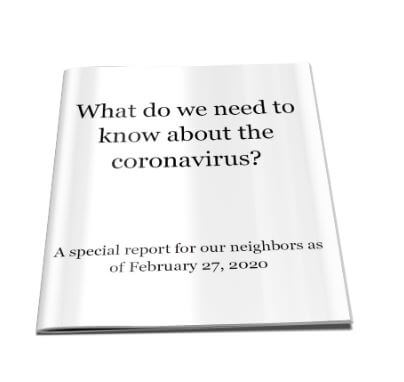
Download a copy of my memo. It is a 4-page Word document written in a big font and very simple language. Here’s the link.
Make changes to customize it for YOUR neighbors or your family.*
Pass it along or duplicate and pass it out to everyone on your block.
This isn’t the last we’ve heard about this rapidly expanding disease. I don’t know when we’ll want to address the topic again. But I felt obligated to share as best I can — and I’m counting on you to spread the word more widely.
The more everyone knows, the safer we all will be!
Virginia Your Emergency Plan Guide team
P.S. I make reference in the coronavirus memo to a basic list of emergency supplies for sheltering in place. I assume you already have such a list but if you want to use ours as a starter, here’s a link to it.
* When I think about “customizing” the coronavirus memo, I think about adding a logo or picture to the cover, putting references in the body of the memo to your neighborhood or town, and adding a signature and phone number on the last page. Make it yours!
Assume a major storm, hurricane or earthquake. Communications are disrupted. What happens to your bills – and your credit rating?
Today we went to the bank to set up a new account. We’ve been planning recently about how to promote building a savings account specifically for emergencies, so we figured we’d do some actual background research.
Setting up the account took a lot longer than I expected. It felt as though the “Know your customer” (KYC) regulations, set up after 9/11 to combat fraud, have been integrated into every step of the account opening process!
This exercise brought me back for another look at an earlier Advisory about what happens when a disaster interrupts your regularly-scheduled bill paying. It’s clearly time for an update!
Do you receive bills, and pay them, via the US Postal Service?
Yes, online transactions are more popular than ever, but still, did you know that 4 out of all 10 bills are still paid using a paper check? So let’s start with them.
If you like the control of paper bills and checks, do you have a record of when your various bills come due and where the payments go? Would you be able to write and send at least a minimum payment if the actual paper bills didn’t arrive? (As we have seen, this isn’t fantasy. Over the course of the summer 2020 delivery times for the U.S. mail were severely impacted.)
You can be sure that just because the mail truck couldn’t make
it through the flooded creek, your creditors will be looking for their expected
payment. When that payment doesn’t arrive, your account will be automatically
charged with a late fee.
Do you receive bills and pay them online by going to your creditors’ websites or by using the bill pay functions offered by your bank?
In a disaster, your bank’s website will continue to be open for business – but if your computer or smartphone isn’t able to access the internet, you may not be able to get to that website to pay the bills that are coming due every day!
What can you do starting now to protect your credit rating?
Even if you’re used to paying bills online, and using ATM machines for convenient transactions, there are three things you should do starting now to protect your credit BEFORE an emergency strikes.
Step One: Pay your bills immediately.
Pay your bills as soon after you receive them as possible. If
you wait until the last minute, you may end up weeks behind because of the
emergency and you run the risk of late charges and damage to your credit rating
if your payments didn’t get there on time.
Step Two: Have payment slips prepared.
If you pay by check, take time now to make two hard copies each of the payment slips that have the account numbers, barcodes and amount/s due imprinted on them. Following a major even you can use these to make minimum payments by hand until things get back to normal.
Step Three: Set up automatic bill-paying BY COMPUTER.
Paying online is faster, less expensive (no stamps) and the chances are good that you will be able to get back to operating on line more quickly than by mail following a major disaster event. Setting up accounts to be paid automatically each month simplifies things even more.
We’re often asked, “Won’t the creditors give me leeway in a
major emergency?”
Yes . . . there’s a concept called “disaster forbearance” that may apply — but usually only if you are in a federally-declared disaster area. And that declaration may take some time — or never happen. (We have witnessed a “forebearance” policy from some banks as the result of COVID-19 — but that period came and went . . .)
In any case, creditors will be happier to work with you if you contact them before your next bill is due! If you are lucky, you may be able to avoid late fees and extra interest payments.
But be ready to jump through all sorts of hoops to correct the records. Once you get put sideways into their (and the credit reporting agencies’) computers, you go through hell trying to straighten them out. Multiply this times the number of creditors and you have a monster of a problem to look forward to at a time when you will have plenty of other problems to be solving!
Virginia Your Emergency Plan Guide team
P.S. Oh, and getting back to that “emergency savings account?” Like every other good idea for saving money, the simplest approach is to set up an automatic “payment” to yourself, designed to go directly into a separate account. Since the average American who says they have put money aside for emergencies has actually saved less than $400 (!), it would be a good idea to set that up now!
How many prescription medicines do you take? When you add up all the pills, drops, injections, teas, lotions and medicinal oils for every member of the family – including pets – how many do you get?
Many families take dozens of pills and prescriptions every single week! Our ability to afford them aside, we have gotten accustomed to being reminded to refill our prescriptions. We count on picking up refills at the local pharmacy or getting them by mail, whenever we order them.
In an emergency, what will happen if you run out?
Will you be
troubled . . . or will your life, or the
life of a family member, actually be threatened?
This Advisory has been inspired by a report I heard on the news last night. Actually, it was a phone call coming from a quarantined passenger on one of the cruise ships being held off the coast of Japan. “I ran out of insulin. And although the ship promised they were working on getting me more, it wasn’t happening. Finally I called on friends back home who got my prescription filled and mailed it to me here on the ship. I’m expecting it to arrive tomorrow.”
Going on a
cruise isn’t normally considered an emergency! But as we have seen, anything
can happen.
Let’s take a look at pills and prescriptions so an unexpected event in our lives doesn’t become a disaster.
Getting an extra supply of essential medicines.
Know what’s
essential for you!
Over-the-counter
drugs are easy enough. Just buy a few of the ones you take regularly and be
sure they are in your Survival Kits or long-term Shelter-in-Place stores.
When it comes to the essential pills and prescriptions, talk with your doctor. Understand which pills you could discontinue without a severe reaction. (You may be pleasantly surprised . . .!)
Ask your doctor for an “emergency preparedness prescription” for 2 weeks or a month’s supply. At the same time, start now to apply for regularly-scheduled refills a few days early. Squirrel away a few extra pills at the end of each month until you have your stash.
Action Item: Try to get at least a 2 weeks extra supply of prescription medicines!
Storing pills and medicines safely.
Many pills have a statement on the label that says something like: Store in dark, dry place. Some eye drops say they need to be refrigerated. Directions on insulin may say “Store in refrigerator.” but the label may continue with something like, “If refrigeration is not available, store at room temperature.” Nearly all medicines have a “Use by . . .” date.
In an emergency you may not have
refrigeration. You may not be able to control humidity. You may need to
consider taking “out of date” medicines!
Action Item: Talk with your doctor or pharmacist to find out what options you have for safely storing and using your essential medicines.
Organizing your pills and medicines at home.
In our house everything was going along fine until Joe experienced an unexpected and severe reaction to a drug. We’re still coping with the aftermath – and one thing that has meant is managing over a dozen new pills, shots and medicinal creams! The list changed weekly for a while and still changes.
Keeping track of when to take what has been a major effort!
In a disaster, without electricity or communications, or maybe not even being at home, managing medicines will be even tougher. You may not be able to do it safely without a couple of tools.
Tool #1: Your medicines list
You can do this on paper, but using the computer will be a lot more efficient. Keep an updated list of ALL your over-the counter and prescription medicines as well as medicines you doctor doesn’t even know about, like laxatives or pain relievers. Keep your list with you at all times! (Put one on the refrigerator, too, for the use of Emergency Medical Personnel. Read about our Vial of Life program.)
List name of the medicine (generic and/or brand name), dosage, and what it’s for. If you have space, describe the pill (“oval, white”) so that someone else could take over if necessary.
Tool #2: Your medicines calendar
When you have to take six or seven pills a day, it’s easy to skip one, particularly if they all come at different times. When you don’t feel well, managing is harder. As you age, it may become impossible.
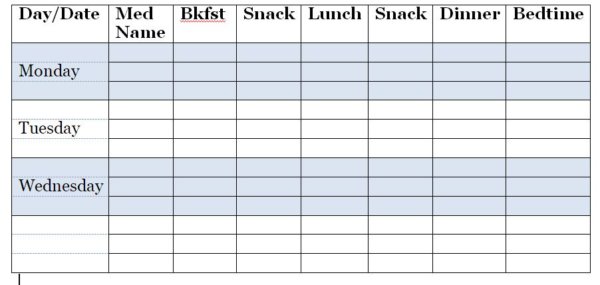
Set up a calendar NOW so you can be sure you haven’t missed anything. Be disciplined about marking the calendar each time you take your medicine.
You can create your own layout based on your own logic, but here are the top few rows of the one we’ve developed for our household. As you can see, there is room for 3 medicines per day. You may need more. We put a O in the square where a pill is needed, and then an X inside the O to show it was taken. (If several people need calendars, I’d print them on different color paper.)
Packing pills and medicines for a trip or emergency
evacuation.
Again, here
we’re thinking about having to manage medicines when you are away from home.
Here are three recommendations – and I make them from experience!
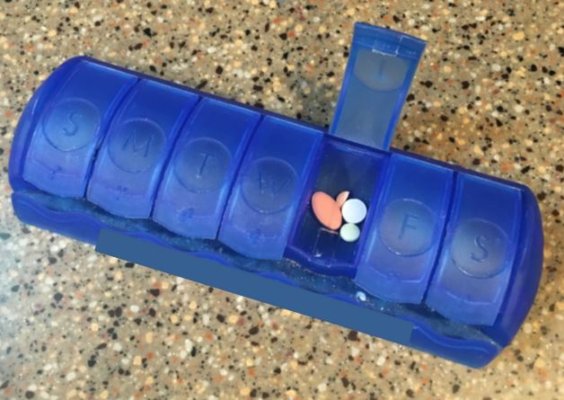
Pill box or pill container – Actually, I use a pillbox at home, all the time. My own box has roomy compartments, with ergonomic compartments – smooth, no corners — one for each day of the week. (It’s the blue one in the image at the top of the Advisory.)
I can see in a moment if I’m up to date on my pills.
As I
mentioned, Joe takes a whole collection of pills these days. He needs a pill
box with compartments for different times of day.
Here are two larger boxes from Amazon that I’d consider particularly for travel use. The first is water proof, and the second is smaller, discrete and flexible!
Individual pill packets – I have used these small baggies for a number of items when I travel – for pills, for herbs, even for (small) jewelry. (Each is about 2 in. on a side.) I tuck the small baggies into a larger see-through container, then just pull one out when I want it.
Original prescriptions – I don’t know exactly how the woman on the cruise ship managed, but I have had my own experience with being unable to get a prescription filled without at least a copy of the original, showing when it was issued and the doctor’s signature. If you deal with one medical service or one pharmacy, they probably have a computerized record of all your prescriptions. (But if that pharmacy is impacted by the disaster, will the records be available?)
Action Item. Scan and store prescriptions in the cloud. Take pictures of the actual bottles, too. That way you’ll have them in your phone and you can blow up the pictures to read the labels more easily.
This Advisory has a lot of ideas, and your own list of things to do may be even longer. But when it’s a question of life and death of a loved one, the effort is worth it. Please share any of your own good ideas for managing pills and prescriptions on a regular basis or during emergencies!
Getting prepared for emergencies isn’t exactly simple.
Have you ever been overwhelmed with everything there is to do when it comes to
prepping for emergencies?
Is it a constant battle to get others in your family – or your neighborhood — to
support your efforts?
Do you worry that there is so much to think
about that you’ve missed some
essentials?
Could a few short lists make prepping easier for you?
Would you welcome a few simple preparedness QUESTIONS & ANSWERS? How about some short lists with actions you can complete easily, check off and feel like you’ve accomplished something?
We have heard from a lot of people that YES, they are always looking for something simpler and easier to help them keep on track.
So here at Emergency Plan Guide we are now in the planning stage for something new. Introducing the soon-to-appear . . .
Emergency Preparedness Q&A Mini-Series
Imagine a collection of slim booklets, or mini-books. Each mini-book sticks to one preparedness topic. Each has 15 or so questions on the topic, with short answers. (Naturally, there will be optional links to more resources.) There will be room to take notes if you can’t check everything off the first time through the booklet.
Which topics would be on YOUR short list?
Below are the topics we’ve come up with so far. Can you give us a hand and let me know which FIVE topics you would like to see first given where you are in your own state of preparedness? You can just drop the 5 numbers into the comments below, or send me an email, whichever you prefer. Naturally, if there’s a topic you’d like to see but it’s not listed here, just add it to your answer.
Pre-Disaster Planning
Storing Food & Water
Emergency Water Treatment
Prescriptions, Medications
& First Aid
Securing Appliances &
Furniture Against Earthquake
Home Improvements for
Increased Safety
Shelter Alternatives
Ready to Evacuate
Avoiding Mistakes in
Preparing
Emergency Communications
Preparing Your Car for
Emergencies
Emergency Cash Options
Dealing with Power Outages
Go-Bag Options &
Alternatives
Disposing of Waste Matter
Protecting Important
Documents
Emergency Clothing
Sanitation & Personal
Hygiene
Self-Defense Considerations
Firearms & Alternatives
Insuring Against Losses
Makeshift Toilet
Flashlights, Lighting &
Batteries
Getting Neighbors Involved
We know you’re serious about preparedness, so we value your response! Can you send your 5 recommendations right now? I’ll be watching for them!
Thank you for reading, and for your input.
Virginia Your Emergency Plan Guide Team
P.S. These are just possible topics for the booklets, not the titles. We’re working on titles as you read this!
Disclaimer: I am not a medical professional so my comments are based on info from sources I believe to be reliable. Consequently, please check with your own sources and try to stay up to date with this rapidly developing emergency.
What’s
the latest on the coronavirus?
As I write this on January 30, 2020, China has placed 50 million of its citizens under quarantine because of coronavirus. Facebook and Google are restricting employee travel to China (and Hong Kong). Foreign governments are airlifting their citizens out of Wuhan, the center of the outbreak, and, in the case of the U.S., flying them to Alaska and to the mainland U.S..
Two days ago the World Health Organization changed its earlier assessment and now labels the virus a Global Health Emergency.
Meanwhile, here in my California neighborhood, two elementary school children crossed my street wearing white surgical masks.
Should your kids be wearing masks?
Should you?
As the coronavirus spreads, what should we do at home?
First, try to be realistic about this virus. Even though it
is a new one and spreading rapidly, it does seem (so far) to be like other
viruses. That is, a lot of people get sick, but it doesn’t mean they all will
die.
(The most recent statistic I’ve seen is a mortality rate among people with severe cases of 2-3%. Compare that with Ebola, with a death rate of 90%. Another disclaimer – statistics like these can be misleading because it’s never quite clear which strain of the disease is being tracked. Similarly, it’s never clear exactly what the definition of “severe” is. Still, you can get an idea of the relative danger.)
Keep up with the news so you’ll know when to take action as a result of the coronavirus.
I have several sources that I turn to: broadcast news, online news, and my LinkedIn Emergency Management group. I recommend you also take a look at the regularly updated pages at the Center for Disease Control: https://www.cdc.gov/coronavirus/2019-ncov
In the meanwhile, follow these basic sensible steps.
Don’t plan travel to Wuhan, China or anywhere in China, for that matter.
Wash your hands often, with soap and water.
Don’t touch your eyes, nose and mouth with dirty hands.
If you cough or sneeze, smother it with a tissue and throw the tissue away.
Clean often-used objects and surfaces with disinfectant. (Phone? Computer keyboard? Kitchen counter? Bathroom faucets?)
If you do get sick, stay home. If persistent high fever or trouble breathing, contact your doctor. (Do NOT walk in without instructions.)
If you are working and traveling, do you need to be ready to be quarantined because of coronavirus?
Today I read that a planeload of Americans scheduled to land in Ontario, CA had been diverted to a nearby military base where they are being kept quarantined for 14 days. (They will get to watch the Super Bowl in their quarantine setting.)
Your plane or even your office could be caught up in
quarantine, too. So it’s good to
understand what “quarantine” really means, and to distinguish it from
“isolation.”
Important definitions: quarantine vs. isolation.
According to Health and Human Services, “Quarantine is used to separate and restrict the movement of well persons who may have been exposed to a communicable disease to see if they become ill.” That explains why the planeload of people watching the Super Bowl won’t be locked into some sort of hospital. Rather, they’ll be observed for several days.
Isolation is different. Per the HHS, “Isolation is used to separate ill persons who have a communicable disease from those who are healthy.” You may remember the dramatic cases of Ebola victims being isolated during and after transport to the U.S.
Isolation and quarantine are authorized by the Federal
Government for a number of communicable diseases including Cholera, Diphtheria,
Infectious tuberculosis, Smallpox, etc. Today’s news reports that the
governments of both the U.K. and Australia have authorized quarantine for up to
14 days for people returning from Wuhan.
How to prepare to be quarantined.
You can consider the preparations for quarantine to be the
same as for sheltering in place.
So, right now, before anything more happens, ask yourself
these questions:
Do we have supplies to carry EVERYONE through a 14-day quarantine?
At home you are likely to have to make no extreme emergency preparations. And since you will have running water and utilities as usual, life won’t be onerous. Make a list today and get extra dog food, toilet paper, aspirin, etc. immediately.
Think of a few projects you can engage in with other family
members. Just remember, once the quarantine starts, there will be no running to
the grocery store or to the hardware store.
At work it could
be a whole different story. Do you have food and water for everyone in the
workplace? Where will people sleep, and with what blankets and/or pillows? What
about hygiene? What to do about people
who refuse to stay quarantined?
Preparing to be quarantined at work because of the coronavirus could take several days and cost a fair amount.
Find out what your legal responsibilities are in this situation.
On the road you may find yourself quarantined without any notice. If you travel, be sure you have basic emergencies items in the car or in your carry-on bag. In particular, have a few snacks, a warm jacket, a supply of your prescription drugs and your list of emergency contact names. Carry batteries and a portable battery so your devices won’t run out of power.
What’s your plan for letting people know you’ve been quarantined because of coronavirus?
Family members may be concerned is they hear about you being quarantined. Be sure you keep them up to date. Don’t forget to cancel and/or reschedule appointments, etc.
Use your crisis communications procedures at work to let employees, suppliers and customers know that activity at your business has been temporarily interrupted (and to what extent). Prepare draft messages NOW so they are ready to be finalized and sent out at a moment’s notice.
Operate
from knowledge and caution and not from fear.
The more you know about how the virus is developing and the
steps the various governments and/or medical authorities are taking, the easier
it will be for you to anticipate any changes you should be making in your
personal or work life.
Virginia Your Emergency Plan Guide team
P.S. And to answer that question about face masks? It seems to me that since the virus is transmitted when people sneeze or cough, the people who really should be wearing the masks are not well people (after all, the mask doesn’t protect your eyes) but rather people who themselves have flu symptoms! (The problem is that multi-day incubation period . . .)
Sure, wearing a surgical mask keeps large particles of smoke/soot from your mouth and nose, and keeps you from touching your nose or mouth with dirty fingers. But it doesn’t block airborne viruses.
Still, wearing a mask probably can’t hurt. Read more about masks here.
But we’d done some good planning, and by the time I got to the community room, a handful of volunteers were already digging into the oh-so-carefully-packed box of supplies. Name tags went out onto one table along with colored pens; handouts went onto another. Two people were pinning photos from past events all across the back of the room. And refreshments had magically appeared on a table in the corner. (“Make people walk past the photo display to get to the cookies.”)
I saw immediately that our guest speakers had arrived before me, too!
But my back-up host had directed them to the electrical set-up, the microphone and projector were humming, and as neighbors started arriving, fire extinguishers in hand, everyone was standing about just casually chatting!
What a relief! All I had to do was grab that microphone, take a deep breath, and gather my thoughts for the introductions!Here I am, a few minutes later, double-teaming with our fire captain.
“Bring your extinguisher, wear your Team vest . . .”
What was behind this special community meeting on fire extinguishers?
Pretty simple. We’ve had two fires recently in our neighborhood. In one, the whole house was engaged before the fire department arrived. (No person injured, but two pets died.) In the other, smoke filled the kitchen but an observant neighbor noticed, grabbed a fire extinguisher, ran across the street and stopped the fire before any real damage was done.
The obvious lesson:
“If you can catch a fire right away, and you use the right equipment, you can put it out yourself.”
After the most recent fire, we took a poll of neighbors.
“Do you have a fire extinguisher?”
“Are you confident you could put out a fire in
your house with your extinguisher?”
“Have you ever even USED an extinguisher?”
Too many “no” answers!
So we contacted our local fire department for help.
Not only were they willing to come do a special community meeting on home fire extinguishers, but they offered a magnificent surprise – a chance for us to actually practice putting out a fire.
But not a real fire.
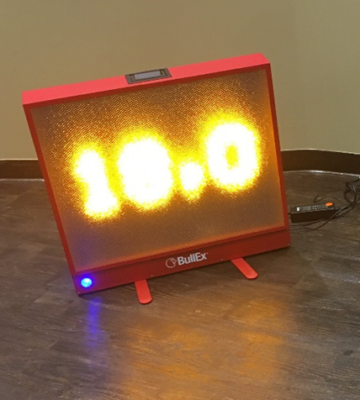
We had the chance to train using a laser-driven fire extinguisher simulator!
First, we went over the basics of fire extinguishers.
In fact, we had invited everyone to BYOE — BRING YOUR OWN EXTINGUISHER – and it made a big difference!
Many people had never even taken their extinguishers out of the box! Hardly any knew what sort of fire their extinguisher was good for. And I don’t think any had searched out the date of manufacture.
Imagine if you will a room full of people, many clutching red and white fire extinguishers in their laps, as our fire captain went over the basics using a power point presentation. There were MANY interruptions, much squinting to read the fine print, and MANY questions before it was over. (Remember, this meeting took place in a senior retirement community.)
Classifications tell you what kind of fire this extinguisher will put out – A, B, C, D and K. In our group, nearly all were A, B, C.
What’s actually INSIDE the extinguisher? Again, for our audience, probably dry chemical that comes out as a powder to smother the fire.
How long is the extinguisher good for? “Check the date.” (This became an embarrassment and pretty humorous as people found the dates and called them out. The oldest extinguisher in the room dated to . . . 1987!) The recommendation from our fire department – “Check ‘em often and replace after 5 years to be sure it will work when you need it.”
Where and how to store it? (Designated place, clearly visible. Turn it upside down and hit it with your hand to loosen the powder.)
Other comments – Only attempt to put out a fire you can control. Have an escape route. Call 911. and many more . . .
Then it was time for the SIMULATOR training!
Step back, you’re a little too close.
The head of our local CERT
training stepped up to demonstrate the equipment. The digital “flame” on the
screen was very bright, very realistic! The green dot from the laser was easily
visible.
Before she was completely finished, people were already lining up to try it! (What a relief. As meeting planner you just never know what kind of reaction you’ll get!)
PASS – not so easy to remember when you have an extinguisher in your hands and the clock is ticking.
Our fire captain had gone through the steps to extinguish a fire.
And our CERT trainer had gone
over them again, demonstrating two or three times just how the equipment works.
Still, when people came up to
try, sometimes they forgot! They dropped the pin. The extinguisher was quite
heavy and some couldn’t hold it and squeeze at the same time. A couple squeezed
before they aimed!
Everyone was terribly engaged. Some were anxious. All were watching VERY closely.
Can she do it?
Too heavy? Hold it between your knees.
More than half the people in the audience tried the simulator. And everyone succeeded in putting out their fire. (A few did need a couple of tries.)
More important, as our CERT trainer observed, every one walked away with new-found confidence.
As the community meeting on fire extinguishers broke up, several people told me they wanted to learn more about our city’s CERT training and others wanted to join our local neighborhood response team. (We have no requirement for CERT training.)
As we gathered up all the stray
handouts and took down the displays, we were very satisfied at the outcome.
Gotta love volunteers who stay to help tear down.
Could any meeting be more successful?!
Why yes, because that very evening I got several thank-you emails with many positive comments.
At 9 a.m. the following day our office manager wanted copies of anything that was left over “because people have already been coming in asking about it.” A bystander in the office volunteered, “I’m going to buy a new extinguisher for myself, and two for my daughter.”
Then the manager added, “I have never seen people come out of a meeting with so much excitement. They were talking and waving. They were laughing. They were energized!”
The Bullex Digital Fire Simulatoruses LEDs to create a “fire,” and the special fire extinguisher (same size and weight as regular one) “puts the fire out” using a laser beam.
I think you can agree, somewhere along the line this training will pay off. I hope you can add a similar meeting to YOUR group’s schedule!
Virginia Your Emergency Plan Guide team
P.S. I’ll be adding this to my next collection of published Meeting Ideas! Let me know if you want to be on the pre-publication list!
If you love words like I do, you probably cringe when you read something like “practice situational awareness!” I guess if I had to use a better expression it would be “Pay attention to what’s going on around you!”
This image above is one of my favorites. That young woman could walk right off a curb, or into the arms of a stranger, without even realizing it!
OK, now let’s add a second image to help our story. Imagine this driver cruising right up beside the woman in the first picture, grabbing her phone and speeding off!
Potential snatch and grab thief?
Have you heard about the Moped Muggers? Phones are being snatched from purses, from pockets and right out of people’s hands — often by thieves on skateboards or scooters.
As one newscaster put it, “You wouldn’t go out on the street waving five $100 dollar bills in your hand, would you?” (Time to update that figure to more like six or seven $100 bills, eh?)
Situational Awareness will save you.
Being aware will save you from losing valuable items. It will save you from embarrassing mistakes. It could also save your life in an emergency by giving you a head start on decision making.
You can train yourself and your kids to be more observant.
For example, when you go into a building, note the number of people you see, where they are and what they are wearing. (Try to do this unobtrusively, of course!) Notice the number of doors to the room or exits from the building.
When you get back outside, quiz yourself and the kids on those details!
Here’s another example. If you find yourself waiting for a train or a bus, take a closer look at people around you. Try predicting where they might be going or what they are planning to do. If your timing is right, you may actually be able to see if your prediction was accurate.
These exercises can be fun. The most important result? You’ll find yourself getting better at noticing when and why people “just don’t fit.”
When things don’t look or feel “right,” trust your instincts and take action.
At that point, your first action may be to simply move away from the uncomfortable situation. You can go further and report your concerns to authorities. (“See something, say something.”)
Either way, you have taken a move to protect yourself from possible danger.
Paying attention to what goes on around you isn’t hard. But it surely is essential to being prepared!
Virginia Your Emergency Plan Guide team
P.S. Response to our Advisories about Situational Awareness has been so great that we added a lot more on the topic in our Q&A Mini-Series booklet, Personal Safety. Situational Awareness starts off the second part of the book, and there are several more “exercises” for practicing with your kids. Perfect for getting a conversation started on being responsible for your own safety!
Just a week ago I was sweeping up the last remnants of 2019 and getting set for 2020. Remember? I ended 2019 with some entertaining books and movies with disaster themes!
Well, that easy start was obliterated by recent 2020 REAL disasters in the news.
In just the last 7 days we’ve seen headlines like: Assassination — Missile strikes – Earthquakes — Raging Wildfires – Retaliation — Plane Crash – Deepfakes – Drone Swarms – Power Grid Cyber-attack — and of course, Harry and Meghan.
(I added that last item just to lighten things up a little.)
All the turmoil was enough to cut through any complacency I was feeling
and bring me sharply back to reality.
Above all, it prompted me to once again make sure that I have basic emergency supplies at the ready – in the house, in the car, and in the office. Supplies I can tap if I’m stuck at home, and supplies that are packed up (or could be quickly packed up) if I have to leave and head somewhere safer.
The following list of emergency supplies is the most basic I can come up with.
I hope and trust you are familiar with everything I write about here!
In any case, here it is for your review. I am adding a few details that might encourage you to refresh or add to your supplies.
If you do see something that’s missing from your list, don’t delay! If one of the disasters in the news comes to pass in YOUR neighborhood, you may NOT have the opportunity to get any of these essentials!
Water in an emergency.
Earthquake, cyber-attack, flood, accident – any of these could interrupt your supply of clean water. Be sure you revisit your long-term supply. And if you haven’t yet, get aLifeStraw personal water filter for everyone in the family. Cheap, pretty sturdy, and easy to use. Even a child understands how to use it. (Click on the link above to check pricing at Amazon, where we are Associates. This LifeStraw was on sale when I grabbed the image!)
Keeping warm.
As I’ve mentioned many times, it doesn’t take actual freezing temperatures to create an emergency; a few hours at 50 degrees may be enough. Do you have blankets in the house and in the car? What about emergency sleeping bags?
We all are familiar with Mylar space blankets, costing less than $5 each. I’ve talked about the advantages of buying them by the dozen, so everyone in the family (or the neighborhood group) has several in every backpack.
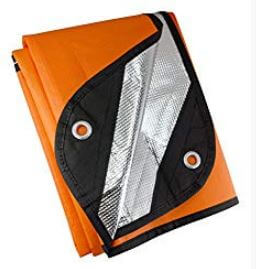
Lately I’ve noticed some better quality space blankets. Some are larger sizes. Others are gold/silver reflective. Still others, like this one, have Mylar on one side and a waterproof tarp on the other. (See the grommets? Meant to help turn it into a shelter.)
You can get this version in orange/silver and in green/silver (from other manufacturers). Again, click the link in the text above — not the image — to compare prices and styles at Amazon.
And in this Mylar category I have to include — again! — the Bivy Bag. Here’s the whole description of this WATERPROOF bag:
Wondering about that word “bivy?” (Also spelled “Bivvy.” I assumed it was from the French, bivouac – “a temporary camp without shelter.” Actually, after writing this I then had to look up the word. I found what I had expected. I also found “bivvy sac” – a waterproof bag meant to protect a sleeping bag. Eh, voila!)
Something nourishing to eat.
I am sure you have snacks, hard candies, and some pop-top cans of fruit in every survival kit. These will work for a day or two. But if the power is off and the emergency continues, particularly if there is damage to your environment, you’ll need more than snacks! The easiest things to buy and to count on to be there when you need them? MREs. Delicious? Maybe not. Nutritious and comforting? Yes. (In this case, both the image and the link will take you to Amazon so you can compare MRE packages — sizes, menus, etc.) (While we’re on vocabulary, MRE = Meals Ready to Eat.)
You know our attraction to emergency lanterns. (I have one of the Vont pull-upsright here on my desk as I am typing this.) Don’t overlook extra batteries for lamps, lanterns or flashlights. In addition, you may want to consider a solar-powered battery charger.
Likewise, you may want to take a look at this new gadget. (New to me, anyway.) It charges 11 sizes of batteries that fit in your lanterns, your flashlights, and your emergency radio. Click on the image and read all the details carefully to be sure this will work for the batteries you’re using. I have not personally used this charger, so I’d welcome any comments!
Emergency radio.
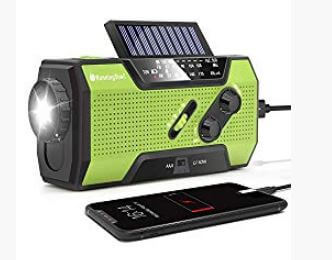
I notice that some of the emergency radios are on post-holiday sales, so don’t hesitate. What to look for? Sturdy. Powered by solar, battery and hand crank. AM/FM and probably NOAA. What you want to know is how the disasters in the news are developing. Everything else — flashlights, etc. — are extra.
This image shows an emergency radio from RunningSnail. The company makes a couple of versions — I like this one because it can store more power than the less expensive model.
Actually, consider getting several radios (perhaps with different features). You’ll want one for the house and one to keep in each car. (Our radio reviews are being updated right now for the New Year.
Emergency communications.
Your cell phone will be the first thing you turn to when you hear about disasters in the news. Be sure you have a car charger plug. And get a power bank and/or solar charger for the phone, too. Remember, TEXT messages may get through when a phone call won’t.
(Do you know the number of your emergency contact? In your phone does run out of battery, you won’t be able to look up a number. You need to know it by heart!)
Hygiene.
Stock up on toilet paper NOW! The shelves in the grocery store will be emptied within hours of a storm announcement! (You can always use extra paper supplies for bartering.) Same with baby wipes and antiseptic wipes. And be sure you have some sturdy plastic bags in the car, packed in a plastic container (with lid) big enough to serve as an emergency toilet. Messy but better than getting out of the car in the blowing sleet — or having an accident IN the car . . .!
First aid and medicines.
Only you know what you need. The trick is to actually have your pills and/or drops with you at all times. Not so easy, actually. You’ll need to find the right size plastic containers, label them, and hoard enough extra pills so you can pack up a couple of week’s supply. Really, do it.
Now I wear contact lenses, so one of my emergency challenges is to have extra lenses and a packable size bottle of lens fluid ready. (I have to search to get the 4 oz. sizes – necessary if you fly, too. Actually, even my 4 oz. bottle was confiscated at the airport last year, so I had to board without anything other than a tiny bottle of artificial tears. NOT good for a 15 hr. flight . . .!)
Cash.
The recent national study by FEMA reported that most people who have set aside money for emergencies have less than $500. If disasters are threatening in the news, and you have to leave home, that money isn’t going to take you far.
Talk to friends and family about being ready to take in someone when disaster hits the news. Maybe you could get a bulk deal on blow up mattresses! (I borrowed a mattress over Thanksgiving. These days nearly all mattresses have built in electric pumps – fantastic! – and most are at least 18 inches high so they are like a real bed, not like camping on the ground. I figure you know about what a blow up bed looks like. Here’s a link to a positively reviewed queen sized mattress that’s actually 22 inches high, so you can get an idea of prices!
How can you afford to stock up on emergency supplies?
Now, as I look back over this list I see that many of the items cost less than $25! A few are more expensive, of course. All these items are readily available. And many are on sale right now, when merchants want to clear the shelves for spring and summer items.
Push back against the negativity of disasters in the news by taking positive action.
Please, make up your own shopping list and get started checking things off as soon as you can. And share this list with friends, family and neighbors.
We all need to bolster our feeling of confidence in the face of so many disasters in the news. Knowing you’ve taken basic precautions will make a big difference in your outlook.
But don’t be foolish! As you shop, watch for these dangers.
In the aftermath of the holidays there are still lingering sales promotions. And, of course, some people prey on the fear and concern that comes with negative headlines, and they offer deals you “need to get before it’s too late.”
So while I encourage you to shop, I also urge caution. Here are three reminders about sales scams to avoid:
Don’t click links in emails that go directly to products. These products could be counterfeit. Get the name of the manufacturer and go to their website or to a trusted retailer where you have some recourse if the product isn’t what it was advertised.
Don’t open ads or click on product pop-ups on your computer or smartphone. Not only could you be being scammed as far as the product goes, you could be inviting malware onto your computer. Again, go to the source or to a trusted retailer.
“Free” or “introductory” offers are always suspect. Watch for “shipping and handling” costs (Often that’s where the seller is making his or her profit). And be particularly careful to read “the fine print” which might reveal you will be charged “the regular price” starting two weeks from now!
Whew, that should be enough for today! So I wish you well with your shopping — and getting started in this New Year!
The more I learn about preparedness, the more I see that genuine security for your family depends on far more than you alone can do. In other words, preparedness takes a village, with every member taking a role.
So as we head into 2020, let’s take a look at some of the options you have to improve your situation and the situation of the people around you, too.
You must take the initiative to keep your family safe.
Here at Emergency Plan Guide we try not to discriminate between young or old, single or married, urban or rural preppers. However, we do aim our outreach to the kinds of friends who are looking for “practical, simple and sensible every-day actions” they can take to become better prepared. (By and large, these friends don’t plan to depend solely on the government or other “authorities.”)
In September, FEMA’s 2018 annual National Household Survey came out. I was interested to see how our preparedness objectives fit in with what the survey reports!
According to the survey (5,000 people across the country), 57% of us have taken at least 3 or more
“preparedness actions.”
FEMA identifies six basic preparedness actions.
Below is a list of what FEMA counts as “actions.” How many
of these actions did you take in 2019?
Gather and store 3-days’ worth of emergency supplies
Talk with others about getting prepared
Attend a local meeting
Seek information on preparedness
Participate in a drill
Make an emergency plan
Did you take all six actions in 2019? If not, what can you add to your “to-do” list for 2020?
What keeps us from doing all six?
If you read more deeply into the results of FEMA’s study,
you’ll discover that of the people interviewed, 97% admitted that at least one disaster could impact where they
live – but only 47% of them feel
confident that they can prepare effectively.
47%! That’s nearly half! What stands in their way? The study quotes the same “reasons” we’ve heard for years: (1) perceived hassle (2) anticipated cost (3) don’t know exactly what to do.
(When I look at this list, I see “reasons” we give for not
doing a lot of things! For example, I can easily apply all three of those reasons
to buying or selling a car, changing dentists,
applying for a new bank account, etc.!)
Getting more people involved depends on what’s going on in
your neighborhood.
If you look back at that list of preparedness actions, you’ll see that half of them can be accomplished by working on your own – but the other half require participation by others! Yup, that the “preparedness takes a village” aspect!
And here’s where Emergency Plan Guide stands out from most other resources. We’ve written community preparedness into every one of the books in our Disaster Survival Series.
You want your neighbor to be ready to help.
After all, that neighbor is likely to be YOUR first responder in an emergency!
The FEMA list cites the value of “talking with others,” “attending local meetings” and “participating in a drill.” Somebody has to manage these – they don’t just happen by themselves.
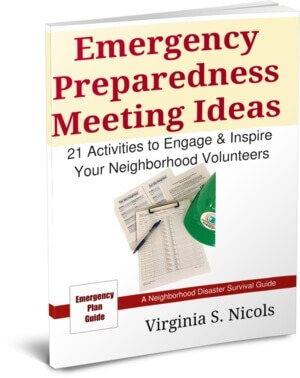
CERT training, offered by local emergency management office, usually becomes the basis for neighborhood readiness. But the next step requires local community leaders to step up. Our Emergency Preparedness Meeting Ideasbook is aimed at those leaders, helping them in planning and putting on educational neighborhood meetings. (This is our best-selling book, by the way!)
What role can you take in 2020 to support your local neighborhood?
If your job disappears, all your personal work may be for
naught.
The past several years we have seen whole communities
decimated and destroyed by flood, storm, and fire. Even if people escape with
their lives, when businesses are destroyed a lot more “goes up in smoke:”
Employees no long have a source of income.
Business owners lose their investments.
Suppliers and advisers lose a client.
Customers lose a valued product or service.
The community loses vitality – and tax revenue.
Our book Emergency Preparedness for Small Business helps business owners make plans — for protecting their business in the face of a disaster and getting their business back up and running if the disaster actually hits.
Business preparedness depends on a whole team.
The concept of teamwork really stands out when it comes to business continuity planning. In the book we spend time on the professional team of advisers that a business typically has in place – but may not have called upon to help it build a plan!
These advisers include:
Skilled and experienced employees (and not necessarily just upper management)
Business attorney (who can assess contractual liabilities associated with disaster and, in particular, liability associated with not having a plan)
Business accountant (helps identify value of equipment, business activities, etc. and thus helps set priorities for protection and recovery)
Business banker (prepared to offer emergency funds, extend loans, etc.)
Business insurance agent (with added expertise in Business Interruption insurance, Extra and/or Contingent Expense coverage or riders)
If you
are a business owner or a member of management where you work, how would you
assess your business continuity plan? Have professional business advisers been
involved in putting it together? Is it time for a review of your plan?
What’s your plan of action for preparedness in 2020?
In the midst of everything else that is happening, can you
commit to improving the resilience of the “village” around you?
This Advisory lays out several broad suggestions. I hope you’ll
take up at least one of them!
In the meanwhile, we’ll keep examining options in more detail here at Emergency Plan Guide. We would very much appreciate your help in that – in the form of questions, comments, and suggestions. Here’s to a very busy 2020!
Virginia Your Emergency Plan Guide team
P.S. I would also welcome your offer to write a guest advisory! Do you have something you’d like to share? Let me know and we’ll talk about the best way to get your good info out to “our” village here!
Popular Mechanics “Swedish fire” built into one log
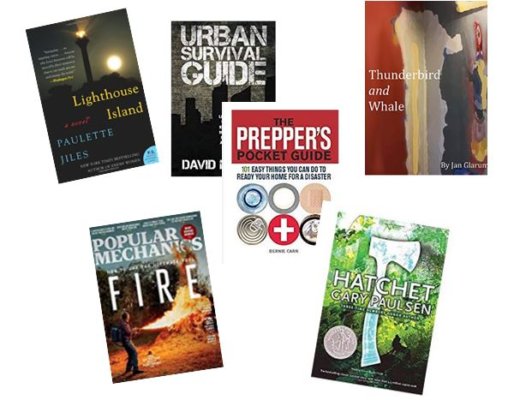
When you are lucky enough to enjoy a few days of vacation, or if you’re in the mood to CHANGE your mood, consider spending some time with some survival entertainment!
Read for escape and pleasure!
If you are a hard-core reader like I am, you’ll demand a certain level of quality in your survival books. Or magazines, as the case may be. I found the article from Popular Mechanics, shown above, to be a treat! (Have you heard of the Swedish fire? You break apart one block of wood, wrap it loosely with wire to keep it all held together and upright, build your fire on top of the center splits so the fire falls down into the cracks. Burns for several hours! Love it!)
Over the Thanksgiving holiday I managed to discover and read
something totally different – a survival novel that takes place in a nearly
ruined America of the not-so-distant future.
If you’re looking for some different survival themes, different levels of intensity and even survival excitement, please head over there and take a look. Several of the books are “How to” on survival; a couple are novels with plenty of accurate survival imagery, and a couple are written for young people – and young at heart like me! I’ll be adding more.
You’ll see some of our Emergency Plan Guide books at the site, too!
Of course, in addition to books there are . . .
Movies for thrills and excitement!
It’s the day after Christmas as I write this Advisory. Yesterday
we watched the obligatory re-run of Die
Hard. Not a classic wilderness survival movie – but certainly an epic
survival story! (Hans Gruber, so very smooth and sinisterly multi-lingual!)
Which brings me to some more of the “Best Survival Movies
Ever Made.” Here’s a short list. Which
of these have you seen? Would you watch
them again?
Most recent disaster film, which you’ve surely heard of if you haven’t seen it: San Andreas! Sure, it’s not the most scientifically accurate disaster movie. (Savvy preppers here in California find it pretty easy to pick out the faults – a pun!) But what special effects! And Dwayne Johnson!
The Martian – science fiction full of well — science mixed with humor! I read the book a few years ago, and I loved it. (Made me laugh out loud even though the hero was stranded on Mars and had to survive on practically nothing but his brains until he could be rescued! The thinking man’s survival skills on display . . .!) Of course any movie with Matt Damon deserves a Golden Globe nearly sight unseen.
Just the next year a traditional survival film actually won an Oscar – in fact, many, many other awards, for that matter. It is The Revenant, starring Leonardo DiCaprio. The scene: western frontier wilderness in the early 1800s. The challenge: winter weather, grizzly bear and other wildlife, plus some treacherous travel companions. Hollywood loved this film, and movie-goers turned it into a blockbuster.
Now, there have been survival movies for years, well before the three described above which you’ve probably at least seen ads for.
How about some survival movie classics?
Into the Wild came out in 2007, directed by Sean Penn. It’s an absorbing story of a young man who leaves his comfortable life to test his survival skills in Alaska. I saw this film myself several years ago – every spectacularly beautiful and excruciating minute of it. This is more drama than adventure. And it’s good!
Volcano, starring Tommy Lee Jones (another must-see actor) as an emergency manager. It came out in 1997 and is available on Netflix. Set in L.A., this one line describes it all – “Hot on entertainment!”
Twister was the second highest grossing film of 1996! It followed storm-chasers across Oklahoma. A Rotten Tomatoes review cites the film’s “visceral thrills” and again, special effects.
Learn some good stuff via documentaries and semi-documentaries.
In no particular order, here are some films that captured the interest of professional members of the Emergency Management group on LinkedIn. I’ll be checking these films off my own holiday viewing list. (One or the other might be appropriate for showing at a neighborhood meeting.)
Fire in Paradise, which aired on Frontline, covers the 2018 wildfire that basically destroyed the town of Paradise in California. It’s a 39 minute documentary with interviews of people who went through the ordeal. You’ll learn a lot about evacuations.
Dirty War is a docu-drama first broadcast in 2004 by the BBC and made available in the U.S. through HBO. The situation: A radioactive “dirty” bomb detonates outside a subway station in London. At that time, this was a thriller. Today, it’s become too real.
American Blackout is now top of my own list. Produced by National Geographic, the 90-minute docu-drama “reveals in gritty detail the impact of what happens when a cyber-attack on the U.S. takes down the power grid.” The power shut-downs earlier this year gave us a taste . . .
There’s plenty more survival entertainment where these came from!
These movies are available at Amazon and other streaming services. Most are available for purchase at Amazon, too, if that’s how you want to enjoy them. Click away here!
Of course, not all survival fiction may be award-worthy.
But today we’re talking about a vacation change of pace! If necessary, you can always pick out the totally unrealistic moments and describe to your family members what it REALLY would be like. (They may not appreciate the interruption, so maybe save those criticisms until afterwards!?)
At the very least, a book or movie can start a conversation at home to inspire new interest in emergency preparedness and response. Maybe you’ll get ideas for a family adventure tour, or some cool gifts.
Who knows what might happen?! We’re talking survival entertainment here! Hope you enjoy some of these!
Virginia Your Emergency Plan Guide Team
P.S. Of course you have your own survival entertainment favorites! Let us know what they are!